


Why Electrical Connection Problems Are One of the Leading Causes of AC Breakdowns
How electrical connection problems cause AC breakdowns is something every Bend, Oregon homeowner should understand before summer heat pushes their system to its limits. Electrical faults account for roughly 30% of all residential AC failures — and many of them build slowly and silently, long before your system stops working.
Here is a quick summary of how it happens:
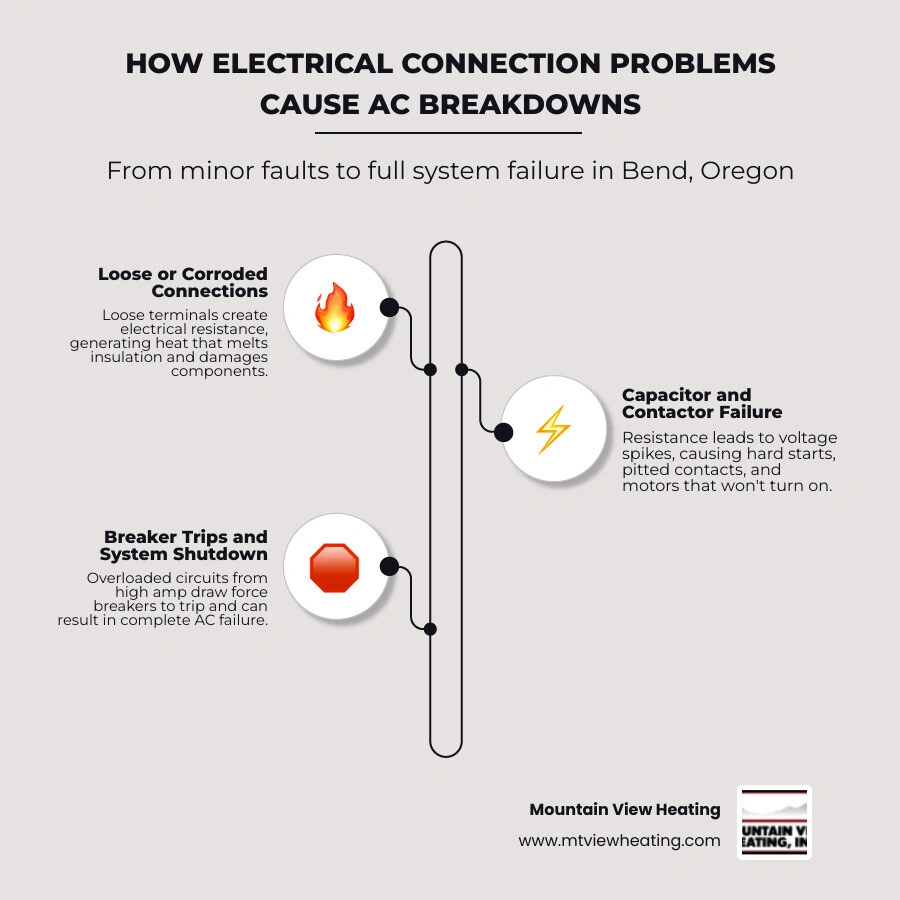
- Loose or corroded wires create resistance, which generates heat and melts insulation
- Failing capacitors prevent motors from starting, leading to compressor damage
- Pitted contactors cause arcing and can weld shut, forcing the system to run nonstop
- Power surges destroy control boards and sensitive components
- Tripped circuit breakers signal that the system is drawing more power than it should
- Dirty filters and airflow restrictions force motors to work harder, overloading wiring
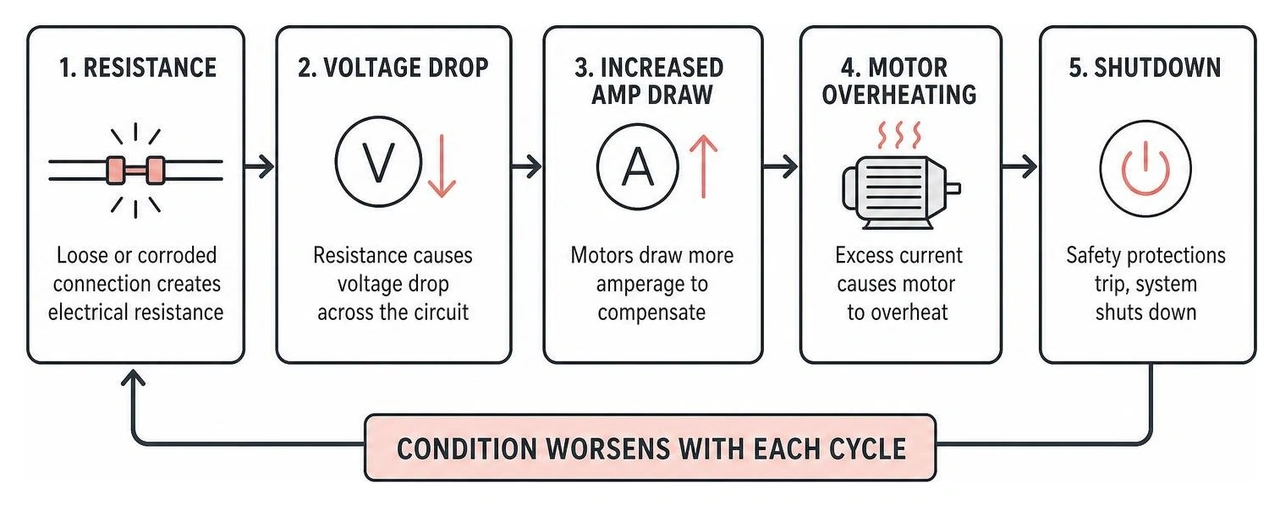
Most of these problems start small — a slightly loose terminal screw, a little corrosion on a wire lug — and get worse with every heating and cooling cycle. By the time your AC stops working on a hot July afternoon in Bend, the damage has often been building for months.
Understanding the chain of events that leads from a small wiring issue to a full system breakdown can help you catch problems early, protect your equipment, and avoid a costly emergency repair.
How electrical connection problems cause ac breakdowns definitions:
How Electrical Connection Problems Cause AC Breakdowns
To understand why electrical connection issues are so destructive, we have to look at the physics of how electricity moves through your air conditioning system. Your AC relies on a steady, uninterrupted flow of high-voltage electricity (typically 240 volts for central residential units) to power the compressor and the outdoor fan motor.
When an electrical connection becomes loose, corroded, or damaged, it creates electrical resistance. Think of resistance like a kink in a garden hose. Instead of water flowing smoothly, it backs up and builds pressure. In an electrical wire, that "pressure" translates directly into extreme heat. As current struggles to cross a compromised connection, temperatures at that specific point can spike rapidly, easily reaching levels hot enough to melt plastic wire insulation, burn terminal blocks, and destroy nearby electronic control boards.
Furthermore, a poor connection causes a localized voltage drop. This is highly damaging to the system's motors. When the voltage drops, the compressor and fan motors must draw more amperage to perform the same amount of work. It is the electrical equivalent of forcing your system to breathe through a straw while running a marathon. This increased amp draw overheats the motors' internal windings, eventually leading to a complete system meltdown. Ground faults, which make up roughly 98% of all electrical faults in residential AC systems, are frequently the final result of this degraded insulation.
For a deeper look into how these issues fit into the broader picture of common system failures, check out our guide on the Most Common AC Repairs and What Causes Them.
How electrical connection problems cause ac breakdowns via capacitor failure
The capacitor is a small, cylindrical component located inside your outdoor unit's service panel, and it plays a massive role in your system’s operation. Essentially acting as a temporary battery, the capacitor stores up electrical energy and releases it in a powerful burst to give the compressor and fan motors the initial torque they need to start running (the start capacitor), while maintaining a steady electrical flow during operation (the run capacitor).
Capacitor strength is measured in microfarads. Over time, electrical connection problems like loose terminal wires or sudden voltage spikes degrade the capacitor's internal chemistry, causing its microfarad rating to drop below acceptable limits.
When a run or start capacitor weakens or fails:
- The compressor experiences "hard starts," where it struggles, hums, and shakes as it tries to kick on.
- The motor draws massive amounts of inrush current (sometimes exceeding 60 amps) to compensate for the missing electrical boost.
- This excess current generates intense heat inside the compressor, rapidly cooking its internal insulation.
- Eventually, this strain leads to total compressor burnout—one of the most expensive component failures in any residential air conditioner.
Identifying how electrical connection problems cause ac breakdowns through pitted contactors
The contactor is the physical switch inside your outdoor unit that controls when power is sent to the compressor and fan motor. When your indoor thermostat calls for cooling, it sends a low-voltage (24) signal to the contactor coil, creating a magnetic field that pulls down a metal bridge, closing the 240-volt circuit.
Every time this metal bridge closes and opens, a tiny electrical arc occurs between the metal contacts. Over thousands of cycles, this arcing causes contactor pitting, where the smooth metal surfaces become rough, blackened, and covered in carbon deposits.
Pitted contactors create high electrical resistance, leading to "relay chatter" (a rapid clicking or buzzing noise as the contacts struggle to make a solid connection). In severe cases, the intense heat generated by this resistance can actually weld the contacts together. When contacts weld shut, the outdoor unit will run continuously—even if you turn the thermostat off—rapidly freezing the evaporator coil and risking catastrophic compressor damage.
The Silent Killers: Loose Wires, Corrosion, and Environmental Wear
While a sudden lightning strike can instantly fry your system, most electrical AC breakdowns are caused by "silent killers" that wear down your system over months or years. Loose wiring connections, terminal corrosion, and physical wire damage build up slowly, gradually choking off power to vital components.
These issues do not just affect the high-voltage side of your system. Your indoor and outdoor units rely on low-voltage thermostat wiring to communicate. If a rodent chews through these thin wires in your crawlspace, or if moisture corrodes the low-voltage terminal strip, your system will lose its connection entirely, leaving you with a completely unresponsive thermostat.
To understand how these separate electrical pathways communicate to keep your home comfortable, read about How Your Indoor and Outdoor AC Units Work Together.
Environmental Factors Accelerating Electrical Wear in Central Oregon
Homeowners in Bend, Redmond, Sisters, and Sunriver live in a unique high-desert climate that presents specific challenges for outdoor electrical equipment. Our local weather directly accelerates electrical wear in several ways:
- Thermal Cycling: In Central Oregon, we frequently experience dramatic daily temperature swings—sometimes up to 40 degrees between a hot summer afternoon and a cool high-desert night. This rapid heating and cooling causes copper wires and brass terminals to expand and contract at different rates. Over time, this thermal cycling literally wiggles terminal screws loose.
- System Vibration: Your AC compressor naturally vibrates while running. If terminal screws have already been slightly loosened by thermal cycling, this constant vibration will back them out even further, leading to loose wires and arc faults.
- Pest Activity: Mice, chipmunks, and other local rodents love to seek shelter inside the warm, dry control boxes of outdoor condenser units. They often chew through the plastic insulation of low-voltage thermostat wires, causing direct short circuits that instantly blow control board fuses.
If environmental wear has already started to compromise your system's electrical connections, you might notice your home's air quality or temperature starting to slip. If you are experiencing cooling issues, review these Why Is My AC Blowing Warm Air? Troubleshooting Steps.
Circuit Breakers, Power Surges, and Indirect Electrical Overloads
Your home’s electrical panel uses circuit breakers to protect your wiring and appliances from drawing too much current. Central air conditioners require a dedicated 240-volt double-pole breaker. When your AC experiences an electrical or mechanical fault, the breaker is designed to trip to prevent a house fire.
However, not all breaker trips are the same. Understanding how your breaker trips can help diagnose the underlying issue:
| Trip Type | Mechanism | Common AC Cause | Visual/Physical Symptom |
|---|---|---|---|
| Thermal Trip | Gradual heating of an internal bimetallic strip over 5 to 30 minutes. | Overloading due to dirty coils, clogged filters, low refrigerant, or high-resistance loose connections. | The breaker feels physically warm to the touch after tripping. |
| Magnetic Trip | Instantaneous reaction to a massive current spike (milliseconds). | A direct short circuit, a grounded compressor, or a dead short to the unit's metal chassis. | The breaker trips immediately the millisecond the unit tries to start. |
If you are dealing with a breaker that won't stay on, our article on AC Circuit Breaker Keeps Tripping: What It Means provides an in-depth breakdown of the safety risks and technical causes.
How Mechanical Neglect Triggers Electrical Failure
Many homeowners do not realize that mechanical neglect is one of the leading indirect causes of electrical AC breakdowns. When you neglect basic maintenance, you force the electrical components of your system to work under extreme stress.
For example, when a system suffers from severe airflow restriction, the indoor blower motor has to work significantly harder to pull air through the system. This mechanical strain causes the motor to draw a much higher amperage than it is rated for. The excess current generates intense heat within the motor's internal wiring, eventually melting the wire insulation and causing a short circuit.
You can prevent this entire chain reaction by keeping up with simple maintenance tasks. Learn more about how a simple filter swap protects your system's electrical health in How Dirty Air Filters Destroy Your AC Performance and explore the mechanics of airflow in How Airflow Affects Your Air Conditioner's Performance.
Early Warning Signs and Safety Risks of Failing Connections
Electrical connection problems are rarely completely silent before a total breakdown occurs. Your system will almost always give you a few warnings. Paying attention to these sensory indicators can save you from a complete system failure:
- Flickering or Dimming Lights: If your home's lights dim significantly every time your air conditioner kicks on, this indicates a severe voltage sag. Your compressor is likely struggling to start due to a failing capacitor or a loose high-voltage connection.
- Buzzing, Popping, or Clicking Sounds: A loud buzzing or chattering sound from your outdoor unit is a classic sign of pitted contactors or a weak contactor coil struggling to hold the electrical bridge closed.
- A Burning Plastic or "Fishy" Odor: If you smell burning plastic near your outdoor unit or through your home's vents, turn the system off immediately. This smell is the physical off-gassing of melting wire insulation or overheating terminal blocks.
Ignoring these signs carries massive safety risks. When electrical current arcs across a loose connection, it can reach temperatures hot enough to vaporize copper. Over time, persistent low-level arcing against wooden framing or insulation can cause pyrophoric carbonization—a chemical process that lowers the ignition temperature of wood, potentially leading to spontaneous combustion and a devastating house fire.
If you notice any of these warning signs, check out our guide on Signs You Need Emergency HVAC Service to determine if you need to shut down your system immediately.
Troubleshooting Steps Before Calling a Professional
Before you pick up the phone to call our team, there are a few safe, basic troubleshooting steps you can perform to rule out simple control issues:
- Check the Thermostat: Ensure your thermostat is set to "Cool," the temperature setting is lower than the current room temperature, and the batteries are fresh.
- Inspect the Breaker Panel: Walk to your main electrical panel and check if the dedicated double-pole breaker for your AC is tripped. If it is, reset it once. Do not reset it a second time if it trips again immediately.
- Check the Outdoor Disconnect Box: Ensure the pull-out fuse block or switch in your outdoor disconnect box is firmly inserted and turned to the "ON" position.
- Inspect the Air Filter: If your air filter is completely caked in dust and pet dander, replace it immediately to restore proper airflow and reduce electrical strain on your blower motor.
For a step-by-step walk-through of these basic checks, read our helpful resources on AC Troubleshooting Tips Before Calling a Pro, How to Troubleshoot an AC Issue, and AC Not Turning On: What to Check First.
Frequently Asked Questions about AC Electrical Issues
Why does my AC breaker trip immediately after I reset it?
If your circuit breaker trips the exact millisecond you reset it and the AC tries to start, you are dealing with a magnetic trip caused by a direct short circuit. This usually means a high-voltage wire has rubbed against the metal cabinet of the unit and is touching bare metal, or the compressor motor has suffered a "ground fault" (the internal windings have melted and are directly touching the compressor's steel shell). Do not attempt to reset the breaker again. Repeatedly forcing a shorted system to take power can cause permanent damage, ruin your electrical panel, or start a fire. This issue requires professional diagnostic tools like multimeters and megohmmeters to safely locate and repair the short.
Can a dirty air filter really cause an electrical breakdown?
Yes, absolutely. A heavily clogged air filter restricts the volume of air passing over your indoor evaporator coil. This forces your blower motor to work significantly harder against high static pressure to move air through your home. To overcome this resistance, the motor draws more electrical current (amperage). This sustained high amp draw generates intense heat within the motor's internal copper windings, degrading the insulation until the motor shorts out, trips your breaker, or suffers a complete electrical breakdown.
What is that burning smell coming from my vents?
A burning plastic, metallic, or chemical smell coming through your home's supply vents is a serious warning sign. It usually indicates that an electrical component—such as the indoor blower motor, a wire connector, or the heating element assembly—is overheating and melting its plastic insulation or surrounding components. If you smell this, go to your thermostat and turn the system completely off, then flip the main breaker to the AC at your electrical panel. Do not run the system until a licensed professional has thoroughly inspected the wiring.
Conclusion
At Mountain View Heating, we have spent over 40 years helping homeowners across Central Oregon—including Bend, Redmond, Sisters, Sunriver, La Pine, Terrebonne, Three Rivers, and Geneva—keep their homes comfortable and safe. We know that how electrical connection problems cause AC breakdowns is a complex issue, but preventing it is incredibly simple.
The single best way to protect your system from costly electrical failures is to schedule a professional, annual spring tune-up. During a routine maintenance visit, our highly trained technicians will physically tighten every terminal screw, test your capacitors' microfarad strength with precise multimeters, check your contactors for pitting, and clean your coils to keep your system's amp draw within safe manufacturer limits.
Don't wait for a loose wire to leave you sweating in the high-desert heat. Schedule professional air conditioning services in Bend with our friendly, customer-first team today, and rest easy knowing your cooling system is safe, efficient, and ready for summer.