


The Hidden Teamwork Behind Your Home's Comfort
How your indoor and outdoor AC units work together is one of the most important things to understand about your home's cooling system — and most homeowners never think about it until something goes wrong.
Here's the short answer:
• Outdoor unit — pulls heat out of the refrigerant and releases it into the outside air
• Indoor unit — absorbs heat from your home's air using the evaporator coil, then circulates cooled air through your ducts
• Refrigerant lines — connect both units, continuously moving refrigerant back and forth to transfer heat
• Thermostat — signals both units to start, stop, and adjust based on your comfort settings
Together, these two units form what's called a split system — the most common residential HVAC setup in the U.S. Neither unit can do its job without the other. When they're properly matched and working in sync, your home stays cool, your energy bills stay manageable, and the system runs quietly in the background. When they're mismatched or out of sync, you'll feel it — in your comfort, your utility costs, and eventually your repair bills.
For homeowners in Bend, Oregon, where summers are dry and sunny and temperatures regularly climb into the mid-80s, getting this relationship right matters more than most people realize.
What is a Matched HVAC System?
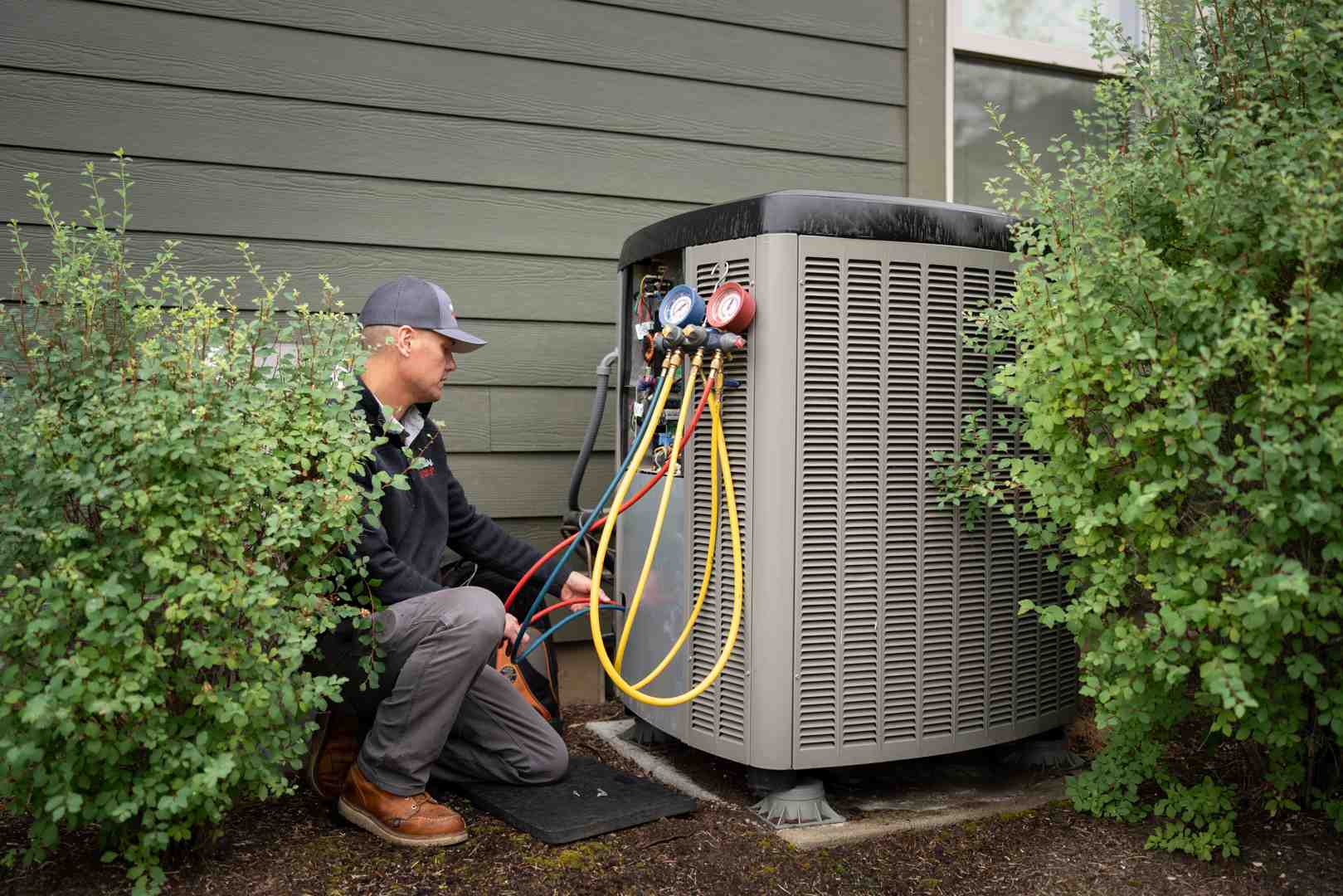
When we talk about a "matched system," we aren't just talking about two boxes that happen to be made by the same brand. A matched Air Conditioning system is a combination of indoor and outdoor components specifically engineered to work together as a single, cohesive unit.
Think of it like a high-performance car. You wouldn't put a tractor transmission into a luxury sedan and expect a smooth ride. In the same way, your outdoor condenser and your indoor air handler (or furnace coil) are designed to "speak the same language." They are tested by the manufacturer and certified by the Air-Conditioning, Heating, and Refrigeration Institute (AHRI) to ensure they hit specific efficiency and performance targets.
When we help you with How to Choose the Right AC System for Your Home, we focus on this engineered compatibility. A matched system ensures that the capacity of the indoor coil perfectly balances the output of the outdoor compressor. This balance is what allows the system to remove the right amount of heat and humidity from your Bend home without overworking the components.
In Central Oregon’s high desert climate, where the air is dry but the sun is intense, a matched system provides the ultimate climate control. It’s not just about staying cool; it’s about achieving that comfort with the maximum possible efficiency and reliability.
Primary Components of Your Split System
To understand how your indoor and outdoor AC units work together, it helps to know who the players are. A standard split system is divided into two main zones:
The Outdoor Unit (The "Hot Side")
• The Compressor: Often called the "heart" of the system, this is a large electric pump that pressurizes the refrigerant gas.
• The Condenser Coil: A series of copper or aluminum fins where the heat collected from inside your home is released into the outdoor air.
• The Outdoor Fan: This pulls air across the condenser coils to facilitate heat transfer.
The Indoor Unit (The "Cool Side")
• The Evaporator Coil: This is where the magic happens. Cold refrigerant flows through these coils, absorbing heat from the air in your home.
• The Blower Motor: This fan pushes the newly cooled air through your ductwork and pulls warm air back into the system.
• The Air Filter: This removes dust, allergens, and debris from the air before it reaches the coils, keeping the system clean and your air breathable.
• The Thermostatic Expansion Valve (TXV): This critical component regulates the flow of refrigerant into the evaporator coil. You can learn more about its role in The Function of a Thermostatic Expansion Valve.
In many Oregon homes, the indoor unit is paired with a furnace. Modern furnaces in 2026 use advanced ignitor technology, which enhances safety and efficiency. If you are starting from scratch or upgrading an old setup, professional AC Installation Bend OR ensures that all these components are sized correctly for your home’s square footage and layout.
How your indoor and outdoor ac units work together to cool your home
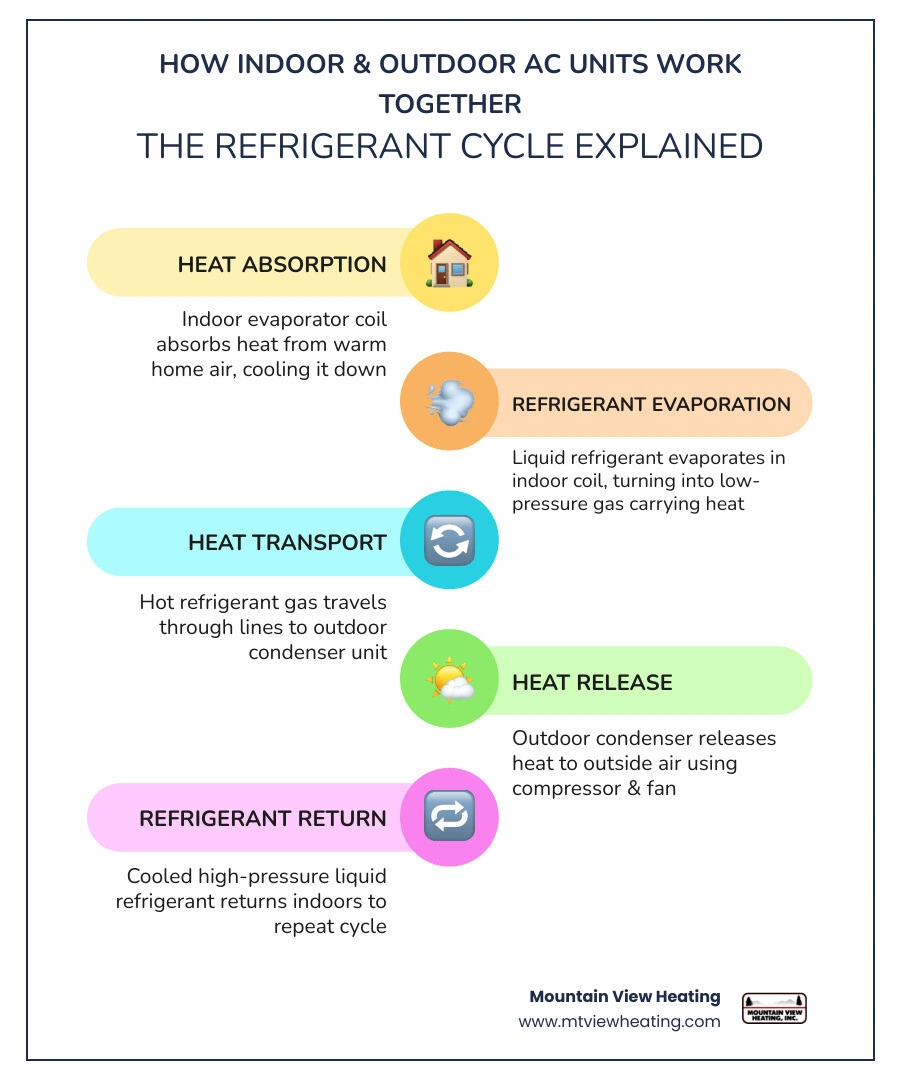
The process of cooling your home isn't actually about "creating cold." It's about moving heat. Here is the step-by-step journey of how your indoor and outdoor AC units work together:
1. Heat Absorption: The indoor blower pulls warm air from your rooms through the return vents. This air passes over the cold evaporator coil. The refrigerant inside the coil absorbs the heat, causing the refrigerant to turn from a liquid into a gas.
2. Transportation: The now-warm gaseous refrigerant travels through copper refrigerant lines to the outdoor unit.
3. Compression: The outdoor compressor squeezes the gas, raising its temperature even higher. This is necessary because heat naturally moves from a warmer substance to a cooler one. By making the refrigerant hotter than the outside air, the heat can be released easily.
4. Heat Release: The outdoor fan blows air over the condenser coils. The heat from the refrigerant escapes into the Central Oregon air, and the refrigerant cools back down, turning into a high-pressure liquid.
5. Recirculation: The liquid refrigerant travels back inside, passes through the expansion valve to drop its pressure (and temperature), and the cycle begins again.
This cycle also handles moisture removal. As warm, moist air hits the cold evaporator coil, water vapor condenses into liquid (just like on a cold soda can) and drains away. If this process is interrupted, you might find Reasons Your AC System May Be Blowing Out Warm Air.
Comparison of Indoor vs. Outdoor Functions
• Primary Goal — Indoor Unit (Evaporator): Absorb heat from indoor air — Outdoor Unit (Condenser): Release heat to outdoor air
• Key Component — Indoor Unit (Evaporator): Evaporator Coil & Blower — Outdoor Unit (Condenser): Compressor & Condenser Coil
• Refrigerant State — Indoor Unit (Evaporator): Changes from liquid to gas — Outdoor Unit (Condenser): Changes from gas to liquid
• Air Movement — Indoor Unit (Evaporator): Circulates air through ductwork — Outdoor Unit (Condenser): Exhausts heat away from house
• Secondary Function — Indoor Unit (Evaporator): Dehumidifies and filters air — Outdoor Unit (Condenser): Pressurizes refrigerant
How your indoor and outdoor ac units work together to meet modern regulations
Efficiency isn't just a suggestion; it's the law. As of April 2026, all matched indoor and outdoor units must meet strict energy standards. In our region, systems must generally meet a minimum 14 SEER2 (Seasonal Energy Efficiency Ratio) rating to be accepted by code inspectors.
The "2" in SEER2 refers to updated testing procedures that more accurately reflect real-world ductwork conditions. To hit these numbers, the indoor blower motor and the outdoor compressor must be perfectly synced. For example, using an old 20-year-old furnace blower with a brand-new outdoor unit can drop your efficiency from a rated 14 SEER down to a measly 12 SEER. This doesn't just waste energy; it fails to meet modern building codes.
Regular AC Maintenance Bend OR is the best way to ensure your system continues to meet these efficiency standards throughout its lifespan.
The Benefits of a Perfectly Matched System
Investing in a matched system is one of the smartest moves a homeowner can make. When we install a factory-matched package, we are ensuring several key benefits:
• Maximum Energy Efficiency: Because the components are engineered to pair specifically, they operate at the peak of their design capacity. This leads to lower monthly utility bills.
• Reliable Performance: Mismatched systems often struggle to maintain consistent temperatures, leading to hot and cold spots. A matched system provides even, reliable cooling throughout your home.
• Full Warranty Protection: Most manufacturers will only honor the full parts warranty if the system is a certified AHRI match. Replacing only the outdoor unit while keeping an ancient indoor coil can actually void your warranty.
• Quiet Operation: Modern matched systems are designed to minimize noise. Many outdoor units now run between 50–60 dB, which is about the level of a quiet conversation.
• System Longevity: When units work in harmony, they don't have to work as hard. This reduces wear and tear on the compressor and fan motors, helping your system last the typical 12 to 15 years (or longer with care).
If your system is making strange noises or struggling to keep up, it might be time for AC Repair Bend OR to see if a component has fallen out of sync.
Risks of Mismatched Indoor and Outdoor Components
It can be tempting to save money by replacing only the outdoor unit when it fails, especially if the indoor unit "seems fine." However, this "mix-and-match" approach often backfires.
One of the biggest risks is compressor strain. If your new outdoor unit is designed for a modern refrigerant like R-32 but your indoor coil is an old R-410A model, the pressures and flow rates won't match. This forces the compressor to work much harder than intended, leading to an early (and expensive) failure.
Another common issue is frozen coils. When the indoor and outdoor units aren't matched in capacity, the refrigerant may not evaporate correctly. This can cause the indoor coil to drop below freezing, leading to ice buildup that blocks airflow. If you've ever wondered Why Do Air Conditioners Freeze Up?, a mismatched system is a prime suspect.
Finally, you lose out on the technological advances of the last decade. Modern indoor units often feature variable-speed blowers that provide better humidity control and air filtration. By keeping an old indoor unit, you're essentially putting a brand-new engine into a car with flat tires—you won't get the performance you paid for.
Multi-Split Systems vs. Traditional Split Systems
While traditional split systems use one indoor unit to cool the whole house through ducts, many homeowners in Sisters and Sunriver are turning to multi-split systems.
A multi-split system still features a single outdoor compressor, but it can connect to multiple indoor "heads" or air handlers. This allows for zoned cooling, where you can set different temperatures for the kitchen, the master bedroom, and the home office.
This is a fantastic solution for:
• Homes without existing ductwork.
• Room additions or converted garages.
• Multi-story homes where the upstairs always stays too hot.
How your indoor and outdoor ac units work together in a ductless configuration
In a ductless multi-split setup, the interaction between units is even more sophisticated. These units don't just turn on and off; they "talk" to each other constantly via proprietary communication wires.
• Communication Protocols: The indoor unit tells the outdoor unit exactly how much cooling is needed in that specific room.
• Inverter Technology: The outdoor compressor adjusts its speed in tiny increments to match that demand, rather than running at 100% or 0%.
• Localized Comfort: Each indoor unit operates independently, but they all share the same outdoor "power plant."
Benefits of ductless multi-split systems include:
• Independent temperature control for every family member.
• No energy loss through leaky ducts (which can account for 20-30% of energy waste in central systems).
• Sleek, wall-mounted or ceiling-recessed designs.
• Remarkable energy efficiency ratings, often exceeding 20 SEER2.
Frequently Asked Questions about AC Units
Can I replace just the outdoor unit?
Technically, yes, but we rarely recommend it. Because of modern 14 SEER2 regulations and the phase-out of older refrigerants, a new outdoor unit will likely be incompatible with an indoor unit older than 10 years. You will end up with lower efficiency, a voided warranty, and a higher risk of system failure.
How do I verify if my system is AHRI certified?
Every matched system has an AHRI Reference Number. You can ask your HVAC technician for this number or look it up in the AHRI Directory of Certified Product Performance. This number is like a VIN for your AC, proving that the indoor and outdoor units were engineered to work together.
Why is my indoor unit responsible for air distribution?
While the outdoor unit creates the cooling capacity by compressing refrigerant, it has no way to move that air into your living room. The indoor unit contains the blower fan and is connected to your ductwork. It is the "delivery driver" of the system, ensuring the cool air actually reaches you.
Conclusion
At Mountain View Heating, we’ve spent over 40 years helping our neighbors in Bend, Redmond, and across Central Oregon stay comfortable. We know that how your indoor and outdoor AC units work together is the foundation of a reliable home. Whether you need a simple tune-up or a full system replacement, our team is committed to 100% customer satisfaction.
We provide 24/7 emergency support because we know that AC issues don't always happen during business hours. If you're concerned that your system is mismatched, or if you're ready to upgrade to a modern, high-efficiency matched system, we're here to help.
Keep your home cool and your energy bills low by ensuring your HVAC team is working in perfect harmony. Contact us today for all your Air Conditioning needs!