


Why Your AC Breaks Down — and What's Really Behind It
Understanding the most common AC repairs and what causes them can save you from a sweltering house on the hottest day of the year. Here's a quick look at what fails most often:
• Bad capacitor — Most Common Cause: Heat stress, age, power surges
• Refrigerant leak — Most Common Cause: Corrosion, vibration, worn fittings
• Frozen evaporator coil — Most Common Cause: Dirty filter, low refrigerant
• Clogged condensate drain — Most Common Cause: Algae, mold, debris buildup
• Thermostat failure — Most Common Cause: Dead batteries, sun exposure, age
• Electrical/contactor failure — Most Common Cause: Surges, heat, normal wear
• Blower or condenser fan failure — Most Common Cause: Motor wear, debris, overheating
Your AC is one of the hardest-working systems in your home — especially during a Central Oregon summer. And like most things that work hard, it eventually shows wear. The trouble is, most breakdowns don't happen out of nowhere. A small clicking noise, a slightly warm room, or a brief spike in your energy bill are often the first signs something is quietly going wrong. Ignore them long enough, and what started as a $150 fix can turn into a full system emergency.
Skipping regular maintenance is the leading cause of AC breakdowns, and research shows that nine out of ten central air systems that aren't cooling properly trace back to something as simple as a dirty air filter. Bad capacitors alone account for more than one in five service calls. These aren't freak failures — they're predictable, and often preventable.
Whether your AC just stopped working, is blowing warm air, or is making a noise you've never heard before, this guide walks you through what's actually going wrong and what to do about it.
The Most Common AC Repairs and What Causes Them
Peak cooling season tends to expose the same weak points over and over. In our experience serving homeowners in Bend and surrounding Central Oregon communities, the repairs below show up most often because they are tied to heat, dust, airflow problems, and normal wear.
Most common AC repairs and what causes them: the top failures homeowners see
Here are the issues homeowners run into most often:
1. Bad capacitors
2. Refrigerant leaks
3. Frozen evaporator coils
4. Clogged condensate drain lines
5. Thermostat problems
6. Contactor and other electrical failures
7. Blower motor problems
8. Outdoor condenser fan failures
9. Short cycling issues
10. Weak airflow and no-cool calls
A failed capacitor is one of the biggest repeat offenders. Research cited above found that bad capacitors accounted for 52 out of 242 repair calls, or 21.5% of all visits. That is a pretty large share for one small part.
Refrigerant leaks are also extremely common and are often behind warm air complaints. Frozen coils usually stem from restricted airflow or low refrigerant. Drain clogs create water leaks and humidity issues. Electrical parts like contactors wear out from repeated cycling. Fan and blower issues often develop when debris, dust, or overheating put extra stress on the motors.
Why capacitors, contactors, and other electrical parts fail first
Electrical parts tend to fail early because they deal with repeated starts, high heat, and power fluctuations.
A capacitor gives the compressor and fan motors the boost they need to start and keep running. Over time, that part weakens. Hot weather speeds that process up. So do power surges and simple age. If your AC is humming, clicking, or struggling to start, a failing capacitor may be the reason.
Contactors are another common failure point. They act like switches that send power to major components. When the contact surfaces wear down, they may stick, chatter, or fail to close properly. That can lead to short cycling, a system that will not start, or one that keeps trying and failing.
Common signs of electrical trouble include:
• Clicking when the system tries to start
• Buzzing from the outdoor unit
• AC not turning on at all
• Breaker trips
• Hard starting
• Intermittent cooling
If your system will not power up, start with AC Not Turning On: What to Check First. For anything beyond basic checks, electrical diagnosis should be left to a licensed technician. Capacitors can store dangerous voltage even when power is off, so this is not a good DIY adventure.
Why refrigerant leaks, frozen coils, and drain clogs are so common
These three problems are closely related.
Refrigerant leaks happen when vibration, corrosion, or worn connections allow refrigerant to escape. Once charge drops too low, your AC cannot absorb and move heat properly. That often leads to warm air, longer run times, and eventually coil freezing.
Frozen evaporator coils usually happen for one of two reasons:
• Airflow is restricted
• Refrigerant is low
A dirty filter is one of the biggest culprits. If not enough warm air passes over the coil, the coil temperature can drop below freezing and ice begins to form. Low refrigerant can do the same thing by changing system pressures.
Drain clogs develop because the condensate line is dark, damp, and perfect for algae, sludge, and debris buildup. Once blocked, water backs up instead of draining away. That can lead to indoor leaks, excess humidity, and in some systems, a safety switch that shuts the AC down.
If you are dealing with ice or freeze-ups, these guides can help:Why Do Air Conditioners Freeze Up?Ice Forming on Your AC Unit: Causes and What to Do
The Warning Signs You Should Never Ignore
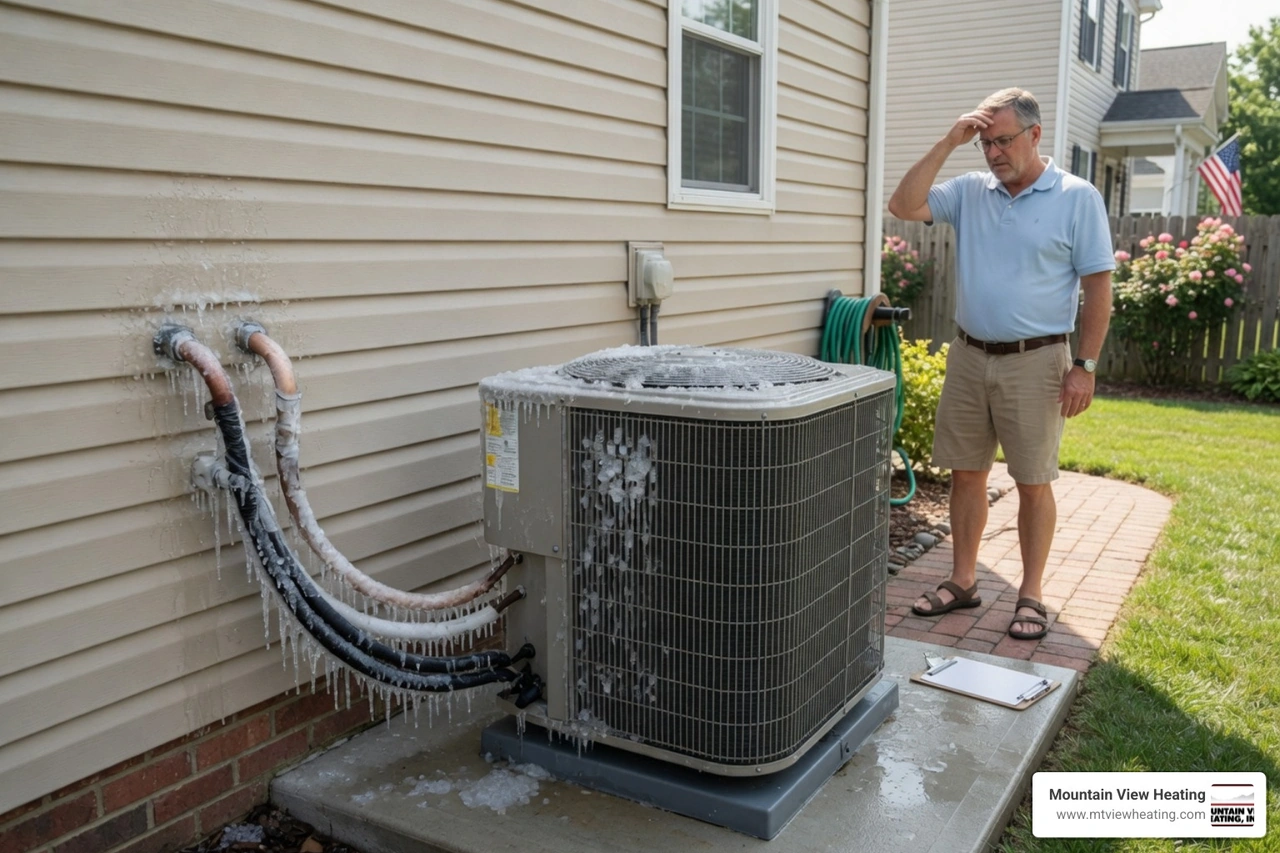
Most major AC repairs start with smaller warning signs. The problem is that they are easy to shrug off at first. A little noise here, a little leak there. Then suddenly your house feels like late July inside.
Most common AC repairs and what causes them often start with subtle symptoms
Watch for these early symptoms:
• Clicking sounds
• Rattling or vibrating
• Hissing
• Buzzing
• Musty odors
• Burning smells
• Uneven cooling between rooms
• Rising indoor humidity
• Water around the indoor unit
• Ice on refrigerant lines
• AC that runs constantly
What do these signs often mean?
• Clicking can point to a failing contactor or capacitor
• Rattling may mean loose panels or hardware
• Hissing can suggest a refrigerant leak
• Buzzing often points to electrical trouble
• Musty smells can indicate moisture buildup or a dirty drain line
• Burning odors can signal overheating wiring or motors
A small clicking noise today can absolutely turn into a bigger repair tomorrow. Ignoring early electrical symptoms may lead to motor damage, no-start conditions, or a complete shutdown during the hottest stretch of the season.
What warm air, weak airflow, and short cycling usually mean
Warm air does not always mean the entire system is done for. It often comes from a smaller root problem such as:
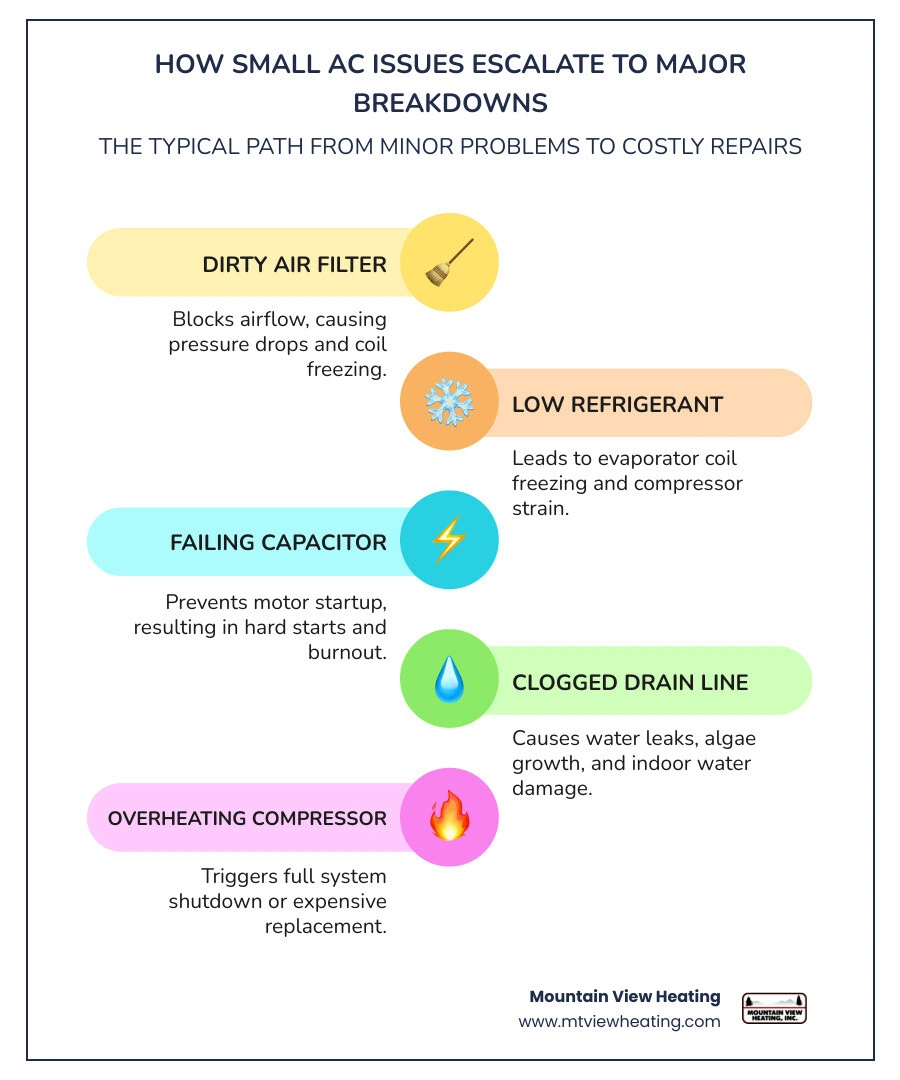
• Dirty air filter
• Low refrigerant
• Dirty outdoor coil
• Thermostat set incorrectly
• Condenser problem
• Airflow restriction
• Duct leakage
Weak airflow usually points to a clogged filter, blower problem, blocked vents, dirty evaporator coil, or duct issue. Short cycling, where the system turns on and off too frequently, may be caused by an overheating unit, dirty coils, thermostat issues, or electrical faults.
If your AC is running but not cooling, start here:Why Is My AC Blowing Warm Air? Troubleshooting StepsReasons Your AC System May Be Blowing Out Warm Air
What breaker trips, no-start issues, and odd noises point to
A breaker that trips once may be a fluke. A breaker that keeps tripping is a message.
It can point to:
• Overheating motors
• Locked compressor
• Failing capacitor
• Electrical short
• Loose wiring
• Condenser fan problems
Odd noises also matter. Squealing may mean a worn motor bearing. Grinding can point to serious motor trouble. Loud buzzing can indicate electrical arcing or a failing contactor. None of these improve by being ignored.
If the breaker keeps tripping, read AC Circuit Breaker Keeps Tripping: What It Means. Repeated resets are not a fix. They are more like pressing snooze on a much worse morning.
What Homeowners Can Safely Check Before Calling for Repair
There are a few safe troubleshooting steps homeowners can take before calling us. These checks can sometimes solve a simple problem or at least narrow down the cause.
Safe DIY troubleshooting steps that can solve simple AC problems
Before scheduling repair, you can safely check:
• Thermostat setting
• Thermostat batteries
• Air filter condition
• Supply and return vents
• Breaker position
• Outdoor unit clearance
• Condensate drain outlet
Here is a practical checklist:
1. Make sure the thermostat is set to cool and the temperature is below room temperature.
2. Replace thermostat batteries if applicable.
3. Check the filter. If it is dirty, replace it. Research shows dirty filters are tied to 9 out of 10 central AC performance problems.
4. Confirm vents are open and not blocked by furniture or rugs.
5. Check the breaker once. If it is tripped, reset it a single time. If it trips again, stop there.
6. Look at the outdoor unit and clear leaves, dust, grass, and debris. Keep about 2 feet of open space around it.
7. Inspect the condensate drain outlet for visible blockage.
8. If the outdoor coil is dirty, you can gently rinse it with power off using a garden hose, not a pressure washer.
For more step-by-step help, see AC Troubleshooting Tips Before Calling a Pro.
Repairs that always require a licensed technician
Some AC issues should never be DIY.
Call a professional for:
• Refrigerant leak detection and repair
• Refrigerant charging
• Capacitor replacement
• Contactor replacement
• Electrical diagnosis
• Motor testing
• Compressor work
• Frozen coil diagnosis if the cause is not obvious
• Repeated breaker trips
• Burnt wiring smells
Why? Because these repairs involve high voltage, pressurized refrigerant, specialized tools, and exact performance measurements. Replacing a part without fixing the underlying cause can make the problem worse. For example, adding refrigerant without finding the leak is like refilling a tire with a nail still in it.
Why Dirty Filters and Neglected Maintenance Cause Major Breakdowns
Skipping maintenance is the top cause of AC breakdowns, and it is easy to see why. Air conditioners rely on proper airflow, clean coils, healthy electrical parts, and correct refrigerant charge. Let one thing slide, and the rest of the system starts working harder.
How a clogged filter can trigger 9 out of 10 cooling problems
This is the big one.
Research above notes that nine out of ten central air units that are not working well come down to a clogged filter. That makes sense because the filter affects almost everything else.
When the filter is clogged:
• Airflow drops
• The evaporator coil gets too cold
• Ice can form
• The blower works harder
• Rooms cool unevenly
• Energy use rises
• Comfort drops
Over time, restricted airflow can also stress the compressor, which is one of the most important and expensive parts of the system. A cheap filter change can prevent a very inconvenient summer surprise.
A good rule for homeowners is to check filters every month during heavy-use season and replace them regularly. In dusty areas or homes with pets, you may need more frequent changes.
How heat, dust, and yard debris wear down the outdoor condenser
Outdoor units have a rough life. They sit in the sun, pull in outside air all day, and collect dust, cottonwood fluff, pine needles, and yard debris. In Central Oregon, heat and airborne debris can combine to reduce airflow through the condenser coil.
That creates several problems:
• The system cannot release heat efficiently
• Pressures rise
• The compressor runs hotter
• The fan motor works harder
• Cooling performance drops
• Parts wear out faster
This is one reason outdoor fan failures and overheating shutdowns become common during peak summer weather. Keeping the area around the condenser clear helps more than many homeowners realize.
How regular maintenance and proper sizing reduce emergency repairs
Preventative maintenance catches small issues before they become emergency calls. A spring tune-up typically includes checking electrical components, cleaning coils, inspecting refrigerant performance, flushing drains, and testing system operation before the hottest weather arrives.
Proper system sizing matters too. An oversized AC may short cycle, which increases wear on capacitors, contactors, and motors. An undersized AC may run nonstop, which also accelerates wear. A properly sized system based on the home's actual cooling load is less likely to suffer repeated breakdowns.
Duct leakage can also make a correctly working AC seem underpowered. If cool air is leaking into unconditioned spaces, rooms may stay warm and the system may run longer than it should.
When to Repair Your AC and When Replacement Makes More Sense
Eventually, every homeowner reaches the question: should we repair this system again, or is it time to replace it?
• System age — Repair May Make Sense: Newer unit — Replacement May Make More Sense: Older unit near end of lifespan
• Breakdown history — Repair May Make Sense: First major issue — Replacement May Make More Sense: Repeated repairs
• Refrigerant type — Repair May Make Sense: Modern refrigerant — Replacement May Make More Sense: R-22 system
• Major component condition — Repair May Make Sense: Compressor and coils healthy — Replacement May Make More Sense: Compressor failing or multiple worn parts
• Comfort and reliability — Repair May Make Sense: Mostly consistent — Replacement May Make More Sense: Frequent hot spots or poor cooling
The repair-vs-replace rule of thumb homeowners can use
A common rule of thumb is the $5,000 rule: multiply the age of the unit by the repair cost, and if the result is over $5,000, replacement deserves serious consideration.
Even without discussing exact numbers, the principle is useful. Older units with repeated repairs, declining efficiency, and ongoing comfort issues are often better long-term replacement candidates than systems with one isolated problem.
AC systems typically last around 12 to 15 years, though regular maintenance can help some last longer. If your system is in that age range and major components are failing, replacement may provide better reliability and fewer future breakdowns.
Compressor failure is a major turning point. Because the compressor is central to the cooling process, a serious compressor issue on an aging unit often pushes the decision toward replacement.
How R-22 refrigerant changes the decision on an older system
If your older AC uses R-22 refrigerant, repair decisions get more complicated. R-22 has been phased out, which means it is increasingly scarce and harder to justify investing in for an aging residential system.
So if you have:
• An older unit
• An R-22 system
• A refrigerant leak
• Repeated cooling issues
replacement may make more sense than continuing to patch leaks and nurse the system along. Even if the AC can be repaired, the long-term reliability picture may not be great.
Frequently Asked Questions About the Most Common AC Repairs and What Causes Them
Why is my AC blowing warm air even though it’s running?
Usually one of these is to blame:
• Dirty air filter
• Low refrigerant from a leak
• Outdoor condenser issue
• Thermostat setting problem
• Frozen evaporator coil
• Blower or electrical fault
Start with the easy checks: thermostat, filter, breaker, and outdoor debris. If those look fine, professional diagnosis is the next step because refrigerant, electrical, and airflow issues can overlap.
What happens if I ignore a small water leak or clicking sound?
Small AC problems rarely stay small.
A water leak may come from a clogged condensate drain. If ignored, that can lead to water damage, mold growth, humidity problems, or safety switch shutdowns. A clicking sound may point to a failing contactor or capacitor. Ignore that, and the system may stop starting altogether or damage a motor.
In other words, minor symptoms are often early warning signs, not harmless quirks.
How long do common AC repairs usually take?
Many common AC repairs take anywhere from 1 to 8 hours, depending on the problem, the parts involved, and how long diagnosis takes. A straightforward capacitor replacement is generally quicker than tracking down a refrigerant leak or diagnosing intermittent electrical faults.
Part availability and system condition also affect repair time. If multiple issues are present, the visit may take longer because the original symptom was only part of the story.
Conclusion
Most AC breakdowns are not random. They usually start with a familiar pattern: dirty filter, stressed electrical part, low refrigerant, blocked drain, or neglected maintenance. Catching those issues early can save you from a hotter house, a longer repair, and a lot more frustration.
If your air conditioner in Bend, Redmond, La Pine, Sisters, Sunriver, Terrebonne, Three Rivers, or nearby communities is showing signs of trouble, we are here to help. At Mountain View Heating, we focus on residential cooling solutions with a customer-first approach and the experience to diagnose problems the right way.
For more local help, explore our guides:AC Repair Bend OR Complete GuideAC Repair Redmond ORAC Repair La Pine OR Complete Guide
And if you want a full overview of residential cooling options, visit More info about air conditioning services.