


Why the Single Stage vs Two Stage vs Variable Speed AC Comparison Matters for Bend Homeowners
When shopping for a new air conditioner in Bend, Oregon, the single stage vs two stage vs variable speed AC comparison is one of the most important decisions you'll make — and it affects your comfort, energy bills, and how long your system lasts.
Here's a quick look at how the three types compare:
| Feature | Single-Stage | Two-Stage | Variable-Speed |
|---|---|---|---|
| Capacity | 100% only | 65% or 100% | 25% to 100% |
| Energy Efficiency (SEER2) | 14-15 | 17-18 | 18-26+ |
| Temperature Consistency | ±3-4°F swings | ±1-2°F swings | Within ±0.5°F |
| Humidity Control | Basic | Better | Best |
| Typical Lifespan | 10-12 years | 12-15 years | 15-20 years |
| Upfront Cost | Lowest | Moderate | Highest |
Most homes in Bend still run single-stage systems — in fact, roughly 70-80% of American homes do. But that doesn't mean it's always the right fit. Bend's high desert climate brings hot afternoons, cool nights, and shoulder seasons where a system that only runs at full blast can feel like overkill — and waste energy in the process.
Whether you're replacing an aging unit or buying your first central AC, understanding how each compressor type works helps you make a smarter choice for your home and budget.
Single Stage vs Two Stage vs Variable Speed AC Comparison at a Glance
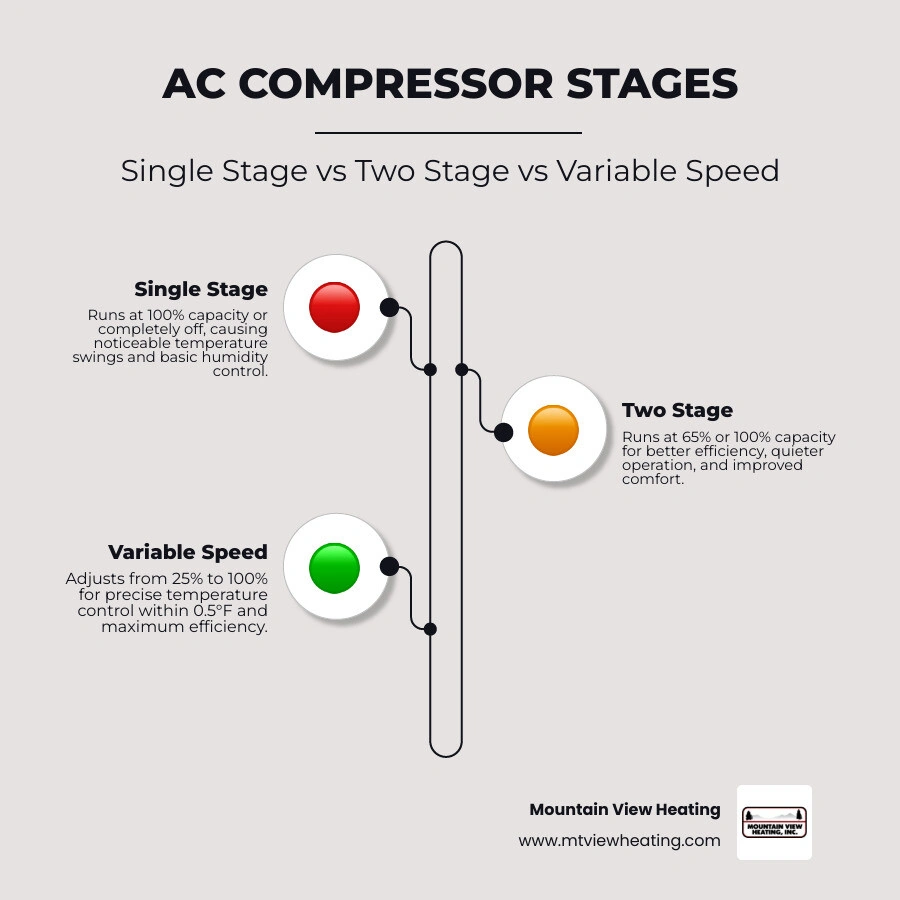
At the simplest level, these systems differ in how many "gears" the compressor has.
- Single-stage AC has one gear: all on or all off
- Two-stage AC has two gears: low and high
- Variable-speed AC has many gears and adjusts gradually
That one difference affects almost everything else: temperature stability, sound, runtime, moisture removal, and efficiency.
| Comparison Point | Single-Stage AC | Two-Stage AC | Variable-Speed AC |
|---|---|---|---|
| Compressor operation | 100% or off | Usually about 65% on low, 100% on high | Modulates roughly 25% to 100% |
| Runtime pattern | Shorter, harder cycles | Longer low-stage cycles most of the time | Long, steady low-speed operation |
| Comfort | More noticeable temperature swings | More even temperatures | Most precise comfort |
| Noise | Louder starts and stops | Quieter than single-stage | Usually quietest |
| Moisture removal | Limited | Improved | Best overall |
| Efficiency range | Basic modern efficiency | Moderate to high efficiency | Highest efficiency |
What single-stage air conditioning means
A single-stage air conditioner is the most basic design. When your thermostat calls for cooling, the compressor turns on at full power. Once the set temperature is reached, it shuts off completely.
This is still the most common style in American homes, and for good reason: it is straightforward, dependable, and simpler to service. But the tradeoff is that it cools in bursts. That can create more temperature swing and more noticeable cycling.
Single-stage systems usually land in the lower SEER2 range, often around 14 to 15. If you want a refresher on what that rating means, see What is a SEER Rating.
What two-stage air conditioning means
A two-stage AC adds a middle ground. Instead of always blasting at full output, it typically runs at about 65% capacity on low stage and shifts to 100% only when your home really needs it.
That means on many summer days, the system can cruise instead of sprint. The result is steadier indoor temperatures, quieter operation, and better efficiency than a comparable single-stage unit.
For many homeowners, two-stage feels like the practical "sweet spot" between basic and premium.
What variable-speed air conditioning means
A variable-speed AC is the most adaptive option. Instead of just one or two operating levels, it can adjust output across a wide range, often from about 25% to 100%.
Think of it like a dimmer switch instead of a simple on/off switch. Rather than waiting for your home to get too warm and then hitting it with a burst of cold air, a variable-speed system makes small adjustments to stay ahead of temperature changes.
These systems often reach SEER2 ratings from 18 to 26 or higher, and they can keep indoor temperatures within about half a degree of your thermostat setting. In everyday life, that means fewer hot spots, fewer cold blasts, and less thermostat fiddling.
How Each AC Type Works in Real Homes
Specs are helpful, but how the system behaves in a real house matters more. In Bend-area homes, cooling loads can change a lot between morning, afternoon, and evening. A system that handles those swings smoothly usually feels better.
Single stage vs two stage vs variable speed AC comparison: compressor speed and capacity
Here is how each type actually runs:
- Single-stage: always 100% output when on
- Two-stage: usually around 60% to 70% on low, 100% on high
- Variable-speed: adjusts as needed, often between 25% and 100%
Why that matters:
- Startup uses more power than steady running
- Frequent on/off cycles add wear to components
- Lower-speed operation can maintain comfort with less drama
Single-stage systems cool quickly, but they also shut off quickly. That stop-start pattern can lead to short cycling if the system is oversized. Two-stage and variable-speed systems reduce that problem by running longer at lower capacity.
In simple terms: a system that can loaf along instead of flooring it every time tends to feel smoother and operate more efficiently.
Why longer, lower-speed cycles usually feel better indoors
Home comfort is not just about hitting the thermostat number. It is about how the home feels between cycles.
Longer, lower-speed operation helps with:
- More even temperatures from room to room
- Fewer hot and cold spots
- Better air mixing
- Quieter operation
- Less of that "AC just kicked on like a jet engine" feeling
This can matter even in Bend's drier climate. Many homes in our area have big windows, open living spaces, or multiple levels. Those layouts often benefit from gentler, steadier cooling instead of repeated full-power bursts.
How system sizing affects performance more than many homeowners realize
Here is the part that surprises a lot of homeowners: the best compressor type in the world will still disappoint if the system is the wrong size.
An oversized AC may:
- Cool too fast
- Shut off too soon
- Deliver uneven temperatures
- Remove less moisture during milder weather
- Wear out faster from frequent starts
An undersized AC may:
- Run too long without catching up
- Struggle during peak afternoon heat
- Increase energy use
- Leave rooms uncomfortable
Proper sizing requires a real load calculation, not a guess based on the old unit or square footage alone. Ductwork, insulation, sun exposure, window area, and airflow all matter. If you are comparing options, our guide on How to Choose the Right AC System for Your Home is a helpful next step.
Efficiency, Humidity Control, and Comfort Differences
Which system is most energy efficient and why
Variable-speed AC is generally the efficiency winner.
Typical ranges look like this:
- Single-stage: SEER2 14 to 15
- Two-stage: SEER2 17 to 18
- Variable-speed: SEER2 18 to 26+
Two-stage units often improve efficiency by about 15% to 20% over comparable single-stage systems. Variable-speed systems can reduce energy use by about 25% to 40% compared to single-stage units, and in some homes they may lower utility bills by 20% to 50%.
Why the advantage?
- They avoid repeated high-energy startups
- They run at lower output most of the time
- They better match actual cooling demand
- They reduce wasted full-power operation during mild conditions
That matters in Central Oregon, where cooling needs can change quickly throughout the day. A system that can adjust to those shifts is usually more efficient than one that only knows "full blast."
Single stage vs two stage vs variable speed AC comparison for humidity control
Bend is known for dry air, so humidity control is not usually the first thing homeowners ask about. But it still matters more than many people think.
Why?
- Shoulder season weather can create indoor stuffiness
- Cooking, showers, and occupancy add moisture indoors
- Some homes have rooms that feel clammy even in a generally dry climate
Air conditioners remove moisture when warm indoor air passes over the cold evaporator coil. Systems that run longer at lower speed usually do this better because they keep air moving across the coil longer.
That means:
- Single-stage offers the most basic moisture removal
- Two-stage removes more moisture because low stage runs longer
- Variable-speed offers the best dehumidification overall
Research shows variable-speed systems can remove up to 400% more moisture than standard systems in worst-case conditions. That figure is most dramatic in humid climates, but the principle still applies here: longer, steadier cycles are better at balancing indoor comfort.
Best choice for comfort in Bend’s high desert climate
For Bend and surrounding communities like Redmond, Sisters, Sunriver, La Pine, Terrebonne and Three Rivers, the "best" system depends on the house and the homeowner.
In our high desert climate, common challenges include:
- Hot sunny afternoons
- Cooler nights
- Big day-to-night temperature swings
- Uneven comfort in larger or multi-level homes
- Rooms with strong solar gain
That often makes two-stage and variable-speed systems especially attractive. They can adapt better when a home needs only a little cooling in the morning and much more later in the day.
Single-stage can still make sense for homes with simple cooling needs, but if comfort complaints already include hot spots, noisy cycling, or uneven temperatures, a more adaptive system may be worth a look.
If your home also has layout or zoning challenges, Ductless vs Ducted Cooling Pros and Cons can help you compare alternatives.
Lifespan, Maintenance, and Repair Considerations
How long single-stage, two-stage, and variable-speed AC systems typically last
With proper installation and regular maintenance, all three types can provide many years of service. In general:
- Single-stage: about 10 to 12 years
- Two-stage: about 12 to 15 years
- Variable-speed: about 15 to 20 years
Why the difference? A big part of it is cycling stress. Systems that start hard and stop often place more strain on the compressor and related components. Systems that operate more smoothly at lower speeds usually experience less wear over time.
That said, lifespan depends heavily on:
- Correct sizing
- Installation quality
- Duct condition
- Filter replacement
- Annual maintenance
- How often the system runs in your home
A poorly installed premium system can underperform a properly installed basic one. Fancy technology cannot rescue bad airflow.
Maintenance needs homeowners should expect from each system
All residential AC systems need the same core care:
- Change the air filter regularly
- Keep the outdoor unit clear of debris
- Schedule annual professional tune-ups
- Check thermostat operation
- Inspect coils, electrical components, and refrigerant levels
You can learn more about routine care and service support on our Air Conditioning page.
The difference is not whether advanced systems need maintenance. They all do. The difference is that two-stage and variable-speed systems benefit even more from precise setup and ongoing performance checks because they rely on controls and sensors to do their best work.
Spring service is especially smart in our area, before the hottest weather arrives.
Repair complexity and parts considerations
This is where the tradeoff becomes clearer.
Single-stage systems tend to have:
- Simpler controls
- Fewer specialized parts
- More straightforward diagnostics
Two-stage systems add:
- More control logic
- Staging components
- Extra setup considerations
Variable-speed systems may include:
- Advanced control boards
- Sensors
- Inverter-driven components
- Communicating thermostats or smart controls
That does not mean variable-speed systems are unreliable. It just means repairs can be more specialized when they are needed. Homeowners should understand both sides of the equation: better comfort and efficiency usually come with more sophisticated electronics.
Which AC Type Fits Your Home, Budget Priorities, and Cooling Goals?
Best for smaller homes, simpler cooling needs, or basic replacement goals
Single-stage AC can be a good fit if:
- Your home is smaller or straightforward to cool
- You are replacing an older basic central AC
- You do not have major comfort complaints now
- You want simple operation and simpler repair paths
This can work well in compact homes, some single-level layouts, or houses with modest cooling demands. If your current system kept you reasonably comfortable and your goal is dependable cooling without extra bells and whistles, single-stage may be enough.
Best for homeowners wanting a balance of comfort and efficiency
Two-stage AC is often the middle-ground choice.
It is a strong fit if:
- You want better comfort without going all the way to premium equipment
- Your home gets warm unevenly through the day
- You want quieter operation than a typical single-stage unit
- You plan to stay in the home long enough to value improved efficiency
For many Bend-area families, two-stage hits the "sweet spot." It handles fluctuating weather better, runs more gently most of the time, and usually delivers a noticeable comfort upgrade.
Best for premium comfort, steadier temperatures, and maximum efficiency
Variable-speed AC is the top option for homeowners who want the most refined performance.
It is often ideal if:
- Your home is larger or multi-story
- You notice frequent temperature swings
- You want the quietest, most even cooling possible
- You prioritize long-term efficiency
- You want the system to make small adjustments instead of dramatic ones
These systems are especially good at keeping indoor temperatures very steady, often within about 0.5 degrees of the set point. If you are the kind of person who notices every room that runs warm by 2 p.m., variable-speed may feel like a major quality-of-life upgrade.
If you are also considering all-electric comfort options, our guide on How Does a Heat Pump Work is worth reading.
When to consider a ductless or heat pump alternative instead
Sometimes the best answer is not choosing among single-stage, two-stage, and variable-speed central AC at all.
A ductless or heat pump solution may make more sense if:
- Your home has ductwork issues
- You have an addition, bonus room, or converted space
- You want zoned comfort in different parts of the house
- Your older home is difficult to cool evenly
- You are exploring electrification
These resources can help you compare those paths:
- Mini Split vs Central AC Cost Comparison
- Central Air vs Mini Split for Older Homes
- Central Air vs Mini Split High Desert Guide
Frequently Asked Questions About Single Stage vs Two Stage vs Variable Speed AC Comparison
Is variable-speed AC worth it in Bend if summers are dry?
Often, yes. Even though Bend is not known for sticky summer air, variable-speed systems still offer major benefits through steadier temperatures, quieter operation, and better efficiency during changing conditions.
They are especially appealing in homes with:
- Big sun exposure
- Open floor plans
- Multiple levels
- Comfort complaints during shoulder seasons
Dry climate does not cancel out the comfort advantage.
Do two-stage AC units usually last longer than single-stage systems?
They often can, because they spend much of their time running at lower capacity instead of starting and stopping at full output over and over. Fewer hard starts can mean less compressor stress over time.
But "usually" is the key word. Maintenance habits, airflow, sizing, and installation quality still matter more than the label on the equipment.
Are advanced AC systems louder or quieter than basic models?
Usually quieter.
Single-stage units tend to be the most noticeable because they start at full power every time. Two-stage systems are quieter on low stage, and variable-speed systems are usually quietest because they often run at very low output for long stretches.
So yes, the more advanced option is often the one that makes less of a scene. Your AC does not need to announce itself like it is making a dramatic entrance.
Conclusion
The right answer in this single stage vs two stage vs variable speed AC comparison depends on your home, your comfort priorities, and how you want your system to perform through Bend’s changing summer conditions.
In general:
- Single-stage is best for simple, budget-conscious cooling needs
- Two-stage offers a strong balance of comfort and efficiency
- Variable-speed delivers the highest comfort, best efficiency, and most precise control
At Mountain View Heating, we help homeowners across Bend and nearby communities sort through those options without the jargon overload. We focus on residential HVAC service, repair, and replacement, and we bring a customer-first approach to every project, big or small.
If you would like help choosing the best cooling system for your home, learn more about our air conditioning services.