



Central Air vs Mini Split for Older Homes: Which One Actually Works?
Central air vs mini split for older homes is one of the most common questions homeowners in Bend, Oregon ask — and for good reason. Older homes were built before central air existed, which means most of them have no ductwork at all. Adding ducts to an existing home is a major renovation, and in many cases, it simply is not practical.
Here is a quick answer based on your situation:
• No existing ductwork? A mini split is almost always the better choice. Installing new ductwork can be a major undertaking on top of the system itself, and the disruption to walls, ceilings, and floors in an older home can be extensive.
• Already have working ductwork? Central air may still make sense — but only if those ducts are in good shape. The U.S. EPA and Energy Star estimate that homes lose 20 to 30 percent of cooling through leaky ducts.
• Historic or character home? Mini splits require only a small hole through an exterior wall, preserving original plasterwork, moldings, and structural elements.
• Want heating and cooling in one system? Mini split heat pumps handle both, making them a strong fit for older homes with outdated or inefficient heating systems.
• Cooling a specific room or addition? Mini splits are purpose-built for exactly this — bonus rooms, finished basements, converted garages, and sunrooms all benefit from targeted, zoned comfort.
For most older homes in Central Oregon — especially those built before the 1970s — a ductless mini split is the more practical, efficient, and less invasive solution. That said, the right answer depends on your home's specific layout, insulation, and existing systems.
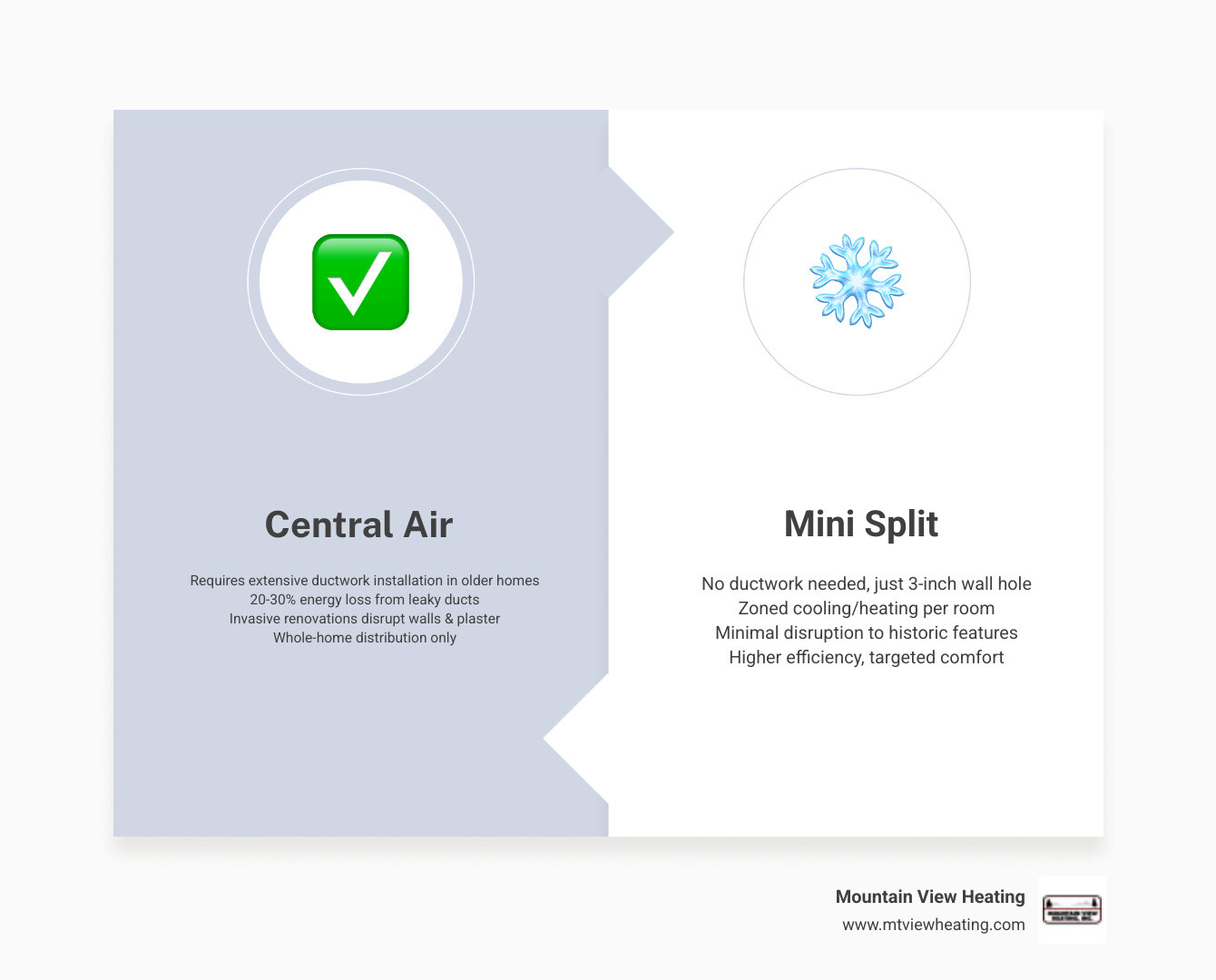
Understanding the Differences: Central Air vs Mini Split for Older Homes
When we talk about central air vs mini split for older homes, we are really comparing two different philosophies of home comfort. Think of central air like a whole-house audio system where one source pipes music through the walls to every room. A mini split is more like having high-quality Bluetooth speakers in each room; you choose exactly where the "music" goes and how loud it is.
For our neighbors in Bend and the surrounding high desert, choosing between these two often comes down to the architecture of the house itself. Central air requires a massive network of hidden "veins" — the ductwork — to move air. If your home was built in an era of radiator heat or wood stoves, those veins simply aren't there.
Air Conditioning in a traditional central system relies on a large indoor air handler, usually tucked away in a basement or attic, which pushes cooled air through the entire house at once. A Mini Splits system, however, uses individual indoor units (often called "heads") mounted directly on the wall or ceiling of the rooms you use most. These systems use advanced inverter technology, allowing them to speed up or slow down smoothly rather than just clanking on and off like older equipment.
How central air vs mini split for older homes impacts air quality
In older homes, indoor air quality is a major concern. Over decades, traditional ducts can accumulate dust, pet dander, and allergens. If those ducts are leaky or poorly maintained, they can actually pull in "bad" air from crawl spaces or attics and distribute it throughout your living areas.
A modern HVAC strategy using ductless technology sidesteps this issue. Since there are no ducts to collect debris, you aren't circulating the same dust year after year. Most mini split units come with multi-stage filtration systems that capture microscopic particles. This is a huge win for families in Central Oregon dealing with seasonal pollen or smoke. While central air systems can be fitted with high-end HEPA filters or UV purifiers, they still rely on the cleanliness of the ductwork itself to deliver that air.
System components and operation
The hardware involved in Mini-Split AC Bend OR is surprisingly simple. You have an outdoor condenser unit that looks much like a standard AC unit but is often slimmer and quieter. This connects to the indoor units via small refrigerant lines, power cables, and a condensate drain.
Central air, by contrast, is a heavy-lifter. It uses a large outdoor condenser and a significant indoor evaporator coil. The operation is "all or nothing" — when the thermostat clicks on, the whole house gets treated, whether you are using the guest bedroom or not. Mini splits allow for true zoned comfort, meaning you can keep your kitchen cool while cooking without freezing out the person napping in the bedroom.
Why Mini-Splits Excel in Homes Without Existing Ductwork
If you live in a historic bungalow in Sisters or a mid-century home in Redmond, you probably appreciate the original craftsmanship. The biggest hurdle for central air vs mini split for older homes is the invasive nature of retrofitting ducts. To put in central air where it never existed, a crew might have to cut into original lath-and-plaster walls, drop ceilings, or sacrifice closet space to hide the bulky metal trunk lines.
This is where Mini-Split Installation Bend OR truly shines. We only need to drill a small, three-inch hole through an exterior wall to connect the indoor and outdoor components. This preserves the architectural integrity of your home. If your house is built on a slab foundation — common in parts of Ductless Terrebonne OR — there is often no "hidden" space for ducts to go, making a ductless system the only viable permanent cooling solution.
Comparing installation challenges of central air vs mini split for older homes
The structural limitations of older properties can be daunting. Many homes in our area have tight attic spaces or narrow crawl spaces that simply cannot accommodate standard 12-inch or 14-inch ducting. When we perform Mini-Split Installation Redmond OR, we aren't fighting the house; we are working with its existing footprint.
The small-diameter conduits used in mini splits can be snaked through walls or tucked behind decorative "line hides" on the exterior of the house. For homeowners looking for Mini-Split Installation Sisters OR, this means a faster installation process with significantly less mess and no need for a follow-up drywall contractor or painter to fix holes in the ceiling.
Versatility for room additions and converted spaces
Older homes are often works in progress. Maybe you’ve finished an attic in Sunriver or converted a garage in La Pine into a home office. Extending existing ductwork to these spaces is often a nightmare—the existing blower fan might not be strong enough to push air that far, or there simply isn't a path for the vents.
Mini-Split Installation Sunriver OR is the perfect answer for these "problem zones." Whether it's a bonus room that always stays five degrees warmer than the rest of the house or a Mini-Split Installation La Pine OR project for a new workshop, ductless units provide independent climate control without putting a strain on your main system.
Energy Efficiency and Performance in Central Oregon’s Climate
Efficiency isn't just about being green; it's about maximizing system performance. In the central air vs mini split for older homes debate, the "duct loss" is a real factor. Research from the Department of Energy shows that typical duct systems lose 20% to 30% of conditioned air through leaks and poor insulation.
• Energy Loss — Central Air (Ducted): 20-30% through duct leaks — Mini Split (Ductless): 0% (no ducts)
• Zoning — Central Air (Ducted): Possible with specialized dampers — Mini Split (Ductless): Built-in by design
• Max SEER2 — Central Air (Ducted): Up to ~26 — Mini Split (Ductless): Up to ~42
• Installation — Central Air (Ducted): Invasive (if no ducts exist) — Mini Split (Ductless): Minimal (3-inch hole)
When air travels through a hot attic in a Bend summer, it warms up before it even hits your living room. By using Heat Pumps in a ductless configuration, you eliminate that waste. A Mini-Split AC Sisters OR system delivers the air exactly where it's needed, achieving much higher operational efficiency than even the best central systems.
Year-round heating and cooling capabilities
One of the best-kept secrets of mini splits is their dual functionality. They aren't just for cooling; they are high-efficiency Heating systems too. Modern "cold-climate" heat pumps can keep your home toasty even when the Central Oregon winter gets serious.
For residents needing Mini-Split AC Sunriver OR, this is a game-changer. These units use variable-speed compressors that don't just blast air; they modulate to maintain a perfectly steady temperature. This is far more comfortable than the "hot-cold-hot" cycle of a traditional furnace.
Maximizing comfort in poorly insulated properties
Older homes are notorious for poor insulation. You might have one room with drafty windows and another that gets direct afternoon sun. Central air struggles here because it relies on a single thermostat, usually located in a hallway, which doesn't know the west-facing bedroom is sweltering.
With Mini-Split AC La Pine OR, you get localized control. If you are struggling with temperature fluctuations, you can adjust the unit in that specific room to compensate. This targeted approach is often the only way to achieve true comfort in a 100-year-old home. Whether you are in Mini-Split AC Redmond OR or downtown Bend, having that control at your fingertips makes a world of difference.
Maintenance and Longevity for Older Home HVAC Systems
No matter which system you choose, it's only as good as the care it receives. In older homes, HVAC systems often have to work harder due to those insulation gaps we mentioned.
For a mini split, routine care is straightforward but essential. We recommend a Mini-Split Service Bend OR at least once a year. Unlike central systems that use disposable cardboard filters, most mini splits have washable filters that you can slide out and rinse in the sink every few weeks. For those with traditional furnaces, we also emphasize the importance of ignitor inspections. Modern furnaces use electronic ignitors that need to be checked to ensure you aren't left in the cold. If you ever hear clicking but no heat follows, you might need a Mini-Split Repair Bend OR or a furnace check-up.
Professional Mini-Split Service Redmond OR ensures that the condensate drains are clear and the refrigerant levels are perfect, which can extend the system lifespan to 20 years or more.
Routine care for peak performance
Maintaining the area around your outdoor unit is just as important as the indoor units. Keep at least two feet of clearance from shrubs, weeds, or snow drifts. During our Mini-Split Service Sisters OR visits, we often find that Central Oregon's high winds can blow debris into the coils, reducing efficiency.
Regular Mini-Split Service La Pine OR is about catching small issues before they become big headaches. A clean system runs quieter and operates with peak efficiency, which is exactly what every homeowner wants.
Addressing common repairs in aging systems
Even the best systems occasionally need a hand. In the high desert, extreme temperature swings can cause materials to expand and contract, which may lead to refrigerant leaks over time. Sensor issues can also occur if the indoor unit's "eye" gets dusty, causing it to misread the room temperature.
If you notice water dripping down your wall, that’s usually a sign of a clogged condensate drainage line — a common Mini-Split Repair Redmond OR task. We also provide Mini-Split Repair Sisters OR and Mini-Split Repair Sunriver OR to handle everything from electrical glitches to fan motor replacements.
Frequently Asked Questions
Can I combine mini-splits with my existing central heating?
Absolutely! Many of our customers use what we call a "hybrid" approach. They might have a perfectly good gas furnace for the winter but no way to cool the house in the summer. Instead of a full Mini-Split Replacement Bend OR, we can install a few ductless heads in the main living areas to provide supplemental cooling and zoning. This allows you to keep the heating system you’re comfortable with while gaining modern cooling.
Are mini-splits effective during freezing Bend winters?
Yes, they are. While older heat pumps used to struggle when the temperature dropped below freezing, today's cold-climate models are designed for our environment. They can maintain high-efficiency performance even when it’s 5°F outside. For those in particularly cold spots, we often suggest a Mini-Split Replacement Sisters OR with a model specifically rated for low-ambient heating.
How do mini-splits impact the aesthetics of a historic home?
We get this question a lot! While the standard white wall-mounted unit is the most common, it’s not your only option. For a Mini-Split Replacement Redmond OR project where the owner wants something more discreet, we can look at floor-mounted units that look like low-profile radiators or ceiling cassettes that sit nearly flush with the ceiling. For Mini-Split Replacement Sunriver OR homes with attic access, we can even install "slim duct" units that are completely hidden, with only a small, traditional-looking vent visible in the room.
Conclusion
At Mountain View Heating, we have over 40 years of experience helping Central Oregon families stay comfortable. We know that every home is unique, and there is no "one-size-fits-all" answer to the central air vs mini split for older homes debate. Whether you need a Mini-Split Replacement La Pine OR or you're just starting to explore your options, our residential HVAC experts are here to help.
We pride ourselves on a customer-first attitude and 100% satisfaction on every project. If you're tired of window units or worried about the complexity of adding ductwork to your cherished older home, let's talk about how Mini Splits can bring modern comfort to your historic space. Give us a call today — we're ready to help you find the perfect fit for your home and your lifestyle.