


The Smartest Way to Stay Cool: Choosing the Right AC for Your Bend Home
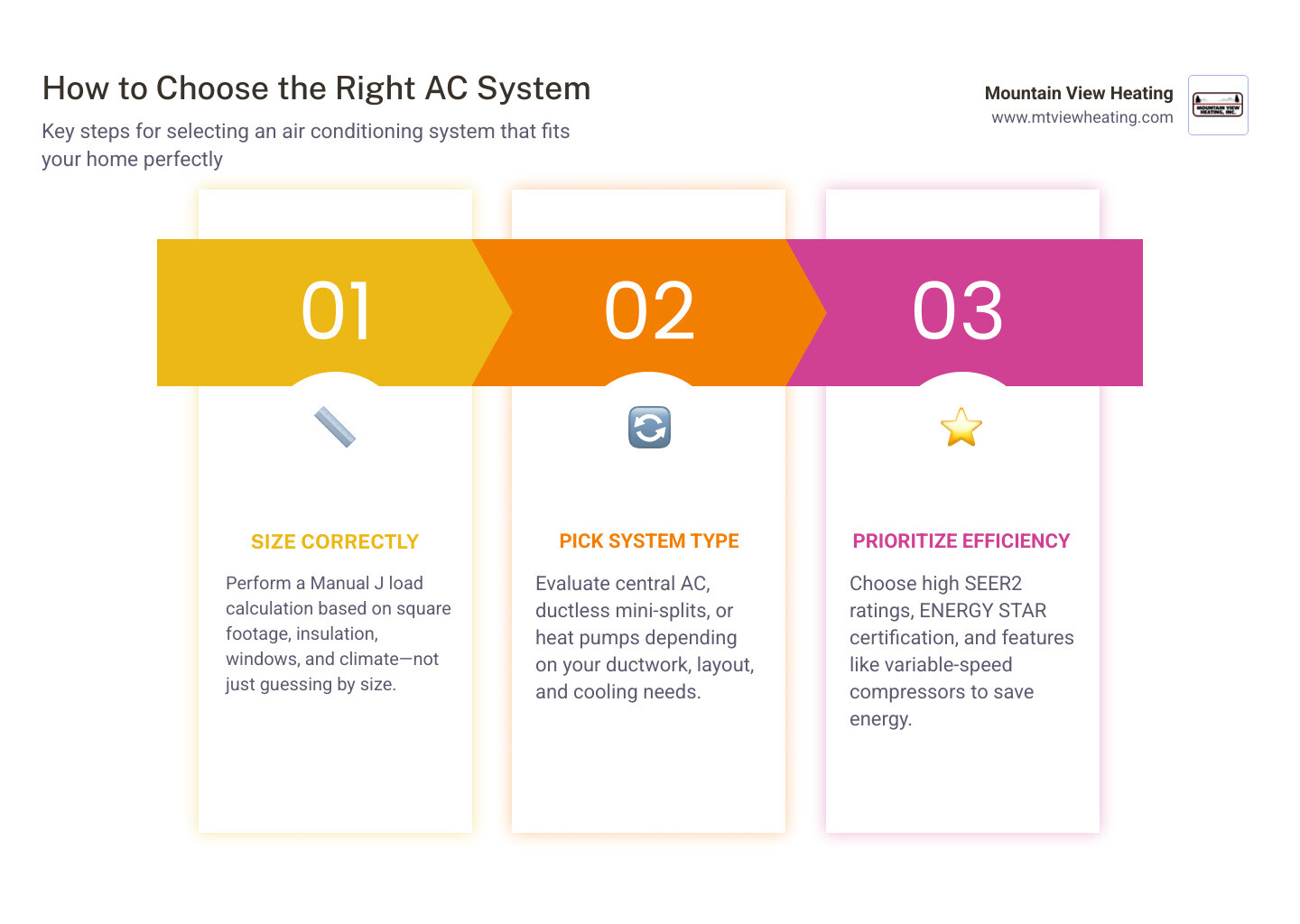
Knowing how to choose the right ac system for your home comes down to a few key steps:
1. Determine your cooling needs - Consider your home's square footage, ceiling height, insulation, and window placement.
2. Choose the right system type - Central AC, ductless mini-split, or heat pump depending on your home's layout and ductwork.
3. Get properly sized - Have a professional perform a Manual J load calculation rather than guessing by square footage alone.
4. Check efficiency ratings - Look for a high SEER2 rating and ENERGY STAR certification to keep energy bills in check.
5. Match your climate - In Central Oregon's high desert, dry air and big temperature swings affect which system performs best.
6. Plan for maintenance - Factor in filter changes, annual tune-ups, and a realistic system lifespan of 10 to 15 years.
7. Work with a local pro - A trusted HVAC contractor familiar with your area will help you avoid costly sizing mistakes.
Summer in Bend, Oregon can catch homeowners off guard. One week you're enjoying cool mornings in the 40s, and the next you're dealing with mid-80s heat and relentless sunshine. With over 300 sunny days a year and a high desert climate that behaves unlike most of the country, choosing the right air conditioning system isn't as simple as picking the biggest unit on the shelf.
In fact, that's one of the most common and costly mistakes homeowners make. A unit that's too large will "short cycle" — turning on and off too quickly to properly remove humidity from the air — leaving your home feeling clammy and uncomfortable. A unit that's too small will run constantly and still struggle to keep up. Neither is good for your comfort or your energy bill.
The good news is that with the right information and a qualified local HVAC professional by your side, finding the perfect fit for your home is very achievable. This guide walks you through every factor that matters — from system types and efficiency ratings to sizing methods and climate-specific considerations for Central Oregon.
Why Proper Sizing and Manual J Calculations Matter

When it comes to air conditioning, many people believe that "bigger is better." In the HVAC world, that is a myth that can lead to years of frustration. Cooling capacity is measured in British Thermal Units (BTUs) or "tonnage" (one ton equals 12,000 BTUs per hour). If you install a 5-ton unit in a home that only requires 3 tons, you will experience "short cycling." This is when the unit turns on, blasts the house with cold air, and shuts off before it can complete a full cooling cycle.
Short cycling is bad for several reasons. First, it wears out the compressor and other mechanical parts much faster because the most stressful part of an AC's life is the startup. Second, it fails at humidity control. Even in our dry high desert, some moisture removal is necessary for comfort. A short-cycling unit doesn't run long enough to pull moisture out, leaving you with a home that feels cold but damp. Conversely, an undersized unit will run 24/7, driving up your utility bills while never actually reaching your desired temperature. This is why AC Installation Bend OR requires a precise approach rather than a "rule of thumb" guess.
How to choose the right ac system for your home using Manual J
The industry standard for determining the exact size you need is called a Manual J load calculation. Unlike simple square footage estimates that might suggest 1 ton for every 500 square feet, a Manual J calculation is an exhaustive look at your home’s unique DNA.
When we perform a professional assessment for AC Installation Sisters OR, we look at:
• Insulation levels: How well do your walls and attic hold in the cold?
• Window orientation: South-facing windows in Redmond catch significantly more heat than north-facing ones.
• Air leakage: How "tight" is your home's construction?
• Occupancy: How many people live in the home and generate heat?
• Ceiling height: Vaulted ceilings increase the "volume" of air that needs cooling, even if the square footage remains the same.
A Manual J calculation ensures that the system we recommend is exactly the right "size" for your specific living space, maximizing both comfort and equipment longevity.
Comparing System Types: Central, Ductless, and Heat Pumps
Choosing the right hardware is the next step in the process. Depending on whether your home has existing ductwork or if you are looking to cool a specific addition, your options will vary.
• Central AC — Best For: Homes with existing ducts — Pros: Even, whole-home cooling — Cons: Requires ductwork; can lose efficiency if ducts leak
• Ductless Mini-Split — Best For: Homes without ducts or additions — Pros: Highly efficient; zoned control — Cons: Visible indoor units; higher upfront cost for multi-zones
• Air Source Heat Pump — Best For: Year-round heating & cooling — Pros: Extremely efficient; replaces both AC and furnace — Cons: Higher initial investment than a standalone AC
If your home already has a furnace and a network of vents, a central Air Conditioning system is often the most straightforward choice. However, we always recommend a ductwork integrity check. Statistics show that leaky ducts can waste 20% to 30% of your energy. For homes in Sunriver where properties might have unique layouts, AC Installation Sunriver OR often involves evaluating whether ductless options might be more effective.
Benefits of Ductless Mini-Splits and Heat Pumps
In April 2026, we are seeing more homeowners move toward ductless mini-splits and heat pumps. Ductless units are fantastic for "zoning," allowing you to cool the master bedroom to 68 degrees while leaving the guest room at 75. This saves a massive amount of energy because you aren't cooling empty rooms.
Heat pumps are particularly popular in Central Oregon. They provide dual functionality—acting as an air conditioner in the summer and a highly efficient heater in the winter. Because they move heat rather than creating it, they are often the most cost-effective way to maintain year-round comfort. If your old system is nearing the end of its life, AC Replacement Redmond OR with a heat pump can be a smart long-term financial move.
How to Choose the Right AC System for Your Home Based on Efficiency
Once you know the size and type, you need to look at the efficiency ratings. The primary metric here is the SEER2 (Seasonal Energy Efficiency Ratio 2). As of 2023, the testing standards became more rigorous to better reflect real-world conditions.
A higher SEER2 rating means the unit uses less electricity to produce the same amount of cooling. While a unit with a rating of 14 or 15 is the standard minimum, high-efficiency models can reach 20 or even 26. When considering What is a SEER Rating, while the upfront price for a high-SEER2 unit is higher, the monthly savings on your electric bill can pay for that difference over time.
Look for the ENERGY STAR label, which signifies the unit is at least 15% more efficient than standard models. Modern systems also feature variable-speed compressors. Unlike traditional units that are either "100% on" or "off," variable-speed units can run at 30% or 50% capacity to maintain a steady temperature. This results in much lower energy usage and a quieter home environment. For many AC Replacement Bend OR projects, these "smart" features are the biggest selling point for local residents.
Maximizing Efficiency with Modern Features
Beyond the compressor, you should look for:
• Inverter Technology: This allows the system to make tiny adjustments to its speed, preventing those annoying temperature swings.
• High-Efficiency Blower Motors: These move air more effectively while using less wattage.
• Smart Thermostat Compatibility: Integrating your AC with a smart thermostat can reduce cooling costs by about 10% by automatically adjusting the temp when you aren't home.
If you aren't sure if your current system is performing at peak efficiency, a professional AC Service Bend OR can help identify where you might be losing money.
Adapting to the Central Oregon High Desert Climate
Central Oregon is a unique place to live, and it presents unique challenges for HVAC systems. We live at a high altitude with very dry air. In places like Sunriver, the temperature can drop 40 degrees the moment the sun goes down.
When figuring out how to choose the right ac system for your home in this region, you have to account for the "sensible" vs "latent" load. In humid climates like Florida, the AC spends most of its energy removing water from the air. In Bend and Terrebonne, our air is already dry, so the system focuses almost entirely on lowering the temperature. This means your system needs to be rugged and capable of handling intense, direct sun exposure. If you find your system struggling during a heatwave, you might need AC Repair Sunriver OR to ensure the refrigerant levels are correct for our specific altitude.
How to choose the right ac system for your home for high desert living
Because our nights are so cool, some homeowners think they can get away without AC. However, with the increasing number of days reaching the 90s, a reliable system has become a necessity. For AC Terrebonne OR residents, we often recommend systems that have high durability ratings because of the dust and wind common in the high desert.
Additionally, because we have over 300 days of sun, your outdoor condenser unit will be baking. Proper placement—ideally on the north or east side of your home—can improve efficiency significantly. If your unit was installed in a "sun-trap," you may find yourself needing AC Repair Sisters OR more frequently due to heat-stressed components.
Maintenance and Knowing When to Replace Your Unit
Even the perfect AC system won't last forever. Most central air units have a lifespan of 10 to 15 years. In our environment, the dry air and dust can clog coils quickly, which is why annual professional maintenance is so critical.
A standard AC Tune-Up Bend OR should include:
• Cleaning the coils: Dust acts as an insulator, preventing the unit from releasing heat.
• Checking refrigerant levels: Too much or too little refrigerant will kill your efficiency and eventually your compressor.
• Inspecting the ignitor: While we are there for the AC, we often check the furnace components since they share the same blower motor. Modern furnaces use ignitors, and these require regular technician inspections to ensure they don't fail when the snow starts to fall.
• Clearing the condensate drain: Even in the desert, your AC produces water that needs to go somewhere.
Regular AC Maintenance Sisters OR can extend the life of your unit by several years and prevent 24% of the common problems that cause systems to stop working.
Signs It Is Time for an AC Replacement
How do you know when to stop repairing and start replacing? Here are the red flags:
1. Rising Utility Bills: If your bills are climbing but your habits haven't changed, your unit is losing its "muscle."
2. Frequent Repairs: If you've called for service more than twice in the last two years, you're likely throwing good money after bad.
3. Uneven Cooling: If the living room is a freezer but the bedroom is a sauna, your system is failing.
4. Age: If your unit is over 12 years old, it likely uses outdated refrigerant (R-22) which is becoming extremely expensive and difficult to find.
If you notice Reasons Your AC System May Be Blowing Out Warm Air, it might be a simple fix, but it could also be a sign of a terminal compressor failure. In those cases, AC Replacement Sisters OR is usually the most cost-effective path forward.
Frequently Asked Questions about Choosing an AC
What is the most efficient AC for a home in Bend?
For our climate, a variable-speed air source heat pump with a SEER2 rating of 18 or higher is generally considered the "gold standard." It handles our temperature swings beautifully and provides efficient heating in the winter, making it a year-round workhorse.
How do I know if my current AC is the wrong size?
If your AC turns on and off every 10 minutes (short cycling), it’s likely too large. If it runs all afternoon and the house never gets below 78 degrees, it’s likely too small. Both issues lead to high bills and uncomfortable rooms.
Should I choose a heat pump or a traditional AC?
In Central Oregon, a heat pump is almost always the better choice if you are replacing your entire system. The ability to use it for high-efficiency heating in the "shoulder seasons" (spring and fall) provides significant savings over a traditional furnace-and-AC combo.
Conclusion
Choosing the right AC system is one of the biggest investments you'll make in your home's comfort. By focusing on proper sizing through Manual J calculations, selecting the right system type for your ductwork, and prioritizing high SEER2 ratings, you can ensure your home remains a cool sanctuary even during the hottest August afternoons.
At Mountain View Heating, we’ve spent over 40 years helping our neighbors in Bend, Redmond, Sisters, and beyond find the perfect cooling solutions. We prioritize 100% customer satisfaction, whether we're performing a routine tune-up or a full system replacement. Our local expertise means we understand the high desert climate better than anyone else, and our 24/7 support ensures you're never left in the heat.
Ready to find the perfect fit for your place? Explore our Air Conditioning services today and let us help you stay cool for years to come.