



When August Winds Choke Your AC: The Hidden Culprit Behind Weak Airflow
Your air conditioner is running nonstop, but the vents are barely pushing out any cool air—a classic symptom that forces homeowners to confront the impact of dusty high desert winds on your blower motor. You walk over to a register, place your hand over the metal grate, and feel nothing more than a weak, room-temperature breeze. The thermostat is set to 70 degrees, the outdoor compressor is humming loudly, but your home is steadily growing warmer by the hour.
At Mountain View Heating, our technicians see this exact scenario play out every year during late-summer August windstorms across Central Oregon. Your HVAC system has just completed a long season of heavy use, running hard through June and July. Just when you need it to carry you through the final heat waves of the year, the airflow mysteriously drops off. Many homeowners assume the system is simply low on refrigerant or that the compressor is failing, but the truth is often hidden deep inside the indoor air handler.
The primary culprit is ultrafine dust. When high winds whip across the region, they carry microscopic particulate matter that infiltrates your home through tiny gaps in doors, windows, and ductwork. This isn't the standard household dust made of lint and pet dander. This is a highly abrasive, powdery substance that easily bypasses standard air filters.
Once this fine dust slips past your filtration defenses, it travels directly into the heart of your cooling equipment. Resolving this specific issue requires much more than just a routine filter change. To understand why your vents have stopped blowing air, you have to look at how this unique regional dust directly impacts the internal mechanical components responsible for moving air through your home.
Why Central Oregon's Powdery Dust Bypasses Standard Filters
The environment in the Bend, OR high desert presents a unique challenge for heating and cooling equipment. To understand why your system is struggling, you have to look at the geological nature of the dust itself. Unlike the heavier, organic soil dust found in other parts of the country, Central Oregon is covered in fine, volcanic pumice dust. This material is incredibly light, highly abrasive, and easily lifted into the atmosphere.
During late-summer wind events, this ultrafine particulate matter—often classified as PM2.5 because the particles are smaller than 2.5 microns in diameter—remains airborne for extended periods. Because it is so light, it easily finds its way inside your living spaces, severely degrading your indoor air quality and putting a massive strain on your equipment.
The Filtration Failure Point
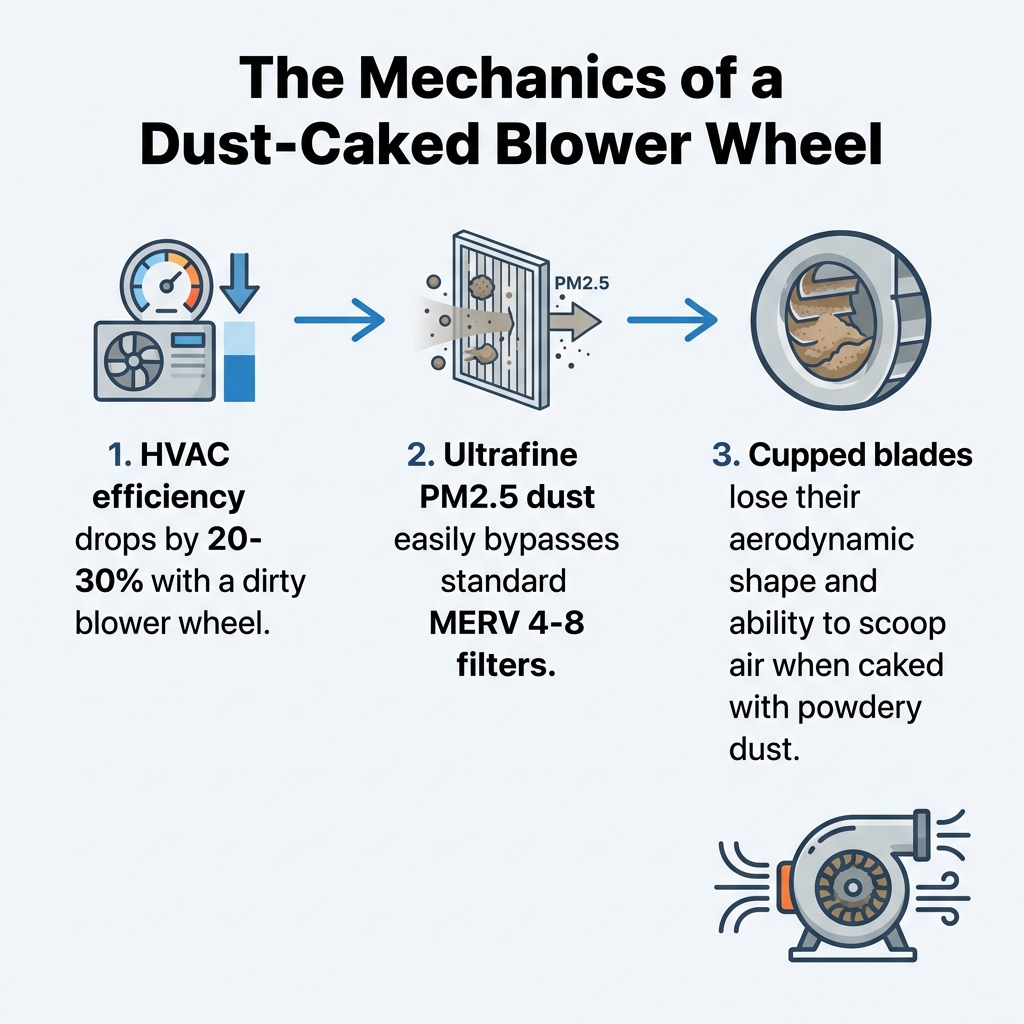
Most homes are equipped with standard fiberglass or pleated filters rated between MERV 4 and MERV 8. These filters are designed to catch large debris like pet hair, carpet fibers, and larger pollen particles to protect the equipment. However, when faced with ultrafine volcanic dust, a standard MERV 8 filter acts like a chain-link fence trying to stop dry sand.
During high-wind events, the powdery dust simply flows right through the porous filter material. Once it bypasses the filter, it enters the return duct and travels directly into the air handler. The first major mechanical component it encounters is the blower assembly.
• Composition — Standard Household Dust: Skin cells, pet dander, fabric fibers — High Desert Pumice Dust: Volcanic ash, ultrafine silica, pumice
• Weight — Standard Household Dust: Heavier, settles quickly on surfaces — High Desert Pumice Dust: Extremely light, remains airborne longer
• Texture — Standard Household Dust: Soft, clumps together easily — High Desert Pumice Dust: Abrasive, powdery, acts like fine sandpaper
• Filter Bypass Risk — Standard Household Dust: Low (easily caught by MERV 8 filters) — High Desert Pumice Dust: High (requires advanced PM2.5 filtration)
Because this dust is so fine, it doesn't just pass through the system and blow out the vents. The moisture present inside the air handler—created by the cold evaporator coil—causes the dust to stick to the first surface it touches. Unfortunately, that surface is usually the rapidly spinning blades of the blower wheel.
Inside the Squirrel-Cage: The Aerodynamics of a Blower Wheel
To fully grasp how dust destroys your airflow, you need a basic understanding of how a blower motor actually works. If you open up your indoor air handler, you won't find a standard fan with flat blades like the one sitting on your desk. Instead, you will find a cylindrical component known in the industry as a "squirrel-cage" blower wheel.
This wheel looks exactly like an exercise wheel for a hamster, but it is lined with dozens of small, tightly spaced, cupped blades. The physics of this design are highly specific. As the motor spins the wheel at high speeds, these cupped blades act like tiny shovels. They scoop the air from the return duct, pressurize it inside the housing, and propel it forcefully through your ductwork and out of your vents.
The precision of the blade design: The efficiency of this process relies entirely on precise aerodynamics. Each blade is curved at an exact angle to maximize air-scooping capability. Furthermore, the entire wheel is meticulously weight-balanced at the factory. Even a fraction of an ounce of uneven weight can throw the wheel off-balance, causing it to wobble at high speeds.
Because the Bend, OR high desert environment is so tough on mechanical equipment, our technicians at Mountain View Heating frequently educate homeowners on these specific vulnerabilities. We see how hidden mechanical issues strain systems, especially as families transition back to school in late summer. For example, during a recent August windstorm, our team responded to a home where the AC was running non-stop but producing zero airflow. Our technician quickly identified that the blower wheel was completely packed with pumice dust. It takes that level of precise, hands-on diagnostic skill to spot a failing blower motor before it burns out. When the precise shape and weight of the squirrel-cage blades are altered by environmental factors, the system's air-moving capabilities are drastically reduced.

How Fine Dust Destroys Your System's Airflow Physics
When late-summer August windstorms push ultrafine dust past your filter, that dust collides with the rapidly spinning blower wheel. Because the air inside the handler is often humid from the cooling process, the powdery dust acts like a paste, caking onto the cupped blades. This initiates a cascading series of mechanical failures.
First, the caked dust fills in the curve of the blades. The cupped shape that was designed to scoop air becomes flat and blunt. Instead of grabbing the air and pushing it forward, the blades simply slap at the air, creating turbulence rather than forward pressure. The wheel continues to spin at full speed, but it moves a fraction of the air it was designed to handle. This is how dirty air filters destroy your system's performance—by allowing the internal components to lose their aerodynamic efficiency.
The Mechanical Chain Reaction
1. Aerodynamic failure: The flattened, dust-filled blades lose their ability to scoop air, resulting in a severe drop in airflow at the vents.
2. Weight imbalance: The dust does not cake evenly. One side of the wheel becomes heavier than the other, causing a high-speed wobble that wears out the motor bearings.
3. Motor over-amping: The added weight of the dirt makes the wheel heavier to turn. The motor has to draw more electrical current (over-amping) just to maintain its normal speed.
4. Heat buildup: Drawing excessive electrical current causes the motor to run incredibly hot, eventually leading to thermal overload and complete motor failure.
The U.S. Department of Energy (DOE) notes that a dirty blower wheel can reduce overall HVAC efficiency by up to 20-30%. Your system is forced to run longer cycles to meet the thermostat's demands, consuming significantly more electricity while providing far less comfort.
Why Changing Your Air Filter Won't Fix a Caked Blower Motor
When airflow drops, the first instinct for most homeowners is to check the air filter. You might pull out a filter that is completely choked with dirt, replace it with a brand new one, and expect the airflow to instantly return to normal. When the vents continue to barely trickle air, panic often sets in.
Here is the reality of the situation: a new filter only prevents future dust infiltration. It does absolutely nothing to remove the heavy layer of dust that has already bypassed the old filter and baked onto the internal blower blades. Once the motor is caked, the damage to the system's aerodynamics is already done.
If you live in the Bend, OR high desert and notice these symptoms, swapping the filter is no longer enough:
• Constant running: The system runs for hours without ever reaching the temperature set on the thermostat.
• Elevated energy consumption: The motor is over-amping and drawing excessive electricity to fight through the weight of the dust.
• Weak register pressure: You can hear the system running loudly, but almost no air is coming out of the vents.
• Strange vibrations: A low humming or vibrating noise indicates the blower wheel is out of balance and shaking inside its housing.
A warning on overheating: Allowing the system to continue running in this state is highly risky. The motor is straining against added weight and poor airflow. Without enough air moving over the motor to cool it down, it will eventually overheat and burn out, turning a cleaning job into a major component replacement. Furthermore, cleaning a blower wheel is never a DIY task. It requires completely dismantling the blower assembly, safely removing the electrical connections, and carefully rebalancing the wheel after cleaning.
Deep Cleaning and Upgraded Filtration for High Desert Homes
Fixing a caked blower motor requires professional intervention. The process begins with safely shutting down the system and dismantling the blower assembly. A technician must carefully pull the squirrel-cage wheel out of the housing to perform a specialized cleaning. Using specific brushes and compressed air, the technician removes the baked-on dust from every individual cupped blade, restoring the wheel's aerodynamic shape without throwing off its delicate factory balance.
Just as importantly, the technician will inspect the motor itself for heat damage caused by over-amping. They will check the electrical draw, test the capacitor, and ensure the bearings haven't been ground down by the wheel's high-speed wobble. Catching these issues early is crucial for long-term reliability.
At Mountain View Heating, we know how important reliable, ongoing service is when dealing with complex system maintenance. Our team has spent decades helping Bend residents navigate the unique challenges of high desert cooling. We frequently see systems that have run hard all summer finally wave the white flag in August due to dust accumulation. Building trust with our customers means ensuring your equipment is thoroughly protected against these late-summer elements, providing the exact level of thorough maintenance you need to keep your home comfortable.
To prevent the issue from recurring during the next round of late-summer August windstorms, you must upgrade your filtration strategy. Standard 1-inch filters are simply not enough for this climate. Upgrading to a deeper media cabinet that can accommodate MERV 11 to MERV 13 filters, or installing dedicated whole-home air purifiers designed to capture ultrafine PM2.5 particulate matter, is the best way to protect your equipment. Scheduling an end-of-season inspection is the smartest way to catch hidden dust accumulation before it causes a total system failure, requiring extensive furnace repair in Bend when the weather turns cold.
Frequently Asked Questions About Blower Motors and High Desert Dust
Why is my AC barely blowing air in late summer?
Months of heavy operation combined with late-season windstorms often result in a dust-caked blower wheel that can no longer push air effectively. The fine dust flattens the cupped blades of the wheel, destroying its ability to scoop and propel air. Even though the motor is spinning at full speed, the aerodynamic failure prevents the air from reaching your vents.
How does dust damage an HVAC blower motor?
Dust adds significant weight to the blower wheel, throwing it out of balance and causing it to wobble at high speeds. This wobble grinds down the motor bearings over time. Furthermore, the added weight forces the motor to work harder and over-amp, which generates excessive heat and can eventually cause the motor to burn out entirely.
Why didn't changing my air filter fix my airflow?
A new filter stops new dust from entering the system, but it cannot clean the dust that has already bypassed the old filter and baked onto the internal blower blades. Once the wheel is caked with dirt, its aerodynamic shape is ruined. The only way to restore airflow is to have a professional dismantle and manually clean the blower assembly.
What does a dirty blower wheel sound like?
A dirty blower wheel often produces a louder-than-normal humming noise because the motor is straining against the added weight of the dirt. If the dust has caused the wheel to become significantly out of balance, you may also hear a distinct vibrating or rattling sound coming from the indoor air handler as the wheel shakes inside its housing.
Can a dirty blower motor cause my AC coils to freeze?
Yes, a dirty blower motor is a leading cause of frozen evaporator coils. When the blower cannot push enough warm house air over the cold coils, the condensation on the coils drops below freezing. This causes ice to form, completely blocking the system and forcing you to shut the AC off until the ice melts.
Restore Your System's Airflow with Expert Local Care
Understanding the blower wheel caking phenomenon is the key to solving mysterious, sudden drops in airflow during late-summer August windstorms. When the fine dust of the high desert bypasses your filter, it alters the fundamental physics of your equipment, causing the system to strain, over-amp, and underperform.
The good news is that a professional deep clean of the blower assembly can restore up to 30% of your lost efficiency, bringing strong, cold airflow back to your vents. Don't let a struggling motor burn itself out. Schedule professional heating maintenance and a thorough inspection today to address the root cause of the dust infiltration, upgrade your filtration, and ensure your home stays comfortable no matter how hard the wind blows outside.