


Is Ducted or Ductless Cooling Right for Your Bend, Oregon Home?
Ductless vs ducted cooling pros and cons come down to a few key factors: your home's existing ductwork, how many rooms you need to cool, and how much control you want over your comfort.
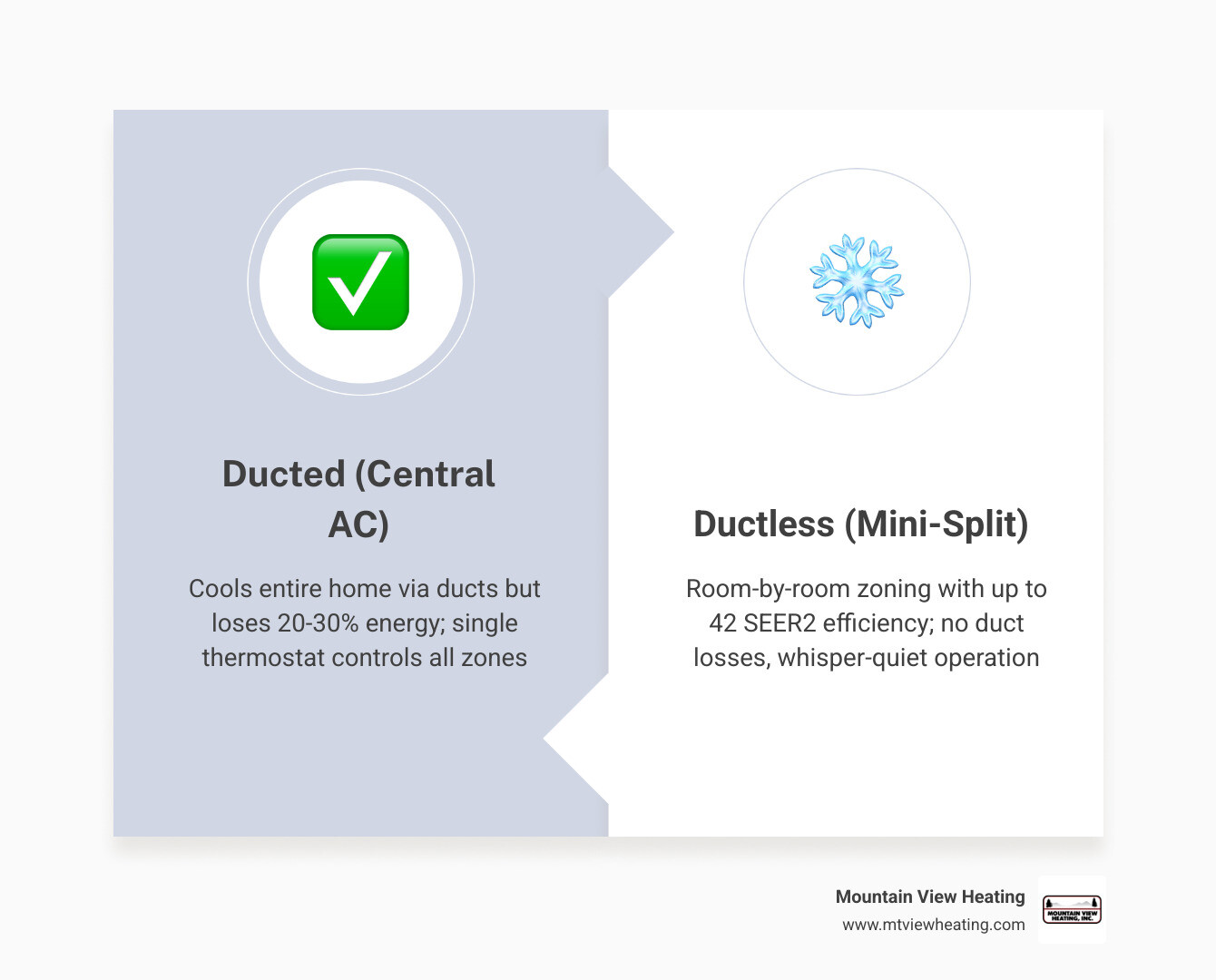
• Efficiency — Ducted (Central AC): SEER2 up to 26; loses 20–30% through ducts — Ductless (Mini-Split): SEER2 up to 42; no duct loss
• Installation — Ducted (Central AC): Easier if ducts exist; invasive without them — Ductless (Mini-Split): Minimal — small wall opening only
• Zoning — Ducted (Central AC): Whole-home, single thermostat — Ductless (Mini-Split): Room-by-room independent control
• Noise — Ducted (Central AC): Quiet at vents — Ductless (Mini-Split): Whisper-quiet (19–26 dB indoors)
• Maintenance — Ducted (Central AC): Filter change every 1–3 months + duct cleaning — Ductless (Mini-Split): Filter rinse every 2–4 weeks per unit
• Best For — Ducted (Central AC): Larger homes with existing ductwork — Ductless (Mini-Split): Additions, older homes, rooms without ducts
Central Oregon summers are no joke. Bend's high desert climate swings from blazing July afternoons to cool evenings — and your cooling system needs to handle both without driving up your energy bill. Whether you're replacing an aging system, finishing a basement, or adding a room, choosing between ducted and ductless cooling is one of the biggest decisions you'll make for your home's comfort.
The right answer isn't the same for every homeowner. A family in a 1970s ranch home without ductwork faces a completely different situation than someone upgrading an existing forced-air system in a newer build. Both systems use the same basic refrigeration cycle — moving heat out of your home using refrigerant — but they deliver that comfort in very different ways, with real differences in efficiency, performance, noise, and flexibility.
This guide breaks down what you actually need to know, without the sales pitch.
Understanding the Basics of Ductless vs Ducted Cooling Pros and Cons
When we talk about home cooling, we generally look at two different philosophies of comfort: whole-home uniformity and zonal precision. Both systems rely on the same fundamental physics to keep you cool, but their delivery methods couldn't be more different.
Central air conditioning is a "forced air" system. It uses a single, powerful indoor unit (often an air handler or part of your furnace) to push cooled air through a network of hidden metal or flexible tubes called ducts. This air enters your rooms through vents in the floor, walls, or ceiling. It’s designed to keep the entire house at one consistent temperature, managed by a single thermostat.
On the other hand, Ductless Mini-Split Systems Explained reveals a more localized approach. Instead of one big unit pushing air through the whole house, a ductless system uses individual indoor air handlers mounted directly in the rooms you want to cool. These units are connected to an outdoor compressor by small, flexible refrigerant lines that only require a tiny three-inch hole in your wall.
How Ducted and Ductless Heat Pumps Work
Both systems are often "heat pumps," which is a bit of a misnomer because they are world-class at cooling. A heat pump doesn't actually "create" cold air; it uses electricity to move heat from one place to another. In the summer, it pulls heat out of your living room and dumps it outside.
In a ducted system, the outdoor compressor works with an indoor evaporator coil tucked inside your ductwork. If your home uses a furnace for heat, this is where the cooling components "piggyback" on the existing fan. Modern furnaces in our region utilize electronic ignitors, ensuring reliable operation when the seasons shift.
Ductless Mini Splits work similarly but skip the middleman (the ducts). The refrigerant travels directly to the indoor head in your bedroom or kitchen. The fan inside that head pulls warm air over the cold coils and blows the chilled air right back into the room. This direct delivery is why many people find them so effective for "hot spots" that central air just can't seem to reach.
Energy Efficiency and Performance in the High Desert
In Central Oregon, we deal with intense sun and dry heat. Efficiency isn't just a buzzword; it’s the key to maintaining a comfortable home environment. The primary way we measure this is through SEER2 (Seasonal Energy Efficiency Ratio 2) ratings. As of April 2026, efficiency standards have become even more stringent, making it easier for homeowners to identify high-performing equipment.
One of the biggest 3 Ways a Ductless Mini-Split System Can Save You Money is by eliminating the "thermal bypass" common in older homes. In a ducted system, your cooled air has to travel through attics or crawlspaces that might be 120 degrees in the middle of a Bend summer. If those ducts aren't perfectly sealed and insulated, you lose a massive amount of cooling before it ever hits your living room.
How Ductless vs Ducted Cooling Pros and Cons Impact Energy Efficiency
The numbers are eye-opening: typical duct systems lose 20% to 30% of their cooling energy through leaks, holes, and poor connections. That is a significant loss of cooling capacity before the air reaches its destination. Ductless systems deliver 100% of the conditioned air directly into the room, instantly bypassing this waste.
Furthermore, ductless systems almost exclusively use inverter technology. Think of a standard central AC like a light switch—it’s either 100% on or 100% off. This leads to "temperature swings" where the room gets too cold, the unit shuts off, and then it gets too warm before it kicks back on. Inverter technology works like a dimmer switch. It allows the compressor to ramp up or down to maintain a perfectly steady temperature.
This is why many homeowners ask, "Do Ductless Mini-Splits Use a Lot of Electricity?" The answer is usually no. Because they don't have to restart from zero constantly and don't lose air through leaky ducts, they are often 30% to 40% more efficient than older central units. High-end mini-splits can reach SEER2 ratings of 38 to 42, while even the best central systems usually top out around 26.
Comfort, Control, and Aesthetic Considerations

Beyond the numbers, there is the "feel" of the system. Central air is invisible; you don't see anything but the vents. This is a major plus for homeowners who prefer a minimalist look or have historic homes where they don't want to see modern equipment on the walls.
However, ductless systems have made huge strides in design. While the classic wall-mounted "head" is most common, there are also ceiling cassettes that sit flush with the ceiling and floor-mounted units that look much like a traditional radiator.
Noise is another area where the ductless vs ducted cooling pros and cons are distinct. Central AC is generally quiet inside the home, though you can often hear the "whoosh" of air through the vents or the hum of the unit in the basement. Ductless indoor units are whisper-quiet, often operating between 19 and 26 decibels. To put that in perspective, a quiet library is about 40 decibels. You might literally forget the unit is running.
Ductless vs Ducted Cooling Pros and Cons for Zoned Comfort
The true "superpower" of the ductless system is zoning. This is the ability to set the temperature in your home office to 68 degrees while the guest bedroom stays at 74. If you have a room that always stays hot—like a sunroom or a bedroom over the garage—a mini-split can solve that problem without freezing out the rest of the family.
Central systems struggle with this. Even with the best Air Distribution design, a single thermostat usually dictates the temperature for the whole house. If that thermostat is in a cool hallway, your upstairs bedrooms might remain sweltering. While you can add dampers and zones to a central system, it is often a complex and expensive retrofit compared to the "built-in" zoning of a mini-split.
For a deeper dive into these differences, check out our Central AC vs Ductless Mini-Split Comparison.
Maintenance and Indoor Air Quality Requirements
Maintaining your system is the only way to ensure it reaches its full lifespan—which is typically 15 to 20 years for central AC and up to 20 to 30 years for high-quality ductless systems.
Maintenance for central systems is relatively simple for the homeowner: change your filters every 1 to 3 months. However, the "hidden" part of the system—the ducts—can collect dust, pet dander, and even mold over time. This is why professional duct cleaning is a vital part of indoor air quality for ducted homes. If you live in Ductwork Bend OR, you know how much high-desert dust can find its way into every nook and cranny.
Ductless units require a different rhythm. Because the units are smaller and more localized, their filters are smaller too. You’ll need to pop the cover and rinse the reusable mesh filters every 2 to 4 weeks. It only takes a few minutes, but if you forget, the unit’s efficiency will drop quickly. On the plus side, because there are no ducts, there is nowhere for dust and allergens to hide and recirculate, which many allergy sufferers find to be a major benefit.
Regardless of the system, we always recommend an annual professional inspection. We check refrigerant levels, clean the outdoor coils, and ensure all electrical connections are tight to prevent mid-summer breakdowns.
Choosing the Best System for Your Central Oregon Home
So, which one should you choose? There is no "wrong" answer, only the one that fits your house and your lifestyle.
A Ducted System is usually the best choice if:
• Your home already has ductwork in good condition.
• You prefer "invisible" cooling where only the vents are seen.
• You want a simple, "set it and forget it" whole-home temperature.
• You already have the infrastructure for a central unit.
A Ductless Mini-Split is usually the best choice if:
• You have an older home (common in downtown Bend or Sisters) that never had ducts.
• You’ve added a room, finished a basement, or converted a garage.
• You have "problem rooms" that are always too hot or too cold.
• You want the absolute highest energy efficiency possible to lower your bills.
• You live in a multi-generational home where everyone wants a different temperature.
For those in older residences, our guide on Central Air vs Mini-Split for Older Homes offers specific advice on preserving your home's character while staying cool.
Frequently Asked Questions about Cooling Systems
Can I combine ducted and ductless systems in one home?Absolutely! This is a "hybrid" approach that we see more and more in Redmond and La Pine. Many homeowners keep their central system for the main living areas but add a single-zone mini-split to a primary bedroom for better sleep or to a home office that gets too much afternoon sun.
How long do these cooling systems typically last?Central AC systems generally last 15 to 20 years. Ductless mini-split systems often last longer—20 to 30 years—partly because the inverter technology reduces the "wear and tear" of constant on/off cycling.
Do these systems provide efficient heating in cold climates?Yes. Modern heat pumps are incredibly capable. Many ductless units are now rated to provide full heating capacity even when the temperature drops to -22°F. In Central Oregon, they are an excellent, efficient way to stay warm in the winter and cool in the summer.
Conclusion
At Mountain View Heating, we’ve spent over 40 years helping our neighbors in Bend, Redmond, Sisters, La Pine, Sunriver, and Terrebonne find the perfect balance of comfort and efficiency. We know that every home is unique, and we prioritize 100% customer satisfaction in every recommendation we make.
Whether you are leaning toward the whole-home simplicity of central air or the high-tech precision of a mini-split, we are here to help you navigate the ductless vs ducted cooling pros and cons. From fast residential repairs to full system replacements, our team is ready to ensure your home remains a sanctuary from the high desert heat.
Ready to explore your options? Discover Some Benefits of Setting Up a Ductless Mini-Split System or visit our mini-splits service page to learn more. Let's get your home ready for summer!