


Why Knowing the Signs Your Heat Pump Needs Professional Attention Can Save You From a Costly Breakdown
The most common signs your heat pump needs professional attention include:
- Strange noises — grinding, squealing, or rattling during operation
- Short cycling — the system turns on and off too frequently
- Uneven temperatures — some rooms are too hot or too cold
- Rising energy bills — a sudden spike with no change in usage
- Ice buildup — frost or ice forming on the outdoor unit
- Weak airflow — reduced output from vents throughout the home
- System blowing the wrong temperature air — cool air in heating mode or warm air in cooling mode
If you're noticing any of these, it's time to call a professional before a small problem becomes a major repair.
Heat pumps work hard in Bend, Oregon. The high desert climate here means big temperature swings — cold winters, hot summers, and everything in between. Your heat pump runs year-round to keep up, and that constant demand puts real wear on the system over time.
Here's the problem most homeowners run into: heat pump issues rarely appear all at once. They creep in slowly — a slightly higher energy bill here, a noise you didn't notice before there. By the time something seems seriously wrong, the damage is often already done. Research consistently shows that systems without regular attention fail years earlier than those that get timely care, and repair bills grow fast when early warning signs go ignored.
If your system has been acting up lately, the sections below will walk you through exactly what to look for and what to do about it.
Simple signs your heat pump needs professional attention glossary:
- common heat pump problems and how to prevent them
- heat pump maintenance tips for homeowners
- how often should you service your heat pump
Key Signs Your Heat Pump Needs Professional Attention
It is easy to take a heat pump for granted when it is working perfectly. It sits outside in the elements, quietly keeping your home cozy during a freezing Sisters night or cool during a hot Redmond afternoon. However, because a heat pump operates as both a heating and cooling system, it experiences twice the annual run-time of standard single-season HVAC systems. This constant mechanical work inevitably leads to wear and tear.
One of the most immediate indicators of a struggling system is a sudden, unexplained spike in your monthly utility bills. When internal components begin to wear down, the system has to work much harder to achieve the temperature set on your thermostat. This extra effort translates directly to increased electricity consumption. If your utility bill climbs by 15% to 20% compared to the same period in previous years—and the local weather hasn't been unusually extreme—your heat pump is likely crying out for help.
Ignoring these early warning signs is a risky gamble. A heat pump operating with a minor mechanical fault will continue to degrade, putting extra strain on other parts. For example, a failing blower motor can cause the entire system to overheat, potentially damaging the expensive compressor. Addressing issues early is the key to protecting your investment. If you suspect your system is struggling, check out our Heat Pump Repair Bend OR Complete Guide to understand how professional diagnostics can get your system back on track.
Strange Noises That Are Signs Your Heat Pump Needs Professional Attention
While no HVAC system is completely silent, modern heat pumps are designed to run relatively quietly. You should expect a gentle hum and the soft rush of air through your vents. What you should not hear are sudden, loud, or persistent mechanical noises.
If your heat pump begins making unusual sounds, it is usually a sign that a specific component is failing:
- Grinding or Screeching: This often points to dry or worn-out bearings in the blower motor or the outdoor fan. Without proper lubrication or replacement, the motor can seize entirely, shutting down your system.
- Rattling or Clanging: These sounds typically indicate loose components. A panel screw might have vibrated loose, or a fan blade could be striking a piece of debris. In worse cases, it can mean a internal part of the compressor has detached.
- Hissing or Bubbling: This classic sound usually signals a refrigerant leak. As the pressurized gas escapes through a small crack in the coils, it makes a distinct hissing noise.
To learn more about what these sounds mean and how they are diagnosed, read through our Best Heat Pump Repair Bend OR Guide.
Short Cycling and Other Signs Your Heat Pump Needs Professional Attention
Have you noticed your heat pump turning on, running for just a few minutes, shutting off, and then repeating the process all over again? This behavior is known as short cycling.
A normal heating or cooling cycle should last anywhere from 10 to 20 minutes, allowing the system to distribute air evenly throughout your home. Short cycling is a serious concern because the startup phase of any motor requires the most electrical current. When your system starts up dozens of times an hour, it places immense strain on the compressor and fan motors, accelerating wear and driving up your energy bills.
Short cycling can be caused by a variety of issues, ranging from a simple clogged air filter to a malfunctioning thermostat, low refrigerant levels, or even an oversized system. Because the root cause can be complex, it requires a trained eye to diagnose safely. If your system is rapidly cycling and your home comfort is suffering, our Emergency Heat Pump Service Bend OR Guide offers quick insights on when to call in the pros to prevent a total system breakdown.
Uneven Temperatures and Weak Airflow
When a heat pump is operating at peak performance, it should deliver consistent, balanced comfort to every room in your home. If you notice that your living room feels like a sauna while your back bedroom feels like a freezer, your system is struggling.
Uneven temperatures are often accompanied by weak airflow from your supply registers. If you hold your hand up to a vent and can barely feel the air moving, your blower motor may be failing, or there could be significant ductwork leaks. In our high desert region, ductwork can expand and contract with the temperature swings, occasionally causing joints to pull apart and dump conditioned air into your crawlspace or attic.
When a heat pump runs constantly but fails to reach the temperature set on the thermostat, it is a clear sign of system inefficiency. For a deep dive into why this happens and what it means for your home comfort, check out our article on Heat Pump Running But Not Heating or Cooling What It Means.
Underlying Causes of Heat Pump Inefficiency
Understanding why these symptoms occur can help you appreciate the importance of professional care. Most heat pump issues can be traced back to a handful of common physical and mechanical failures.
In places like Bend, La Pine, and Redmond, our beautiful high desert environment presents unique challenges for HVAC systems. We experience dry, dusty summers and high seasonal pollen counts. This fine dust and airborne debris quickly clog up your system's air filters.
When an air filter becomes heavily loaded with dust, it acts like a wall, severely restricting airflow. Without sufficient air flowing over the indoor evaporator coil, the system cannot transfer heat effectively. This simple restriction forces every single mechanical component in your heat pump to work twice as hard, leading to overheating, frozen coils, and premature part failures. For a detailed look at how to protect your system from these environmental factors, read our guide on Common Heat Pump Problems and How to Prevent Them.
Thermostat Malfunctions and Electrical Failures
Your thermostat is the brain of your heating and cooling system. If it is miscalibrated, has dead batteries, or has faulty internal wiring, it cannot communicate properly with your heat pump. This can cause the system to ignore temperature settings, run constantly, or refuse to turn on at all.
Inside the outdoor unit, there is also a complex web of electrical connections, contactors, and capacitors. Capacitors act like temporary batteries, providing the high-voltage boost needed to start the compressor and fan motors. Over time, heat, cold, and electrical surges wear these components down. A failed capacitor is one of the most common reasons a heat pump will suddenly stop running or make a humming sound without starting up.
Low Refrigerant and Frozen Coils
Your heat pump relies on a specialized chemical called refrigerant to move heat between the indoor and outdoor air. Unlike fuel in a car, refrigerant is not consumed by the system; it flows continuously through a closed loop of copper lines.
If a leak develops in these lines—often due to vibration or corrosion—refrigerant levels will drop. Low refrigerant reduces the system's ability to absorb or release heat. It also causes the pressure inside the system to drop, which can lead to the indoor or outdoor coils freezing over. If you see a thick block of ice forming on your coils during the summer or persistent ice that won't melt in the winter, you are likely dealing with a refrigerant leak or a failed defrost control board.
DIY Maintenance vs. Professional Servicing
Taking care of a heat pump requires a balance between proactive homeowner habits and trained professional expertise. While there are several tasks you can safely handle on your own, attempting complex mechanical repairs can be incredibly dangerous and may void your system's warranty.
| Maintenance Task | Homeowner DIY | Professional Technician |
|---|---|---|
| Inspect and replace air filters | Yes | Yes |
| Clear leaves, snow, and debris from outdoor unit | Yes | Yes |
| Ensure indoor supply and return vents are open | Yes | Yes |
| Clean outdoor condenser coils | No (Requires specialized care) | Yes |
| Check and test electrical connections | No (High voltage risk) | Yes |
| Measure and adjust refrigerant levels | No (EPA certification required) | Yes |
| Inspect and clear condensate drain lines | No (Internal access needed) | Yes |
| Calibrate thermostat and test system safety controls | No | Yes |
If you want to understand the full scope of what goes into keeping your system running smoothly year after year, take a look at our Heat Pump Service Bend OR Complete Guide.
Safe Homeowner Maintenance Tasks
The single most important task you can perform as a homeowner is regularly checking and replacing your air filters. In our dusty Central Oregon climate, we recommend checking your filter every 30 to 90 days. If you have pets or suffer from seasonal allergies, you may need to replace it more frequently.
Additionally, keep a close eye on the outdoor unit. Ensure there is at least a two-foot clearance around the entire perimeter. Gently sweep away dry leaves, pine needles, and weeds, and clear away snow accumulation during our winter storms. Make sure your indoor vents are completely unblocked by furniture or drapes to maintain proper system balance. For a step-by-step troubleshooting routine you can perform before calling a technician, refer to our Heat Pump Troubleshooting Guide 2026.
What Professional Servicing Includes
While DIY tasks keep the airflow moving, professional servicing addresses the deep mechanical health of your system. A certified technician has the specialized tools and training required to handle high-voltage electrical components and pressurized refrigerant safely. Under federal law (EPA Section 608), only certified professionals are permitted to handle and adjust refrigerant.
A comprehensive professional service visit includes:
- Testing all electrical connections, contactors, and capacitors for wear.
- Checking refrigerant levels and inspecting lines for potential leaks.
- Deep cleaning the indoor evaporator and outdoor condenser coils.
- Verifying correct airflow and testing the defrost cycle controls.
- Lubricating moving parts to reduce friction and wear.
We highly recommend scheduling these professional tune-ups twice a year: once in the spring before the summer heat hits, and once in the autumn before the winter freeze. To see a complete breakdown of what our technicians look for during a visit, read our Heat Pump Maintenance Complete Guide.
Repair vs. Replacement: Making the Right Choice for Your Home
When a heat pump begins to experience frequent breakdowns, every homeowner faces a tough question: Is it better to keep repairing the old system, or is it time to invest in a modern replacement?
Several factors influence this decision, including the age of your system, how often it breaks down, and how much your energy bills have climbed. While a well-maintained heat pump can last 15 to 20 years, systems that have skipped regular maintenance often begin to fail around the 10-to-12-year mark. If your heat pump is approaching its second decade of service and requires frequent repairs, replacing it with a new, high-efficiency model is often the more reliable and efficient choice in the long run.
Key Considerations for Aging Systems
To help make an objective decision, consider these guidelines:
- System Age: If your heat pump is under 10 years old, repairs are usually the best path forward. However, if it is past the 10-to-15-year mark, a replacement becomes more practical.
- Frequency of Repairs: A system that needs multiple service calls in a single season is signaling that its major components are reaching the end of their lifespan.
- Energy Efficiency: Older systems work harder and consume more energy. Upgrading to a modern, high-efficiency heat pump can significantly lower your monthly energy consumption.
Frequently Asked Questions About Heat Pump Troubleshooting
Why is my heat pump blowing cool air in heating mode?
If your heat pump is blowing cool air during the winter, start by checking your thermostat settings to ensure it hasn't been accidentally switched to "Cool" or "Fan Only" mode. If the settings are correct, the cool air could be due to the system entering its temporary defrost mode, which is completely normal.
However, if the cool air persists for more than 15 minutes, you may be dealing with a stuck reversing valve (the component that switches the system between heating and cooling), low refrigerant levels, or a malfunctioning outdoor sensor.
Is it normal for ice to form on my outdoor unit?
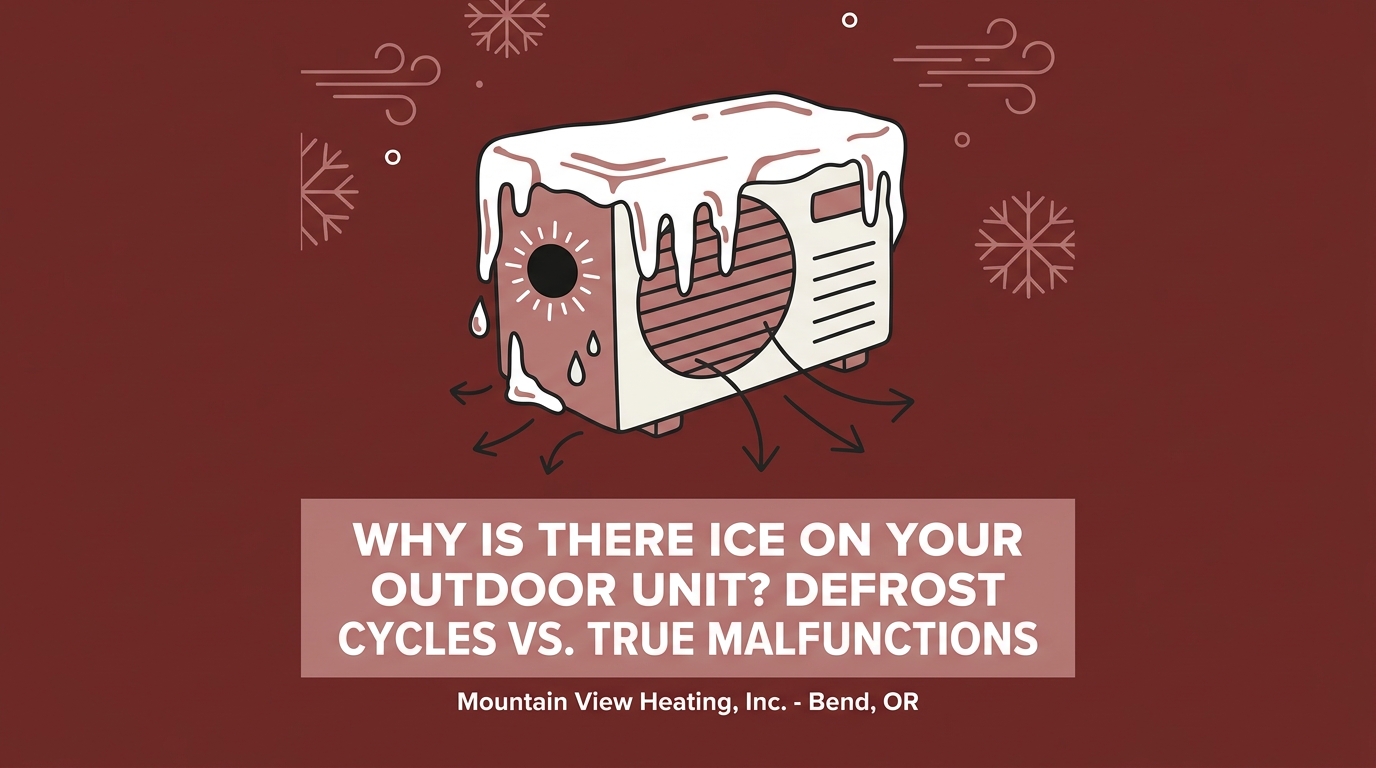
During cold, damp winter days in Sunriver or La Pine, it is completely normal for a thin layer of frost to form on the outdoor coils. Your heat pump is designed to automatically run a defrost cycle every 30 to 90 minutes to melt this frost away.
However, if the outdoor unit is covered in a thick, solid block of ice that does not melt, something is wrong. This is usually caused by restricted airflow (such as a clogged filter or debris blocking the unit), a failing defrost control board, or a refrigerant leak. Never attempt to chip ice off the unit with a shovel or sharp tool, as you can easily puncture the delicate copper coils.
How often should I change my heat pump's air filter?
In our high desert environment, we recommend checking your air filter once a month. For standard 1-inch pleated filters, a general rule of thumb is to replace them every 1 to 3 months. If you have pets, high dust levels in your home, or suffer from severe allergies, you will want to lean toward changing them every 30 days to keep your indoor air clean and your heat pump running efficiently.
Conclusion
Your heat pump is the unsung hero of your home comfort, working tirelessly through every season to keep your family safe and cozy. Recognizing the early warning signs of trouble—whether it's a strange grinding noise, a sudden spike in your energy bills, or uneven temperatures in your bedrooms—is the best way to prevent a stressful, middle-of-the-night system breakdown.
At Mountain View Heating, we have been serving homeowners across Bend, Redmond, Sisters, Sunriver, and the surrounding Central Oregon communities for over 40 years. We prioritize 100% customer satisfaction on every single job, big or small. Whether you need a quick seasonal tune-up, a complex repair, or a complete system upgrade, our experienced, friendly technicians are here to help. We also offer 24/7 emergency support to ensure you are never left out in the cold.
If your heat pump is showing signs of wear or isn't keeping up with the Central Oregon weather, don't wait for it to fail completely. Explore our professional Mountain View Heating Heat Pumps services and schedule your visit today to restore your home's comfort and peace of mind.