


What It Really Means When Your Heat Pump Is Running But Not Heating or Cooling
Understanding heat pump running but not heating or cooling what it means can save you from a cold night and an unnecessary panic call. Here is a quick summary of the most common reasons this happens:
| Cause | Heating Mode | Cooling Mode |
|---|---|---|
| Thermostat set to wrong mode | Yes | Yes |
| Fan set to "On" instead of "Auto" | Yes | Yes |
| Dirty air filter blocking airflow | Yes | Yes |
| Unit in defrost cycle (temporary) | Yes | No |
| Low refrigerant or leak | Yes | Yes |
| Stuck or failed reversing valve | Yes | Yes |
| Frozen or dirty coils | Yes | Yes |
| Tripped circuit breaker | Yes | Yes |
| Outdoor unit blocked by snow or debris | Yes | Yes |
| Aging or failing compressor | Yes | Yes |
Your heat pump can sound completely normal — fan spinning, outdoor unit humming — and still fail to move heat in or out of your home. That is the key thing to understand. The fan running does not mean the refrigerant cycle is working.
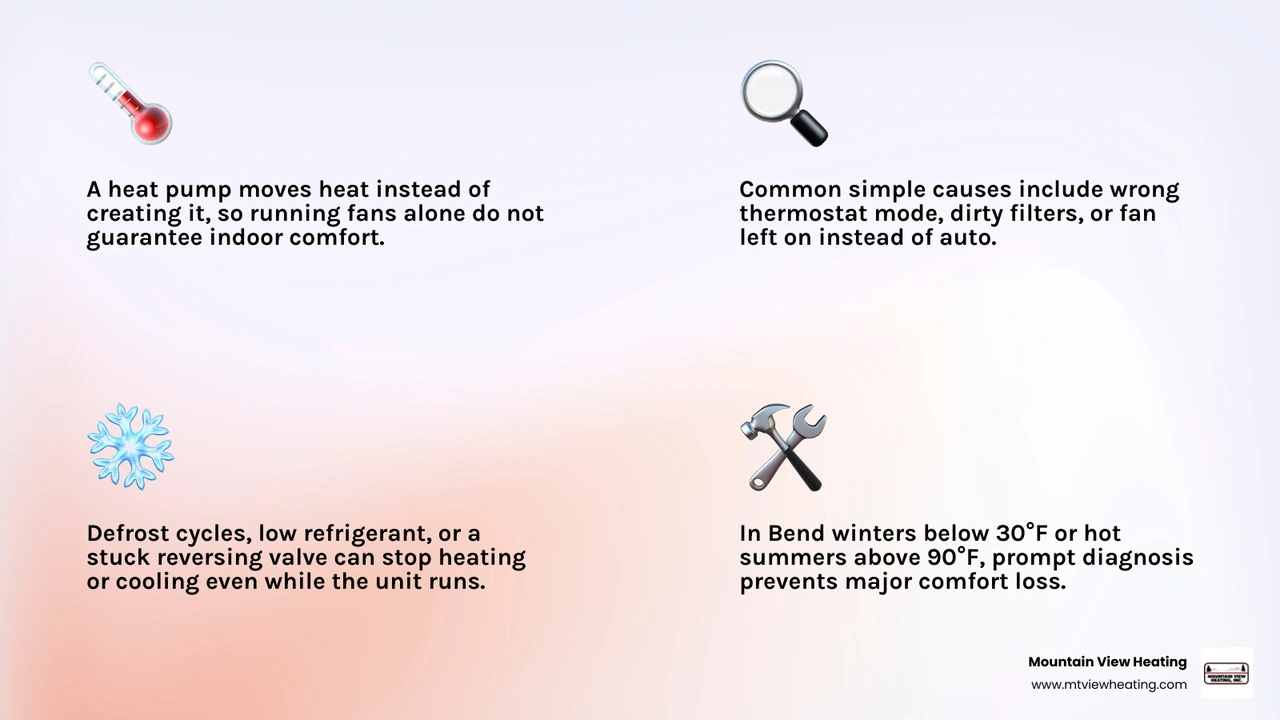
Here in Bend, Oregon, where winter temperatures regularly dip below 30°F and summer days can push past 90°F, a heat pump that runs without heating or cooling is more than an inconvenience. It is a real comfort problem that needs a clear diagnosis.
The good news is that many causes are simple to check yourself before picking up the phone. Others do require a professional — and knowing the difference saves time and money.
This guide walks you through both.
Introduction: What a Running Heat Pump Is Telling You
When a heat pump is running, it tells us one important thing: the system has at least some power and at least one part is trying to operate. But that does not guarantee actual heating or cooling is happening.
A heat pump works by moving heat, not creating it the way many homeowners expect from a furnace. In winter, it pulls heat from outdoor air and moves it indoors. In summer, it reverses that process and sends indoor heat outside. If airflow is weak, refrigerant is low, the thermostat is set wrong, or a key part fails, the unit may still run while comfort disappears.
For homeowners in Bend, Redmond, Sisters, Sunriver, La Pine, Terrebonne, Three Rivers, and nearby communities, that can show up as:
- Air blowing from vents but no temperature change
- Lukewarm air in heating mode
- Warm air in cooling mode
- Long run times with little comfort improvement
- Weak airflow from supply vents
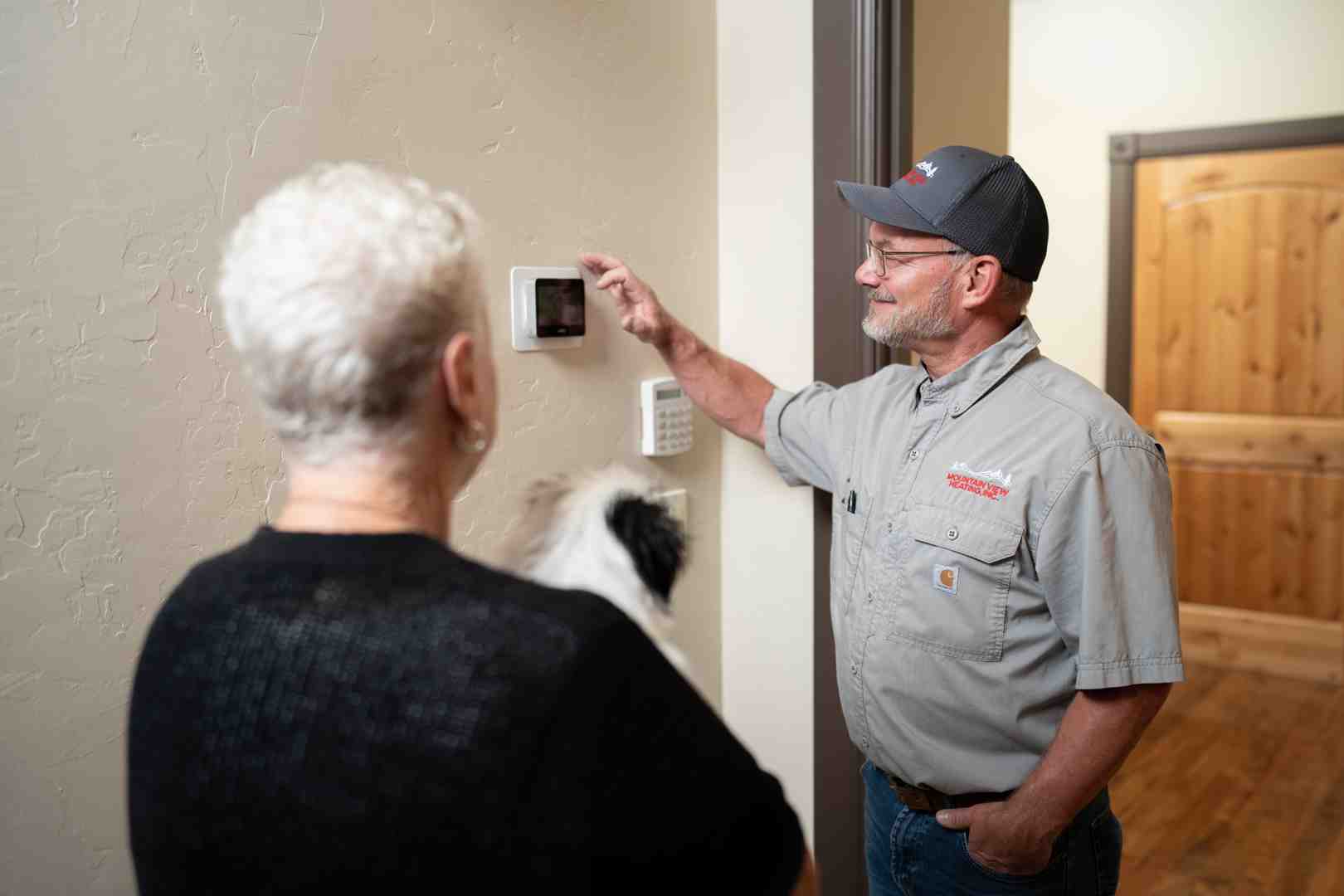
Why “running” does not always mean “working”
A heat pump has multiple parts that have to work together:
- The thermostat has to call for heating or cooling
- The indoor blower has to move air
- The outdoor unit has to run
- The refrigerant cycle has to transfer heat
- The reversing valve has to switch modes correctly
If only the blower fan is running, you may hear the system and feel airflow, but that air may not be conditioned. That is why a heat pump can appear active while doing very little besides circulating room-temperature air.
What homeowners should check before assuming a major repair
Before assuming the worst, we recommend checking the basics first:
- Thermostat mode and setpoint
- Fan setting
- Air filter condition
- Breaker panel
- Indoor power switch near the air handler
- Open supply and return vents
- Leaves, snow, or debris around the outdoor unit
Sometimes the problem is minor. Sometimes it is not. But these first checks help narrow things down fast.
Heat Pump Running But Not Heating Or Cooling What It Means
At the simplest level, heat pump running but not heating or cooling what it means is that the system has power, but something is stopping heat transfer. That “something” is usually one of these:
- Thermostat mismatch
- Airflow restriction
- Defrost cycle
- Low refrigerant
- Reversing valve problem
- Frozen coil
- Electrical issue
- Aging equipment
Heat pump running but not heating or cooling what it means in heat mode
In heating mode, the most common complaint is, “The system is on, but the air feels cool.”
That can mean a few different things:
- The air only feels cool because heat pumps usually deliver air around 85 to 95 degrees, which feels mild compared to furnace heat
- The fan is set to On, so it keeps blowing between heating cycles
- The unit is in a normal defrost cycle
- Auxiliary heat is not engaging when needed
- The system has low refrigerant
- The outdoor coil is frozen
- The reversing valve is stuck in the wrong position
If the home is still reaching the thermostat setting, the system may be operating normally. If it runs and runs without warming the house, there is likely a real issue.
Heat pump running but not heating or cooling what it means in cooling mode
In cooling mode, this problem usually shows up as:
- Warm or room-temperature air from vents
- Airflow with no cooling effect
- Long run times on hot days
- Indoor humidity staying high
Common causes include:
- Thermostat accidentally set to Heat or Fan Only
- Fan set to On instead of Auto
- Dirty filter reducing airflow
- Dirty outdoor coil
- Ice buildup on the indoor coil
- Refrigerant leak
- Compressor trouble
- Reversing valve stuck in heating position
If you want more cooling-specific troubleshooting, our guide on Why Is My AC Blowing Warm Air Troubleshooting Steps is a helpful next read.
When lukewarm air is normal and when it signals a problem
This is where a lot of homeowners get tripped up. Heat pumps usually supply air in roughly the 85 to 95 degree range. Your body temperature is 98.6 degrees, so that air can feel surprisingly mild on your hand.
That is normal if:
- The home temperature is rising
- The system reaches the thermostat setting
- Airflow is steady
- The unit is not making unusual noises
- There is no heavy ice buildup
It is more likely a problem if:
- The air feels truly cold for long periods
- Indoor temperature keeps dropping
- The system never reaches setpoint
- The outdoor unit is iced over
- Energy use suddenly climbs
- You notice only weak airflow
Start With the Simple Checks First
Before calling for service, we suggest starting with the homeowner-friendly checks below.
How thermostat settings and modes affect heat pump performance
Thermostat settings cause a surprising number of “broken heat pump” calls.
Check these first:
- Make sure the thermostat is set to Heat in winter or Cool in summer
- Set the temperature several degrees above or below room temperature to trigger a call
- Set the fan to Auto, not On
- If your thermostat uses batteries, replace them
- Review the schedule in case programming changed the mode or setpoint
- Look for Aux Heat or Emergency Heat indicators
Why this matters:
- Fan set to On can make the system blow unconditioned air between cycles
- Wrong mode means the system may be trying to do the opposite of what you want
- Programming errors can override your manual setting
- Emergency heat should be used only when the heat pump has actually failed, because it can use 2 to 3 times more electricity than normal heat pump operation
How a dirty air filter can stop heating or cooling
A dirty air filter is one of the most common and most fixable causes of poor performance.
Restricted airflow can lead to:
- Weak air from vents
- Reduced heating and cooling capacity
- Frozen indoor coil
- Strain on the blower motor
- Longer run times
- Poor comfort throughout the house
Most standard filters should be checked monthly and changed every 1 to 3 months, depending on the filter type, pets, dust levels, and seasonal use. If light barely passes through the filter, that is your clue.
For more maintenance tips, visit Heat Pump Maintenance Bend Or Tips.
Outdoor unit checks homeowners can safely make
Your outdoor unit needs breathing room. In Central Oregon, winter snow, drifting debris, and dusty shoulder seasons can all affect performance.
Safely check for:
- Leaves or branches blocking airflow
- Snow packed around the unit
- Ice buildup that does not clear
- Shrubs or weeds too close to the cabinet
- Dirty visible coil surfaces
- A disconnected outdoor shutoff or obvious power issue
A good rule is to keep about 2 feet of clearance around the unit. Do not chip away ice with tools, and do not force parts loose. Gentle cleanup around the cabinet is fine. Internal cleaning and repairs are not DIY jobs.
For a broader local service overview, see Heat Pump Service Bend Or Guide.
The Most Common Mechanical Causes Behind No Heat or No Cooling
If the simple checks do not solve it, the issue is often mechanical. These are the most common culprits we see in residential heat pumps.
Low refrigerant or a refrigerant leak
Refrigerant circulates in a sealed loop. It does not get “used up.” If the level is low, there is a leak.
Research consistently points to low refrigerant as a major cause of heat pump heating problems, with some sources estimating it contributes to up to 95% of heating failures. Whether the exact share in your case is high or low, the takeaway is the same: low charge is a serious issue.
Signs can include:
- Weak heating and weak cooling
- Ice on refrigerant lines or coils
- Longer run times
- Poor temperature control
- Hissing or bubbling sounds
- Rising energy use
Low refrigerant can also reduce capacity significantly and put extra strain on the compressor. This is a professional repair. The leak needs to be found and fixed before the system is recharged.
If you see icing, our article on Ice Forming on Your AC Unit Causes and What to Do can help explain what to watch for.
Reversing valve problems and failure to switch modes
The reversing valve is the part that lets a heat pump switch between heating and cooling.
If it sticks or fails:
- The system may cool in summer but not heat in winter
- It may blow warm air in cooling mode
- It may blow cold air in heat mode
- It may seem stuck in one mode no matter what the thermostat says
This is one of the classic reasons a heat pump “runs” but does the wrong job. Because the reversing valve directly controls refrigerant direction, diagnosing it correctly matters. Learn more in How Does a Heat Pump Work.
Frozen coils, dirty coils, and blocked airflow
Airflow and coil condition are tightly linked.
When air cannot move properly because of a dirty filter, blocked vents, matted dust on coils, or blower issues, the indoor coil can get too cold and freeze. That ice then blocks even more airflow, and the system performance drops further. It is one of those problems that snowballs. Sometimes literally.
Watch for:
- Little or no airflow from vents
- Ice on the indoor or outdoor unit
- Water around the indoor unit after thawing
- Cooling that fades over time
- Heat pump running constantly with poor results
Also check that:
- Supply vents are open and not blocked by furniture
- Return vents are clear
- Indoor doors are not restricting airflow too much
For more on freeze-ups, see Why Do Air Conditioners Freeze Up.
Defrost cycle: normal winter behavior vs a service issue
In cold weather, some frost on the outdoor coil is normal. To remove that frost, the heat pump periodically enters defrost mode.
During defrost, you may notice:
- Steam rising from the outdoor unit
- A temporary change in sound
- Short periods of cooler air indoors
- The outdoor fan stopping briefly on some systems
A normal defrost cycle usually lasts about 5 to 15 minutes. In cold, humid Bend-area weather, this can happen periodically and still be normal.
It becomes a service issue if:
- The unit seems stuck in defrost
- Defrost cycles happen constantly
- Thick ice never clears
- The home never warms back up afterward
- You see repeated icing on the whole cabinet, not just light frost on the coil
When the Problem Is Weather, System Age, or a Sign You Need Help
Not every performance issue means the system is broken beyond repair. Sometimes it is weather-related. Sometimes it is age. Sometimes it is your heat pump waving a big red flag and asking for help.
| Normal operation | Warning signs |
|---|---|
| Longer cycles during cold snaps | Runs nonstop and never changes room temperature |
| Mild supply air in heat mode | Truly cold air for extended periods |
| Brief cool air during defrost | Constant cold air in heat mode |
| Light frost that clears | Thick ice that stays put |
| More runtime below freezing | Breakers trip, smells, leaks, or loud noises |
Why a heat pump may struggle in colder Bend-area weather
Heat pumps lose capacity as outdoor temperatures drop. That does not mean they stop working. It means they work harder and may run longer to maintain comfort.
In the Bend area, especially during below-freezing nights, you may notice:
- Near-constant runtime
- Slower recovery after thermostat setbacks
- More frequent defrost cycles
- Backup or auxiliary heat helping out
That can be normal. In many systems, auxiliary heat engages when outdoor temperatures drop enough that the heat pump alone cannot keep up. Emergency heat is different: it is a manual backup setting meant for actual heat pump failure, not routine cold weather.
If you are wondering whether a heat pump is the right fit for your home and climate, read Is a Heat Pump Right for Your Home.
Warning signs that mean you should call an HVAC technician
Call for professional service if you notice any of the following:
- Burning smell that does not fade quickly
- Loud grinding, buzzing, or banging
- Breaker trips repeatedly
- Outdoor fan stopped while the system is calling normally
- Constant ice buildup
- Water leaks around the indoor unit
- No temperature change after basic troubleshooting
- Thermostat is correct, filter is clean, but comfort is still poor
Electrical issues especially should not be treated like a weekend hobby project. If the breaker trips again after one reset, leave it off and call for help.
You may also find our article AC Not Turning On What to Check First useful for related power and startup issues.
When repair no longer makes sense for an older heat pump
A well-maintained heat pump can last over a decade, and many systems make it 12 to 15 years with proper care. But age matters.
Replacement may be worth discussing when:
- Repairs are becoming frequent
- Comfort is declining year after year
- Energy bills keep rising without another clear cause
- A major component is failing
- The system is already in the 12 to 15 year range
- The equipment struggles through both summer and winter seasons
Newer heat pumps can be substantially more efficient than older equipment, and in Central Oregon that can make a real difference in year-round comfort. If you are weighing options, Heat Pump vs Furnace How to Choose the Right One is a good place to start.
Frequently Asked Questions About Heat Pump Running But Not Heating or Cooling What It Means
Why is my heat pump blowing cool air when set to heat?
Possible reasons include:
- The fan is set to On instead of Auto
- The system is in a normal defrost cycle
- The air only feels cool because heat pumps deliver gentler heat than furnaces
- The thermostat is set incorrectly
- The reversing valve is stuck
- Auxiliary heat is not working when needed
- Refrigerant is low
If the house still reaches the set temperature, lukewarm air may be normal. If the home stays cold, it is time to investigate further.
Is it normal for my heat pump to run all the time in winter?
Sometimes, yes. Below about 40 degrees, longer cycles are common. During cold snaps in Bend and surrounding communities, a heat pump may run for long stretches to maintain temperature.
It is less normal if:
- Outdoor weather is mild
- The thermostat setting is never reached
- Air from vents feels cold instead of mildly warm
- The system is iced over
- Utility use suddenly spikes
Should I use emergency heat if my heat pump is not heating?
Use emergency heat only as a temporary backup when the heat pump itself has failed or a technician tells you to use it. It is not meant for everyday cold weather operation, and it can use 2 to 3 times more electricity than normal heat pump heating.
Think of emergency heat like the spare tire in your trunk. Very useful. Not how you want to drive all month.
Conclusion: What to Do Next if Your Heat Pump Still Isn’t Heating or Cooling
If your heat pump is running but not heating or cooling, start with the basics:
- Confirm thermostat mode and fan setting
- Replace the air filter
- Check breakers and indoor power
- Make sure vents are open
- Clear debris or snow around the outdoor unit
- Watch for icing, weak airflow, or strange noises
If those steps do not solve it, the issue may involve refrigerant, a reversing valve, frozen coils, defrost controls, or aging equipment. That is when professional diagnosis matters.
At Mountain View Heating, we help homeowners across Bend and nearby communities with residential heat pump service, repair, and replacement. With more than 40 years of experience and a customer-first approach, we focus on clear answers, reliable work, and 100% customer satisfaction on every project, big or small.
If your system still is not keeping you comfortable, learn more about our heat pump solutions here: heat pump services
Regular maintenance twice a year can help catch many of these issues before they become no-heat or no-cool emergencies. And when your heat pump starts acting more like a noisy fan than a comfort system, we are here to help make sense of it.