


Why Capacitor Failure Is the Most Common AC Repair — and What It Means for Your Home
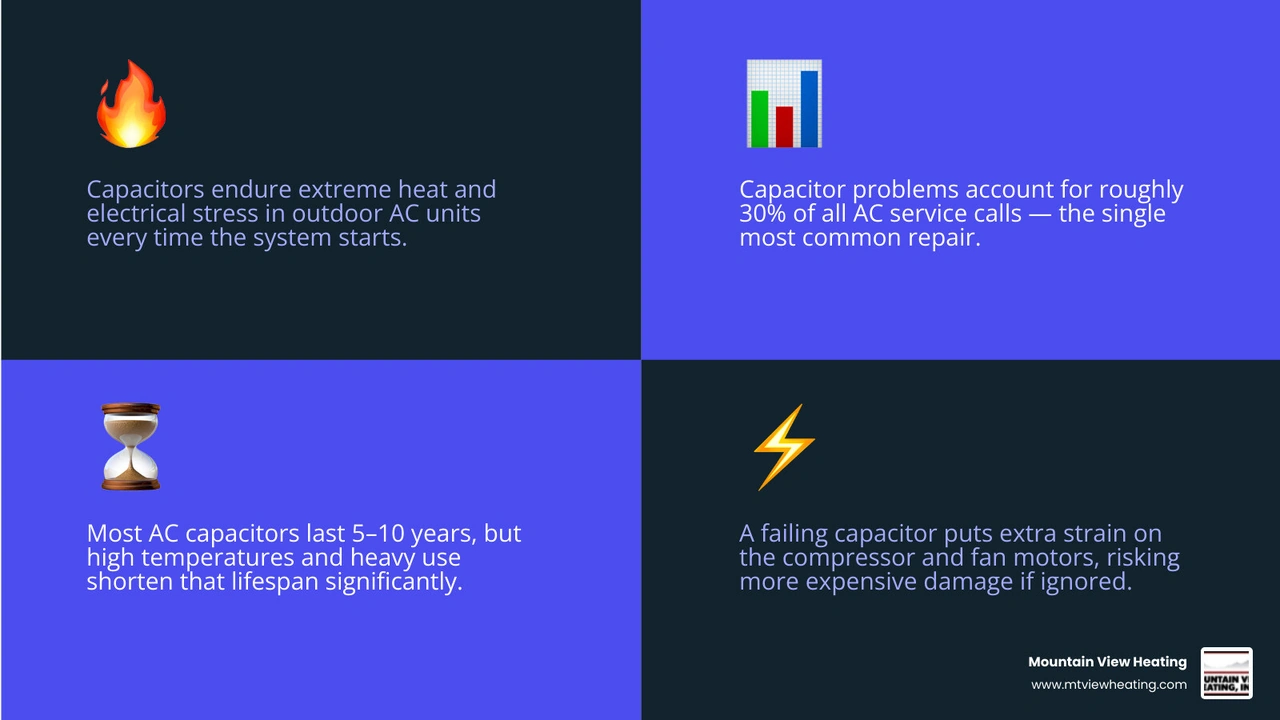
Capacitor failure why it is the most common AC repair comes down to one straightforward fact: capacitors are small, heat-sensitive electrical components that endure enormous stress every single time your air conditioner turns on. According to industry data, capacitor problems account for roughly 30% of all AC service calls — more than any other single component. Some technicians report seeing capacitor issues behind as many as 7 out of 10 repairs.
Here is a quick summary of why capacitor failure tops the list:
- High electrical stress — Capacitors take a massive power hit every time your AC starts up, wearing them down over time.
- Heat sensitivity — They are rated for high temperatures, but outdoor units in warm climates regularly push those limits.
- No warning signs at first — A capacitor can weaken gradually for months before it finally gives out, often on the hottest day of the year.
- Ripple effect — A failing capacitor puts extra strain on the compressor and fan motor, turning a small repair into a much bigger one if ignored.
- Short lifespan — Most AC capacitors last between 5 and 10 years, and that window shrinks in hot, high-use environments.
For homeowners in Bend, Oregon, where summer temperatures push outdoor AC units hard and the high desert climate adds its own stress, understanding capacitor failure can be the difference between a quick, simple fix and a major compressor replacement. This guide walks you through everything you need to know — from how capacitors work, to what failure looks and sounds like, to why this is one repair you should never put off.
What is an AC Capacitor and How Does It Work?
To understand why this tiny component fails so often, it helps to know what it actually does. Think of your home’s air conditioner as a high-performance vehicle. The compressor and the outdoor fan motor require a massive amount of electrical energy to break their stationary inertia and start spinning.
Standard household electrical wiring simply cannot deliver enough immediate amperage to start these heavy-duty motors on its own. If your AC relied solely on your home's electrical panel to start up, you would likely trip a circuit breaker every time the cooling cycle kicked on.
This is where the AC capacitor comes in. A capacitor is a small, cylindrical metal canister housed inside the electrical service panel of your outdoor condenser unit. It acts like a temporary, high-powered storage battery. It absorbs electrical energy from your home's power supply, stores it as an electrostatic charge between internal metal plates separated by a non-conductive dielectric material, and then releases that energy in a concentrated burst when the system calls for cooling.
Once the motors are running, the capacitor continues to provide a steady, stabilized stream of electrical current to keep them spinning efficiently. This continuous voltage stabilization ensures that electrical fluctuations do not disrupt the delicate refrigeration cycle.
Understanding how this component fits into the broader system is key to keeping your home comfortable. You can read more about the overall process in our guide on How Your Air Conditioner Works and explore how these electrical parts keep the cooling cycle moving in our breakdown of How the Refrigeration Cycle Cools Your Home.
Start Capacitors vs. Run Capacitors
Not all capacitors do the same job. Depending on the design of your air conditioner, your system may use separate start and run capacitors, or it may combine them into a single, multi-tasking component.
Here is how they differ:
| Feature | Start Capacitor | Run Capacitor | Dual-Run Capacitor |
|---|---|---|---|
| Primary Role | Provides an initial torque burst to start the motor. | Maintains a continuous, stable phase shift while running. | Combines start and run functions for both fan and compressor. |
| Active Time | 1 to 3 seconds (drops out of circuit once motor hits 75% speed). | Continuous (stays active the entire time the motor runs). | Continuous (different terminals serve fan and compressor). |
| Microfarad (µF) Rating | High (typically 50 to 300+ µF) to deliver massive starting power. | Lower (typically 5 to 45 µF) for steady operational voltage. | Dual ratings (e.g., 45/5 µF — 45 for compressor, 5 for fan). |
| Construction | Often non-hermetically sealed; designed for brief duty cycles. | Hermetically sealed; built to withstand continuous heat and current. | Hermetically sealed; most common in modern residential AC units. |
Most modern residential air conditioning systems in Bend utilize a dual-run capacitor. This single canister has three terminals on top (labeled HERM for the compressor, FAN for the outdoor fan motor, and C for common). Because a dual-run capacitor handles two critical motors at once, a failure in just one side of the capacitor will bring your entire cooling system to a halt.
Capacitor Failure: Why It Is the Most Common AC Repair
If we were to pull our service logs from any busy summer week in Redmond, Sisters, or Sunriver, capacitor replacements would outnumber almost all other electrical repairs combined. But why is this specific part so prone to quitting?
Capacitors are wear-and-tear items, much like the brake pads or tires on your car. They are designed to degrade slowly over time. Every single time your air conditioner cycles on, the capacitor experiences a rapid discharge and recharge cycle. This process causes minor internal physical stress. Over several years, the dielectric insulation inside the capacitor breaks down, reducing its ability to store an electrostatic charge.
When a capacitor's actual storage capacity (measured in microfarads) drops below its rated tolerance—usually a 6% to 10% threshold—the connected motors begin to struggle. To find out where this issue ranks among other typical system hiccups, check out our comprehensive article on the Most Common AC Repairs and What Causes Them.
Environmental Stressors and Capacitor Failure: Why It Is the Most Common AC Repair
While normal wear and tear is inevitable, our local climate in Central Oregon acts as a major accelerator for capacitor failure.
- Extreme High Desert Heat: When summer temperatures climb, the interior cabinet of your outdoor condenser can easily exceed 150°F. Capacitors are highly sensitive to thermal stress. Excessive heat causes the liquid or gel electrolyte inside the capacitor to expand and degrade rapidly, leading to premature failure.
- Dust and Pollen Accumulation: High desert winds carry dust, pine needles, and pollen that coat your condenser coils. When coils are dirty, the outdoor unit cannot reject heat efficiently. This forces the system to run longer, hotter cycles, placing extreme thermal and electrical strain on the capacitor.
- South-Facing Exposure: Condenser units installed on the south or west sides of local homes take a brutal beating from the afternoon sun, raising internal cabinet temperatures even further.
Regular upkeep is the best defense against these environmental factors. For a deeper look at keeping your system running smoothly in our unique climate, read our AC Repair Bend OR Complete Guide.
Electrical Fluctuations and Capacitor Failure: Why It Is the Most Common AC Repair
Beyond local weather, your home's electrical environment plays a massive role in capacitor health. Because capacitors are directly connected to your incoming power supply, any instability in the electrical grid can damage them.
- Power Surges and Grid Instability: Summer heatwaves put a heavy load on the local electrical grid, leading to voltage fluctuations, brownouts, and sudden surges. A single high-voltage spike can instantly puncture the delicate internal insulation of a capacitor.
- Lightning Strikes: Summer storms in Central Oregon can cause indirect lightning strikes on power lines, sending massive electrical surges straight into residential HVAC systems.
- Weak Electrical Connections: Over time, the natural vibration of the outdoor unit can loosen terminal connections. Loose wires cause electrical arcing, which generates intense local heat and damages the capacitor's terminals.
Warning Signs and the Ripple Effect of a Bad Capacitor
Because capacitors usually fail gradually rather than instantly, your system will often drop hints that something is wrong before it shuts down completely. Catching these signs early can save you from a major headache. If you want to do a quick check on your system before calling us, take a look at our AC Troubleshooting Tips Before Calling a Pro and our step-by-step guide on How to Troubleshoot an AC Issue.
Physical and Performance Symptoms of Failure
When a capacitor is failing, it will exhibit distinct physical and performance symptoms:
- The Bulging Top: A healthy capacitor has a perfectly flat metal top. As internal pressure builds from overheating or electrical shorting, the top will bulge or dome upward. If your capacitor looks like a popped soda can, it has failed and must be replaced.
- Leaking Fluid: Capacitors are filled with a dielectric oil that helps dissipate heat. If you see oily residue leaking from the seams or terminals, the internal seal has ruptured.
- Humming and Clicking Noises: If you hear a loud, strained humming sound coming from your outdoor unit, but the fan blades aren't spinning, the motor is trying to start but lacks the necessary torque from the capacitor.
- Delayed or Hesitant Starts: If your AC hesitates for several seconds or clicks repeatedly before finally starting, the capacitor is on its last legs.
When these electrical issues crop up, they often manifest as cooling problems inside the home. If your system is struggling to start, check out our resource on AC Not Turning On: What to Check First. If the system runs but fails to cool, read through Why is My AC Blowing Warm Air? Troubleshooting Steps and Reasons Your AC System May Be Blowing Out Warm Air.
The Ripple Effect on Compressors and Fan Motors
Ignoring a weak capacitor is one of the most serious mistakes a homeowner can make. When a capacitor loses its capacitance, the compressor and fan motor have to work much harder to spin. This is known as hard starting.
During a hard start, the compressor draws excessive electrical current (amperage) for an extended period. This extra current generates intense heat within the motor windings. Over time, this thermal stress degrades the motor's internal insulation, eventually leading to a complete compressor burnout.
Replacing a capacitor is a quick, straightforward repair; replacing a burned-out compressor is a major, complex job that often requires replacing the entire outdoor unit. A failing capacitor also forces the system to run longer, less efficient cycles, reducing your home's overall comfort.
Why DIY Replacement is Highly Dangerous
With plenty of DIY videos online, it can be tempting to try replacing an AC capacitor yourself. However, we strongly advise against this for several critical safety reasons:
- Lethal Shock Hazard: Capacitors are designed to store massive amounts of electrical energy. Even if you turn off the power at your home's main breaker panel, a capacitor retains a high-voltage charge that can deliver a severe or even fatal electrical shock if touched.
- Hazardous Chemicals: Older or low-quality capacitors can contain toxic or skin-irritating dielectric oils that require specialized handling and disposal.
- Risk of System Damage: Installing a capacitor with the wrong microfarad (µF) or voltage rating can quickly destroy your fan motor or compressor.
- Warranty Voidance: Most HVAC manufacturers require certified technicians to perform electrical repairs. A DIY replacement can instantly void your system's remaining warranty.
Our NATE-certified technicians use specialized diagnostic tools, such as digital multimeters, to safely discharge, test, and replace capacitors while verifying the overall health of your system's motors.
Frequently Asked Questions About AC Capacitors
How long do AC capacitors typically last in Bend, Oregon?
While a high-quality run capacitor can last up to 10 or 15 years in mild, coastal climates, the reality in Central Oregon's high desert is closer to 5 to 10 years.
Our hot summer afternoons, combined with dust and high system run hours, shorten their operational life. South-facing units or older systems with aging compressors may see capacitors fail in as little as 3 to 5 years.
To prevent unexpected summer breakdowns, we recommend having your capacitor's microfarad output tested annually. Learn more about local system care in our AC Service Bend OR Complete Guide.
Can a weak capacitor cause my energy consumption to spike?
Yes, absolutely. When a capacitor's storage capacity drops, the compressor and fan motors require more electrical current (amps) to start and run.
This increased amperage draw directly translates to higher energy consumption. Furthermore, because the system takes longer to cool your home, it runs extended cycles, multiplying your overall energy usage.
Should I replace my capacitor proactively or wait for it to fail?
We always recommend proactive replacement. During a routine maintenance visit, our technicians measure your capacitor’s actual microfarad output and compare it to the rating printed on the canister.
If a capacitor rated for 45 µF is reading below 42 µF (outside the safe 6% to 10% tolerance window), we recommend replacing it immediately. Replacing a weak capacitor proactively is excellent insurance against a sudden breakdown on a hot weekend—and it protects your compressor from unnecessary wear.
Conclusion
Capacitor failure is a natural part of owning an air conditioner, but it doesn't have to ruin your summer. By recognizing the early warning signs—like strange humming noises, delayed starts, or a bulging top—and scheduling regular maintenance, you can keep your system running efficiently all season long.
At Mountain View Heating, we have spent over 40 years helping homeowners in Bend, La Pine, Redmond, Sisters, Sunriver, and Terrebonne stay comfortable. We prioritize 100% customer satisfaction on every single job, offering fast, reliable residential AC repair and maintenance.
If your air conditioner is humming, blowing warm air, or simply overdue for a checkup, don't wait for a complete system breakdown. Contact our friendly, local team today to schedule your professional Mountain View Heating Air Conditioning Services.