


How the Refrigeration Cycle Cools Your Home (And Why It Matters This Summer)
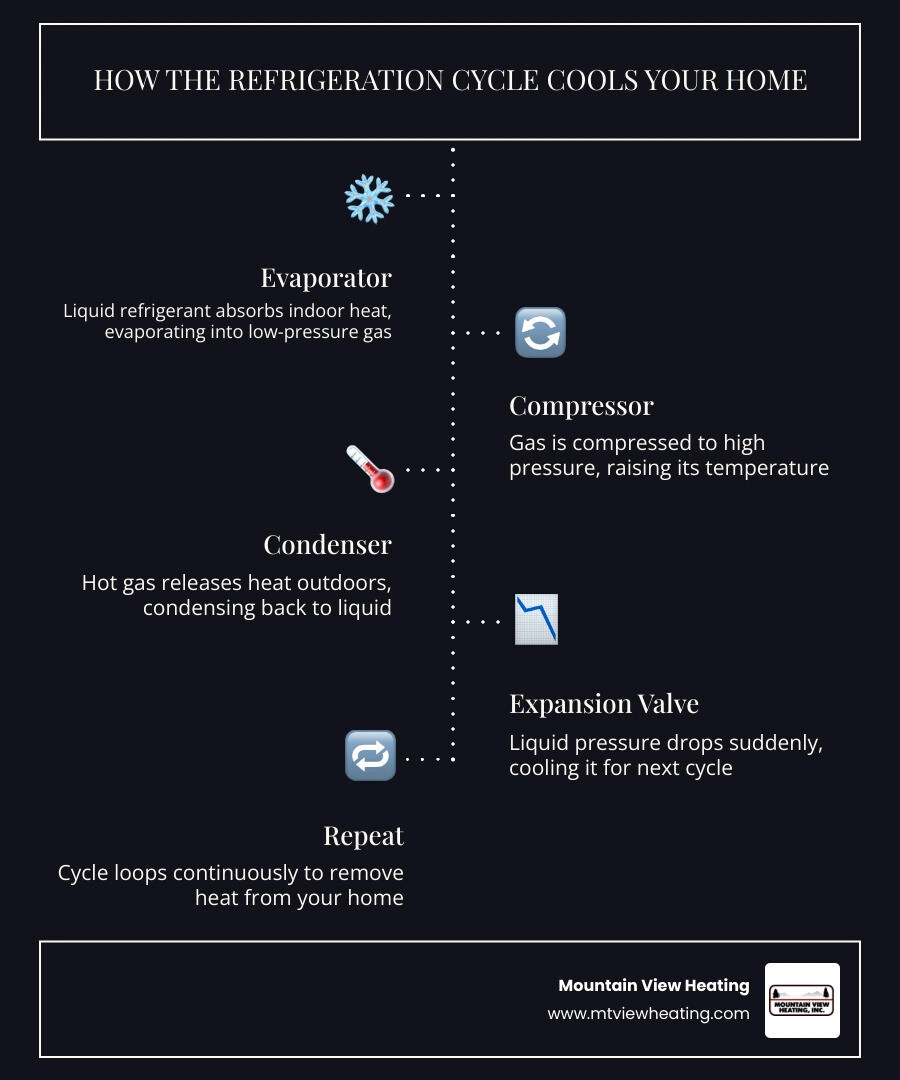
How the refrigeration cycle cools your home is simpler than it sounds: it moves heat from inside your house to the outside, using refrigerant that continuously absorbs and releases heat as it changes between liquid and gas states.
Here's the basic process at a glance:
1. Evaporator — Liquid refrigerant absorbs heat from your indoor air and turns into a gas
2. Compressor — That gas gets pressurized, raising its temperature even higher
3. Condenser — The hot gas releases its heat outside and condenses back into a liquid
4. Expansion valve — The liquid refrigerant drops in pressure and temperature, ready to absorb heat again
Your AC doesn't create cold air. It removes heat from the air inside your home and dumps it outdoors — over and over, in a continuous loop. Air passing over the cold evaporator coil typically drops around 20°F, which is what you feel coming out of your vents.
If you've ever noticed the hot air blowing out of your outdoor unit on a summer afternoon, that's exactly what's happening — your system is literally pushing your indoor heat outside.
For homeowners in Bend, Oregon, where summer temperatures can swing dramatically and dry, high-altitude air adds extra demands on your equipment, understanding this cycle helps you spot problems early and keep your system running efficiently all season long.
The Physics of Heat Removal and Thermodynamics
To truly grasp how the refrigeration cycle cools your home, we have to look at a few "laws" of the universe. Don't worry, there won't be a quiz, but these principles are why your home stays at a crisp 72°F when it's 95°F out in Redmond.
The Second Law of Thermodynamics
The most important rule is the Second Law of Thermodynamics, which states that heat always travels from a warmer object to a cooler one. It’s why your coffee gets cold and your ice cream melts. In an air conditioner, we use this law to our advantage. By making the refrigerant inside your indoor coils colder than the air in your living room, the heat naturally "jumps" into the refrigerant.
The Combined Gas Law and Pressure-Temperature Relationship
Physics tells us that pressure and temperature are best friends—they go everywhere together. When you increase the pressure of a gas, its temperature rises. When you drop the pressure, the temperature plummets. This is the "Combined Gas Law" in action. Think of an aerosol can; when you spray it, the can feels cold. That’s because the pressure inside is dropping rapidly. Your AC does this on a massive scale to create a "heat sink" (a place to put heat) and a "heat source."
Sensible vs. Latent Heat
There are two types of heat your AC manages:
• Sensible Heat: This is the heat you can "sense" with a thermometer. When the air temperature drops 20 degrees, that’s sensible heat removal.
• Latent Heat: This is the "hidden" heat used to change a substance's state (like turning water into steam). In your home, this manifests as humidity. As your AC cools the air, it also removes moisture, which is why your system has a drain line.
How the refrigeration cycle cools your home: The Four Key Stages
The refrigeration cycle is a closed-loop system. This means the refrigerant never (ideally) leaves the copper lines; it just circulates, changing its identity from liquid to gas and back again. This process is identical whether you have a standard air conditioner or a heat pump. In fact, if you've ever wondered How Does a Heat Pump Work, the answer is that it uses this exact same cycle, just with the ability to reverse the flow in the winter.
The Compressor and Condenser: The Outdoor Phase
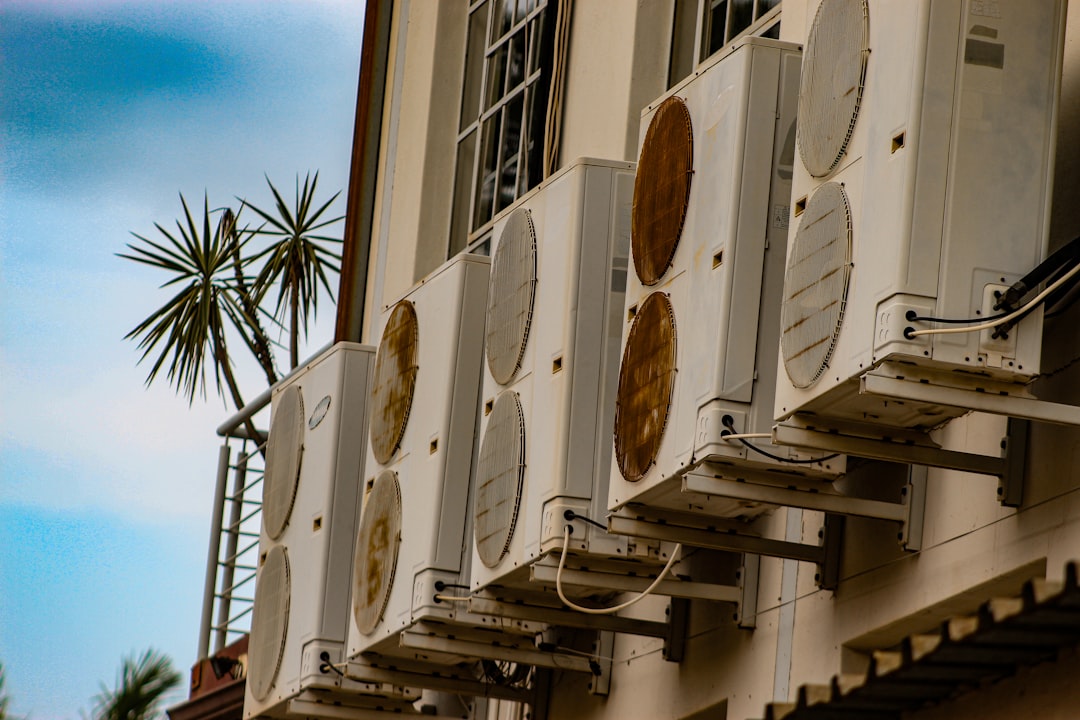
The "hot side" of the cycle happens in that large metal box sitting in your yard.
1. The Compressor: Often called the "heart" of the system, the compressor takes low-pressure gas from indoors and squeezes it. This concentrates the heat molecules, turning the refrigerant into a high-pressure, super-hot vapor.
2. The Condenser: This hot gas flows into the condenser coils. A large fan pulls outdoor air across these coils. Because the gas is now much hotter than the outdoor air (even on a scorching July day in Sisters), the heat radiates outward. As the heat leaves, the refrigerant cools down and "condenses" into a high-pressure liquid.
The Expansion Valve and Evaporator: The Indoor Phase
Now that the refrigerant is a high-pressure liquid, it heads back inside to do the actual cooling.
1. The Expansion Valve: This is the "brain" of the operation. You can learn more about The Function of a Thermostatic Expansion Valve here, but essentially, it acts like a nozzle. It restricts the flow of refrigerant, causing a sudden drop in pressure. This creates "flash gas," where the liquid becomes incredibly cold—usually around 40°F.
2. The Evaporator: This cold mixture enters the evaporator coil located inside your furnace or air handler. Your indoor blower fan pushes warm house air over these cold coils. The refrigerant absorbs the heat and "evaporates" back into a gas. This is also where dehumidification happens. If the airflow is restricted or the refrigerant is low, you might run into issues—this is one reason Why Do Air Conditioners Freeze Up during the summer.
Understanding Superheat and Subcooling for Peak Performance
In May 2026, modern HVAC systems are more precise than ever. To ensure how the refrigeration cycle cools your home is happening at peak efficiency, our technicians look at two critical measurements: Superheat and Subcooling.
• Superheat: This is the extra heat added to the refrigerant vapor after it has completely turned into a gas in the evaporator. We measure this to make sure no liquid refrigerant reaches the compressor. Compressors are designed to pump gas, not liquid; trying to compress a liquid is like trying to squeeze a rock—it will break the "heart" of your system.
• Subcooling: This is the cooling of the liquid refrigerant below its saturation point in the condenser. Proper subcooling ensures that a solid column of liquid reaches the expansion valve, which is vital for the system to work correctly.
The relationship between pressure and temperature is non-negotiable. For example, R410a refrigerant (the most common type in residential homes) at a saturation pressure of 207.7 PSI will always be exactly 72°F. If the pressure increases to 235.7 PSI, the temperature rises to 80°F. By monitoring these numbers with manifold gauges, we can tell exactly how healthy your system is.
How the refrigeration cycle cools your home through phase changes
The "magic" happens during the transition. When refrigerant boils at 40°F inside your evaporator, it isn't just "getting cold." It is performing a massive energy grab. It takes a huge amount of thermal energy to turn a liquid into a gas (latent heat of vaporization). By forcing this phase change to happen inside your home, the refrigerant "vacuums" the heat out of your air with incredible efficiency.
Optimizing Your System for the Central Oregon High Desert
Living in Bend, Redmond, or Sunriver presents unique challenges for an HVAC system. We live in a high-desert climate at altitudes between 3,000 and 4,000 feet. The air is dry, and the temperature can drop 40 degrees the moment the sun goes down.
1. Airflow is King: Because our air is so dry, your AC doesn't have to work as hard to dehumidify, but it needs plenty of airflow to move sensible heat. A dirty filter can drop your efficiency by 5% to 15% almost instantly.
2. Altitude Adjustments: At higher altitudes, air is less dense. This means your system's blower fan and condenser fan have to work a bit differently than they would at sea level.
3. Temperature Swings: Our rapid cooling at night means your AC might work hard at 4 PM and be completely unnecessary by 8 PM. This is why How Heat Pumps Equal Energy Efficiency is a hot topic locally—they handle these transitions beautifully.
Energy Usage Comparison
Understanding your energy footprint is key to managing summer utility bills. Here is how different cooling methods typically stack up:
• Window Unit — Typical Wattage (Per Hour): 900 – 1,440 Watts
• Portable Unit — Typical Wattage (Per Hour): 2,900 – 4,100 Watts
• Central Air Conditioner — Typical Wattage (Per Hour): 3,000 – 3,500 Watts
While central AC uses more raw wattage than a small window unit, it is significantly more efficient at cooling a whole home, especially when paired with a high SEER rating.
How the refrigeration cycle cools your home more efficiently with high SEER ratings
If you are looking at a system replacement in 2026, you'll hear the term SEER2. But What is a SEER Rating? It's essentially the "miles per gallon" for your air conditioner. A higher SEER rating means the refrigeration cycle is optimized through better coil design, more efficient compressors, and variable-speed fans. A system with a SEER of 18 or higher will use significantly less electricity to move the same amount of heat as an older SEER 10 unit.
Frequently Asked Questions about the Refrigeration Cycle
Does an air conditioner create cold air?
Technically, no. Cold is simply the absence of heat. Your air conditioner is a "heat mover." It uses the laws of physics to grab heat from your living room and relocate it to your backyard. When you feel "cold air" coming from the vents, you are actually feeling air that has had its heat removed.
What is the difference between an AC and a refrigerator cycle?
The science is exactly the same! Both use a compressor, condenser, expansion valve, and evaporator. The main difference is the "box." A refrigerator cools a small, highly insulated plastic box and runs almost continuously to maintain a steady temperature. An air conditioner cools a large, less-insulated "box" (your home) and cycles on and off based on the thermostat's demand.
Why is refrigerant essential to the cooling process?
Refrigerant is the "courier" for heat. We use specific chemicals because they have very low boiling points. For instance, some refrigerants boil at -60°F at normal atmospheric pressure. This allows us to manipulate them into boiling at 40°F inside your home, making them the perfect sponge for absorbing indoor heat.
Conclusion
Understanding how the refrigeration cycle cools your home helps you appreciate the complex work your HVAC system does every time the sun hits the high desert. From the high-pressure squeeze of the compressor to the refreshing chill of the evaporator coil, every component must work in perfect harmony to keep you comfortable.
At Mountain View Heating, we’ve spent over 40 years ensuring that families in Bend, La Pine, Redmond, and throughout Central Oregon stay cool when the temperatures climb. Whether you need a routine tune-up to check your subcooling levels or a 24/7 emergency repair because your compressor stopped "beating," we are here to help. We prioritize 100% customer satisfaction, ensuring your residential system is ready for whatever the Oregon summer throws at it.
Ready to ensure your home stays a sanctuary this summer? Explore our Air Conditioning Services or give us a call today for expert support you can trust.