


How Long Does an AC Unit Last in Central Oregon — and What to Expect
If you've been wondering how long does an AC unit last in Central Oregon, here's the short answer:
• Central Air Conditioner — Typical Lifespan in Central Oregon: 12–17 years
• Heat Pump — Typical Lifespan in Central Oregon: 10–12 years
• Ductless Mini-Split — Typical Lifespan in Central Oregon: 15–20 years
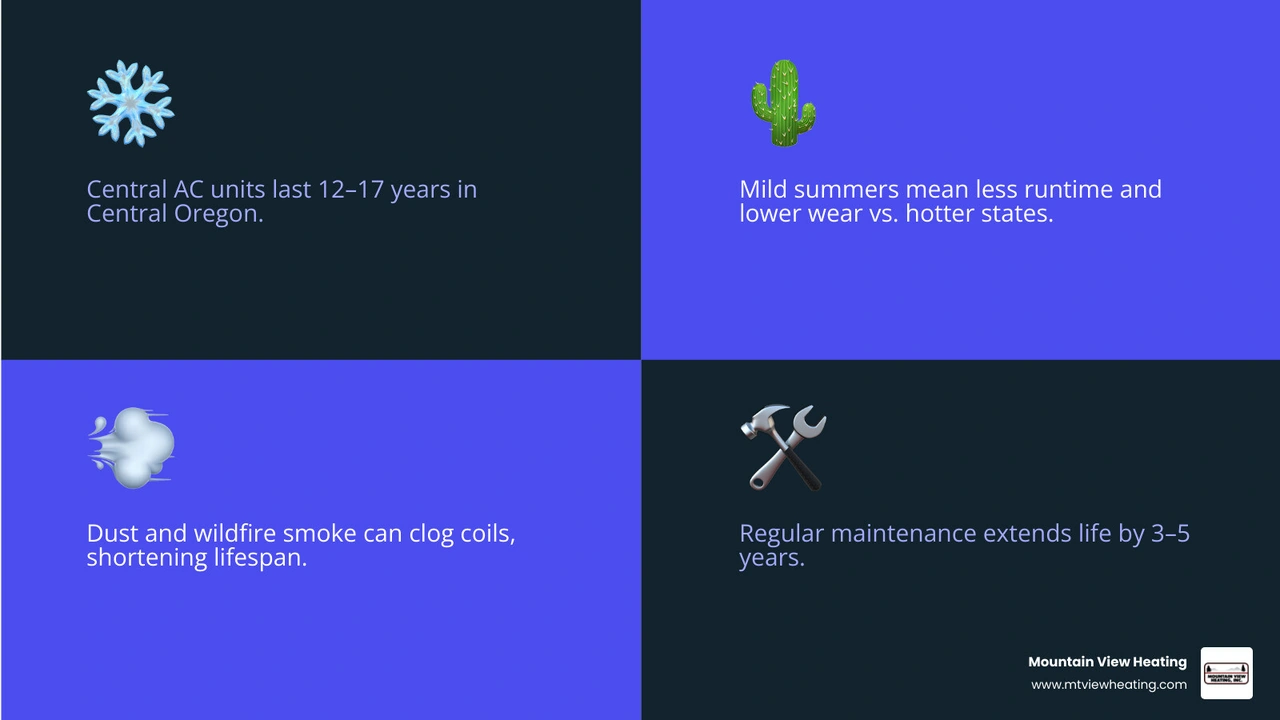
Most central AC units in the Bend area last 12 to 17 years with regular maintenance — slightly longer than in hotter states like Texas or Arizona, thanks to Central Oregon's shorter cooling season. Skip the upkeep, and that number can drop closer to 10 years.
Central Oregon's high desert climate is a bit of a mixed bag for your AC. Mild summers mean your system runs fewer hours per year than units in the Southwest — and less runtime means less wear. But dry air, dust, wildfire smoke, and sharp temperature swings between day and night create their own kind of stress on outdoor equipment.
Whether you're in Bend, Redmond, Sisters, Sunriver, or La Pine, knowing what to expect from your AC — and when it's time to replace it — can save you from a surprise breakdown on the hottest afternoon of the year.
How Long Does an AC Unit Last in Central Oregon?
When we talk about the average lifespan of a cooling system in our neck of the woods, we generally look at a window of 12 to 17 years for central air conditioners. While the national average often sits between 15 and 20 years, the high desert presents unique challenges. However, compared to the humid, sweltering climates of the South where units might only last 10 years due to constant operation, Central Oregon homeowners actually have a bit of an advantage.
How Long Does an AC Unit Last in Central Oregon for Most Homes?
For the typical residential home in Bend or Redmond, the cooling demand is relatively seasonal. We usually don't start cranking the AC until late June, and by mid-September, the crisp evening air often does the work for us. Because of this limited cooling season, a well-installed system shouldn't have to work nearly as hard as a unit in a hotter region. With proper maintenance, hitting that 15-year mark is a very realistic goal for most of our neighbors.
Why How Long Does an AC Unit Last in Central Oregon Depends on Usage and Care
While the climate provides a head start, the actual number of years you get out of your system depends heavily on a few key variables:
• Runtime: Do you keep your home at a chilly 65 degrees all summer, or do you use a smart thermostat to give the unit a break when you're at the office?
• Installation Quality: A system that was incorrectly sized or poorly installed will struggle from day one, leading to premature component failure.
• Airflow: If your ductwork is leaky or your filters are clogged, the system has to work twice as hard to move air, which wears out the motor and compressor.
Why Central Oregon’s Climate Can Help or Hurt AC Longevity
Living in a high desert means we deal with conditions that are vastly different from the Willamette Valley. Our dry air is actually great for AC units because it reduces the risk of rust and corrosion on internal components. However, our altitude and environmental factors bring their own set of "lifespan shorteners."
Mild Summers vs. Hotter States
The biggest "pro" for our local AC units is the short duration of the summer heat. In states like Arizona, an AC might run for 3,000 hours a year. In Central Oregon, we might only see 500 to 800 hours of heavy use. This lower "mileage" means the mechanical parts—like the fan motor and the compressor—don't reach their wear-and-tear limits as quickly. This is why a unit in Bend might comfortably reach 17 years while the exact same model in Phoenix dies at age 11.
High Desert Conditions That Still Cause Wear
On the flip side, we have dust. Lots of it. Our volcanic soil and dry winds mean that outdoor condenser coils can become "blanketed" in fine silt very quickly. When those coils are dirty, the unit can't release heat efficiently, causing the system to run hotter and longer than it should.
Additionally, wildfire smoke has become a significant factor in recent years. The fine particulates in smoke can clog filters and coat sensitive components. Finally, our "freeze-thaw" cycles in the shoulder seasons can cause physical stress on the outdoor unit's housing and base, potentially leading to shifting or vibration issues over time.
What Shortens or Extends AC Life in Central Oregon Homes
It’s not just the weather that dictates how long your system lasts; it’s the environment inside and around your home. For instance, a home with poor insulation or old single-pane windows will force an AC to run constantly to keep up with the heat gain, effectively "aging" the unit faster.
The Maintenance Habits That Add Years to System Life
If you want to push your AC toward that 20-year mark, maintenance isn't optional—it's the secret sauce. Regular AC maintenance in Bend OR ensures that small issues don't turn into system-killing catastrophes.
Key habits include:
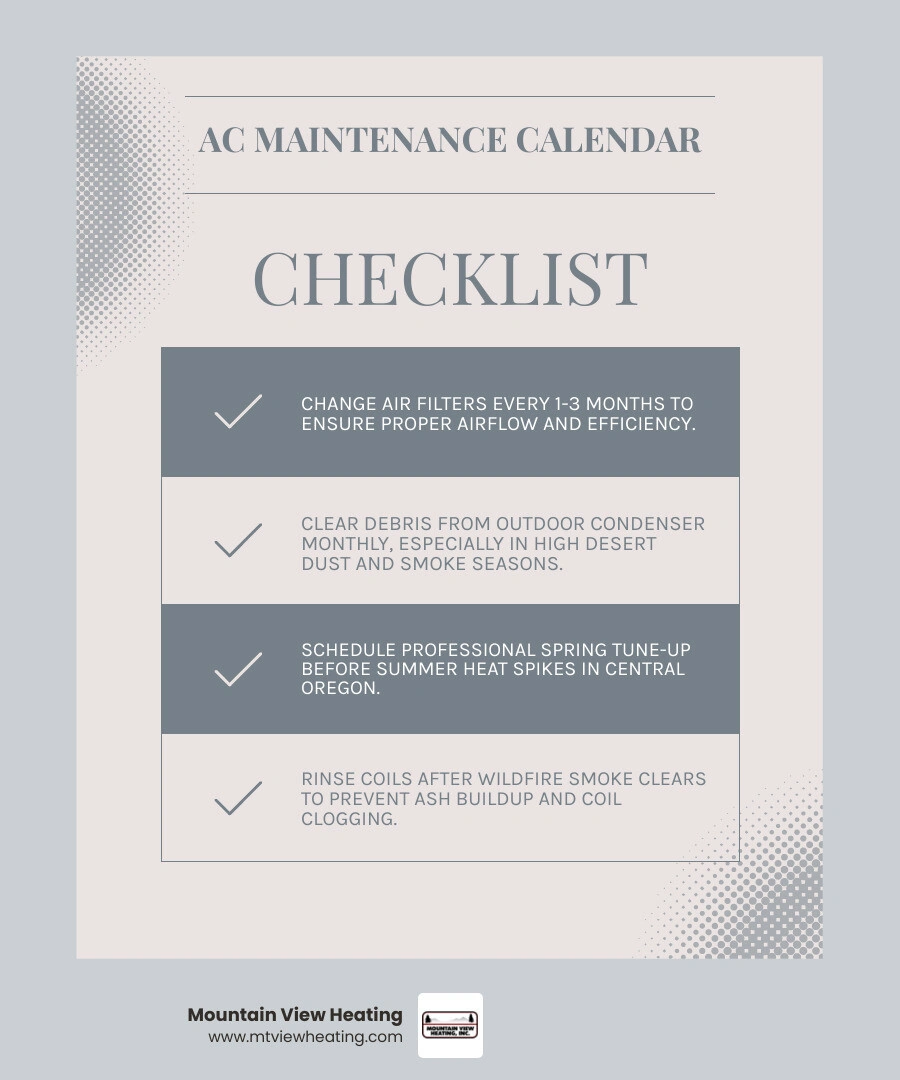
• Coil Cleaning: Rinsing the outdoor unit to remove dust and debris.
• Filter Changes: Replacing your 1-inch filters every 30-90 days (or more often during smoke season).
• Professional Tune-ups: Having a technician check your capacitors and refrigerant levels. Scheduling an AC tune up in Bend OR every spring is the best way to ensure your system is ready for the first heat wave.
How Long Does an AC Unit Last in Central Oregon if You Skip Service?
If you ignore your AC, you’re essentially rolling the dice. A system with dirty coils or a restricted air filter will experience "short cycling," where it turns on and off rapidly. This puts immense strain on the compressor—the most expensive part of the system. Without service, you can expect a lifespan closer to 10 years, and you'll likely deal with much higher energy bills and frequent emergency repairs in the meantime.
Which System Type Lasts Longer: Central AC, Heat Pump, or Mini-Split?
The type of system you choose also dictates the timeline. Standard central AC units often last longer than heat pumps simply because they only run for 3-4 months a year. Heat pumps, which provide both heating and cooling, work year-round, which naturally leads to more wear.
However, ductless mini-splits are the "marathon runners" of the HVAC world. Because they use sophisticated inverter technology that allows them to run at lower speeds rather than constantly stopping and starting, they can often last 20 years or more. You can learn more about these differences in our Central Air vs Mini-Split High Desert Guide.
Signs Your AC Is Nearing the End of Its Life
How do you know if your unit is just having a bad day or if it’s time to say goodbye? There are several "red flags" that homeowners in Sisters and Sunriver should watch for as their systems age.
Repair or Replace? The Best Time for Homeowners to Decide
We generally suggest looking at the unit’s age, condition, and how often it needs service. Replacement is often the better long-term choice when repairs are becoming frequent or the system is no longer keeping your home comfortable.
Consider replacing if:
• The unit is over 15 years old: Even if it's running, it's likely much less efficient than newer systems.
• It uses R-22 Refrigerant: This older refrigerant (often called Freon) has been phased out, which can make future repairs more complicated.
• Frequent breakdowns: If you've needed multiple repairs over the last couple of summers, the system may be nearing the end of its service life.
• Higher energy use: If your summer electric bill keeps climbing and your comfort is dropping, your system may be losing efficiency.
Warning Signs You Shouldn’t Ignore Before Summer
Don't wait for a 95-degree day in July to find out your AC is failing. Watch for these signs in the late spring:
1. Odd Noises: Squealing, grinding, or banging sounds often indicate a failing motor or a loose part.
2. Weak Airflow: If air is coming out of the vents but feels "lazy," your blower motor or airflow may need attention.
3. Musty Smells: This can indicate biological growth inside the evaporator coil or drain line.
If you notice these, it's time for an AC repair in Bend OR or an AC repair in Redmond OR before the heat truly hits.
How to Get the Longest Life from Your AC in Central Oregon
Maximizing your system's life is all about reducing the "load" it has to carry. In our high desert environment, a few small DIY tasks and professional checks go a long way.
Best Maintenance Tips for Bend, Redmond, Sisters, Sunriver, and La Pine Homes
• The 2-Foot Rule: Keep plants, shrubs, and debris at least two feet away from your outdoor condenser. It needs to "breathe" to release heat.
• Smoke Season Cleanup: If we have a heavy smoke season, don't wait for your annual service. Rinse your outdoor coils (gently!) with a garden hose once the air clears to remove ash.
• Thermostat Wisdom: Avoid "cranking" the thermostat down to 60 degrees to cool the house faster. It doesn't work that way; it just makes the system run longer.
• Local Expertise: Each town has its own quirks. For example, AC maintenance in Sisters OR might focus more on pine needle removal, while AC maintenance in Redmond OR often deals with more wind-blown dust. We also provide specialized AC maintenance in La Pine OR and AC maintenance in Sunriver OR to handle the specific needs of those communities.
Do Newer SEER2 Systems Last Longer or Just Cost Less to Run?
As of 2023, the industry moved to SEER2 ratings. These newer systems are designed with much more advanced technology, such as variable-speed compressors. While they definitely cost less to run (sometimes saving homeowners up to 50% on cooling costs compared to a 15-year-old unit), they also tend to last longer. Why? Because they don't have to "slam" on and off at 100% power. They can ramp up and down smoothly, which reduces mechanical stress.
Frequently Asked Questions About AC Lifespan in Central Oregon
Is 15 years old too old for an AC unit in Central Oregon?
Not necessarily "too old" to function, but it is the age where you should start a "replacement fund." At 15 years, the efficiency has likely dropped significantly, and the risk of a major component failure (like the compressor or coil) increases every season. If your 15-year-old unit needs a repair that costs more than a few hundred dollars, we usually recommend looking at AC replacement in Bend OR.
Can a heat pump wear out faster than a standard AC here?
Yes, typically. Because a heat pump is your primary heat source in the winter and your cooling source in the summer, it's working year-round. While a standard AC might sit idle for 8 months, the heat pump is busy running defrost cycles in January. You can expect a heat pump to last about 10–12 years, whereas a dedicated AC might hit 15–17.
What should I do if my AC still works but struggles on hot afternoons?
This is a common complaint in the high desert. It could be a simple fix like a dirty coil or a low refrigerant charge, or it could be that the system was undersized for the home's square footage. The first step is always a professional evaluation. Our team provides comprehensive AC service in Bend OR and AC service in Redmond OR to diagnose exactly why your comfort is dipping when the sun is at its peak.
Conclusion
So, how long does an AC unit last in Central Oregon? While the high desert environment presents challenges like dust and smoke, our mild summers can help a well-maintained system last 12 to 17 years.
For homeowners in Bend, Redmond, Sisters, Sunriver, La Pine, and nearby communities, regular residential AC service, repair, and replacement make a big difference in how long a system performs reliably. At Mountain View Heating, we’ve spent over 40 years helping local homeowners stay comfortable with a customer-first approach and fast support when it’s needed most.
If your AC is getting older or not keeping up like it used to, don’t wait for a midsummer breakdown. Whether you need routine maintenance, a repair, or a full replacement, Mountain View Heating is here to help.
Explore our Air Conditioning services today and ensure your home stays comfortable for years to come.