


What Causes Heat Pump Ice Buildup and What to Do About It
Understanding heat pump ice buildup causes and what to do about it can save you from a cold house and major system damage. Here's a quick overview:
Common causes of heat pump ice buildup:
• Restricted airflow from a clogged air filter or blocked vents
• Low refrigerant levels causing the coils to run too cold
• A malfunctioning defrost cycle or failed reversing valve
• Dirty evaporator coils reducing heat transfer
• Poor drainage or gutter runoff refreezing on the unit
• Heavy snow or debris blocking the outdoor unit
What to do immediately:
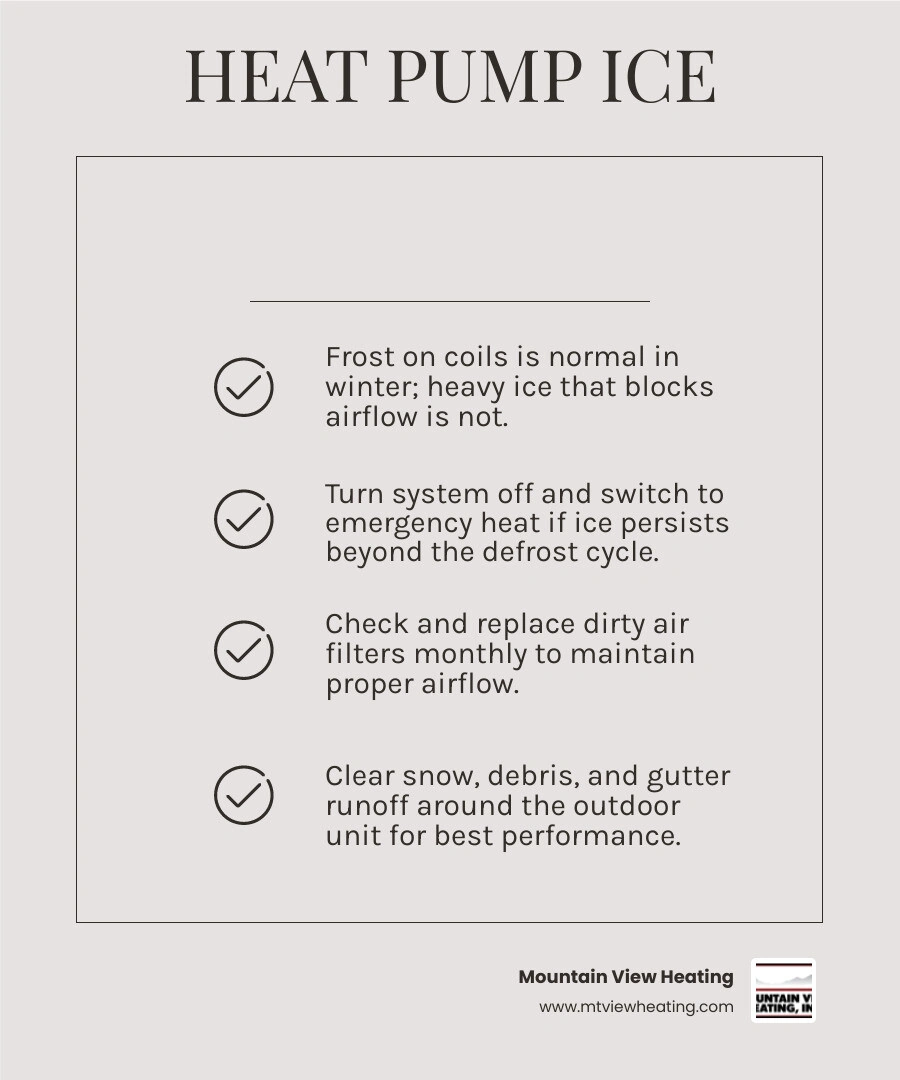
1. Turn the heat pump off at the thermostat
2. Switch to emergency/auxiliary heat to keep your home warm
3. Check and replace a dirty air filter
4. Clear snow and debris from around the outdoor unit
5. Allow ice to melt naturally — never chip at it with tools
6. Call a licensed HVAC technician if ice returns or won't melt within 6–8 hours
If you step outside on a cold Bend, Oregon morning and find your heat pump encased in ice, it's normal to feel a little alarmed. A light layer of frost on the outdoor coils is actually expected during cold, humid weather — your system's built-in defrost cycle is designed to handle it automatically. But when ice builds up heavily and doesn't clear on its own, that's a different story. Left unchecked, severe ice buildup can block airflow, strain the compressor, and force your system to rely on backup heat strips. In this guide, we'll walk you through exactly what's normal, what's not, and what steps to take to get your system running safely again.
Normal Frost vs. Problematic Ice Buildup
To avoid unnecessary service calls, it is essential to distinguish between a healthy system doing its job and a malfunctioning unit in desperate need of repair. In the dead of winter, outdoor coils naturally become cold as they extract thermal energy from the freezing outdoor air. When the temperature of these coils drops below the freezing point, any moisture in our Central Oregon air condenses and freezes directly onto the metal surface.
This means a thin, even layer of white frost is completely normal. However, when this frost accumulates into a thick, solid block of ice, system efficiency plummets, and your winter performance will suffer.
How the Defrost Cycle Works
Your heat pump is a highly engineered system designed to solve its own freezing problems under normal circumstances. To understand how it manages this, it helps to look at How Does a Heat Pump Work in detail.
During the winter heating mode, the outdoor coil acts as an evaporator, absorbing heat from the outside environment. As frost builds up, the system must periodically enter a defrost cycle to melt the accumulation. Here is exactly what happens when your system initiates this process:
1. Reversing Valve Activation: The system temporarily shifts its reversing valve, which reverses the flow of refrigerant. This essentially turns the outdoor unit into an air conditioner for a brief period, sending hot, pressurized refrigerant back through the outdoor coils.
2. Outdoor Fan Pause: The outdoor fan shuts off. By stopping the fan, the heat pump keeps the heat concentrated on the coils to melt the frost as quickly as possible.
3. Steam and Vapor: As the frost melts off the warm coil surfaces, you will often see steam rising from the unit. This is completely normal and is often mistaken by homeowners as smoke.
4. Duration: A standard defrost cycle typically lasts between 5 to 15 minutes. It ends when the coil reaches a preset temperature or when a maximum time limit (usually around 10 minutes) is reached.
5. Frequency: The control board monitors the system and initiates a defrost cycle as needed, typically checking the coil status every 30 to 90 minutes depending on whether it is a timed or demand-based system.
When Frost Turns Into Problem Ice
While a temporary layer of frost is normal, solid ice that persists is a clear warning sign. When a system can no longer clear its coils, a thick layer of ice begins to encase the entire unit. This creates a severe airflow blockage, preventing the system from extracting heat from the air.
This is especially critical when analyzing How Does a Heat Pump Work in a High Desert Climate like we have here in Bend, Redmond, and Sisters. Our winter weather can feature rapid temperature swings, freezing fog, and heavy snowfalls that put extra strain on outdoor units.
As a general rule, we use the four-hour threshold: if the ice buildup lasts longer than four hours without melting, or if the unit is completely encased in a solid block of ice that prevents the fan from spinning, your system requires immediate attention.
• Appearance — Normal Frost: A thin, even, white coating of frost on the coils. — Problematic Ice Buildup: Thick, solid ice encasing the coils, sides, or top of the unit.
• Fan Operation — Normal Frost: Outdoor fan spins freely (except during a brief defrost cycle). — Problematic Ice Buildup: Fan blade is stuck or blocked by solid ice.
• Defrost Behavior — Normal Frost: Clears completely within 5–15 minutes, repeating every 30–90 minutes. — Problematic Ice Buildup: Ice remains after multiple defrost cycles or doesn't melt at all.
• System Sounds — Normal Frost: Normal humming; brief whooshing sound when defrost starts. — Problematic Ice Buildup: Heavy vibration, grinding, or rattling noises.
• Indoor Comfort — Normal Frost: Steady, warm air flowing from your vents. — Problematic Ice Buildup: House feels cold; system is locked out or running solely on backup heat.
Troubleshooting Heat Pump Ice Buildup Causes and What to Do
When your system crosses the line from normal frost to a solid block of ice, it is time to perform some basic system diagnostics. Understanding the primary environmental and mechanical factors behind a frozen system is the first step toward restoring your home's comfort.
Understanding Heat Pump Ice Buildup Causes and What to Do in Winter
In winter, several conditions can trigger ice accumulation. High humidity combined with near-freezing temperatures (between 20°F and 40°F) is actually the most common weather window for icing, as the air holds plenty of moisture that easily freezes upon contact with cold outdoor coils.
Freezing rain and heavy snow can also physically blanket the unit, choking off its air supply. To understand the physics of how cold temperatures and moisture interact with HVAC equipment, it can be helpful to read about Why Do Air Conditioners Freeze Up as the thermodynamic principles are very similar.
Beyond the weather, local environmental and installation factors often play a major role:
• Drainage Issues: When the defrost cycle melts frost, that water has to go somewhere. If the drain holes in the base pan of the outdoor unit are clogged with leaves, dirt, or ice, the meltwater will pool and refreeze, gradually building a solid block of ice from the bottom up.
• Gutter Runoff: If your outdoor unit is installed directly under a roof drip line or a leaking gutter, water will constantly cascade onto the top of the unit and freeze instantly during sub-zero temperatures, completely encasing the cabinet.
Quick Checklist: Heat Pump Ice Buildup Causes and What to Do Immediately
If you look out your window and see your outdoor unit looking like an ice sculpture, do not panic. Follow this step-by-step checklist to protect your system from damage and begin a safe thaw:
• [ ] Switch to Emergency Heat: Go to your thermostat and change the setting to "Emergency Heat" (sometimes labeled as "Aux" or "Auxiliary Heat"). This shuts down the outdoor compressor entirely and relies on your indoor backup heat strips to keep your home warm, preventing further mechanical strain on the frozen outdoor unit.
• [ ] Power Down the Unit: If you plan to clear the area or perform a manual thaw, shut off the power to the outdoor unit at the breaker panel or the outdoor disconnect box for maximum safety.
• [ ] Clear the Perimeter: Gently remove any snow accumulation, leaves, or debris from around the unit. Maintain a clear zone of at least 18 to 24 inches on all sides.
• [ ] Inspect the Air Filter: Go inside and check your furnace or air handler's air filter. If it is dirty, replace it immediately.
• [ ] Allow a Natural Thaw: If outdoor temperatures are above freezing, letting the unit thaw naturally is the safest approach. If it is well below freezing, you will need to prepare for a controlled manual thaw or call in our professional team.
How Restricted Airflow and Low Refrigerant Freeze Your System
While winter weather can certainly trigger ice, the root cause of a frozen heat pump is often an internal mechanical failure. Two of the most common culprits are restricted airflow and low refrigerant levels. Both issues disrupt the delicate balance of heat transfer, causing the evaporator coils to drop far below normal operating temperatures.
The Impact of Restricted Airflow
For a heat pump to operate efficiently, a massive volume of air must constantly pass over both the indoor and outdoor coils. If this airflow is choked off, the refrigerant cannot absorb or release heat properly. This causes the system pressure to drop, sending the coil temperatures plunging below freezing.
• Clogged Air Filter: A dirty, clogged air filter is one of the most common causes of a frozen system. It restricts the return air flowing over your indoor coils, disrupting the entire thermodynamic cycle. Checking and replacing your filter monthly during peak winter heating is one of the easiest ways to prevent ice.
• Dirty Evaporator Coils: Over time, dust, pet dander, and grime can coat the indoor or outdoor coils. This buildup acts as an insulating blanket, severely impairing heat transfer. If you want to see how dirty coils cause similar issues in summer, read our guide on Ice Forming on Your AC Unit: Causes and What to Do.
• Blower Motor Failures: If the indoor blower motor is failing or running at a reduced speed, it won't push enough air through the system, leading to a rapid drop in pressure and eventual freeze-ups.
Why Low Refrigerant Requires Professional Repair
Refrigerant is the lifeblood of your heat pump. It circulates through the system, constantly changing states from liquid to gas to transport heat. When there is a refrigerant leak, the overall system pressure drops.
According to basic thermodynamic laws, a drop in pressure causes a corresponding drop in temperature. This means the remaining refrigerant runs exceptionally cold, causing any moisture on the outdoor coils to freeze instantly into a thick ice sheet.
Finding and fixing a refrigerant leak is strictly a job for licensed professionals. It requires specialized diagnostic tools to locate the leak, repair the copper lines, and recharge the system. Handling refrigerant requires EPA certification to ensure safety and environmental compliance. Running a system with low refrigerant can cause permanent compressor damage, which is a major component to replace. If you suspect a leak, refer to our Heat Pump Repair Bend OR Complete Guide to understand how our expert technicians diagnose and resolve these complex issues.
Safe DIY Thawing Methods and Prevention Tips
If your heat pump is frozen, you do not have to stand by helplessly. There are several safe, practical steps you can take to thaw the system and prevent the problem from returning.
Safe Ways to Thaw Your Heat Pump
Thawing a heat pump requires patience and a gentle touch. Using the wrong methods can easily puncture a refrigerant line or destroy the delicate aluminum fins on your coils.
• Use Fan Mode: Turn your thermostat to "Fan Only" or "On" while keeping the heat setting off. This forces the indoor blower fan to run continuously, circulating warm indoor air through the system to help warm up the refrigerant and gently thaw the coils from the inside out.
• Lukewarm Water: If you want to speed up the process, you can gently pour lukewarm water over the frozen outdoor coils. Never use boiling hot water, as the extreme temperature differential can cause thermal shock, cracking the copper tubing or damaging the compressor.
• Absolutely No Sharp Tools: It can be tempting to grab a screwdriver, ice pick, or hammer to chip away at the ice. Do not do this. The aluminum fins and copper tubes are incredibly fragile. A single slip can puncture a coil, leading to a massive refrigerant leak and a major repair.
• Manage the Runoff: As the ice melts, ensure the water can drain away freely from the base of the unit so it does not immediately refreeze into an ice pad.
Preventive Maintenance for Central Oregon Winters
Living in Central Oregon means our heating systems face demanding winter conditions. Taking a few proactive steps in the autumn can keep your heat pump running smoothly all winter long:
1. Elevate Your Unit: In snowy climates like Bend, La Pine, and Sisters, heat pumps should always be installed on snow stands. Elevating the unit 6 to 12 inches off the ground allows snow to accumulate underneath without blocking the lower coils, and ensures proper drainage during defrost cycles.
2. Maintain Clearances: Keep vegetation, shrubs, and weeds trimmed back at least 18 to 24 inches from all sides of the outdoor cabinet. Clear away fallen leaves and pine needles before the first snowfall.
3. Check Your Gutters: Ensure your gutters are clean and draining properly. If you notice water dripping directly onto your outdoor unit from the roof line, install a gutter diverter to redirect the water away.
4. Schedule Professional Tune-Ups: The single best way to prevent winter freeze-ups is to have your system serviced by a professional before the cold weather hits. Our comprehensive checklists ensure your defrost controls, sensors, reversing valves, and refrigerant levels are in perfect working order.
For localized tips on keeping your system in peak condition, check out our helpful guides:
• Heat Pump Maintenance Bend OR Tips
• Heat Pump Maintenance Sisters OR Guide
• Heat Pump Tune Up Redmond OR
Frequently Asked Questions About Frozen Heat Pumps
Here are some of the most common questions our team at Mountain View Heating receives from local homeowners during the winter months.
How long should it take for a heat pump to thaw naturally?
When outdoor temperatures are above freezing, a frozen heat pump will typically thaw naturally within 2 to 4 hours. However, if the temperature remains below freezing, natural thawing can take much longer, sometimes up to a full day.
If your system does not melt its ice within 6 to 8 hours, or if it immediately refreezes after a defrost cycle, it indicates an underlying mechanical issue. In these situations, it is best to schedule a professional inspection. You can learn more about scheduling these routine checks in our Heat Pump Tune Up Sisters OR service guide.
When should I switch my thermostat to emergency heat?
You should switch your thermostat to emergency heat (or auxiliary heat) immediately if you notice any of the following:
• The outdoor unit is completely encased in solid, thick ice.
• The outdoor fan blade is frozen in place and cannot spin.
• The system is making loud, unusual grinding or rattling noises.
• The outdoor unit has locked itself out and is no longer heating your home.
Switching to emergency heat keeps your home warm using your indoor heating elements while preventing further mechanical damage to your outdoor compressor and fan motor.
Can a dirty air filter really cause my outdoor unit to freeze?
Yes, absolutely. It might seem strange that a dirty filter inside your home can cause ice to form on the unit outside, but HVAC systems rely on a delicate balance of airflow and pressure.
When a dirty air filter restricts indoor airflow, the refrigerant cannot absorb enough heat from your home's air during its cycle. This causes the system pressure to drop, which in turn causes the refrigerant temperature to plummet. As this super-cold refrigerant flows back to the outdoor unit, it causes any moisture on the outdoor coils to freeze rapidly, leading to a severe freeze-up. Changing your filter monthly is the easiest way to prevent this chain reaction.
Conclusion
A frozen heat pump can be a frustrating winter headache, but knowing heat pump ice buildup causes and what to do puts you back in control of your home's comfort. While simple steps like replacing a dirty air filter and clearing away fresh snow are easy DIY tasks, persistent ice buildup, low refrigerant levels, and defrost cycle failures require the steady hand of a professional.
At Mountain View Heating, we have been serving homeowners across Bend, Redmond, Sisters, La Pine, Sunriver, Terrebonne, and Three Rivers for over 40 years. We prioritize 100% customer satisfaction on every single job, big or small. If your heat pump is struggling to keep up with the Central Oregon winter, do not wait in the cold.
Check out our Heat Pump Service Bend OR Complete Guide to learn more about how we keep local heating systems running at peak efficiency, or visit our heat-pump service page to schedule your professional diagnostic visit today!