


The Hidden Cost of Sealing Your Home Against Wildfire Smoke
The sky outside turns an eerie orange, the air smells like a campfire, and your immediate instinct is to lock down the house. But while shutting every window is necessary when the Air Quality Index plummets, understanding the role of a fresh air intake when Deschutes County air quality drops is critical to keeping your indoor environment safe. Sealing your home keeps hazardous PM2.5 ash out, but it also traps you inside with rapidly degrading, stale air.
If you are struggling with stale indoor air during heavy smoke seasons, our team at Mountain View Heating recommends exploring modern indoor air quality solutions and dedicated air distribution systems, which we have found can make all the difference.
As families transition into back-to-school routines during the peak of August late-summer wildfire smoke, we frequently see homeowners keep their doors and windows tightly shut for weeks at a time. While this creates a physical barrier against the visible pollution, it introduces a secondary, invisible problem. Without proper mechanical ventilation, normal household activities quickly consume the available oxygen and increase carbon dioxide levels. Every breath, every hour spent cooking, and every pet resting in the living room contributes to a slow but steady decline in air quality.
The indoor air dilemma:
• The natural reaction: Closing all windows stops the immediate influx of visible smoke and ash.
• The hidden consequence: The home becomes completely cut off from fresh oxygen, turning the living space into a sealed box.
• The mechanical solution: Modern HVAC systems use dedicated intakes to filter outdoor air before it enters the home, balancing safety with breathability.
In our experience, integrating dedicated air distribution systems ensures that fresh, filtered air reaches every room rather than remaining stagnant. When a house is completely sealed, the air in isolated bedrooms or basement living areas can become incredibly stale. A properly configured system actively manages this airflow, ensuring that even when you are sheltering from August late-summer wildfire smoke, you are not sacrificing your family's comfort or health in the process.
Understanding Indoor Oxygen Depletion and CO2 Buildup
A well-sealed home in Deschutes County / Bend OR is fantastic for energy efficiency during the cold winters and hot summers. However, our technicians often remind customers that during prolonged window closures, that same tight building envelope acts like a plastic bag. The biological and comfort impacts of stale air during these prolonged smoke lockdowns are significant, even if they are harder to see than the smoke outside.
Indoor CO2 levels can rise significantly over just a few days of lockdown. In a standard home, outdoor CO2 levels hover around 400 parts per million (ppm). When a house is sealed up tight, indoor levels can quickly climb past 1,000 ppm or even 1,500 ppm. At these elevated levels, occupants often experience noticeable physical symptoms.
Common signs of elevated indoor CO2 and stale air we see in the field:
• Persistent fatigue: Feeling unusually tired or sluggish despite getting a full night of sleep.
• Dull headaches: Waking up with a headache or developing one as the day progresses indoors.
• Poor concentration: Experiencing a "brain fog" that makes it difficult to focus on work or daily tasks.
• Lingering odors: Smells from cooking, pets, and cleaning products hang in the air much longer than usual.
The lack of fresh air exchange means indoor pollutants become highly concentrated. Volatile Organic Compounds (VOCs) from cleaning supplies, off-gassing furniture, and cooking fumes have nowhere to escape. The air simply recirculates, becoming heavier and more polluted with household byproducts each day the windows remain shut against the Deschutes County / Bend OR smoke.
The Limits of Standard Filtration
We routinely encounter homeowners who assume that running a standard air purifier is enough to solve the problem. While portable HEPA purifiers are excellent at cleaning the air of particulates, they do absolutely nothing to replenish oxygen. Standard filters capture dust, pet dander, and smoke particles, but they cannot generate breathable air.
Understanding the difference between scrubbing existing indoor air and introducing new, breathable air is vital. Scrubbing removes the bad particles, but ventilation is required to dilute CO2 and VOCs. Relying solely on standard filtration during a long smoke event leaves you breathing perfectly clean, completely exhausted air.
How Mechanical Fresh Air Intakes Safely Replenish Oxygen
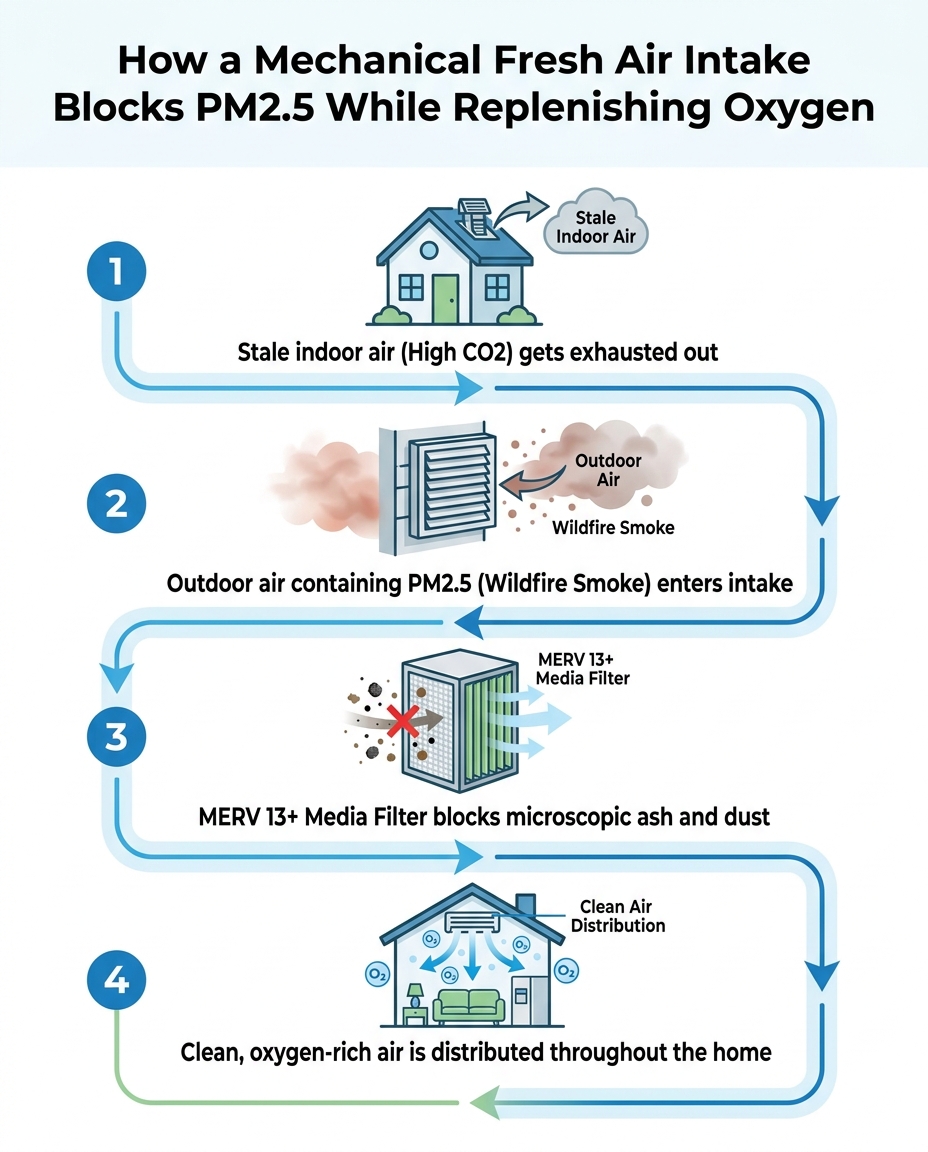
When we install a mechanical fresh air intake, we create a dedicated pathway that draws outside air into your HVAC system under highly controlled conditions. This is the exact mechanism needed to survive August late-summer wildfire smoke without feeling suffocated inside your own home. Instead of relying on drafty windows or opening a door, the system manages the air exchange mechanically.
The process of safely bringing in fresh air during a smoke event involves several precise steps:
1. Controlled Intake: A motorized damper opens, drawing a specific volume of outdoor air into the intake duct.
2. High-Efficiency Filtration: Before this outside air ever reaches your living space, it is forced through high-efficiency media (MERV 13 or higher) capable of capturing microscopic PM2.5 particles and heavy ash.
3. Conditioning: The newly filtered air enters the main HVAC system, where it works seamlessly alongside your existing air conditioning to cool and dehumidify the air.
4. Distribution: The blower motor pushes this clean, conditioned, oxygen-rich air throughout the ductwork to every room in the house.
The power of positive pressure:
One of the most important benefits we point out about a mechanical intake is the creation of positive pressure inside the home. When you mechanically bring air in, the house becomes slightly pressurized compared to the outside. This active pressure pushes stale air out through exhaust vents, bathroom fans, and microscopic cracks in the building envelope. More importantly, positive pressure actively prevents unfiltered August late-summer wildfire smoke from seeping into the house through those same microscopic cracks.

Should You Turn AC On When There Is Smoke Outside?
Many homeowners hesitate to use their cooling systems when the sky is thick with smoke, fearing it will pull hazardous air indoors. This is a common point of confusion our technicians hear in Deschutes County / Bend OR, especially when temperatures spike at the exact same time the air quality drops.
We always tell our customers: yes, you should run your air conditioner. Standard central cooling systems only recirculate existing indoor air; they do not pull air from the outside. The large unit sitting in your side yard (the condenser) is rejecting heat from your home into the outdoor air, but it is not sucking that outdoor air into your ductwork. The air blowing out of your vents is the exact same air that was sucked into your indoor return grilles, just cooled down.
Running your AC during wildfire smoke is generally safe and recommended, provided the system is equipped with a clean, high-quality filter to scrub the recirculating air. In fact, keeping the air moving helps your indoor filter capture any smoke particles that may have hitched a ride inside on your clothes or through an open door.
However, while running your AC during wildfire smoke keeps you cool and filters the existing air, it does not solve the oxygen problem. To actually get fresh air into the house without opening windows, a dedicated mechanical intake or Energy Recovery Ventilator (ERV) must be integrated into the ductwork. Without that specific mechanical addition, your AC is simply cooling the same stale air over and over again.
ERVs and Filtered Dampers: Specialized Defenses for High Desert Homes
At Mountain View Heating, we know Central Oregon's specific climate requires HVAC systems that can handle a unique set of challenges. Systems must be able to simultaneously filter out coarse, high desert dust and ultra-fine, late-summer Cascade wildfire ash without restricting airflow and burning out the blower motor. This requires specialized equipment and precise calibration.
Energy Recovery Ventilators (ERVs) are highly effective solutions we recommend for the Deschutes County / Bend OR climate. These systems exchange stale indoor air for fresh outdoor air while transferring heat and moisture. During a hot, smoky summer day, an ERV will draw in fresh outdoor air, filter out the PM2.5 smoke particles, and use the outgoing stale (but cool) indoor air to pre-cool the incoming fresh air. This keeps indoor climates incredibly stable and reduces the strain on your air conditioner.
Alternatively, filtered motorized dampers offer another layer of defense. These dampers can be programmed to open only when the HVAC blower is running, ensuring all incoming air passes directly through the primary HEPA or MERV 13 filter before it reaches the living space.
• Energy Recovery Ventilator (ERV) — How It Works: Exchanges indoor/outdoor air while transferring heat and moisture. — Best Application in Central Oregon: Homes needing continuous fresh air and energy efficiency during extreme temperature swings.
• Filtered Motorized Damper — How It Works: Opens a dedicated intake duct only when the system blower is active. — Best Application in Central Oregon: Cost-effective way to introduce controlled fresh air through the main system filter.
• Standard Recirculation — How It Works: Moves existing indoor air through the filter without bringing in new oxygen. — Best Application in Central Oregon: Basic cooling, but inadequate for long-term lock-downs during severe smoke.
These systems must be carefully calibrated. If a filter is too restrictive, the system cannot pull enough air, stressing the equipment. Our team at Mountain View Heating brings deep local expertise in configuring Bend-area HVAC systems specifically to balance oxygen intake with PM2.5 exclusion during severe smoke events. Local expertise is critical to configuring these systems so they provide enough oxygen without overwhelming the system's static pressure limits.
The Importance of Proper Air Distribution During Smoke Events
Even with a top-tier fresh air intake installed, poor ductwork or unbalanced vents can leave certain rooms completely starved for oxygen. When you are sheltering from August late-summer wildfire smoke, you need that filtered, fresh air to reach every corner of the house, not just the hallway near the main return vent.
Proper system analysis ensures that filtered, fresh air reaches second-story bedrooms, distant living areas, and home offices equally. If your ductwork is undersized, leaking, or poorly designed, the fresh air drawn in by your mechanical intake will never make it to the rooms where you actually sleep and work.
Recently, our team worked with a local homeowner who purchased a house with existing HVAC issues, noticing that the upstairs had virtually no heating or cooling, and poor air distribution elsewhere. Because the air wasn't moving properly, the upstairs rooms felt stagnant and uncomfortable. One of our technicians analyzed the setup, arranged the necessary servicing, and coordinated with a plumber to fix the underlying issues. The result was vastly improved air distribution throughout the entire house, ensuring every room received proper airflow.
Signs your air distribution needs attention:
• Hot and cold spots: Certain rooms are consistently warmer or cooler than the rest of the house.
• Weak airflow: You can barely feel air coming out of the registers in distant bedrooms.
• Stuffy rooms: Specific areas of the home always smell stale or feel heavy, especially when doors are closed.
Addressing existing distribution issues before smoke season hits prevents the need to rely on noisy, localized box fans to move air around. Professional diagnostics from our team can identify exactly where duct modifications, balancing dampers, or zoning can improve overall whole-home breathability, ensuring your fresh air intake performs exactly as intended.
Frequently Asked Questions About Ventilating During Smoke Events
Does a fresh air intake bring in smoke?
No, a properly configured fresh air intake will not bring smoke into your home. The intake duct is paired with high-efficiency media filters (like MERV 13 or higher) specifically designed to capture microscopic PM2.5 ash and smoke particles. The system draws in the outdoor air, scrubs it clean of the hazardous smoke, and delivers only the fresh oxygen into your living space, keeping your home safe during Deschutes County / Bend OR smoke events.
How to get fresh air in house during wildfire?
The safest way to get fresh air into your house during a wildfire is through a mechanical ventilation system like an ERV or a filtered intake damper. These systems actively pull outdoor air through a dense filter, stripping away the smoke and ash before it enters your rooms. Relying on open windows or standard exhaust fans will pull unfiltered, hazardous air directly into your home, compromising your indoor air quality.
Does central air bring in smoke from outside?
Standard central air conditioning does not bring in smoke from the outside because it only recirculates the air already inside your home. The outdoor unit simply dissipates heat; it does not have an air intake connected to your ductwork. As long as your windows and doors are sealed, running your central AC is safe and actually helps filter your indoor air as it passes through your system's return filter.
What MERV rating is required to stop PM2.5?
To effectively stop PM2.5 particles—the microscopic, hazardous particles found in wildfire smoke—we recommend a filter with a MERV 13 rating or higher. Lower-rated filters (MERV 8 or 10) are great for standard household dust and pollen, but they are not dense enough to trap the ultra-fine ash produced by wildfires. Always ensure your HVAC system can handle the increased airflow resistance of a MERV 13 filter before upgrading.
How long can you safely keep windows closed during a smoke event?
Without mechanical ventilation, keeping windows closed for more than 24 to 48 hours can lead to noticeable increases in indoor carbon dioxide and stale air, causing fatigue and headaches. If you have a dedicated fresh air intake or ERV installed, you can safely keep your windows closed for weeks at a time during severe smoke events, as the system continuously replenishes your oxygen levels mechanically.
Prepare Your Home's Ventilation for the Next Smoke Event
Breathing safe, oxygen-rich air shouldn't require compromising your home's defense against outdoor pollution. When the August late-summer wildfire smoke rolls in, you deserve the peace of mind that comes from knowing your home is both secure against hazardous ash and supplied with fresh, breathable air.
Upgrading your system with a proper mechanical intake ensures your family stays comfortable, alert, and healthy during extended lockdowns. Instead of settling for stale air and rising CO2 levels, talk to our local experts at Mountain View Heating about evaluating your current setup. Exploring specialized air distribution systems and mechanical ventilation will keep your indoor air fresh, safe, and perfectly balanced no matter what the sky looks like outside.