


That Terrifying Metal-on-Metal Sound: Is Your AC in Danger?
Dealing with a Screeching Condenser Fan Motor After Heavy Summer Use is a highly specific, high-stress situation for any homeowner. When customers call our team at Mountain View Heating in a panic, they often describe stepping outside and, instead of the familiar, steady hum of their air conditioner, hearing a sudden, loud metallic screeching noise coming from the outdoor AC condenser unit. It sounds as though the machinery is tearing itself apart, and the immediate panic is entirely justified. That aggressive grinding is not a random glitch or a minor quirk that will resolve itself; it is the sound of an active mechanical breakdown happening in real time.
Here is the most critical decision point you will face today: you must shut the system off immediately at the thermostat. Do not let it continue to run while you wait for a repair. Turning the system off prevents catastrophic compressor damage and stops the failure from spreading to the most expensive components of your cooling system.
If you are experiencing this emergency right now, professional HVAC services are essential to safely diagnose the issue. Do not hesitate to schedule an air conditioning repair before turning the unit back on.
The Anatomy of the Screech: What Is Happening Inside Your Condenser?
To understand why that noise is so alarming, you have to look at the mechanical source of the problem. The outdoor unit of your air conditioning system relies heavily on a condenser fan motor. This crucial component is responsible for pulling massive volumes of ambient outdoor air through the delicate refrigerant coils, dissipating the intense heat absorbed from inside your home.
The Role of the Fan in Heat Dissipation
The fan is the primary mechanism for rejecting indoor heat into the outdoor air. The compressor pumps hot, high-pressure refrigerant gas into the outdoor coils. Without the fan actively drawing air across those fins, the refrigerant cannot condense back into a liquid. The heat remains trapped, and the compressor is forced to work against climbing internal pressures.
Why High-Speed Friction Turns Deadly
Condenser fan motors operate at incredibly high speeds, typically spinning anywhere from 800 to 1,200 revolutions per minute (RPM). To maintain this rapid spinning without destroying themselves, these motors rely on factory-sealed bearings. These bearings contain specialized lubricants that allow the central shaft to rotate smoothly with almost zero resistance.
However, when those sealed bearings lose their lubrication, the metal components are suddenly exposed to extreme friction. At 1,200 RPM, unlubricated metal generates immense heat and physical resistance. The screeching sound you hear is the actual, physical grinding of these dry metal components scraping against one another. This friction physically degrades the motor shaft and the surrounding housing, turning a precision-engineered part into scrap metal in a matter of hours.
• Normal Operation — Bearing State: Fully lubricated, sealed — Motor Performance: Smooth, quiet spinning at 800-1,200 RPM — System Impact: Efficient heat dissipation, stable pressures
• Early Wear — Bearing State: Lubricant drying out — Motor Performance: Mild humming or ticking noises — System Impact: Slightly increased energy draw, warmer casing
• Active Failure — Bearing State: Metal-on-metal friction — Motor Performance: Loud screeching, erratic spinning — System Impact: Severe heat buildup, imminent system shutdown
The Tipping Point: Why Breakdowns Spike After Heavy Summer Use
It is no coincidence that these aggressive mechanical failures tend to happen late in the cooling season. Air conditioning units are subjected to hundreds of hours of continuous operation during the peak summer months. Every time the thermostat calls for cooling, the condenser fan motor must jump from zero to over a thousand RPMs in seconds, hold that speed for long cycles, and then power down.
The reality of thermal fatigue: This constant cycle of heating up during operation and cooling down when off creates thermal fatigue. The metal components expand and contract continuously, which slowly degrades the mechanical tolerances of the sealed bearings. Over time, the seals that hold the vital lubricants inside the bearings begin to warp and weaken.
By the time a system reaches late August continuous operation, it has accumulated its maximum level of mechanical stress for the year. The lubricants have been pushed to their absolute limits. If you hear a screeching sound late in the summer, reassure yourself that late-season failures are a known, common pattern due to this heavy operational load. The cumulative stress simply reaches a tipping point where the bearings can no longer function.
The High Desert Effect: How Dust Accelerates Bearing Failure
While heavy use plays a major role, the local environment acts as a severe catalyst for mechanical breakdown. In our years of servicing HVAC systems across Central Oregon / Bend, we've seen firsthand how our unique environmental challenges create the perfect storm for premature bearing failure. The region is characterized by low humidity, intense sun, and high amounts of airborne dust during the dry summer months.
Infiltration of Airborne Particulates
Dry, high-desert climates produce incredibly fine dust that stays airborne much longer than heavier soil particles found in humid regions. Your outdoor condenser unit acts very much like a giant vacuum cleaner, pulling thousands of cubic feet of this dusty air across the motor housing every single hour it runs.
The creation of abrasive paste: Over time, these fine dust particles manage to bypass protective housings and infiltrate aging motor seals. Once inside the bearing assembly, the dust combines with the factory-sealed lubricants. Instead of a smooth, slippery grease, the mixture turns into a highly abrasive paste—essentially liquid sandpaper. With Bend's hot, dry summers forcing continuous AC use, this prolonged heat combined with airborne dust aggressively degrades sealed bearing lubricants far faster than in milder climates.
The Domino Effect: Shutting Down to Save Your Compressor
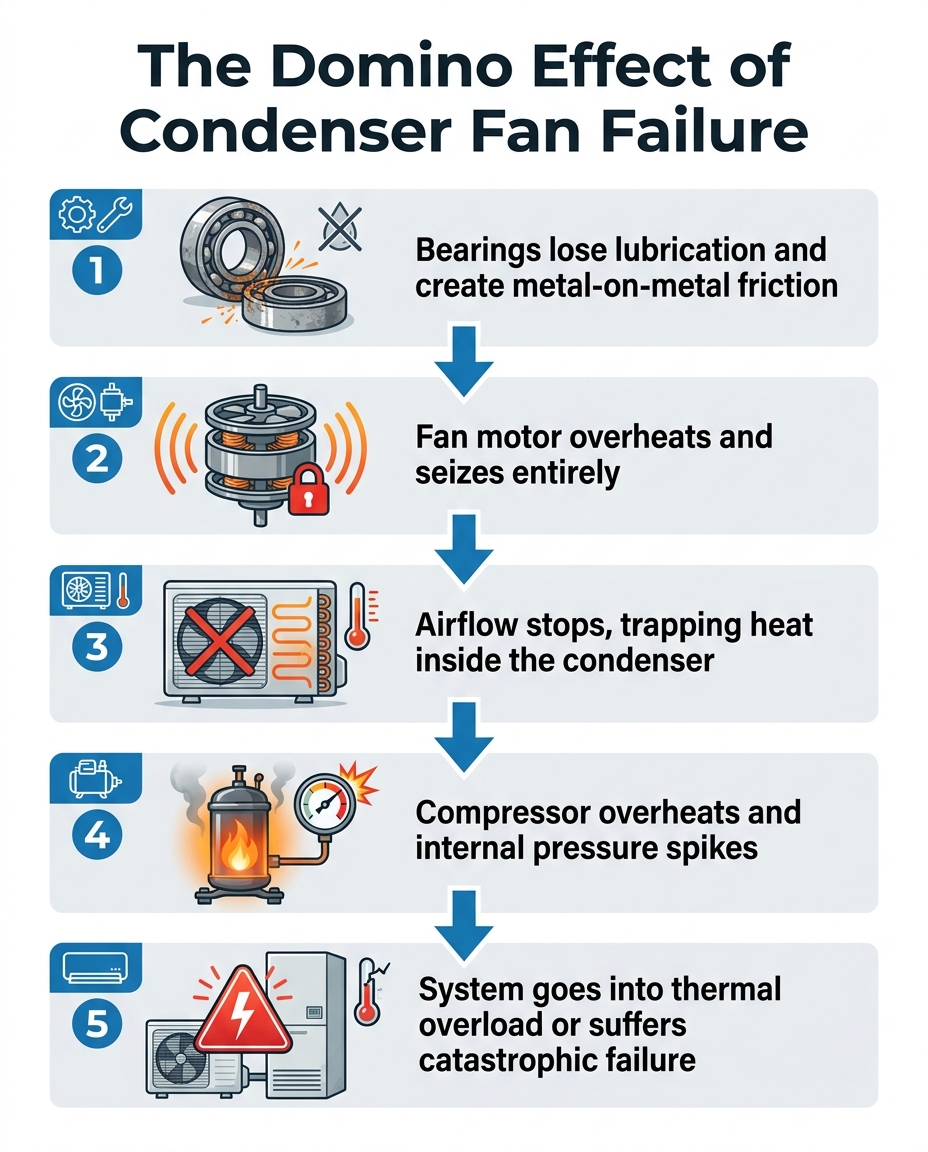
Understanding the severe consequences of a failing fan motor reinforces exactly why we tell our customers they must turn the system off immediately. Ignoring the screeching sound sets off a devastating domino effect inside your air conditioning system.
The chain reaction of failure:
• Loss of heat dissipation: As the fan motor struggles against friction, it slows down or stops entirely, meaning no air is pulled across the condenser coils.
• Trapped thermal energy: The heat absorbed from your home has nowhere to go. It remains trapped in the refrigerant.
• Spiking internal pressures: The compressor continues to pump this hot refrigerant, causing internal temperatures and pressures to skyrocket rapidly.
• Compressor overheating: The compressor—the heart of the AC system—overheats and sustains permanent internal damage.
The compressor is the most complex, vital, and mechanically intensive component to replace in any HVAC system. Contrasting the relatively straightforward process of replacing a burned-out fan motor with the massive undertaking of a full compressor replacement makes the choice obvious. Provide yourself with the ultimate protection: provide a firm, authoritative directive to your household to turn the thermostat to "OFF" immediately upon hearing the screech.

What Happens When a Condenser Fan Motor Seizes Completely?
If the system is allowed to run while the screeching occurs, the worst-case scenario will quickly unfold: complete motor seizure. When a motor seizes, the bearings lock up entirely. The metal components have welded themselves together through friction and heat. The fan blade stops turning completely, even though the system is still receiving high-voltage electrical power.
The electrical and thermal fallout: When the fan stops but power is still applied, the motor draws what is known as "locked rotor amps"—a massive surge of electricity that generates extreme heat in the motor windings until they burn out. Simultaneously, the internal pressure in the compressor spikes dangerously high. To protect itself from exploding, the compressor will eventually trip its internal thermal overload switch and shut down.
At this stage, your indoor blower fan may continue to run, but because the outdoor unit has shut down its cooling cycle, you will notice a distinct change in performance. The system will likely start blowing unconditioned, warm air indoors. If you find yourself in a situation where your system is running but failing to cool, investigating an AC blowing warm air is often the next step in understanding the broader system performance issues caused by outdoor component failure.
Professional Intervention: Why This Is Not a DIY Fix
When dealing with a screeching or seized condenser fan motor, professional intervention is an absolute necessity. The outdoor unit houses complex, high-voltage electrical components that pose a severe safety hazard to anyone without formal training. We strictly advise against attempting a DIY repair on an outdoor condenser due to the risks of electric shock and further system damage.
Here is the professional diagnostic process our licensed technicians follow to safely restore your system:
1. Safe isolation of power: Our technicians will first disconnect the high-voltage power supply at the outdoor disconnect box to ensure the unit is safe to inspect.
2. Verifying bearing failure: By manually testing the fan blade resistance and inspecting the motor housing, we confirm if the bearings have failed or seized.
3. Testing the dual run capacitor: The capacitor provides the electrical jolt needed to start the motor. We always test this component, as a failing motor often damages the capacitor, and vice versa.
4. Assessing compressor health: The most critical step is ensuring the compressor hasn't suffered thermal damage during the motor failure.
5. Component replacement: Because modern condenser fan motors use sealed bearings, they generally cannot be re-lubricated or rebuilt in the field. Replacing the entire motor unit with an OEM or equivalent part is our standard, safe practice.
Local HVAC professionals understand how to handle high demand during peak heat waves to restore cooling quickly. At Mountain View Heating, our deep experience with Bend's high desert climate allows our technicians to quickly diagnose and replace failing motors before they seize and cause fatal compressor damage. Late summer weather can be unpredictable, and system breakdowns often happen at the worst times. In one instance over a recent late-summer weekend, right as families were prepping for the back-to-school transition, a local customer's unit failed completely. We dispatched a technician on a Saturday, diagnosed the catastrophic failure immediately, and because Bend evenings can already start getting chilly in late August, we provided temporary space heaters to manage the sudden evening temperature drop while we ordered the necessary replacement parts. We had the system fully restored by Wednesday.
Breaking the Cycle: Preventing Future Bearing Failures
Transitioning from an immediate emergency to long-term preventative care is the best way to protect your investment. While late-summer wear is unavoidable, our team finds that catastrophic failures can often be prevented with proactive component inspections.
Essential preventative steps we recommend include:
• Clearing the perimeter: Keep debris, dust, leaves, and vegetation at least two feet away from the outdoor unit to ensure unobstructed airflow and reduce strain on the fan motor.
• Gentle cleaning: Periodically washing the outer fins with a gentle hose stream (never a pressure washer) helps remove the abrasive high-desert dust before it can infiltrate the motor housing.
• Listening for early warning signs: Pay attention to subtle changes in sound, such as soft ticking or humming, which often precede the loud screeching of bearing failure.
• Professional end-of-season checks: Having our technicians inspect the system allows us to detect early bearing wear, test electrical draws, and verify capacitor health before a breakdown occurs.
Establishing a consistent schedule for system upkeep is the most reliable way to avoid mid-summer panics. Investing in routine AC maintenance ensures that trained eyes are evaluating the mechanical stress on your system year after year.
Restoring Quiet and Reliability to Your Cooling System
If you heard that terrifying metal-on-metal sound and immediately shut your system down, you made the correct, proactive choice. By stopping the condenser fan motor from seizing completely, you likely saved your compressor from catastrophic failure.
A screeching motor is a highly solvable problem when addressed immediately by a professional. While dealing with a screeching condenser fan motor after heavy summer use is stressful, it does not have to mean the end of your air conditioner. Reach out to our local HVAC experts at Mountain View Heating to properly diagnose the noise, replace the worn components, and safely restore your home's comfort and peace of mind.
Frequently Asked Questions
Why is my outside AC unit making a loud screeching noise?
A loud screeching noise from the outdoor unit is almost always caused by failing bearings inside the condenser fan motor. As the factory lubricants dry out or become contaminated with dust, the metal components grind against each other at high speeds, creating the screeching sound.
Should I turn off my AC if it's screeching?
Yes, you should turn off the AC at the thermostat immediately. Allowing the system to run with a failing fan motor traps heat inside the unit, which can rapidly cause the compressor to overheat and suffer permanent, irreversible damage.
What happens if the condenser fan motor seizes?
If the motor seizes, the fan blade stops turning completely, preventing any heat from being dissipated from the outdoor coils. The system will draw excessive electrical current, potentially burning out the motor windings, and the compressor will trigger its thermal overload protection to prevent an explosion from spiking internal pressures.
Can you just lubricate a screeching AC fan motor?
Modern condenser fan motors are built with sealed bearings that cannot be easily accessed or re-lubricated in the field. Once the bearings have degraded to the point of screeching, the metal is already physically damaged, making full motor replacement the only safe and reliable solution.
How long does it take a professional to replace a condenser fan motor?
A trained HVAC professional can typically diagnose the issue and replace a standard condenser fan motor in one to two hours, provided they have the correct replacement part on hand. The process involves safely disconnecting high-voltage power, swapping the motor and fan blade assembly, and installing a new dual run capacitor to ensure reliable starting.