


What Causes Ice to Form on Your AC Unit (And What to Do About It)
Ice forming on your AC unit causes and what to do is a common concern for homeowners in Bend, Oregon — especially when your system stops cooling on a hot summer day. Here's a quick answer:
Common causes of AC ice buildup:
• Dirty or clogged air filter — restricts airflow over the evaporator coil
• Low refrigerant levels — caused by a leak, drops coil temperature below freezing
• Blocked vents or registers — furniture or debris cutting off return airflow
• Dirty evaporator coil — dust acts as insulation, preventing heat absorption
• Faulty blower fan — reduces air movement across the coil
• Thermostat issues — system runs too long or at too low a temperature
What to do immediately:
1. Turn your AC off at the thermostat
2. Switch the fan setting to "On" (not "Auto") to help thaw the coil
3. Check and replace your air filter
4. Clear any blocked vents or returns
5. Call a professional if ice returns or refrigerant is suspected
Walking outside on a warm Bend afternoon to find your AC unit encased in ice feels completely backwards. But it's more common than most homeowners expect — and it's never something to ignore. A frozen AC isn't a sign that your system is working overtime to cool things down. It's a warning signal that something has gone wrong inside the refrigeration cycle, and continuing to run the system can cause serious, expensive damage to your compressor and other key components.
The good news is that many causes of AC icing are straightforward to identify, and some can even be fixed with basic maintenance. But knowing the difference between a DIY fix and a problem that needs a professional makes all the difference.
Understanding Ice Forming on Your AC Unit Causes and What to Do

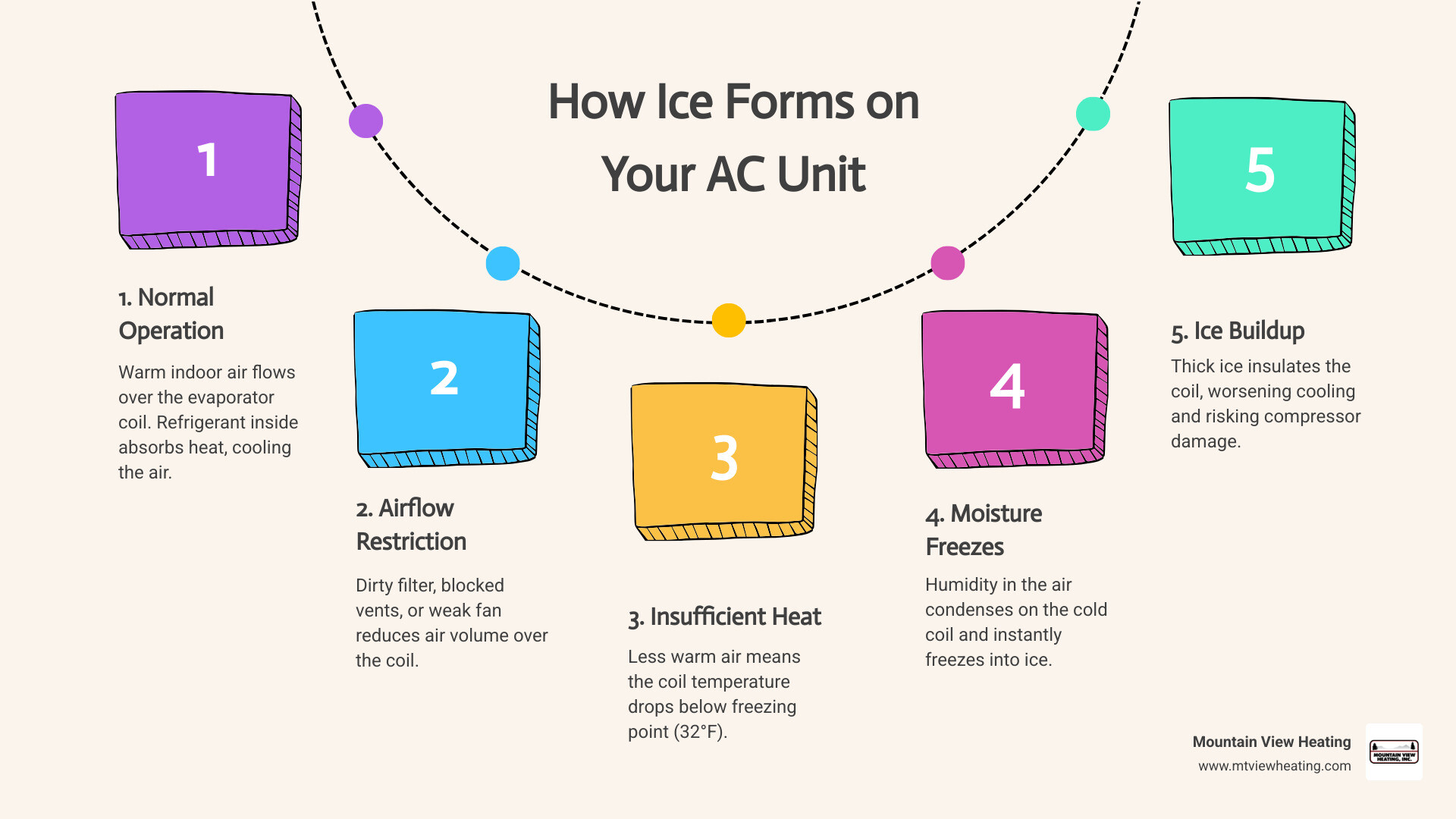
When we see ice on a residential air conditioner, the first question we usually get is, "How can it be frozen when it's 90 degrees in Sunriver?" It comes down to the science of heat exchange. Your AC doesn't actually "create" cold; it removes heat from your indoor air. This happens at the evaporator coil, where cold refrigerant absorbs the warmth from your home.
If anything disrupts this process—meaning the heat isn't being absorbed quickly enough—the refrigerant inside the coil stays too cold. Eventually, the moisture that naturally condenses on the coil (like dew on a glass of iced tea) turns into frost. Once that frost starts, it acts as an insulator, making it even harder for the coil to absorb heat, leading to a runaway ice-building effect.
If you spot ice, the very first thing you must do is shut the system down. We know it’s tempting to keep it running to get whatever little bit of "cool" air is left, but this is the fastest way to burn out your compressor. Switch the thermostat to "Off" and change the fan setting from "Auto" to "On." This keeps the indoor blower running, pushing uncooled air over the ice to help it melt naturally.
For a deeper look at identifying these signs early, check out our guide on How to Troubleshoot an AC Issue.
Dirty Filters: Common Ice Forming on Your AC Unit Causes and What to Do
If there is a "usual suspect" in frozen air conditioners, it’s the air filter. We often see homeowners in Redmond or Sisters who haven't changed their filters in six months, only to find their system turned into an igloo.
Here is why it happens: your AC needs a specific volume of air passing over the evaporator coils to keep the temperature balanced. When a filter is clogged with dust, pet hair, or Central Oregon pollen, that airflow is restricted. Without enough warm air to "warm up" the coils, the temperature drops below the freezing point.
• The 30-90 Day Rule: In our region, especially during the dusty summer months or if you have pets, you should check your filter every 30 days. High-quality pleated filters can sometimes last 90 days, but if you’re running the AC constantly in July and August, they fill up fast.
• The "Invisible" Blockage: Sometimes the filter looks clean but is actually the wrong "MERV" rating for your system. If the filter is too thick, it can restrict airflow just as much as a dirty one.
If you've discovered your filter is the culprit, you can learn more about the mechanics behind this in our article on Why Do Air Conditioners Freeze Up.
Refrigerant Leaks: Serious Ice Forming on Your AC Unit Causes and What to Do
There is a common myth that air conditioners "use up" refrigerant like a car uses gas. In reality, your AC is a closed system. If the refrigerant is low, it means you have a leak.
When refrigerant levels drop, the pressure inside the system also drops. According to the laws of physics (specifically the Joule-Thomson effect), a drop in pressure leads to a drop in temperature. This causes the evaporator coil to become much colder than it was designed to be—often well below 32°F.
Signs of a refrigerant leak include:
• A hissing or bubbling sound coming from the unit.
• The AC is running but blowing warm air.
• Ice forming specifically on the "suction line" (the larger copper pipe leading to the outdoor unit).
If you suspect a leak, this isn't a DIY fix. Handling refrigerant requires specialized tools and EPA certification. Simply "topping it off" without fixing the leak is like trying to fill a bucket with a hole in the bottom; the ice will just come back. For more on this, read about the Reasons Your AC System May Be Blowing Out Warm Air.
Why a Frozen AC is a Serious Residential Problem
It might seem like a minor inconvenience, but ice forming on your ac unit causes and what to do should be treated as an emergency for your equipment. When ice encases the coils, your system has to work twice as hard to do half the work. This leads to several major issues:
1. Compressor Failure: The compressor is the heart of your AC. It is designed to pump refrigerant in a gaseous state. When the coils are frozen, the refrigerant doesn't always evaporate fully, meaning liquid refrigerant can slug back into the compressor. This can cause the compressor to fail entirely, and in many cases, it’s more cost-effective to replace the whole unit than just the compressor.
2. Sky-High Energy Bills: A frozen unit runs almost constantly because the thermostat never reaches the target temperature. You are essentially paying for the electricity to run a giant, inefficient ice-maker in your attic or closet.
3. Water Damage: As that ice eventually melts, it can overwhelm your condensate drain pan. If the drain line is even slightly clogged, that water will spill over, potentially damaging your drywall, flooring, or furnace components below.
4. Uneven Cooling: You’ll notice some rooms are stifling while the vents near the unit might be blowing a tiny bit of freezing air before stopping altogether.
Maintaining your Air Conditioning system isn't just about comfort; it's about protecting one of the most expensive investments in your home.
Step-by-Step: How to Safely Thaw Your System
If you’ve discovered ice, don’t panic, but don't reach for the ice pick either. You need to thaw the system safely to avoid damaging the delicate aluminum fins on your coils.
The Thawing Process:
1. Shut it Down: Turn the thermostat to "Off." This stops the cooling cycle immediately.
2. Activate the Fan: Switch the fan setting to "On." This uses the blower motor to pull warm indoor air over the frozen coils.
3. Check the Drain: As the ice melts, it creates a lot of water. Make sure your condensate drain line is clear. If you see water pooling on the floor, use towels to soak it up and prevent damage.
4. Wait Patiently: Depending on the thickness of the ice, it can take anywhere from 1 to 24 hours to thaw completely. Do not try to speed this up with a hair dryer on high heat, as you can melt the solder joints or damage the plastic components.
5. Inspect the Filter: While you wait, pull out the air filter. If it’s dirty, replace it.
6. Check the Vents: Walk through your home and make sure at least 80% of your supply vents are open and that no furniture or rugs are covering the return air grilles.
For a full breakdown of what to do if the system doesn't kick back on after thawing, see our AC Repair Bend OR Complete Guide.
Proactive Maintenance to Prevent Future Freezing
The best way to handle ice forming on your ac unit causes and what to do is to make sure it never happens in the first place. Regular maintenance is the key to longevity in the high desert climate of Central Oregon.
• Annual Inspections: We recommend a professional tune-up every spring before the heat hits. This includes checking refrigerant pressures, inspecting the blower motor, and cleaning the coils.
• Clean the Coils: Dust and grime on the evaporator coil act as a barrier to heat exchange. A clean coil is a happy, ice-free coil.
• Clear the Outdoor Unit: Make sure there is at least a two-foot "dead zone" around your outdoor condenser unit. Trim back sagebrush, juniper, or ornamental grasses that might be choking the airflow.
• Thermostat Calibration: Sometimes, a faulty thermostat tells the system to run when it shouldn't, or it doesn't accurately read the temperature, leading to overcooling and freezing.
• Filter Replacement — DIY or Pro?: DIY — Frequency: Every 30-90 Days — Why It Matters: Essential for airflow
• Vent Cleaning — DIY or Pro?: DIY — Frequency: Monthly — Why It Matters: Prevents blockages
• Coil Cleaning — DIY or Pro?: Pro — Frequency: Annually — Why It Matters: Increases heat absorption
• Refrigerant Check — DIY or Pro?: Pro — Frequency: Annually — Why It Matters: Prevents pressure drops
• Clearing Debris — DIY or Pro?: DIY — Frequency: Weekly — Why It Matters: Maintains outdoor airflow
For more tips on keeping your system in peak shape, check out the AC Service Bend OR Complete Guide.
Frequently Asked Questions about AC Ice
How long does it take for a frozen AC unit to thaw?
In most residential systems in the Bend area, it takes between 1 and 3 hours to thaw if you run the fan. However, if the ice buildup is severe (like a solid block of ice), it can take up to 24 hours. It is vital to let it melt completely before trying to run the cooling cycle again.
Can I run my AC with ice on it?
No. Running an AC with ice on the coils is one of the fastest ways to kill your compressor. It also won't actually cool your home because the ice acts as a barrier, preventing the refrigerant from absorbing heat from your air.
When should I call a professional HVAC technician?
You should call us if:
1. The ice returns after you have replaced the filter and thawed the unit.
2. You hear hissing or bubbling noises.
3. The indoor blower fan isn't spinning.
4. You see ice on the outdoor copper lines.
5. The system trips the circuit breaker.
Conclusion
At Mountain View Heating, we’ve spent over 40 years helping our neighbors in Bend, Redmond, Sisters, and Sunriver stay comfortable through every season. We know that discovering ice forming on your ac unit causes and what to do can be stressful, but our team is here to help you navigate the fix.
Whether it's a simple filter change or a complex refrigerant leak repair, we prioritize 100% customer satisfaction. We offer 24/7 emergency support because we know AC units don't wait for business hours to freeze up. If you’re in La Pine, Terrebonne, or anywhere in the Three Rivers area and your AC is looking more like a glacier than a cooling system, give us a call. We’ll get your home back to the comfortable sanctuary it should be.
Ready for a cooler, worry-free summer? Explore our Air Conditioning services today.