


Navigating the Extremes of Bend's Late-Summer Evenings
As August late-summer days settle into the Central Oregon region, understanding how evening temperature drops in Bend change your cooling strategy becomes the secret to a comfortable, efficient home. The high desert climate delivers a dramatic, rapid shift from sweltering daytime heat to crisp, cool evening air. You might notice your air conditioner running late into the night, battling heat that is no longer outside but remains trapped inside your walls and furniture. This constant, unnecessary running causes severe end-of-season wear on your compressor.
The core challenge is knowing the exact time and temperature threshold to shut down mechanical cooling and let the natural outdoor air take over. For a comprehensive look at optimizing your equipment throughout the year, explore our guide to air conditioning systems.
Many homeowners simply leave their thermostats set to a static temperature all summer long. While this works in humid, coastal climates where nighttime temperatures stay high, doing so in a high-desert environment works against the natural rhythm of the weather. By treating the evening chill as an active, mechanical component of your home's cooling plan, you can flush out trapped indoor heat efficiently while giving your hardworking equipment a much-needed rest before the autumn season begins.
The Hidden Risk of Running Air Conditioning in 50-Degree Weather
Traditional residential cooling systems are engineered to operate optimally when outside ambient temperatures remain above 60 degrees. When you experience the massive 90-degree daytime to 50-degree nighttime drops common in the region, leaving the system running introduces significant mechanical strain.
Air conditioners rely on a specific pressure and temperature differential to evaporate and condense refrigerant. When the outdoor air plummets into the 50s, the refrigerant inside the outdoor condenser coil cannot absorb and release heat properly. This imbalance often leads to frozen indoor evaporator coils, liquid refrigerant slugging back into the compressor, and eventual system failure.
The heavy toll of cumulative summer usage: By the time late August arrives, your system has already endured hundreds of hours of heavy daytime loads. One local homeowner experienced this heavy strain firsthand when early high temperatures in June caused immense stress on their aging system. Service teams worked extended hours to replace the failing unit, ultimately installing a new system with ductless mini splits to better handle the heavy daytime load while offering precise zoned control.
Understanding End-of-Season Compressor Wear
Continuous operation through July and August weakens internal system components, making them highly vulnerable to breakdowns as the season winds down. The compressor is the heart of your cooling system, and forcing it to run during cold evening hours forces it to work outside its design parameters. The evening temperature drop is the most critical time to shut the system down, allowing the internal motors and electrical relays to cool off and reset for the next day's heat.
Defining Your High Desert Temperature Transition Threshold
To safely bridge the gap between mechanical cooling and natural ventilation, you need a concrete, actionable rule for your daily routine. The Bend high-desert climate provides the perfect natural resource for this transition, provided you time it correctly.
1. Establish the 60-to-65 degree threshold: Monitor your outdoor thermometer or weather app. Once the outside temperature dips below 65 degrees, your mechanical air conditioner begins losing its efficiency advantage. At 60 degrees, it is time to shut the cooling cycle off completely.
2. Account for thermal mass delay: Even after the outside air hits 60 degrees, your indoor thermometer might still read 78 degrees. This happens because your home's thermal mass—drywall, flooring, and furniture—absorbs solar radiation all day and slowly releases it at night. The heat is trapped inside, creating a delay in indoor comfort.
3. Initiate active cross-ventilation: Simply opening one window is rarely enough to combat thermal mass. Open windows on opposite ends of the home, prioritizing lower windows on the cooler, shaded side of the house and higher windows on the warmer side. This creates a natural vacuum that pulls crisp air in and pushes stale, trapped heat out.
4. Treat the evening chill as mechanical cooling: Natural ventilation is not just passive relief; it actively strips heat away from your walls and floors faster than an air conditioner running in inefficient cold weather ever could.
Optimizing Thermostat Settings for Rapid Evening Cooling
Manually monitoring the temperature every single evening can become tedious. Fortunately, you can program your smart thermostat to handle the drastic diurnal temperature swing automatically, ensuring your system shuts down before the outdoor temperature bottoms out.
The danger of over-cooling during the day: A common mistake during August late-summer days is setting the thermostat drastically low (like 65 degrees) at 3 p.m., hoping to "get ahead" of the evening heat. This forces the system to run continuously during the hottest part of the day, maximizing wear and tear and driving up utility bills, all for heat that the evening air will naturally clear out a few hours later.
Instead, utilize your thermostat's fan-only mode. Once you open the windows, switching the HVAC fan from "Auto" to "On" circulates the cooler air pulled in from outside through your ductwork, distributing it evenly into closed-off bedrooms and hallways. For a complete breakdown of how to utilize these features, review our guide to thermostat modes and settings.
Automating the Evening Shut-Off
Modern smart thermostats often feature weather integrations that monitor local ambient temperatures. You can configure the system to pause cooling automatically when the local weather station reports temperatures dropping below your 60-degree threshold. Alternatively, if you use a standard programmable thermostat, set a hard shut-off time based on historical August sunset times—typically around 8:00 p.m. to 8:30 p.m.—so the system never accidentally runs into the cold night.
Balancing Natural Ventilation with Late-Summer Wildfire Smoke
There is one major caveat to utilizing the Bend high-desert climate for natural cooling: poor outdoor air quality during late-summer fire season. Opening your windows is only a viable, healthy strategy when the outside air is clean and safe to breathe.
The risks of pulling in particulate matter: Wildfire smoke contains microscopic PM2.5 particles that can deeply penetrate the lungs. If you open your windows during a smoke event, you pull these hazardous particulates directly into your home's airstream, settling into your carpets, furniture, and ductwork.
Monitoring the Air Quality Index (AQI): Before transitioning to natural ventilation, you must check your local AQI. If the AQI reads above 100 (Orange/Unhealthy for Sensitive Groups), keep your windows tightly closed. You will have to sacrifice natural cooling for respiratory safety and rely on your mechanical system, even if it is slightly less efficient in the evening.
During a particularly smoky stretch, one local homeowner noticed a significant problem with their system's humidifier and overall air filtration. A technician detected the issue and quickly repaired it, restoring safe, breathable indoor air despite the hazardous conditions outside. Upgrading your filtration setup is a vital step for fire season; consider exploring dedicated indoor air quality solutions to keep your home safe when natural ventilation isn't an option.
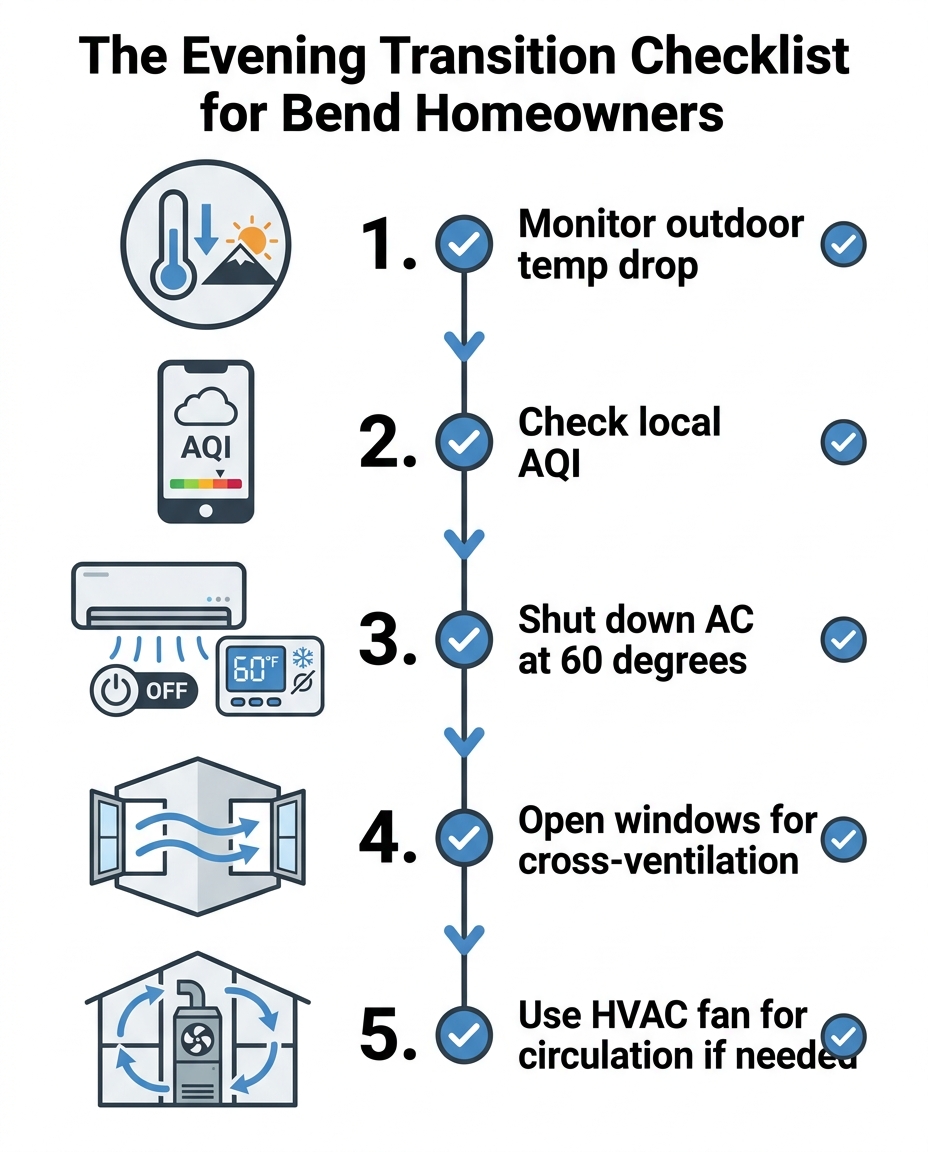
Your Step-by-Step Evening Cooling Transition Checklist
Mastering the 90-degree daytime to 50-degree nighttime drops requires a consistent daily routine. Keep this checklist handy to ensure you are maximizing comfort while protecting your equipment.
• Monitor the outdoor temperature drop: Keep an eye on the weather as the late afternoon transitions into evening.
• Check the local AQI: Verify that there are no active wildfire smoke warnings or high particulate counts in your neighborhood.
• Shut down the AC at the threshold: Manually turn off the cooling cycle or let your programmed schedule take over once outside temperatures hit 60 to 65 degrees.
• Open strategic windows: Create cross-ventilation by opening windows on opposite sides of the house to flush out thermal mass heat.
• Switch the HVAC fan to 'On': Use your thermostat to run the blower motor independently, circulating the fresh, cool air through your ductwork without engaging the outdoor compressor.
• Mechanical Air Conditioning — Best Outside Temperature: Above 65°F — Primary Benefit: Reduces indoor humidity and actively removes high heat — System Impact: Normal operation; safe for compressor and coils
• Natural Cross-Ventilation — Best Outside Temperature: Below 60°F — Primary Benefit: Flushes thermal mass heat quickly using crisp outdoor air — System Impact: Zero compressor wear; extends equipment lifespan
• Fan-Only Circulation — Best Outside Temperature: Below 60°F (with open windows) — Primary Benefit: Distributes fresh outdoor air evenly into closed rooms — System Impact: Minimal energy use; relies only on the indoor blower motor

Frequently Asked Questions About High Desert Cooling Strategies
At what outside temperature should I turn off my AC at night?
You should turn off your air conditioner when the outside temperature drops to between 60 and 65 degrees. Traditional central cooling systems are not designed to operate efficiently below this threshold. Pushing the system to run in cooler weather can disrupt the refrigeration cycle, potentially leading to frozen coils and unnecessary mechanical strain.
Does running the AC when it's cold outside damage the compressor?
Yes, running the system in cold ambient temperatures can severely damage the compressor. The refrigerant needs warm outdoor air to properly convert from a gas back into a liquid inside the condenser. If it remains too cold outside, liquid refrigerant can slug back into the compressor, causing catastrophic internal damage that requires extensive repairs.
How do I use natural ventilation safely during wildfire season?
Always check your local Air Quality Index (AQI) before opening any windows during August late-summer days. If the AQI indicates elevated particulate matter from wildfire smoke, keep your windows closed and rely on your mechanical system and indoor air purifiers. Sacrificing a bit of energy efficiency is necessary to protect your family's respiratory health during heavy smoke events.
What is the best thermostat setting for summer nights in Bend?
The optimal setting is to turn the cooling mode completely off and switch the fan setting from "Auto" to "On." This allows you to open your windows and use the HVAC blower motor to circulate the crisp outdoor air throughout the entire house. This method cools the home rapidly while giving the outdoor compressor a complete rest.
How can I cool a house with natural ventilation effectively?
Effective natural ventilation requires active cross-breezes rather than just opening a single window. Open windows on the cooler, shaded side of your home to pull air in, and open windows on the warmer side to push hot air out. This creates a natural vacuum effect that strips heat out of your drywall and furniture much faster than passive cooling.
Preserve Your Cooling System's Lifespan This Summer
Mastering the evening transition in the Bend high-desert climate does more than just keep your home comfortable; it actively prevents end-of-season wear and tear. By shutting down your mechanical cooling at the right temperature threshold and utilizing natural cross-ventilation, you relieve immense pressure from your compressor, extending the lifespan of your entire system.
A well-maintained system handles these extreme daily temperature swings much more gracefully. As the season progresses, having a knowledgeable professional inspect your equipment ensures it remains in peak condition. One local customer recently prioritized this by having a technician provide thorough, efficient service, ensuring their equipment operated flawlessly through the toughest heatwaves without unnecessary add-ons.
If you want to ensure your system is prepared to handle the demands of the high desert, taking proactive steps now is the smartest move. Schedule your routine HVAC maintenance before the season ends to secure a clear, actionable strategy for long-term comfort and equipment reliability.