



Why a Professional Spring Tune-Up is Essential for Central Oregon Summers
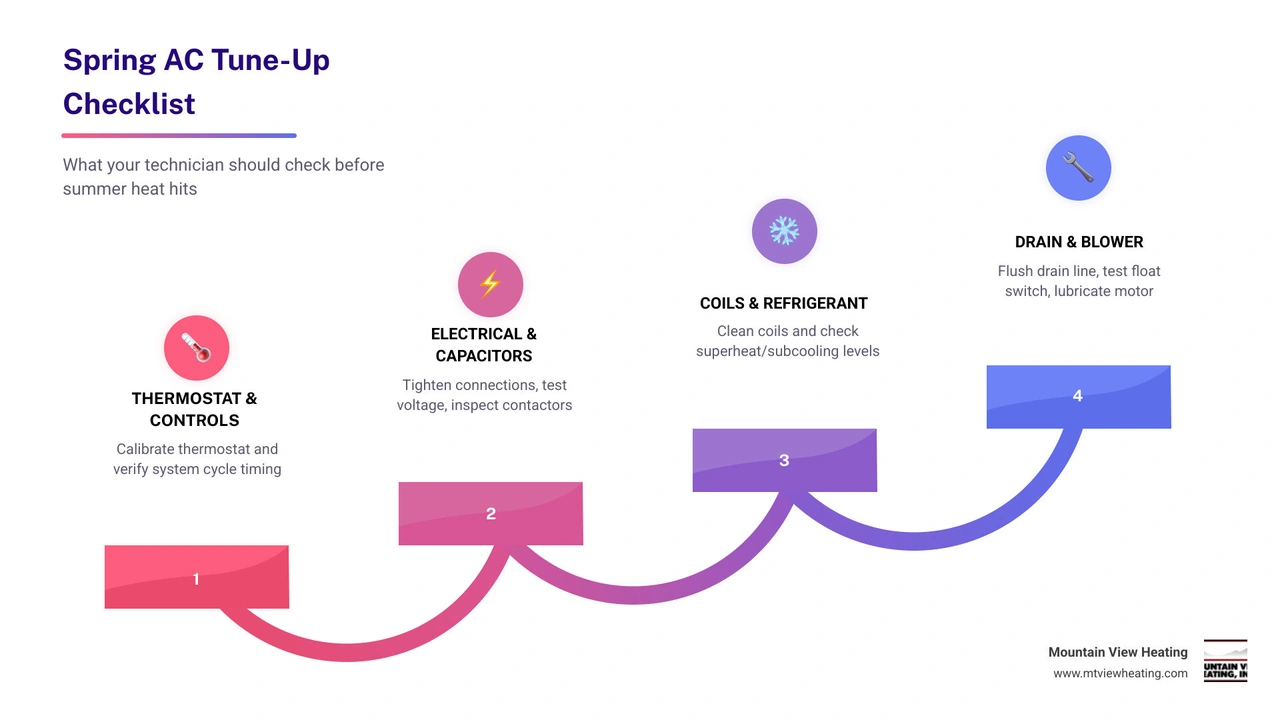
What your technician should check during a spring AC visit covers more ground than most Bend, Oregon homeowners expect — and skipping even one step can mean a very uncomfortable, expensive surprise when July temperatures spike.
Here's a quick overview of the key inspection areas a qualified technician should cover:
1. Thermostat calibration - Verify accuracy and check cycle timing
2. Electrical connections and capacitors - Tighten connections, test voltage, inspect contactors
3. Evaporator and condenser coil cleaning - Remove dirt that reduces heat transfer efficiency
4. Refrigerant levels and leak detection - Measure superheat and subcooling; locate any leaks
5. Condensate drain line - Flush the line, test the safety float switch, check the drain pan
6. Blower motor and fan assembly - Lubricate moving parts, check fan blade balance
7. Air filter and ductwork - Replace the filter, check for duct leakage and airflow restrictions
According to industry data, 75% of no-cooling calls during summer are caused by a lack of maintenance — and a neglected system can lose up to 5% of its efficiency every year it goes without service. A proper spring tune-up catches small problems before they become expensive mid-summer emergencies.
The sections below break down each of these checks in detail so you know exactly what a thorough visit should look like — and what to watch out for.
Living in Central Oregon means enjoying some of the most beautiful summers in the Pacific Northwest. However, our unique high desert climate presents specific challenges for residential air conditioning systems. From Bend and Redmond to Sisters and La Pine, we experience dramatic temperature swings, heavy pollen counts, high desert dust, and, in recent years, seasonal wildfire smoke.
During the spring, it is not uncommon to see daily lows in the 20s or 30s, followed by afternoon highs climbing rapidly. Once summer arrives in earnest, your air conditioner must transition from sitting idle all winter to working overtime to keep your home comfortable.
Here is why a professional spring tune-up is absolutely essential for your home:
• Combatting High Desert Dust and Smoke: The dry, dusty climate of Central Oregon means your outdoor condenser unit and indoor filters collect debris much faster than they would in humid regions. When wildfire smoke or spring pollen coats your system's coils, it acts as an insulating blanket, forcing your system to work twice as hard to cool your home.
• Extending System Lifespan: On average, regular preventative maintenance extends the lifespan of your unit by 5 to 10 years. A neglected system can see its operational life cut in half, forcing you into a premature replacement.
• Maximizing Energy Savings: A well-maintained system uses 15–20% less energy than one that has been neglected. Keeping your system clean and optimized directly translates to lower monthly utility bills when the summer heat sets in.
• Protecting Your Manufacturer Warranty: Many homeowners do not realize that the fine print of their manufacturer's warranty requires annual professional maintenance. If a major component like the compressor fails in year five, the manufacturer may deny your warranty claim if you cannot provide documented proof of regular professional service.
To learn more about how to keep your cooling system in peak condition, check out our AC Tune-Up Guide 2026 Central Oregon Homeowners and discover more about timing in our guide on How Often Should You Schedule an AC Tune-Up.
What Your Technician Should Check During a Spring AC Visit: The Ultimate Checklist
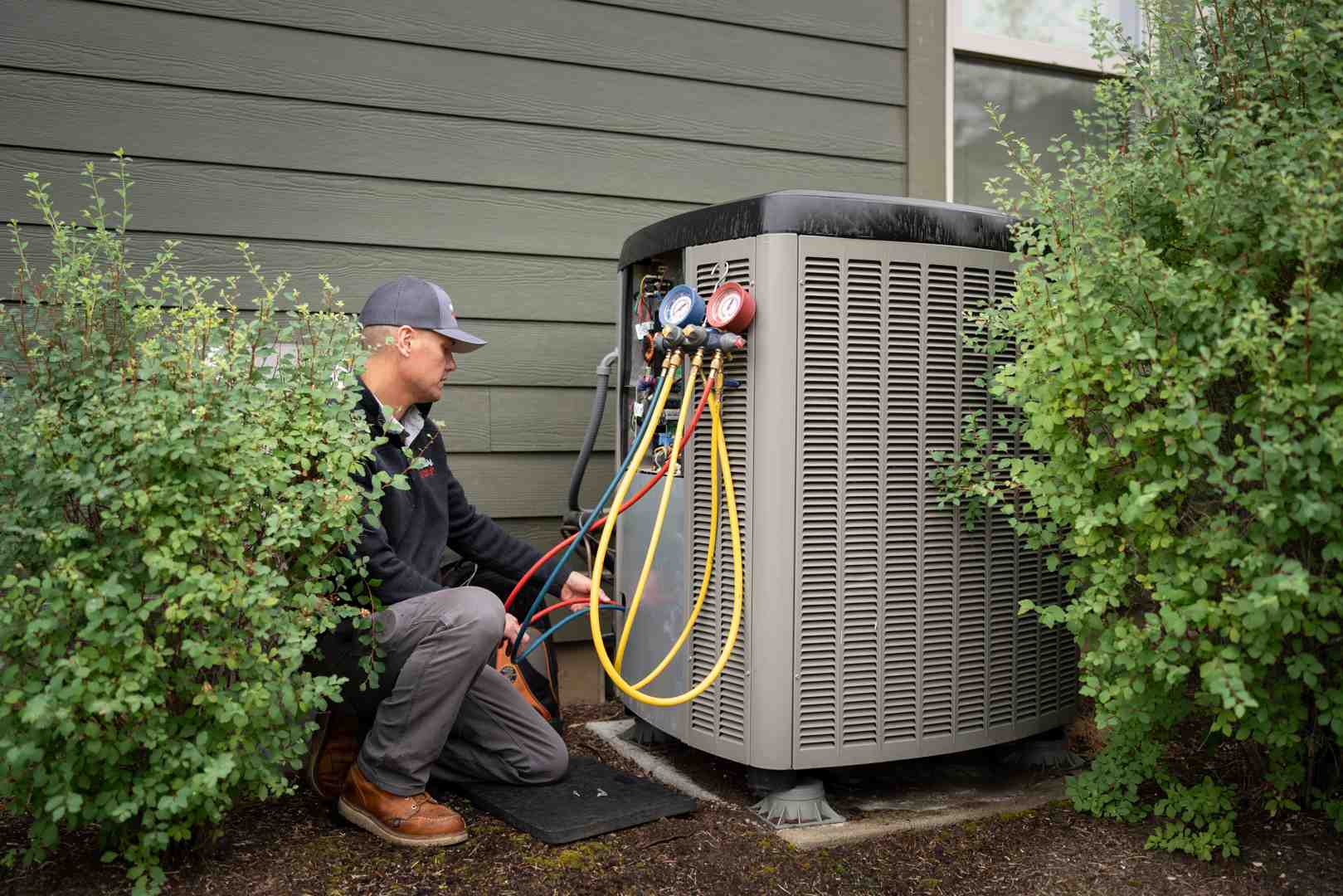
When our technicians arrive at your home for a spring maintenance visit, they do not just perform a quick visual scan and change your air filter. A truly comprehensive tune-up requires a series of highly technical mechanical, electrical, and performance tests to ensure your system is operating safely and efficiently.
To help you understand what happens during a professional visit, we have compiled the ultimate spring AC checklist. This list details exactly what your technician should look for and why each step is critical. For an overall look at what these appointments entail, you can read our breakdown of What Does an HVAC Maintenance Visit Include.
Thermostat Calibration and Controls: What Your Technician Should Check During a Spring AC Visit
Your thermostat is the brain of your entire heating and cooling system. If it is not calibrated correctly, your air conditioner will not receive accurate instructions, leading to uneven cooling and wasted energy.
During a spring visit, your technician should:
• Verify Calibration: Test the thermostat to ensure its temperature reading matches the actual room temperature within 2°F.
• Evaluate Smart Thermostat Settings: If you have a smart or programmable thermostat, the technician should verify that the schedules are optimized and that the device is communicating properly with your AC.
• Monitor Cycle Times: We watch the system run through a full cooling cycle to ensure it does not short-cycle (turning on and off too rapidly), which places immense strain on the compressor.
Electrical Components and Capacitors: What Your Technician Should Check During a Spring AC Visit
As temperatures rise, electrical wires inside your AC expand and contract, which can cause connections to loosen over time. Loose connections are one of the leading causes of premature component failure and can even pose a safety hazard.
During the electrical inspection, the technician will:
• Tighten Connections: Secure all electrical wiring, terminals, and circuit board connections.
• Test Capacitors: Capacitors act like temporary batteries that give your system the extra boost of power it needs to start up. We test capacitor microfarads to ensure they are within 5–10% of their rated value. A weak capacitor is a ticking time bomb; replacing it in the spring is much easier and more convenient than dealing with a sudden system failure on a hot July afternoon.
• Inspect Contactors: Contactors control the flow of electricity to your compressor and fan motor. Technicians check these for pitting or burning, replacing worn contactors before they weld shut and damage your compressor.
For more information on how we prepare your system's electrical and mechanical systems for the heat, read about the 5 Ways a Professional Preps Your HVAC System for Summer.
Evaporator and Condenser Coil Cleaning
Your air conditioner does not actually "create" cold air; instead, it absorbs heat from inside your home and releases it outdoors. This heat transfer process relies entirely on two sets of coils: the indoor evaporator coil and the outdoor condenser coil.
• Indoor Evaporator Coil: This coil absorbs heat and moisture from your indoor air. Over time, airborne particles like dust and pet dander bypass your filter and settle on the coil. Dirty evaporator coils can drop system efficiency by 30% or more, often leading to a frozen system.
• Outdoor Condenser Coil: Located in your outdoor unit, this coil releases the heat absorbed from your home. High desert dust, grass clippings, and pollen quickly coat this coil. Dirty condenser coils can reduce efficiency by 20–30%, forcing the compressor to run hotter and longer.
• The Cleaning Process: Your technician should carefully clean these coils using specialized, non-corrosive cleaners and water, ensuring the delicate aluminum fins are not bent or damaged.
Refrigerant Levels and Leak Detection
Refrigerant is the lifeblood of your air conditioner. It is a sealed chemical loop, meaning your system does not "consume" refrigerant like a car consumes gasoline. If your system is low on refrigerant, it is because there is a physical leak.
During a spring visit, your technician will:
• Measure Charge Levels: We use digital gauges to measure the subcooling and superheat of your system. This is the only accurate way to verify that your refrigerant charge meets the manufacturer's exact specifications.
• Detect Leaks: If the refrigerant level is low, simply topping it off is not enough. Your technician will perform leak detection to find the source of the leak and recommend a permanent repair to protect your compressor and the environment.
• Ensure Efficiency: Running an air conditioner with low refrigerant can decrease system efficiency by up to 20% and eventually destroy the compressor.
Condensate Drain Line Inspection
As your air conditioner cools your home, it removes an incredible amount of moisture from the air. In fact, a typical residential AC unit can produce up to five gallons of water per day. This moisture collects in a drain pan and flows out of your home through a condensate drain line.
To prevent water damage, your technician will:
• Flush the Drain Line: High desert dust can combine with standing water in your drain line to create algae and mold clogs. We flush the line to clear out any blockages.
• Inspect the Drain Pan: Check the pan for rust, cracks, or standing water that indicates a slow drain.
• Test the Safety Float Switch: Many modern systems are equipped with a safety float switch. If the drain line clogs, the float switch will trigger and automatically shut down the system before water overflows into your home, saving you from costly ceiling or floor repairs.
Blower Motor and Fan Assembly
The blower motor is responsible for pushing the cooled air through your home's ductwork. If the blower assembly is dirty or poorly lubricated, airflow drops, and your system has to work significantly harder.
Your technician should:
• Inspect Fan Blades: Check both the indoor blower wheel and the outdoor condenser fan blades for dirt buildup, balance issues, or physical damage.
• Lubricate Moving Parts: If your system has older, non-sealed bearings, the technician will apply the proper lubrication to reduce friction and electrical consumption.
• Measure Airflow: Ensure the blower motor is operating at the correct speed to deliver optimal airflow to every room in your home.
Airflow, Ductwork, and DIY Maintenance Between Visits
While professional spring maintenance is crucial, keeping your air conditioner running smoothly throughout the summer requires a partnership between you and your HVAC team. There are several simple, safe maintenance tasks you can perform between our visits to maximize airflow and protect your system.
• Change Your Air Filters Regularly: Your air filter should be inspected monthly and replaced every 30 to 90 days. In Central Oregon, you may need to change it more frequently during the summer due to high pollen levels, pet dander, and seasonal wildfire smoke. A clogged filter restricts airflow, forcing the blower motor to work 15% harder and potentially causing your evaporator coils to freeze.
• Understand Your MERV Ratings: While it is tempting to buy the highest-rated allergen filter available, dense filters can restrict airflow if your system was not designed for them. We recommend consulting with your technician to find the perfect balance between indoor air quality and system airflow.
• Maintain Outdoor Clearance: Your outdoor condenser unit needs to release heat efficiently. Keep a clear zone of at least 2 to 3 feet around the entire unit. Trim back shrubs, clear away weeds, and periodically check for pine needles, leaves, or dust buildup. You can gently rinse the outdoor unit with a garden hose (never use a high-pressure washer, as this will bend the aluminum fins).
• Keep Vents and Registers Clear: Ensure that furniture, drapes, and rugs are not blocking your indoor supply vents or return grilles. Obstructed vents create added pressure inside your ductwork, which can lead to airflow problems and reduce your system's efficiency by up to 15 percent.
• Ductwork and Static Pressure: During our professional visits, we measure static pressure — which acts like "blood pressure" for your ductwork — to check for blockages or design issues. In many homes, duct leakage accounts for 20–30% of cooling loss. Ensuring your ducts are sealed and insulated keeps that cooled air in your living spaces where it belongs.
To dive deeper into maintaining your system's overall efficiency, check out our AC Service Bend or Complete Guide and explore the Best AC Service Bend or Guide.
Frequently Asked Questions About Spring AC Maintenance
How long does a comprehensive professional AC inspection take?
A thorough, professional spring AC tune-up typically takes between 60 and 90 minutes. This allows our technicians enough time to perform a complete multi-point inspection, clean the necessary components, test electrical loads, check refrigerant levels, and run the system through a full test cycle to monitor performance.
At the end of the visit, you should receive a detailed service report documenting all of your system's key readings, such as capacitor health, refrigerant levels, temperature split, and any recommendations for minor repairs.
When is the best time to schedule a spring AC tune-up?
The ideal time to schedule your spring AC tune-up is in early spring, between late March and early May.
Scheduling your service during this window offers several major benefits:
• Beat the Summer Rush: Once the first true heatwave hits Central Oregon, our phone lines light up with emergency repair calls. By scheduling early, you get your choice of appointment times and avoid waiting for service.
• Identify Problems Early: Running your system before you actually need it allows us to find and fix any hidden issues, ensuring your home stays cool and comfortable the very first day you turn your AC on.
What are the red flags of a subpar tune-up service?
Not all maintenance services are created equal. If you hire a company and experience any of the following, it may be a sign of subpar service:
• The 20-Minute Visit: A technician who is in and out of your home in 20 minutes has only performed a basic visual inspection, not a real tune-up. They cannot clean coils, test capacitors, and flush drain lines in that timeframe.
• No Tools Used: If a technician does not use a multimeter to test electrical components or digital gauges to check refrigerant levels, they are guessing, not measuring.
• Immediate High-Pressure Sales: If a technician immediately pushes for a complete system replacement without taking the time to explain the current health of your unit or offering repair options, seek a second opinion.
Conclusion
Taking care of your air conditioning system before the summer heat arrives is the best way to ensure reliable, energy-efficient comfort all season long. From checking the thermostat calibration to flushing the condensate drain line and cleaning the coils, every step of a professional spring AC visit plays a vital role in preventing unexpected breakdowns, lowering your energy bills, and protecting your system's lifespan.
At Mountain View Heating, we have spent over 40 years helping homeowners across Central Oregon keep their homes comfortable. We prioritize 100% customer satisfaction for all residential projects. Our friendly, highly trained technicians are ready to ensure your cooling system is fully prepared for whatever summer brings.
We proudly serve homeowners throughout our local communities:
Don't wait for the first heatwave to find out if your air conditioner is ready. Schedule your professional spring AC maintenance with Mountain View Heating today and enjoy a cool, worry-free summer!