


The Costly Mistake of Sealing Off Unused Rooms
When you notice certain rooms in your home are struggling to stay cool, you might wonder why closing vents in empty guest rooms actually hurts your cooling instead of solving the problem. In our years of keeping Bend homes comfortable, we hear this completely logical assumption all the time: if you block the airflow going into a room nobody is using, that cold air should automatically redirect to the rooms you actually occupy, right? Unfortunately, modern home cooling systems do not work that way. In fact, our service technicians will tell you this common practice is one of the fastest ways to cause unnecessary wear and tear on your equipment.
During the peak of the August late-summer cooling season, as families transition back to school and AC units have already endured months of heavy use, this strategy actually backfires in a spectacular way. Homeowners often try to pinch pennies on their energy bills by shutting registers in spare bedrooms, offices, or basements. But instead of saving energy, closing these vents disrupts the system's delicate mechanical balance. It forces the blower motor to work significantly harder just to push the same amount of air through a restricted pathway.
Understanding how an air conditioning system distributes air is the first step to optimizing your home's comfort without causing an unexpected mechanical failure. When you make the decision between trying to force perceived energy savings and protecting your expensive equipment, knowing the science behind your ductwork makes all the difference.
• Air is perfectly redirected to hot rooms. — The Reality (What Actually Happens): Air backs up in the ductwork, causing pressure spikes.
• Your energy bills go down. — The Reality (What Actually Happens): The blower motor works harder, consuming more electricity.
• The system runs more efficiently. — The Reality (What Actually Happens): Restricted airflow causes severe strain and potential freezing.
• Unused rooms stay completely isolated. — The Reality (What Actually Happens): Air is sucked from unconditioned spaces through tiny leaks.
The 'Balanced Loop' vs. 'Water Hose' Airflow Reality
The problem: A common misconception we encounter in the field is treating HVAC airflow like a garden hose. If you want a stronger spray from a hose, you put your thumb over the end to restrict the opening. The water pressure increases, and the water shoots further. Many people assume their home's ductwork operates on this exact same principle.
The cause: Our installation team often explains to customers that residential cooling systems are not designed like open-ended hoses; they operate as a carefully balanced, closed loop. Your equipment is engineered and calibrated to move a very specific volume of air—measured in cubic feet per minute (CFM)—throughout the house. It pulls warm air in through the return vents, cools it, and pushes it out through the supply vents. When you close a register, the blower motor inside your furnace or air handler does not magically slow down or produce less air. It continues trying to push the exact same volume of air, but now it has to force it against a blocked path.
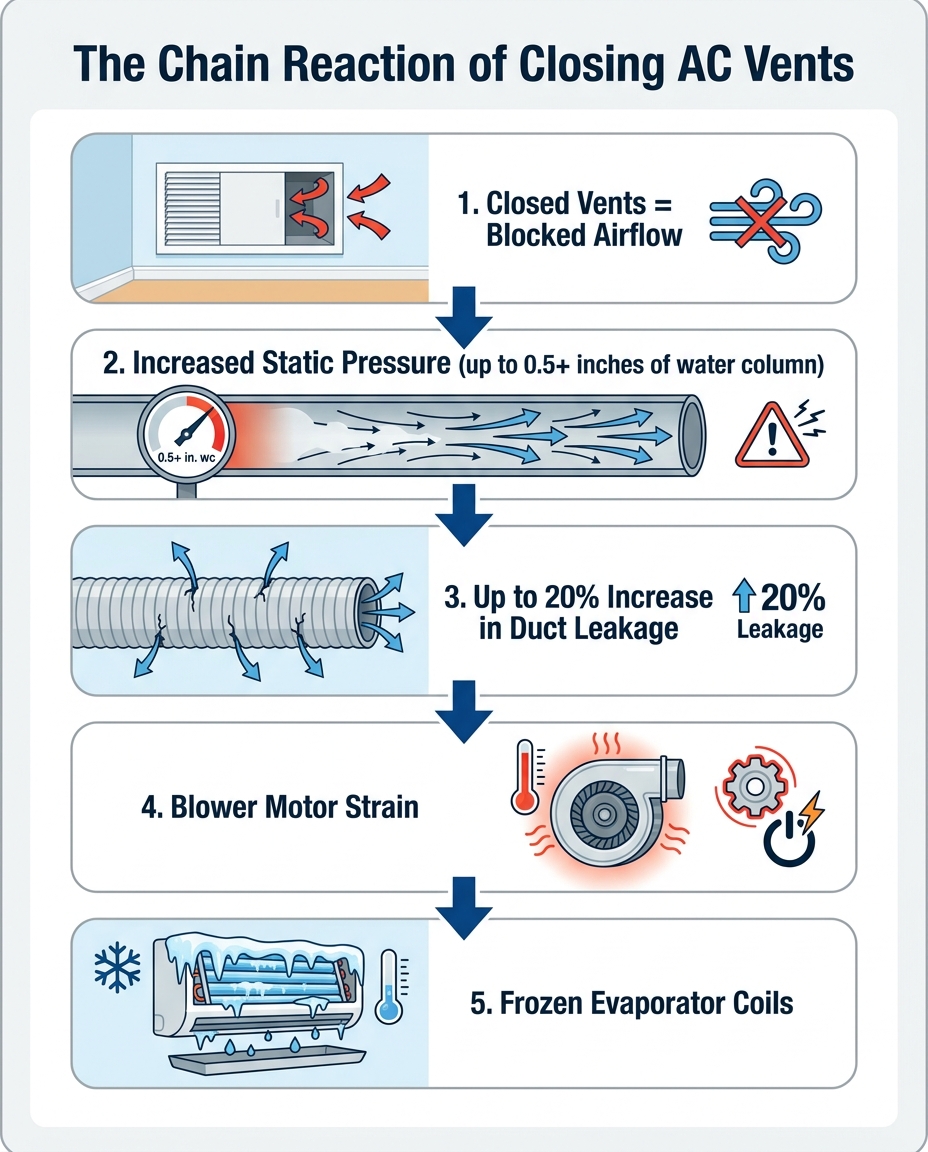
The solution: To fix uneven temperatures, we recommend looking at the entire system rather than choking off individual endpoints. This disruption in air distribution and airflow leads to immediate mechanical stress rather than energy efficiency. The air has to go somewhere. When it hits a closed vent, it backs up into the ductwork, leading to a dangerous condition known as increased static pressure.
Why the Blower Motor Cannot Adapt
Most residential systems use either a standard single-stage blower motor or an ECM (Electronically Commutated Motor). Here is what our technicians see when these motors react to closed vents:
• Standard Motors: When faced with a blocked vent, a standard motor simply overheats. It lacks the ability to adjust its speed, so it spins fruitlessly against the heavy resistance until its internal components begin to wear down prematurely.
• Variable-Speed ECMs: These highly efficient motors are designed to maintain a constant airflow. When you close a vent, the motor senses the resistance and actually ramps up its speed to overcome the blockage. This means it consumes significantly more electricity, completely erasing any energy savings you hoped to achieve.
The Hidden Threat of Increased Static Pressure
HVAC systems are meticulously calibrated to operate at a specific static pressure, typically hovering around 0.5 inches of water column. You can think of static pressure as the resistance to airflow within your ductwork. It is the HVAC equivalent of human blood pressure. Just as high blood pressure strains the heart, increased static pressure strains your cooling equipment.
Shutting registers causes an immediate and dangerous spike in increased static pressure within the duct system. The air backing up behind the closed vent pushes outward against the seams, joints, and walls of your ducts. This resistance forces the blower motor to work incredibly hard, accelerating wear and tear on the internal components. At Mountain View Heating, our technicians frequently trace premature blower motor failures in Central Oregon directly back to heavily restricted ductwork caused by closed vents or neglected, clogged air filters.
Beyond damaging the motor, this excess pressure creates another massive problem: duct leakage. The pressurized air will seek the path of least resistance. If it cannot exit through the vent, it will force its way out through tiny, microscopic leaks in the ductwork's seams. Studies have shown that closing just a few vents can increase duct leakage by up to 20%. As we often warn our customers, this means you are paying to pump perfectly conditioned, cold air straight into your hot attic, crawlspace, or wall cavities instead of your living room.
Signs Your System is Suffering from High Static Pressure
• Excessive noise: A loud, rushing "whoosh" sound coming from the vents that remain open.
• Whistling registers: High-pitched whistling noises at the return or supply grilles as air squeezes through tight gaps.
• Hot and cold spots: Severe temperature imbalances from room to room, even when the system is running constantly.
• Frequent cycling: The air conditioner turning on and off rapidly without fully cooling the home.

Why Restricted Airflow Leads to Frozen Evaporator Coils
The problem: One of the most catastrophic results of closing vents is discovering a literal block of ice growing inside your air conditioner during the hottest part of the year. The evaporator coil—the indoor component responsible for actually cooling the air—relies on a very specific, constant flow of warm indoor air moving across it.
The cause: The refrigerant inside the coil is extremely cold. As warm air from your house blows over the metal fins, the refrigerant absorbs the heat, and the air cools down. If you restrict the airflow by closing vents, not enough warm air reaches the coil to keep the temperature balanced. Without that heat transfer, the temperature of the coil drops rapidly below freezing. The natural condensation that forms on the coil during the dehumidification process will freeze instantly.
The solution: Once a thin layer of frost forms, it acts as an insulator, making the problem exponentially worse until the entire coil is encased in a solid block of ice. This completely suffocates the system and puts the outdoor compressor at severe risk of catastrophic failure. If you notice ice forming on your AC unit, our emergency repair crews find that restricted airflow from closed vents or dirty filters is almost always the primary culprit.
The Impact of High Desert Climates
We see this firsthand because the risk is heavily magnified by our regional weather patterns. Bend's high desert climate features extreme diurnal temperature variations—meaning the temperature swings wildly from cool mornings to blistering hot afternoons. During the August late-summer cooling season, this puts an immense thermal load on the air conditioning system. When peak daytime heat hits, the equipment is already working at its absolute maximum capacity. Restricting the airflow during these massive temperature swings makes the system highly susceptible to freezing over, right when you need it the most.
Solving Poor Air Distribution the Right Way
Homeowners usually do not close vents just for fun; they do it because certain rooms are too hot while others feel like a refrigerator. This indicates a fundamental air distribution issue within the home. Rather than choking the system at the registers, a professional analysis can identify the root cause, which is often related to ductwork imbalances, improper duct sizing, or inadequate return air pathways.
In our daily field work, we see how easily misunderstandings about heating and cooling services happen. We recently saw a situation where a homeowner had a misunderstanding regarding their system's capabilities and why certain rooms weren't cooling properly. After speaking directly with one of our Service Managers at Mountain View Heating, the issue was fully clarified and resolved. By taking the time to let our professionals properly assess the ductwork rather than just closing vents, the home's comfort was restored, and the customer was thrilled to give the proper balancing techniques a chance.
Properly balancing the system ensures even temperatures throughout the house while maintaining healthy static pressure. Addressing these imbalances also presents an excellent opportunity to have our experts assess your indoor air quality, ensuring that the air circulating freely through your newly balanced system is clean, properly filtered, and healthy for your family.
Professional Duct Balancing
When a system is professionally balanced by our team, technicians do not simply shut the grilles in your ceiling or floor. Instead, they manage the airflow safely at the source. Here is how the process works:
1. Airflow Measurement: Technicians use specialized tools like anemometers and flow hoods to measure the exact CFM of air coming out of every register in the house.
2. Static Pressure Testing: They measure the increased static pressure across the blower to ensure the system is operating within the manufacturer's safe parameters.
3. Trunk Line Damper Adjustment: Instead of closing the vent cover in a room, technicians adjust mechanical dampers located deep inside the main ductwork trunk lines.
4. Safe Redirection: Adjusting these inline dampers safely redirects the volume of air further down the duct run without causing the harmful pressure spikes associated with slamming a register shut.
Safe Alternatives to Closing Vents in Empty Rooms
If you have an empty guest room, a storage space, or a formal dining room that rarely sees use, you still have safe options for managing your comfort and energy usage without jeopardizing your HVAC equipment. Especially during the grueling August late-summer cooling season, you want to employ strategies that work with your equipment's engineering, not against it.
Here is a checklist of safe alternatives our HVAC professionals recommend to manage temperatures in unused spaces:
• Keep interior doors open: If a room is truly unused, keep the door wide open. This allows the conditioned air to circulate freely back to the central return vents, maintaining the system's balanced loop.
• Invest in a zoned HVAC system: If you frequently need different temperatures in different areas of the house, a zoned system is the ultimate solution. This uses a central control panel, multiple thermostats, and motorized bypass dampers to safely direct air only where it is needed, without causing static pressure spikes.
• Utilize ceiling fans: Use ceiling fans to circulate air in the rooms you actually occupy. The wind-chill effect of a fan makes you feel cooler, allowing you to raise the overall thermostat temperature by a few degrees safely, which genuinely saves energy.
• Check your return vents: Ensure all return vents remain completely unobstructed. Do not block them with heavy furniture, bookshelves, or thick rugs. The system needs to pull in just as much air as it pushes out.
• Install window treatments: Keep blinds and blackout curtains closed in unused, sun-facing rooms to naturally reduce the heat load without touching the HVAC vents.
Frequently Asked Questions
Is it bad to close AC vents in unused rooms?
Yes, closing AC vents is highly detrimental to your system. It disrupts the balanced airflow the system was designed to maintain, leading to increased static pressure. This pressure strains the blower motor, exacerbates duct leaks, and can ultimately cause the system to break down prematurely.
Does closing vents save money on energy bills?
No, closing vents does not save money. In fact, it often increases your energy costs. Because modern blower motors have to work harder to push air against the blockage, they consume more electricity. Additionally, the excess pressure forces conditioned air out through tiny leaks in your ductwork, wasting the cooling you paid for.
Why does closing vents cause AC coils to freeze?
Closing vents restricts the volume of warm indoor air flowing back over the indoor evaporator coil. The coil relies on this steady stream of warm air to absorb heat and keep the refrigerant above freezing temperatures. Without enough airflow, the condensation on the coil freezes into a solid block of ice, which can severely damage the compressor.
Does closing vents redirect air to other rooms?
Closing a vent does not efficiently redirect air to other rooms. While a tiny fraction of air might be pushed elsewhere, the vast majority of the air simply backs up into the ductwork. This creates a pressure bottleneck that causes duct leakage and forces the blower motor to overwork, rather than smoothly moving air to warmer areas of the house.
How many vents can I safely close?
As a general rule, you should never close more than 10% of the vents in your home. For most average-sized houses, this means closing even one or two vents can push the system past its safe operating limits. It is always safer to leave all vents fully open and have a professional balance the ductwork if temperatures are uneven.
What is static pressure in an HVAC system?
Static pressure is the measurement of airflow resistance within your ductwork. Think of it like blood pressure for your HVAC system. When the static pressure is too high—often caused by closed vents, dirty filters, or undersized ducts—the system has to work dangerously hard to circulate air throughout the home.
Protect Your AC System Through the End of Summer
As the late-summer heat continues to test the limits of your cooling equipment, the last thing you want to do is unintentionally cause a breakdown by closing vents. Keep those registers open, change your air filter regularly, and let the system breathe the way it was engineered to. If you are still struggling with hot and cold spots, the safest and most effective solution is to schedule routine preventative maintenance with our local experts. A Mountain View Heating professional technician can evaluate your ductwork, measure your static pressure, and ensure your Central Oregon home stays perfectly comfortable without putting your equipment at risk.