


Surviving Smoke Season: Will Your AC Help or Hurt Your Indoor Air?
Are you wondering, does air conditioning actually filter out wildfire smoke when the sky turns gray and the local air quality index plummets? It is a question almost every homeowner asks when July's escalating heat collides with hazardous AQI spikes. You close all the windows, turn the thermostat down to find relief from the sweltering temperatures, and wait for the house to cool. Yet, within an hour, that unmistakable, acrid campfire smell begins to drift through your living room, leaving you to wonder if your cooling system is secretly pulling ash indoors.
If you want to protect your home's indoor air quality while running your system, you need to understand exactly how your equipment interacts with outdoor air. Upgrading your filtration or scheduling professional air conditioning services can transform your home into a clean-air sanctuary.
The frustrating reality for many in Bend, OR, is that relying on a standard one-inch fiberglass filter during a heavy smoke event offers a dangerous false sense of security. You hear the blower motor running and feel cold air coming from the vents, which naturally leads to the assumption that the air is being cleaned. However, not all filters are created equal when it comes to microscopic ash. Standard residential cooling systems were engineered primarily for temperature control, not environmental hazard mitigation. Deciding how to handle this requires looking past basic maintenance and understanding the specific mechanics of particulate filtration, airflow dynamics, and the critical differences between simply trapping dust and actually purifying the air you breathe.
Should You Turn Your AC On When There Is Smoke Outside?
The short answer is yes, you absolutely should turn your AC on when there is smoke outside. Central air conditioning systems are designed to cool and recirculate the existing air inside your home; they do not pull fresh, smoky air in from the outdoors.
To understand why it is safe to run your system during the Pacific Northwest wildfire season, it helps to look at how a standard split-system air conditioner operates. Your system consists of an outdoor unit (the condenser) and an indoor unit (the evaporator coil and blower). The outdoor unit's only job is to compress refrigerant and release heat into the outside air. No air travels through the copper refrigerant lines connecting the outside unit to the inside unit. The blower fan inside your house simply pulls warm indoor air through the return vents, passes it over the cold evaporator coil, and pushes that same cooled air back into your rooms.
Because the system is a closed loop, running your air conditioner will not introduce new smoke into your house. However, this also means that if smoke is already seeping into your home through drafty windows, poorly sealed doors, or uninsulated attic hatches, your AC will continuously circulate that contaminated air through every room.
To maximize your protection while the system runs, you must secure the perimeter of your home:
• Lock all windows and doors: Locking creates a tighter seal against weatherstripping than simply closing them.
• Close fireplace dampers: Chimneys are massive sources of outdoor air infiltration.
• Turn off fresh air intakes: If your HVAC system has a mechanical fresh air damper or an HRV/ERV system, switch it off or set it to recirculate mode until the smoke clears.
• Avoid exhaust fans: Running bathroom or kitchen exhaust fans pulls air out of the house, which creates negative pressure and forces smoky outdoor air to leak in through gaps to replace it.
The Truth About Standard 1-Inch AC Filters and PM2.5
Most homeowners don't realize that standard 1-inch fiberglass filters were never designed to protect human lungs. Their sole purpose is to protect the internal components of your HVAC equipment—specifically the blower motor and the evaporator coil—from large debris like pet hair, dust bunnies, and lint. When a fire breaks out near Bend, OR, these basic filters are completely outmatched.
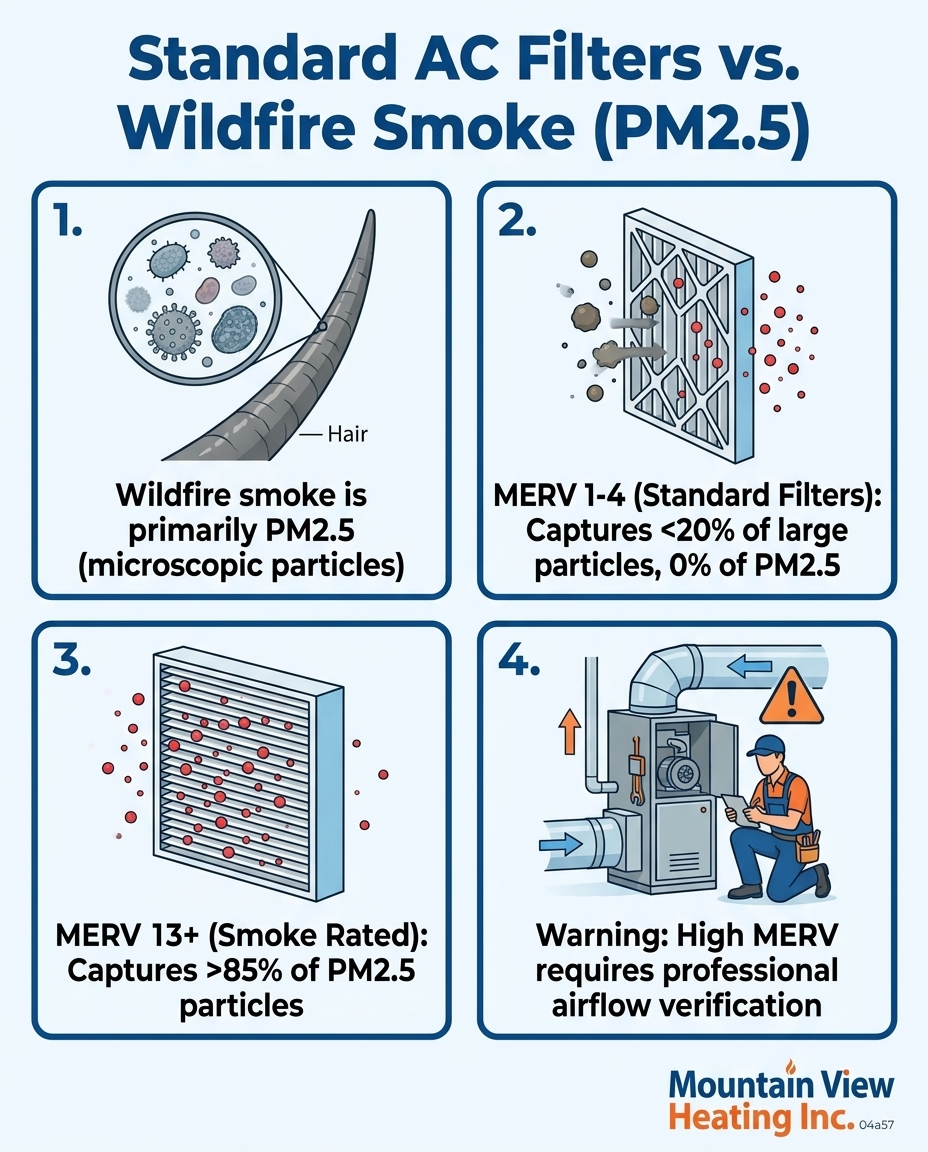
Wildfire smoke is primarily composed of fine particulate matter known as PM2.5. These are microscopic particles that are 2.5 micrometers in diameter or smaller. To put that in perspective, a single strand of human hair is roughly 70 micrometers across. PM2.5 particles are so small that they can remain suspended in the air for days, bypass your body's natural respiratory defenses, and travel deep into your lungs and bloodstream.
Standard fiberglass filters, typically rated between MERV 1 and MERV 4, are essentially "rock catchers." They are manufactured with a loose, porous weave that allows maximum airflow while catching large particles. When microscopic PM2.5 ash passes through the return duct, it slips right through the massive gaps in a standard fiberglass filter as if the filter wasn't even there.
• Standard Fiberglass — MERV Rating: 1 to 4 — Large Dust Capture (3.0 - 10.0 microns): Less than 20% — PM2.5 Capture Capacity: Virtually 0%
• Basic Pleated — MERV Rating: 5 to 8 — Large Dust Capture (3.0 - 10.0 microns): Up to 85% — PM2.5 Capture Capacity: Minimal (under 20%)
• High-Efficiency Pleated — MERV Rating: 11 to 13+ — Large Dust Capture (3.0 - 10.0 microns): Over 90% — PM2.5 Capture Capacity: Up to 85% or higher
Relying on a basic filter during a heavy smoke event leaves your home completely vulnerable. The blower motor will continue to push PM2.5 particles through your ductwork, spreading the campfire smell into every bedroom and living space. To actually clean the air, you have to upgrade the physical barrier that the air passes through.
Choosing the Right MERV Rating to Combat Wildfire Ash
To capture microscopic ash, you need a filter with a tighter weave and more surface area. The filtration industry uses the Minimum Efficiency Reporting Value (MERV) scale to rate how effectively a filter traps specific particle sizes. The higher the MERV rating, the smaller the particles the filter can catch.
During the Pacific Northwest wildfire season, basic filtration simply will not cut it. The EPA and ASHRAE (the American Society of Heating, Refrigerating and Air-Conditioning Engineers) recommend using a filter rated MERV 13 or higher to effectively remove PM2.5 from indoor air.
Here is how to approach upgrading your filters when the smoke rolls in:
1. Identify your current filter size: Check the exact dimensions printed on the cardboard frame of your existing filter. You will need a pleated filter of the exact same size to ensure a tight seal; any gaps around the edges will allow smoke to bypass the filter entirely.
2. Select a MERV 13 pleated filter: These filters use a dense, folded synthetic material that drastically increases the surface area. As your AC recirculates the indoor air, the microscopic ash particles become trapped in the deep folds of the media.
3. Monitor the filter aggressively: The intense, sustained nature of regional smoke events means filters cannot be left in for the standard 90 days. A MERV 13 filter doing its job during a heavy fire will turn dark gray or black incredibly fast.
4. Replace frequently: You must check the filter every single week during a smoke wave. It is not uncommon to need a replacement every two to three weeks until the air quality improves.
While upgrading to a MERV 13 filter is the most direct way to pull ash out of your breathing air, it introduces a significant mechanical challenge to your cooling equipment that cannot be ignored.
The Hidden Danger: Can a High-MERV Filter Freeze Your AC?
One thing we see often is well-meaning homeowners rushing to the hardware store, buying the thickest, highest-MERV filter on the shelf, and shoving it into an older HVAC system. While this might filter out the smoke, it can completely destroy the cooling process. As a local authority on Central Oregon cooling systems, we know exactly what local equipment can handle under peak July heat without suffocating.
The Problem: Airflow Restriction
Air conditioners require a highly specific volume of airflow to function correctly. The dense, tightly woven material that makes a MERV 13 filter so great at trapping microscopic ash also makes it incredibly difficult for air to pass through. This creates high static pressure in your return ductwork. Your system's blower motor suddenly has to work twice as hard to pull the same amount of air through the restrictive material.
The Cause: Starving the Evaporator Coil
When the blower motor cannot pull enough warm return air through the dense filter, the volume of air moving over the indoor evaporator coil drops drastically. The evaporator coil relies on that constant flow of warm indoor air to absorb heat. Without enough warm air passing over it, the temperature of the refrigerant inside the coil plummets below freezing. The natural condensation that forms on the coil during the cooling process then freezes solid, turning your indoor unit into a block of ice.
The Solution: Professional Verification
Before installing a MERV 13 filter, you must ensure your system is capable of handling the pressure drop. Older systems with single-stage PSC (Permanent Split Capacitor) motors often lack the power to overcome dense filters and will quickly overheat or freeze up. Modern systems with variable-speed ECM (Electronically Commutated Motors) can automatically ramp up their speed to compensate for the thicker filter, maintaining proper airflow. Having a professional verify your system's static pressure during routine AC maintenance ensures you can safely upgrade your filtration without destroying your compressor.
Upgrading Your HVAC Filtration vs. Dedicated Air Purifiers
If your current air conditioner cannot handle the static pressure of a MERV 13 filter, or if you want the absolute highest level of protection during the Pacific Northwest wildfire season, you will face a decision: do you modify your HVAC system, or do you invest in dedicated air purification?
A simple filter upgrade is often sufficient for newer homes with modern, variable-speed blowers and properly sized ductwork. If your system can breathe easily through a MERV 13 or MERV 14 filter, simply swapping the filter and running the AC fan on the "circulate" setting can drastically reduce indoor smoke levels. However, for older systems, or for households with asthma, allergies, or compromised immune systems, relying solely on the AC filter is often inadequate.
Dedicated whole-home air purifiers offer a permanent, high-performance solution. These systems integrate directly into your existing ductwork but operate independently of the standard 1-inch filter slot.
• Airflow Impact — High-MERV AC Filter: High restriction; can strain standard blower motors. — Whole-Home Air Purifier (HEPA/Electronic): Minimal restriction; often uses bypass design to protect airflow.
• Particle Capture — High-MERV AC Filter: Up to 85% of PM2.5. — Whole-Home Air Purifier (HEPA/Electronic): Up to 99.97% of PM2.5 (with true HEPA media).
• Maintenance Frequency — High-MERV AC Filter: Must be replaced every 2-4 weeks during smoke events. — Whole-Home Air Purifier (HEPA/Electronic): Media filters typically last 6-12 months due to massive surface area.
• System Wear and Tear — High-MERV AC Filter: Increases strain on older HVAC systems. — Whole-Home Air Purifier (HEPA/Electronic): Protects HVAC equipment while purifying the air.
Whole-home HEPA bypass systems pull a portion of the air out of the return duct, force it through a medical-grade purification process, and return the pristine air to the supply duct without restricting the main airflow over the AC coil. Electronic air cleaners use charged plates to magnetize and trap microscopic ash particles with virtually zero pressure drop. Understanding how effective air purifiers are can help you make an informed decision based on your family's health needs and your system's age.
Frequently Asked Questions About Air Conditioning and Wildfire Smoke
Should you turn ac on when there is smoke outside?
Yes, you should turn your AC on when there is smoke outside. Central air conditioning systems cool your home by recirculating the existing indoor air rather than pulling fresh air from the outside. Running the system will not draw more smoke into your home, provided you keep all windows, doors, and mechanical fresh air intakes tightly closed.
Does air conditioning help with wildfire smoke?
It only helps if equipped with a high-efficiency filter rated MERV 13 or higher. A standard air conditioning system with a basic 1-inch fiberglass filter will simply move smoky air around the house without actually capturing the microscopic ash. To actively remove the smoke, the recirculating air must pass through a dense, smoke-rated filter or a dedicated air purification system.
Will running my AC bring in smoke?
Central AC systems do not pull outside air indoors; they cool and recirculate existing indoor air. The outdoor condenser unit only moves refrigerant, not air, into your house. If you smell smoke while the AC is running, it is because smoke is leaking into your home through drafts, and the AC blower is distributing that contaminated air through your ductwork.
What MERV rating is needed for wildfire smoke?
The EPA and ASHRAE recommend a MERV 13 or higher filter to effectively capture the fine PM2.5 particles that make up wildfire smoke. Lower-rated filters (MERV 1 through 8) are too porous and will allow microscopic ash to pass right through. However, you must ensure your HVAC blower motor is powerful enough to handle the restricted airflow of a MERV 13 filter.
How often should I change my AC filter during fire season?
During heavy smoke events, filters may need to be checked weekly and replaced every 2 to 4 weeks due to rapid clogging. A high-efficiency filter traps a massive volume of microscopic ash, which quickly turns the filter black and chokes off airflow to your cooling system. Leaving a clogged filter in place can cause your AC coil to freeze.
Can I run my window AC unit when it's smoky outside?
Window units are different from central air and require specific precautions. You must ensure the "fresh air intake" or "exhaust" vent on the window unit is completely closed to prevent pulling smoke inside. If the unit only recirculates indoor air and is sealed tightly into the window frame with tape or weatherstripping, it is safe to run.
Secure Your Home's Air Quality Before the Next Smoke Wave
Surviving the smoke season requires a proactive approach that goes beyond simply turning down the thermostat and hoping for the best. While your central cooling system won't pull outdoor ash into your living room, it also won't clean your indoor air unless it is equipped with the right filtration technology. The key is finding the perfect balance between capturing microscopic PM2.5 particles and maintaining the healthy airflow your equipment needs to operate efficiently.
If you are unsure whether your current system can handle the static pressure of a MERV 13 filter, or if you are tired of dealing with lingering campfire odors every summer, it is time to consult a local expert. By evaluating your ductwork and blower capacity, you can get a direct answer explaining the crucial difference between standard fiberglass filters and smoke-rated solutions. Schedule professional air conditioning services today to ensure your home remains a cool, clean-air refuge, effectively answering the question: does air conditioning actually filter out wildfire smoke?