



What "Ductless Mini Split Systems Explained" Actually Means for Bend Homeowners
Ductless mini split systems explained simply: they are heating and cooling systems that move heat between an outdoor unit and one or more indoor units using refrigerant lines — no ductwork required. Each indoor unit delivers conditioned air directly to the room it serves, giving you precise, zone-by-zone control over your home's comfort.
Here is a quick breakdown of what makes them different:
• No ducts — refrigerant lines replace the need for any ductwork
• Zoned comfort — each room or zone has its own indoor unit and temperature setting
• Energy efficient — ductwork in traditional systems can waste more than 30% of energy; mini-splits eliminate that loss entirely
• Dual function — most units both heat and cool using heat pump technology
• Quiet operation — indoor units run as low as 19–30 decibels
• Flexible installation — only a small three-inch hole in the wall is needed to connect indoor and outdoor units
For homeowners in Bend, Oregon and surrounding communities like Sisters, Redmond, and La Pine, ductless systems are becoming a go-to solution — especially in older homes without existing ductwork, garages, home additions, and any space where a central HVAC system simply cannot reach.
This guide walks you through everything: how they work, whether one is right for your home, which indoor unit style fits your space, and how to keep your system running for 15 to 20 years.
I'm looking for a ductless solution. What exactly is a mini-split?
When we talk about a "split" system, we are referring to the fact that the components are divided into two main parts: one stays outside, and the other stays inside. The "mini" part refers to the smaller, individual indoor units (often called "heads") that provide targeted comfort to specific rooms.
At Mountain View Heating, we often see homeowners who are tired of window units or space heaters but don't want the massive project of tearing open walls to install bulky ductwork. That is where Mini Splits shine.
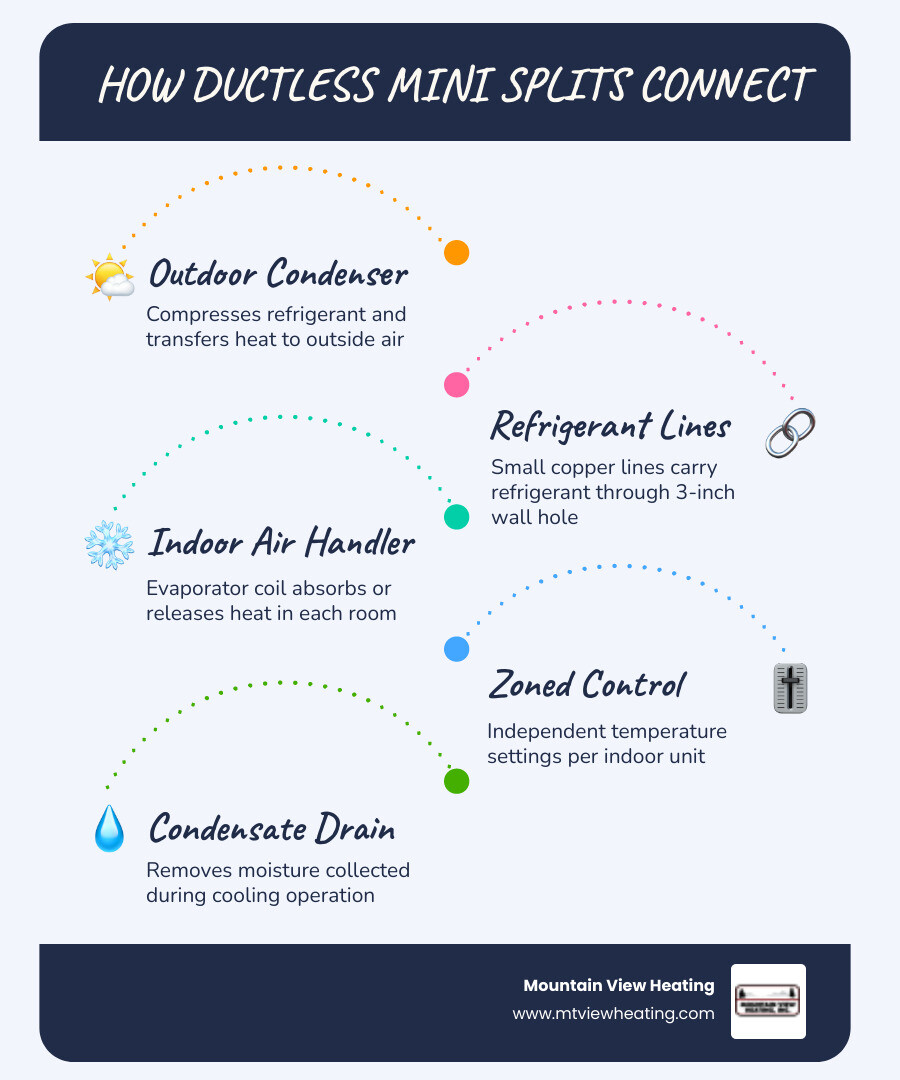
A complete system consists of four primary parts:
1. The Outdoor Condenser: This sits outside your home on a pad or bracket. It houses the compressor and the fan that dissipates or collects heat from the outdoor air.
2. The Indoor Air Handler: This is the unit you see inside your room. It contains the evaporator coil and a quiet blower fan to circulate conditioned air.
3. The Refrigerant Line Set: These are small copper tubes that carry refrigerant between the indoor and outdoor units. They only require a tiny three-inch hole in your exterior wall.
4. The Condensate Drain: As the system cools, it removes moisture from the air. This drain line carries that water safely outside so it doesn't end up on your floor.
Because these systems don't rely on a central furnace or a network of ducts, they are incredibly flexible. You can have a single-zone system for one room or a multi-zone system where up to four indoor units connect to one outdoor unit.
Ductless Mini Split Systems Explained: How They Work
The magic of a mini-split isn't that it "creates" cold or heat; it simply moves it. In April 2026, the technology behind these systems is more advanced than ever, utilizing "inverter-driven" compressors.
Think of a traditional air conditioner like a light switch—it’s either 100% on or 100% off. This leads to those annoying temperature swings where you're freezing one minute and stuffy the next. An inverter-driven compressor is more like a dimmer switch. It can speed up or slow down to provide exactly the amount of heating or cooling needed to maintain a steady temperature. This "cruise control" for your comfort is why Mini Split Ac Redmond Or systems are so much more efficient than old-school ACs.
Ductless mini split systems explained: The cooling cycle
When you set your Mini Split Ac Bend Or to "cool" on a hot Central Oregon afternoon, the indoor unit’s evaporator coil becomes very cold. A fan pulls the warm air from your room across this coil. The refrigerant inside the coil absorbs the heat from your indoor air, turning from a liquid into a gas.
This gas travels through the line set to the outdoor unit. The compressor then squeezes that gas, and the outdoor fan blows the heat away into the outside air. The refrigerant cools back down, turns back into a liquid, and heads back inside to repeat the process. It’s a continuous loop that keeps your home crisp and dry.
Ductless mini split systems explained: The heating cycle
In the winter, the process simply flips. Thanks to a component called a reversing valve, the system can extract heat from the outside air—even when it feels freezing to us—and bring it inside.
Modern Mini Split Ac La Pine Or systems are engineered for cold climate performance. Some premium models can maintain full heating capacity down to +5°F and continue to provide warmth even when temperatures drop as low as -22°F. Because they move heat rather than generating it through combustion or electric resistance, they are significantly more efficient than baseboard heaters or propane furnaces.
Why are so many homeowners in Bend switching to ductless systems?
The number one reason we see people moving toward ductless is efficiency. In a traditional forced-air system, the ductwork is often the weakest link. Studies show that leaky, uninsulated ducts can account for more than 30% of a home's total energy loss. By delivering air directly into the room, mini-splits eliminate this waste.
• Energy Loss — Traditional Ducted HVAC: 20% - 30% through duct leaks — Ductless Mini-Split: Near 0% (No ducts)
• Temperature Control — Traditional Ducted HVAC: Single thermostat for whole house — Ductless Mini-Split: Individual room "Zoning"
• Noise Level — Traditional Ducted HVAC: Audible rushing air and duct pops — Ductless Mini-Split: Whisper-quiet (19-30 dB)
• Filtration — Traditional Ducted HVAC: Standard central filter — Ductless Mini-Split: Multi-stage individual filters
• Max Efficiency — Traditional Ducted HVAC: Typically 14-18 SEER2 — Ductless Mini-Split: Up to 35+ SEER2
Beyond the efficiency gains, there are Some Benefits Of Setting Up A Ductless Mini Split System that involve pure comfort. Because each indoor unit has its own thermostat, you no longer have to fight over the temperature. You can keep the master bedroom at 68 degrees while the guest room stays at 72.
I need to heat my garage in Sisters. Is a mini-split the right choice?
Absolutely. In fact, for many spaces in Central Oregon, a mini-split is the only logical choice. We frequently perform Mini Split Installation Sisters Or for homeowners who are converting a garage into a workshop or gym. Since it is often illegal to run standard ductwork into a garage (due to the risk of pulling exhaust fumes into the rest of the house), a ductless unit provides a safe, independent solution.
Mini-splits are also the perfect answer for:
• Older Homes: Many historic homes in Bend use radiant heat or baseboards and have no room for bulky ductwork.
• Home Additions: If you're adding a sunroom or a bonus room, it’s often more practical to install a mini-split than to try and "tap into" your existing furnace, which might not be sized to handle the extra space.
• Attics and Basements: These areas are notorious for being "too hot" or "too cold" because they are at the end of the duct run. A mini-split solves that instantly.
Choosing the right indoor unit style
You aren't limited to just one look. Depending on your room's layout, you can choose a head that fits your aesthetic:
• Wall-Mounted Heads: The most common and versatile option. They are usually placed high on a wall to stay out of the way.
• Floor Consoles: These sit low on the wall, similar to a radiator. They are great for rooms with slanted ceilings or limited wall space.
• Ceiling Cassettes: These are recessed into the ceiling, leaving only a flat grille visible. They offer a very discreet look for a Mini Split Ac Sunriver Or vacation home or modern remodel.
How do I keep my ductless system running for 20 years?
A high-quality mini-split is a long-term comfort solution. With proper care, these systems can reliably serve your home for 15 to 20 years. The most important thing you can do as a homeowner is keep the air filters clean. Because these units recycle the air within the room, the filters can get dusty every 4 to 8 weeks. Most filters are reusable—you simply pop them out, rinse them in the sink, let them dry, and put them back.
However, DIY cleaning isn't enough for the internal components. We recommend professional Mini Split Service Redmond Or at least once a year. During a tune-up, our technicians will:
• Deep-clean the indoor evaporator coils to prevent mold growth.
• Clear the condensate drain line to prevent clogs and leaks.
• Check refrigerant levels to ensure the system is running at peak efficiency.
• Inspect electrical connections and the outdoor fan motor.
Signs you need a professional repair
If your system isn't acting right, don't wait until it breaks down completely. Catching an issue early can prevent more extensive repairs later. You should call for Mini Split Repair Bend Or if you notice:
• Weak Airflow: This could mean a clogged filter or a failing blower motor.
• Unusual Noises: Rattling, hissing, or grinding sounds are never a good sign.
• Ice on the Coils: This usually points to a refrigerant leak or a major airflow restriction.
• Dripping Water: If water is leaking from the indoor unit, your drain line is likely backed up.
Frequently Asked Questions about Ductless HVAC
Are ductless mini-splits loud?
Not at all. In fact, they are some of the quietest HVAC systems on the market. Most indoor units operate at decibel levels between 19 and 30 dB—that is quieter than a whisper. The outdoor units are also remarkably quiet, often operating at around 46 dB, which is about the level of a normal conversation. You won't have to worry about a loud compressor drowning out your backyard barbecue.
Do mini-splits improve indoor air quality?
Yes. Most modern units come with multi-stage filtration systems. Because there are no ducts to collect dust, pet dander, or allergens, the air being blown into your room is often much cleaner than what you'd get from a central system. Many models even feature specialized filters that can deactivate viruses and bacteria or remove odors from the air.
Can a mini-split replace my furnace in Central Oregon?
In many cases, yes. High-performance heat pumps can serve as the primary heating source for homes in our region. However, for very large homes or those in extremely cold pockets of La Pine, some homeowners choose to keep their existing furnace as a backup or use the mini-split as supplemental heat for specific rooms. We can help you determine the best configuration for your specific property.
Conclusion
Whether you are looking to reclaim your garage, finish a basement, or finally bring cooling to an older home in Bend, ductless technology is a game-changer. By choosing Mountain View Heating, you’re partnering with a team that has over 40 years of local experience and a commitment to 100% customer satisfaction.
We provide 24/7 emergency support because we know that HVAC issues don't always happen during business hours. If you're ready to see how ductless mini split systems explained can translate into real comfort for your home, we are here to help.