



The Central AC vs Ductless Mini Split Comparison Every Bend Homeowner Needs
The central ac vs ductless mini split comparison comes down to a few key factors: whether your home has existing ductwork, how many rooms you need to cool, and how much energy efficiency matters to you.
Here's a quick side-by-side to help you decide:
• Requires ductwork — Central AC: Yes — Ductless Mini Split: No
• Best for — Central AC: Homes with existing ducts — Ductless Mini Split: Homes without ducts, additions, zones
• Energy efficiency (SEER2) — Central AC: Up to 26 — Ductless Mini Split: Up to 38+
• Zoned temperature control — Central AC: Limited (add-on cost) — Ductless Mini Split: Built-in, room by room
• Installation disruption — Central AC: Low (with ducts) / High (without) — Ductless Mini Split: Minimal — 3-inch wall hole
• Heating capability — Central AC: Needs separate furnace — Ductless Mini Split: Most models heat and cool
• Indoor air quality — Central AC: Superior filtration — Ductless Mini Split: Basic filtration
• Aesthetics — Central AC: Hidden vents — Ductless Mini Split: Visible wall units
If your Bend home already has well-sealed ductwork, central AC is often the simpler, more direct path. If you're dealing with no ductwork, a room addition, or rooms that never seem to reach the right temperature, a ductless mini split is likely the smarter choice.
Choosing the wrong system for your home's setup can mean wasted energy every month for years. Duct systems alone can lose 25–30% of cooled air through leaks and poor insulation — that's a significant hit to your comfort and your home's efficiency. On the other hand, running multiple mini split indoor units in a large home with many rooms can get complicated fast.
The good news: most Central Oregon homeowners have a clear winner once they look at their home's actual setup. The sections below walk you through everything you need to make a confident decision.
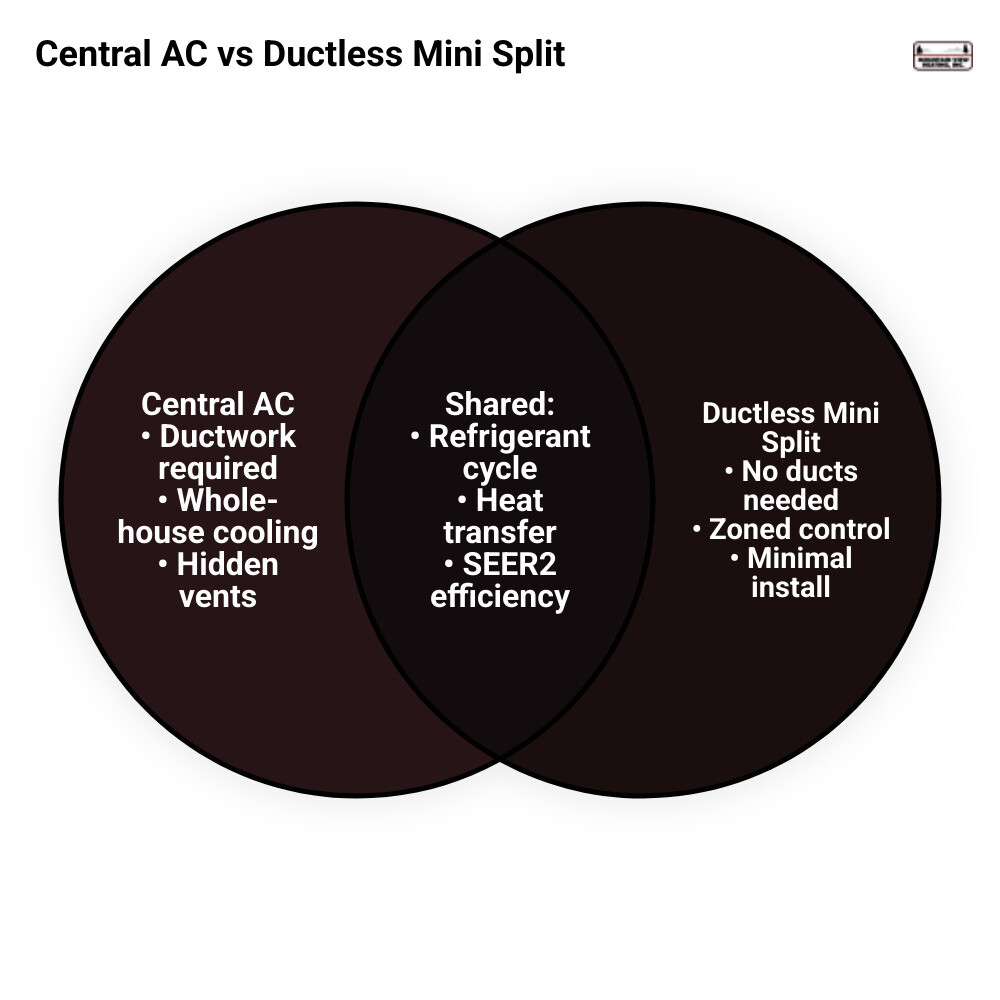
Central AC vs Ductless Mini Split Comparison: How Each System Works
At their core, both systems rely on the same scientific principles to keep your home comfortable during a Sisters summer. They use a closed loop of refrigerant to absorb heat from inside your house and dump it outside. However, the way they distribute that cool air is where the central ac vs ductless mini split comparison really begins.
The Central Air Method
A central Air Conditioning system is a "whole-house" solution. It typically consists of one large outdoor condenser unit and one indoor evaporator coil, usually sits on top of your furnace. A large fan (the air handler) blows air over the cold coils and pushes it through a network of hidden ducts. This forced-air system relies on supply vents to push cold air into rooms and return vents to pull warm air back to the system to be cooled again. It’s like a central heart pumping blood through arteries to the rest of the body.
The Ductless Mini Split Method
As the name suggests, a ductless system does away with the "arteries" entirely. Instead of one central unit, you have an outdoor compressor connected to one or more small indoor air handlers mounted directly on your walls or ceilings. These units are linked by a small conduit housing the refrigerant lines and power cables. Because there are no ducts, the air is cooled right there in the room where the unit is located. It’s more like having individual speakers in every room rather than one giant intercom system.
Why Energy Efficiency Matters for Your Central Oregon Home
In places like Redmond and Sunriver, where summer temperatures can swing wildly, efficiency isn't just a buzzword—it’s a major factor in your monthly energy usage. When we look at the central ac vs ductless mini split comparison through the lens of efficiency, ductless systems often take the trophy.
The "Duct Tax"
The Department of Energy estimates that typical duct systems lose about 25% to 30% of their cooling energy. This happens through leaks in the metal joints, poor insulation in unconditioned spaces like attics or crawlspaces, and "thermal bypass" where the cool air warms up before it even reaches your bedroom. Ductless systems eliminate this waste entirely because the cooling happens exactly where you need it.
Understanding SEER2 Standards
As of April 2026, homeowners should be familiar with What You Need To Know About Seer2 Energy Efficiency Standards. SEER2 (Seasonal Energy Efficiency Ratio 2) measures how much cooling a system provides per watt of electricity used.
• Central AC: High-efficiency models typically reach up to 26 SEER2.
• Ductless Mini Splits: These systems are the overachievers, often hitting 35 to 38+ SEER2.
This massive gap is largely due to inverter technology. Traditional central AC units often operate like a light switch—they are either 100% on or 100% off. Ductless systems use variable-speed compressors that can slow down or speed up to maintain a perfect temperature without the energy-gulping "start-stop" cycle. If you've ever wondered, "Do Ductless Mini Splits Use A Lot Of Electricity," the answer is actually quite the opposite—they are among the most efficient ways to cool a home. For more details, check out 3 Ways A Ductless Mini Split System Can Save You Money and our guide on What Is A Seer Rating.
Installation and Aesthetic Differences Homeowners Should Consider
How a system looks and how much construction it requires can be a dealbreaker. If you live in a historic home in Bend or a slab-on-grade house in Terrebonne, your options might be limited by your home's structure.
The Invisible Nature of Central AC
Central AC is the "ghost" of HVAC. Once installed, the only things you see are the floor or ceiling vents and the thermostat on the wall. For homeowners who spent a lot of time on their interior design and don't want a white box on the wall, central AC is the gold standard for aesthetics. However, if your home doesn't already have ducts, installing them involves cutting into walls and ceilings, which can be a massive, messy project.
The Flexibility of Ductless
Installing a mini split is remarkably non-invasive. We only need to drill a small three-inch hole in the exterior wall to connect the indoor and outdoor components. This makes it perfect for retrofitting older homes or cooling a new sunroom.
While the standard wall-mounted unit is the most common, modern aesthetics have come a long way. You can now choose:
• Ceiling Cassettes: These sit flush with the ceiling, showing only a decorative grille.
• Floor-Mounted Units: Great for rooms with low windows or limited wall space.
• Line Hides: We use these decorative covers on the outside of your home to neatly hide the refrigerant lines, which can even be painted to match your siding.
For a deeper dive into local considerations, see our Mini Split Ac Redmond Or Guide.
Evaluating Comfort: Zoning and Air Quality
Comfort isn't just about the number on the thermostat; it's about how the air feels and where it goes.
• Zoning — Central AC: Possible with dampers/multiple thermostats — Ductless Mini Split: Built-in (each head is its own zone)
• Air Filtration — Central AC: High-MERV whole-home filters — Ductless Mini Split: Basic washable filters per unit
• Humidity Control — Central AC: Excellent whole-home dehumidification — Ductless Mini Split: Good, but localized to specific rooms
• Air Movement — Central AC: Can feel "whooshy" or loud in vents — Ductless Mini Split: Whisper-quiet (19-26 decibels)
Central AC vs Ductless Mini Split Comparison: Zoning and Temperature Control
Have you ever had a "thermostat war" in your house? Maybe the upstairs is sweltering while the basement feels like a meat locker. This is a common issue with central systems that rely on a single thermostat. While you can add zoning to central AC using motorized dampers in the ducts, it can be a complex and involved upgrade.
Mini Splits offer independent thermostats for every indoor unit. If you want your bedroom at 68°F for sleeping but want the guest room kept at 74°F to save energy, you can do that with the press of a button. This is one of the best Solutions To Hot And Cold Spots In Your Home.
Central AC vs Ductless Mini Split Comparison: Indoor Air Quality and Filtration
When it comes to pure air scrubbing power, central AC usually has the upper hand. Because all the air in the house passes through one central filter, you can use high-efficiency MERV filters that catch tiny particles of dust, pollen, and pet dander.
In Central Oregon, this is particularly important during wildfire season. If you're wondering, "Is It Okay To Operate Your Ac During Wildfire Season," the answer is yes—provided you have a high-quality filter. Central systems are also easier to equip with whole-home air purifiers or humidifiers. Mini splits do have filters, but they are smaller and require more frequent cleaning (every 2-4 weeks) to stay effective.
Deciding Which Cooling Solution Fits Your Lifestyle in Bend
Every home in the High Desert is unique. Here is how we usually help our neighbors in La Pine, Redmond, and Sisters decide.
When Central AC Wins
If your home was built after the 1970s and has a functional duct system, central AC is often the "gold standard." It provides consistent, invisible cooling for the entire house. It’s also the better choice if you already have a modern furnace and just want to add cooling to the existing setup.
When Ductless Mini Splits Win
Mini splits are the champions of:
• Historic Homes: Keep the charm of your plaster walls without tearing them up for ducts.
• Room Additions: If you added a garage apartment or a "man cave" that isn't connected to the main HVAC, a mini split is the easiest solution.
• Slab Homes: If you don't have an attic or a crawlspace for ducts, ductless is a necessity.
• Empty Nesters: If you only use three rooms of a five-room house, why cool the whole thing?
Many homeowners also ask, "Is A Heat Pump Better Than Ac?" Most ductless systems are actually Heat Pumps, meaning they can reverse the cooling process to provide heat in the winter. This "two-for-one" functionality is a huge benefit. For more localized advice, check out Some Benefits Of Setting Up A Ductless Mini Split System and our Mini Split Ac Terrebonne Or Guide.
Frequently Asked Questions about Home Cooling
Can mini splits provide heating during Central Oregon winters?
Absolutely. Modern "cold-climate" mini split heat pumps are designed to work even when temperatures drop well below freezing. While traditional heat pumps used to struggle in the cold, today’s technology can maintain high heating capacity even at 5°F. For many Bend homes, a mini split can serve as the primary heat source, though some folks like to keep a backup for those rare sub-zero nights.
What is the typical lifespan of these residential systems?
With proper maintenance, both systems are a long-term investment. Central AC systems typically last 15 to 20 years. Ductless mini splits have a similar lifespan of 15 to 20 years, though premium brands can often reach 20 to 25 years if the indoor filters are kept clean and the outdoor unit is serviced annually.
Is a hybrid system using both central and ductless options viable?
Yes, and it’s actually very common! We often see homes that have a central AC system for the main living areas but use a single-zone mini split for a "problem room" like a converted attic or a master bedroom that stays too hot. This allows you to keep the main thermostat at a higher temperature while staying perfectly cool in the room you use most.
Conclusion
At the end of the day, the central ac vs ductless mini split comparison isn't about which system is "better" in a vacuum—it's about which one fits your specific home and lifestyle. Whether you're looking for the invisible, whole-home comfort of central air or the hyper-efficient, zoned control of a ductless system, we are here to help.
At Mountain View Heating, we have over 40 years of experience serving our neighbors in Bend, La Pine, Redmond, Sisters, Sunriver and Terrebonne. We prioritize 100% customer satisfaction on every project, ensuring that your home remains your sanctuary no matter how high the Central Oregon summer temperatures climb.
Ready to find the perfect cooling solution for your home? Explore our options for Mini Splits or give us a call to schedule a professional comfort assessment today. We’ll help you weigh the pros and cons and find the system that keeps you cool and keeps your energy usage in check for years to come.