


How to Decide Between AC Repair and Replacement for Your Home in Bend, OR
Knowing how to decide between AC repair and replacement can help you avoid putting time and effort into the wrong solution for your home. Here is a quick way to figure out which direction usually makes sense:
Quick Decision Guide:
• Repair if your system is under 10 years old, the fix is minor, and your energy bills are stable
• Replace if your system is 10-15+ years old, has needed multiple repairs recently, or uses R-22 refrigerant
• Replace if the unit is older and a major component has failed
• Replace if comfort, reliability, and efficiency have all declined at the same time
• Get a professional opinion if you are unsure, especially for major component failures
Every homeowner eventually hits that moment: the AC acts up, a technician gives you a repair recommendation, and suddenly you are wondering whether fixing the old system even makes sense anymore. It is one of the most common and frustrating decisions homeowners in Bend, Oregon face, especially when temperatures climb and you need your home to stay cool. The answer is not always obvious, and the wrong call can create more headaches in the long run. This guide walks you through exactly what to look at so you can make a confident, clear-headed decision.
Start With the Big 5 Factors That Usually Make the Decision
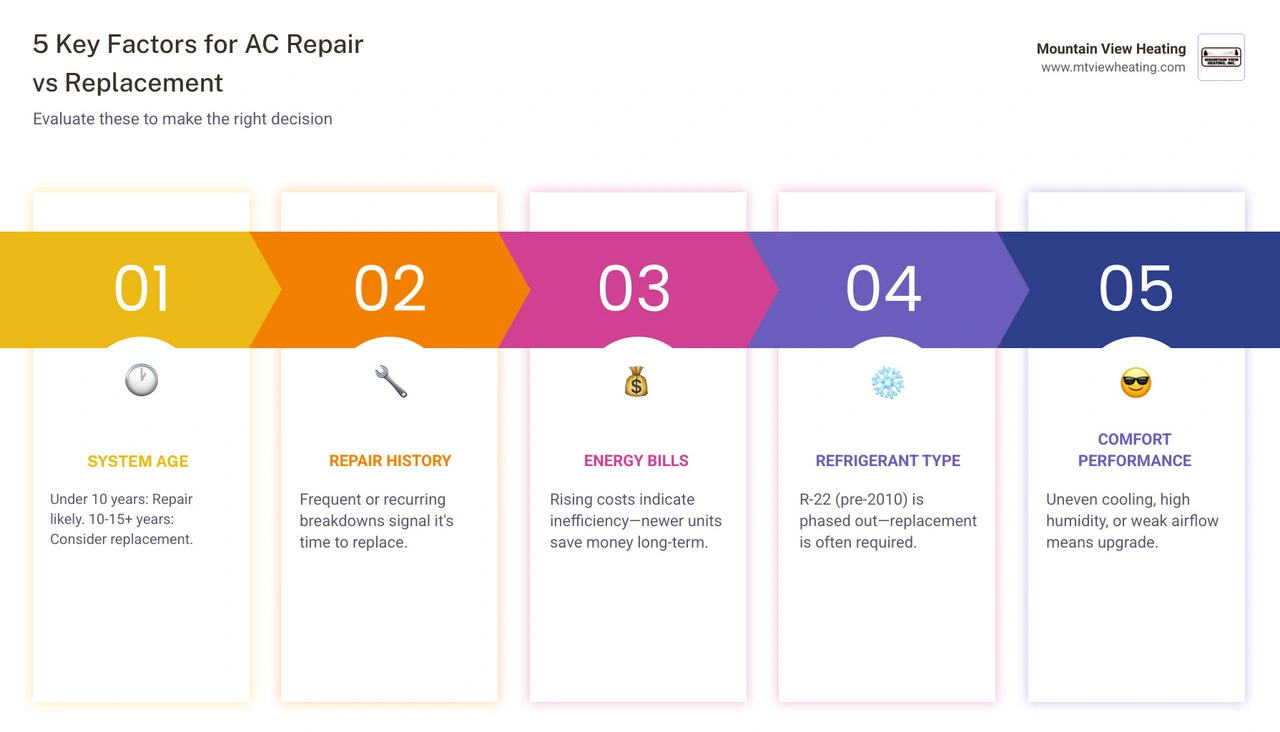
Most repair-versus-replace decisions come down to five things:
• The age of the system
• How often it has needed repairs
• Whether your energy bills keep climbing
• What refrigerant it uses
• How well it still keeps your home comfortable
If you check those five first, the answer usually gets much clearer.
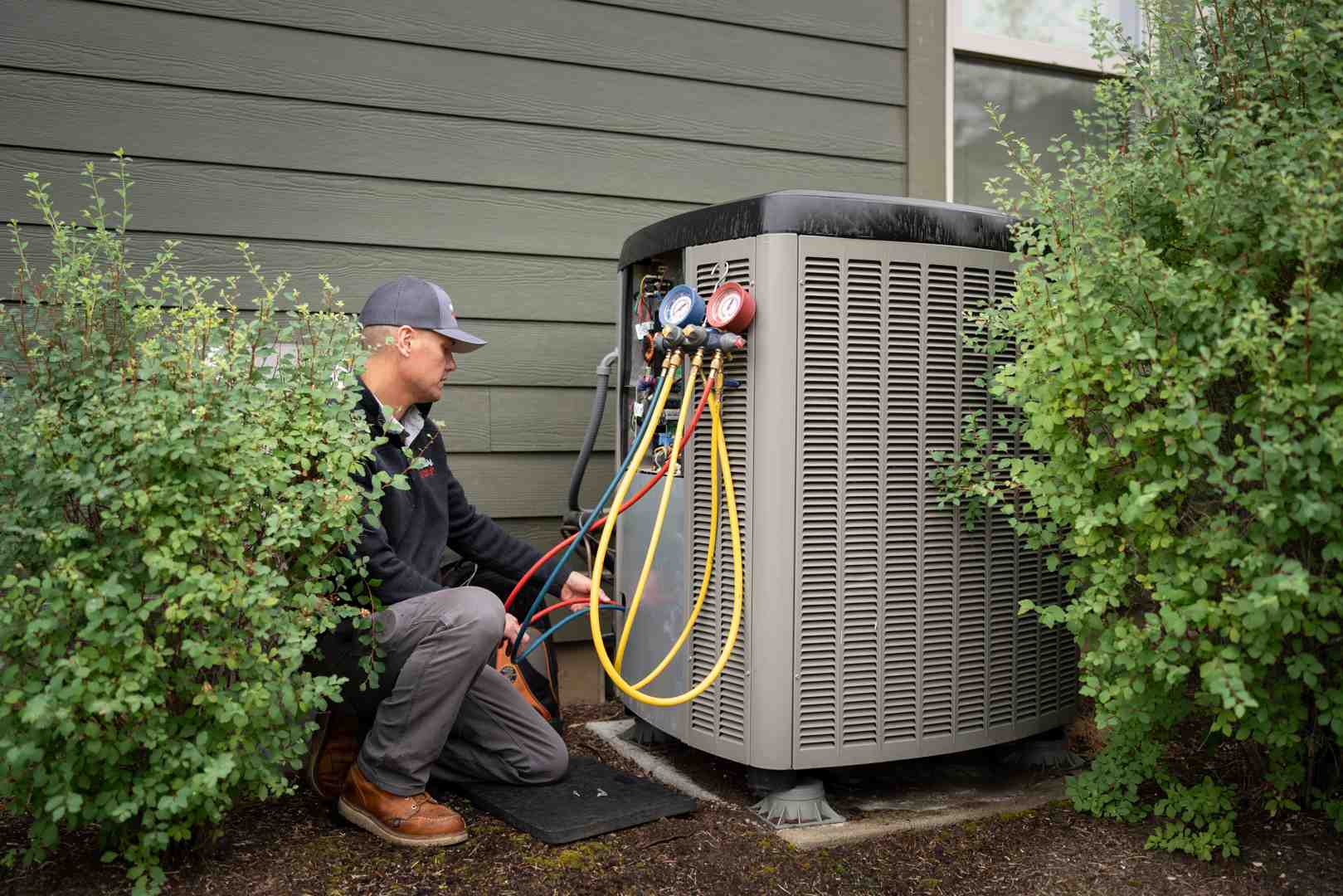
How the age of your AC changes the repair-or-replace answer
For most central air systems, the typical lifespan is about 10 to 15 years. Some units last a little longer with excellent maintenance, and some wear out earlier if they run hard, miss tune-ups, or have airflow problems.
As a general rule:
• Under 10 years old: repair is often worth considering
• Around 10 to 15 years old: it depends on condition, efficiency, and repair history
• Over 15 years old: replacement usually makes more sense
Age matters because older systems lose efficiency, parts wear down together, and breakdowns tend to cluster. It is a little like an aging car: one repair may be reasonable, but if everything starts asking for attention at once, the math changes fast.
You should lean more toward replacement if your older AC also has:
• Weak cooling performance
• Long run times
• Loud operation
• More humidity indoors
• Frequent service calls
How to decide between AC repair and replacement when breakdowns keep happening
A one-time repair is not automatically a reason to replace an AC. But repeated repairs are a red flag.
If your system has needed multiple repairs in the last year or two, that usually means the equipment is entering a less reliable stage. Even if each issue seems unrelated, frequent failures often signal overall wear.
Replacement becomes more attractive when:
• The same issue keeps returning
• Major components are failing
• You are scheduling service every cooling season
• The system breaks down during the hottest part of the year
• You no longer trust it to make it through summer
For homeowners in Bend and nearby communities, reliability matters. If your AC only works "most of the time," that is not much comfort when you need it. If you want a closer look at repair patterns and what they mean, our AC Repair Bend, OR: Complete Guide is a helpful next read.
How to decide between AC repair and replacement if your home is no longer comfortable
Sometimes the biggest clue is not a repair bill. It is the way your home feels.
If your AC runs but comfort has gone downhill, replacement may be the better long-term fix. Common warning signs include:
• Uneven cooling from room to room
• Hot spots upstairs or in sunny rooms
• Sticky indoor air or poor humidity control
• Weak airflow from vents
• The AC blowing lukewarm or warm air
• The system running constantly without catching up
Those issues can sometimes be repaired, especially if the cause is a thermostat problem, airflow restriction, or a failing part. But if the equipment is older and these comfort complaints are getting worse, replacement often solves more than one problem at once.
If your unit is blowing warm air, start with our guide on Reasons Your AC System May Be Blowing Out Warm Air.
Use Simple Rules of Thumb Before You Commit
Homeowners do not need to guess blindly. Two common rules of thumb can help you make a more logical decision: the age-and-repair rule and the major-repair comparison rule.
• Age-and-repair rule — How it works: Compare the system age with how significant the repair is — Usually points to: Replacement for older systems with major repairs
• Major-repair comparison rule — How it works: Compare the size of the repair with the overall condition and expected remaining life of the system — Usually points to: Replacement when the repair is large and the system is already declining
These are not perfect formulas, but they are useful shortcuts.
What the age-and-repair rule means for homeowners
A simple way to think about the decision is this:
• A repair on a newer AC is often worth considering
• The same repair on an older AC may not be the best long-term choice
• The older the system is, the more likely it is that other parts are also wearing out
Why this works: it combines two important realities at once. A repair on a newer unit may be worth doing. The same repair on an older unit may not be, because the rest of the system is much closer to the end of its life.
This rule is especially useful when:
• The unit is around 10 years old or older
• The repair is more than minor
• You are trying to avoid putting more effort into aging equipment
It is a shortcut, not a law of physics. But it is a good gut-check when emotions start talking louder than logic.
When the major-repair comparison rule is more useful
Another useful way to look at the decision is to compare the scope of the repair with the age, condition, and performance of the system as a whole.
This approach tends to be most helpful when:
• A major part has failed
• You are comparing a large repair against a full system upgrade
• The AC is already in the second half of its life
• You want to avoid making a big repair on a system that may still struggle afterward
It is especially relevant for problems like compressor failure, coil issues, or repeated refrigerant leaks. In those cases, even if repair is technically possible, it may not be the smartest long-term move.
A better way to think beyond one repair visit
Rules of thumb are helpful, but the best decision usually comes from looking beyond today's breakdown.
Ask:
• How old will this system be in 2 to 5 years?
• How likely is another repair soon?
• Have my utility bills been rising?
• Is my comfort already worse than it used to be?
• Am I repairing this system because it is truly worth it, or because replacement feels like a bigger decision?
That five-year view often changes everything. A repair that gets the AC running again may still be the wrong investment if the system is inefficient, unreliable, or near end-of-life.
If you are comparing your options, our AC Repair Bend, OR and AC Replacement Bend, OR pages explain what each path looks like.
Efficiency, SEER Ratings, and Rising Utility Bills Matter More Than Most Homeowners Think
A lot of homeowners focus only on whether the AC still turns on. Fair enough. But efficiency matters too.
An older system can still run and still be costing you far more than it should.
Why an older low-efficiency AC can cost more to keep
Research consistently shows that replacing an older 10+ year old system with an ENERGY STAR unit can reduce cooling costs by up to 20 percent. Upgrading from a 10 SEER unit to a 16 SEER unit can cut cooling costs by as much as 40 percent in some homes. High-efficiency systems can save even more compared to much older equipment.
So if your power bills are climbing and your usage habits have not really changed, your AC may be part of the problem.
Watch for:
• Cooling bills that keep creeping up
• Longer run cycles
• The system struggling on warm afternoons
• More noise and less airflow than before
An inefficient unit does not always fail dramatically. Sometimes it just slowly becomes expensive and annoying.
What SEER ratings tell you about replacement value
SEER stands for Seasonal Energy Efficiency Ratio, and newer systems are held to higher efficiency standards than older ones. SEER2 is the updated testing standard used on modern equipment.
In plain English: higher SEER or SEER2 ratings generally mean the system uses less energy to produce the same cooling.
That matters because replacement is not only about avoiding repairs. It is also about upgrading to:
• Better efficiency
• Better airflow control
• More consistent temperatures
• Smarter thermostat compatibility
• Quieter operation
If you want a plain-language breakdown, see What is a SEER Rating?.
Why newer systems often feel better even before they save energy
Homeowners are often surprised that a new AC does not just lower energy use. It can make the whole house feel better.
Modern systems often improve:
• Humidity control
• Airflow consistency
• Temperature balance
• Noise levels
• Filtration and indoor air quality
• Smart thermostat performance
Some newer systems also offer variable-speed operation, which helps maintain steadier temperatures instead of cycling on and off like a light switch with stage fright.
If your current AC cools the house "well enough" but leaves some rooms stuffy, noisy, or muggy, replacement may improve comfort before you even notice the utility savings.
Refrigerant Type, Safety Issues, and Major Failures Can Tip the Decision Fast
Some factors move the decision from "maybe" to "probably yes" very quickly. Refrigerant type is one. Safety is another. Major component failure is a third.
Why R-22 refrigerant is a major replacement warning sign
If your AC uses R-22 refrigerant, that is a big clue you are dealing with older equipment. R-22 has been phased out, which means it is harder to source and repairs involving refrigerant can become much more difficult and expensive.
In general, if your system was installed before 2010, it is worth checking what refrigerant it uses.
Why this matters:
• R-22 is outdated
• Refrigerant-related repairs are less practical
• Older R-22 systems are usually already in the aging category
• Future service gets less convenient over time
If an older R-22 unit has a leak or major cooling issue, replacement is often the smarter path.
Which problems usually point toward replacement instead of repair
Not every breakdown means "new system now." But some issues push strongly in that direction, especially on older units.
These usually lean toward replacement:
• Compressor failure
• Evaporator or condenser coil failure
• Repeated refrigerant leaks
• Significant electrical damage
• Major corrosion
• Multiple failing parts at once
The key is not just the part that failed. It is the combination of age, efficiency, refrigerant type, and overall condition.
For example, a compressor failure on a 6-year-old system is very different from a compressor failure on a 14-year-old system using outdated refrigerant.
Safety and emergency situations that should not wait
Safety always comes first. If your AC shows signs of an electrical problem or creates water-related damage risks, do not wait around hoping it sorts itself out.
Call right away if you notice:
• Burning smells
• Buzzing from electrical components
• Tripped breakers that keep happening
• Smoke or signs of scorched wiring
• Water leaking where it could damage ceilings, walls, or flooring
• Complete breakdown during extreme heat
In urgent situations, speed matters. If you need help fast, our 24-Hour AC Service Bend, OR: Complete Guide explains what to do next.
When Repair Still Makes Sense for a Home AC System
Replacement is not always the answer. Sometimes repair is absolutely the right call.
Repair tends to make sense when:
• The system is under 10 years old
• The issue is minor
• The AC has been maintained well
• Your energy bills are still normal
• Cooling performance has otherwise been solid
• You have not had repeated breakdowns
Signs your air conditioner is still a good candidate for repair
Here are some repair-friendly scenarios:
• A capacitor, contactor, or thermostat issue on a newer system
• A clogged drain line or dirty coil
• A blower-related issue with the rest of the system in good shape
• One isolated repair after years of reliable performance
• Strong airflow and even cooling before the recent issue
• No history of refrigerant leaks or major component failure
If the system is younger, the repair is straightforward, and the unit has been dependable, repairing it is often the most practical move.
Problems to rule out before replacing your AC
Before you assume the whole system is done, rule out simpler issues first.
Common problems that can mimic major AC trouble include:
• Dirty air filters
• Thermostat setting errors
• Dead thermostat batteries
• Tripped breakers
• Blocked vents
• Dirty outdoor coils
• Clogged condensate drains
In other words, do not replace an AC because of a problem caused by a filter that looks like it fought a dust storm and lost.
These guides can help with basic checks:
• AC Troubleshooting Tips Before Calling a Pro
• AC Not Turning On: What to Check First
How a professional HVAC evaluation helps you make the right call
A professional evaluation helps because the right answer is not always visible from the thermostat.
During an evaluation, we may look at:
• System age and model information
• Refrigerant type
• Condition of major components
• Airflow and temperature performance
• Ductwork issues affecting comfort
• Signs of wear, corrosion, or electrical problems
• Whether the system is properly sized for the home
That bigger picture matters. A good evaluation can reveal whether you are looking at one isolated repair or a system-wide decline.
At Mountain View Heating, we focus on helping homeowners in Bend, La Pine, Redmond, Sisters, Sunriver, Terrebonne, Three Rivers, and nearby communities make the choice that fits their home best. Our goal is simple: honest guidance and 100% customer satisfaction, whether repair or replacement is the better answer.
Frequently Asked Questions About How to Decide Between AC Repair and Replacement
What is the typical lifespan of an AC unit?
Most residential central air conditioners last about 10 to 15 years. Good maintenance can help a unit reach the upper end of that range, but age still matters. Once a system moves past 10 years, efficiency often drops and repair frequency tends to increase.
What are the clearest signs it is time to replace instead of repair?
The biggest replacement signs are:
• The system is 10 to 15+ years old
• It needs frequent repairs
• Energy bills are rising
• Cooling is uneven or weak
• Indoor humidity feels high
• It uses R-22 refrigerant
• A major component has failed
• The system has become unreliable and no longer keeps your home comfortable
If several of those apply at once, replacement is usually the smarter long-term decision.
When should I call for an expert second opinion?
Call for a professional evaluation if:
• You have a major repair recommendation
• The unit has broken down more than once recently
• Your home is no longer comfortable
• You notice burning smells, breaker trips, or other safety concerns
• You are deciding between a large repair and a full replacement
That second opinion can help you avoid both over-repairing an old system and replacing one that still has good life left.
Conclusion: Make the Choice That Fits Your Home, Comfort, and Long-Term Reliability
The best answer to how to decide between AC repair and replacement is usually not based on one thing alone. It comes from looking at age, repair history, efficiency, refrigerant type, and how well your system still keeps your home comfortable.
If your AC is newer, reliable, and dealing with a minor issue, repair often makes sense. If it is older, inefficient, using R-22, or breaking down again and again, replacement is usually the better investment in comfort and peace of mind.
If you are not sure which path is right, we are here to help. At Mountain View Heating, we bring more than 40 years of residential HVAC experience and a customer-first approach to every home we serve in Bend and surrounding communities.
For next steps, you can explore How to Choose the Right AC System for Your Home or get more info about air conditioning services.