


Why Ductless Zone Control Is One of the Smartest Ways to Cut Energy Bills in Bend
How ductless systems save energy with zone control comes down to two core advantages: they eliminate the energy lost through leaky ductwork, and they let you heat or cool only the rooms you're actually using.
Here's a quick breakdown of how it works:
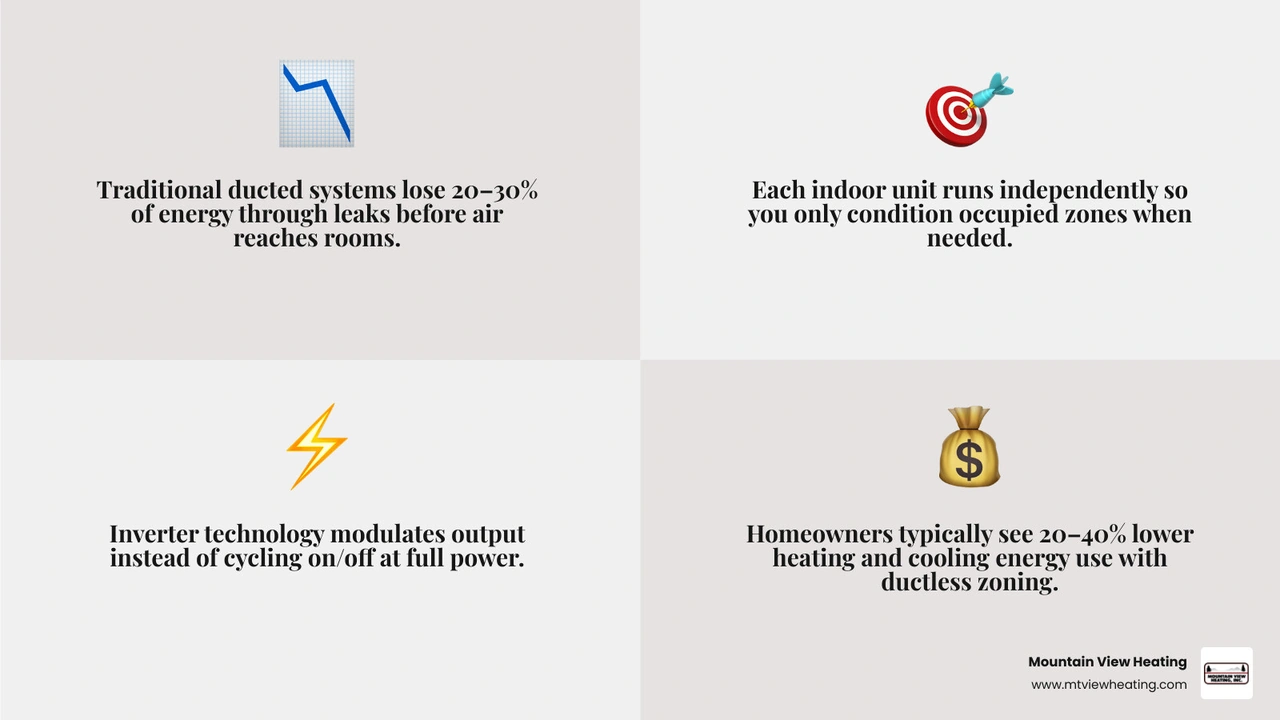
• No duct losses - Traditional ducted systems lose 20–30% of heated or cooled air through leaks and gaps before it ever reaches a room. Ductless systems deliver air directly.
• Room-by-room control - Each indoor unit operates independently, so you only run the zones you need, when you need them.
• Inverter technology - Instead of blasting on and off at full power, ductless compressors modulate their output to match the actual demand in each zone.
• Reduced runtime - Unused rooms like guest bedrooms or a home office after hours can be turned off entirely, not just turned down.
Combined, these features can cut heating and cooling energy use by 20–40% compared to older ducted systems — especially in homes with leaky ducts or rooms that sit empty for most of the day.
If you live in Bend, Oregon, where temperatures swing from cold desert winters to warm dry summers, that kind of targeted efficiency matters. Whether your home has an older forced-air system or no ductwork at all, understanding how zoned ductless heating and cooling works can help you make a smarter decision about your next HVAC upgrade.
What Zone Control Means in a Home HVAC System
Zone control means different parts of your home can be heated or cooled independently instead of all following one thermostat like obedient little soldiers.
In a traditional single-thermostat setup, one control point tells the entire system when to run. That can work fine in a small, open home with even temperatures throughout. But many homes in Bend and nearby communities are not that simple. Some rooms get more afternoon sun, upstairs rooms can feel different from downstairs, and not every room is occupied all day.
With zone control, each area has its own temperature target. That means your bedroom, living room, office, or addition can operate based on actual use rather than the needs of the hallway thermostat.
How ductless systems save energy with zone control compared to one-thermostat systems
A one-thermostat system often creates two common problems:
• It conditions rooms that do not need it
• It still may not make occupied rooms comfortable
That is why thermostat wars happen. One person wants the nursery warmer, another wants the bedroom cooler, and someone working from home wants the office comfortable during the day without conditioning the entire house.
Ductless zoning solves that by giving each indoor unit its own control. Instead of trying to average comfort across the whole house, it targets the rooms that matter most.
Why traditional central systems often condition rooms no one is using
Think about the rooms that sit empty for hours at a time:
• Guest bedrooms
• Storage rooms
• Home offices after work
• Upstairs spaces during the day
• Living areas overnight
A standard ducted system usually still pushes conditioned air toward all of them. Even if supply registers are partly closed, the system is still designed to treat the home as one big zone unless it has a dedicated zoning setup.
That means you may be paying to heat or cool rooms no one is using. It is like making dinner for the whole neighborhood when only two people are home.
How Ductless Mini-Splits Create Separate Zones Without Ductwork
A ductless mini-split system usually includes:
• One outdoor unit
• One or more indoor air handlers
• Refrigerant lines connecting them
• Electrical wiring and condensate drainage
• Individual remotes, wall controls, or app-based controls
Each indoor unit serves a specific room or area. Instead of pushing air through long duct runs, the system delivers conditioned air directly into the space.
This direct delivery is a big reason ductless systems are efficient. There is no duct network in an attic or crawlspace losing heated or cooled air before it reaches the room.
How ductless systems save energy with zone control through room-by-room operation
Each indoor air handler can run based on the needs of its own zone. That allows homeowners to:
• Cool the home office during work hours
• Keep a primary bedroom at a different nighttime setting
• Turn off a guest room until visitors arrive
• Maintain steadier comfort in a nursery or for an older family member
Many systems also support smart scheduling, so operation can match your daily routine instead of running the same way all day.
Because the system only conditions occupied zones, it often runs less overall than a whole-home system serving every room equally.
Single-zone vs multi-zone ductless setups for homeowners
A single-zone system has one outdoor unit connected to one indoor unit. It is a great fit for:
• One problem room
• A bedroom
• A home office
• A finished garage or bonus room
• A new addition
A multi-zone system connects one outdoor unit to multiple indoor units in different rooms or areas. That works well when several parts of the home need independent control.
For a closer look at layouts and equipment options, see Ductless Mini Split Systems Explained.
The Main Ways Ductless Systems Reduce Energy Use
Ductless systems save energy in more than one way. Zone control gets most of the attention, but it is only part of the story. The biggest savings usually come from a combination of direct air delivery, variable-speed operation, and lower runtime in unused spaces.
• Air delivery — Ductless zoning: Direct to room — Ducted zoning: Through ductwork
• Duct losses — Ductless zoning: None — Ducted zoning: Still possible
• Zone control method — Ductless zoning: Individual indoor units — Ducted zoning: Dampers and thermostats
• Partial-load efficiency — Ductless zoning: Strong with inverter systems — Ducted zoning: Depends on equipment
• Best retrofit use — Ductless zoning: Homes without ducts, additions, problem areas — Ducted zoning: Homes with good existing ducts
No duct losses means more heated or cooled air reaches the room
The U.S. Department of Energy has long noted that duct systems can lose more than 30% of energy through leaks, poor connections, and heat gain or loss. Research commonly puts delivered efficiency losses in the 20-30% range.
That matters most when ducts run through unconditioned spaces like attics or crawlspaces. In those situations, the system works hard to create comfort, and part of that comfort never actually arrives.
Ductless systems avoid that issue because the air is conditioned right in the room.
If you want a broader look at the tradeoffs in a home HVAC setup, read Ductless vs Ducted Cooling Pros and Cons.
Inverter compressors avoid wasteful on-off cycling
Many modern ductless systems use inverter-driven compressors. In plain English, that means the system can speed up or slow down instead of running only at full blast and then shutting off.
Why that helps:
• Less energy is wasted during startup
• Temperatures stay more consistent
• The system can match partial loads better
• Operation is often quieter
• Longer, lower-speed cycles can improve humidity control
This is especially useful during milder weather in Central Oregon, when your home may not need full heating or cooling output all day.
Zone-based operation cuts waste in lightly used spaces
This is the most visible part of the savings.
Instead of heating or cooling every room equally, you can focus on the areas being used. For example:
• Keep the guest room off most of the time
• Condition the office during work hours only
• Warm the living room in the evening
• Set bedrooms for nighttime comfort without over-conditioning the rest of the house
That room-by-room strategy can significantly reduce runtime, especially in homes where occupancy changes throughout the day.
Typical energy savings homeowners may see
Actual savings depend on several factors:
• How leaky the old ducts are
• Whether the old system is oversized or inefficient
• How many rooms sit empty regularly
• Home insulation and air sealing
• System sizing and installation quality
• How you use the controls
In many homes replacing older ducted equipment, properly sized ductless systems can reduce heating and cooling energy use by about 20-40%. Homes with underused rooms or significant duct losses are often the best candidates for larger savings.
For more on everyday savings, see 3 Ways a Ductless Mini Split System Can Save You Money.
Where Zoned Ductless Systems Make the Biggest Difference in Bend Homes
Not every home has the same HVAC challenges. Ductless zoning tends to shine where traditional distribution is hard, wasteful, or uneven.
In our area, that often includes older homes, remodels, additions, and spaces with unique temperature patterns.
Best-fit homes for ductless zone control
Ductless systems are often a strong fit for:
• Older homes without existing ductwork
• Homes where adding ducts would be disruptive
• Additions that stay too hot or too cold
• Upstairs bedrooms with uneven temperatures
• Converted garages or bonus rooms used as living space
• Isolated areas that do not need full-time conditioning
These situations are common in Bend and surrounding communities, especially in homes that have changed over time.
For more on homes without ducts, visit Ductless Heating and Cooling for Homes Without Ductwork.
Comfort benefits for households with different temperature preferences
Energy savings are great, but comfort is what people notice first.
Ductless zoning helps when one room needs different treatment than another, such as:
• A nursery that should stay warmer and steadier
• A bedroom that sleeps better cooler
• A home office needing daytime comfort
• A room used by an older family member who prefers more warmth
• Sun-exposed spaces that heat up faster than the rest of the house
Instead of arguing over one thermostat, each zone can be set for the people who actually use it. Fewer blanket negotiations. Fewer passive-aggressive thermostat adjustments. Better peace at home.
Ductless vs damper-based zoning in existing ductwork
Traditional zoning can also be created in a ducted system by adding dampers, thermostats, and a control panel. That can help in some homes, but it is different from ductless zoning.
Damper-based zoning still relies on the existing duct system, which means:
• Duct leakage may still waste energy
• Airflow balancing can be more complicated
• Older ducts may limit performance
• The system must be compatible with zoning
Ductless systems create zones more directly because each indoor unit serves its own space. For problem rooms, additions, or homes without good ducts, that simpler room-by-room approach often makes more sense.
What Homeowners Should Evaluate Before Choosing a Multi-Zone Ductless System
A good ductless installation is not just about picking equipment. Layout, sizing, placement, and everyday habits all affect performance.
Before moving forward, we recommend thinking through the following:
• Which rooms need independent control
• Which rooms are occupied most often
• Whether the goal is whole-home replacement or targeted supplementation
• The condition of any existing ductwork
• Indoor unit placement and line-set routing
• Outdoor unit location
• Filter access and maintenance needs
• Whether smart controls or scheduling matter to you
• Aesthetics and visibility of indoor units
Proper sizing and placement matter for efficiency
This is one area where details really matter. Oversizing can lead to short cycling and poor comfort. Undersizing can leave rooms struggling during peak weather.
Professional load calculations help determine the right capacity for each zone. Proper placement also matters because the unit needs a clear path to move air effectively through the space.
A few examples:
• A wall unit tucked behind obstacles will not distribute air well
• A bedroom head should be placed to avoid blasting directly on sleepers
• An outdoor unit needs proper clearance and service access
• Indoor units should be easy to maintain
Maintenance and daily use habits that protect savings
Even a high-efficiency system needs basic care to stay efficient.
Homeowners should plan for:
• Cleaning or checking filters regularly
• Keeping indoor units unobstructed
• Keeping the outdoor unit clear of debris
• Watching for condensate drainage issues
• Using schedules sensibly instead of constantly overriding them
Daily habits matter too. Ductless systems save the most energy when you use zoning intentionally. If every zone is always running at the same setting, you still gain efficiency from no duct losses and inverter operation, but you miss part of the zoning advantage.
Questions to ask before replacing or supplementing a central system
Before choosing a multi-zone setup, it helps to ask:
• Are your current ducts in good condition and well sealed?
• Are you trying to fix one problem room or the whole home?
• Which rooms are actually occupied every day?
• Do you want a primary heating and cooling solution or supplemental comfort?
• Are certain rooms too hot in summer or too cold in winter?
These resources can help you compare options:
• Central Air vs Mini Split for Older Homes
• Mini Split Benefits for Homeowners
• Mini Split vs Central AC Cost Comparison
Frequently Asked Questions About How Ductless Systems Save Energy With Zone Control
How much energy can ductless zoning save in a typical home?
A common range is about 20-40% in heating and cooling energy use when replacing an older, inefficient ducted setup. Savings depend heavily on:
• How often rooms are unoccupied
• How leaky the old ducts are
• Whether the system is properly sized
• Home insulation and air sealing
• Your temperature settings and schedule
Homes with empty guest rooms, bonus rooms, or daytime-empty bedrooms often benefit the most.
Do you need an indoor unit in every room?
No. In many homes, it makes more sense to put indoor units in the main living areas and the rooms that need the most control.
You may not need a separate unit for:
• Small hallways
• Closets
• Laundry rooms
• Other minor transition spaces
The right layout depends on the floor plan, door usage, and how air moves through the home. The goal is not one head per room at all costs. The goal is effective comfort where you actually live.
Are ductless systems better than ducted zoning for every home?
Not always. Some homes with well-sealed ducts, open floor plans, and a newer compatible system may do well with ducted zoning. But ductless is often especially appealing when:
• The home has no ducts
• Existing ducts are leaky or poorly located
• You want to fix a few problem areas
• You are conditioning an addition or isolated room
• You want true room-by-room control
So the best answer is not "always." It is "often, for the right home."
Conclusion
For many homeowners, the biggest lesson is simple: energy waste usually happens when a system treats every room the same, even when your family does not use every room the same.
That is why how ductless systems save energy with zone control is such a useful question. The answer is a combination of direct air delivery, no duct losses, inverter efficiency, and room-by-room operation. Together, those features can mean lower wasted energy, better comfort, and fewer battles over the thermostat.
In older Bend homes, homes without ducts, and homes with additions or hard-to-balance rooms, zoned ductless systems can be an especially practical solution.
If you are planning a residential HVAC repair, replacement, or upgrade in Bend, La Pine, Redmond, Sisters, Sunriver, Terrebonne, Three Rivers, or nearby communities, Mountain View Heating can help you evaluate whether a single-zone or multi-zone ductless system makes sense for your home. We focus on clear recommendations, dependable service, and 100% customer satisfaction on every project, big or small.
For more details about ductless options, visit More info about ductless mini-split services.