


What Every Homeowner Should Know About How AC Refrigerant Changes Affect Homeowners
How AC refrigerant changes affect homeowners is one of the most talked-about topics in residential HVAC right now — and for good reason. If you have a working air conditioner in Bend, Oregon, new federal regulations are already reshaping what happens the next time your system needs service, a refrigerant top-off, or a full replacement.
Here is a quick summary of the key impacts:
- Existing R-410A systems are still legal to use and repair — no one is forcing you to replace a working AC
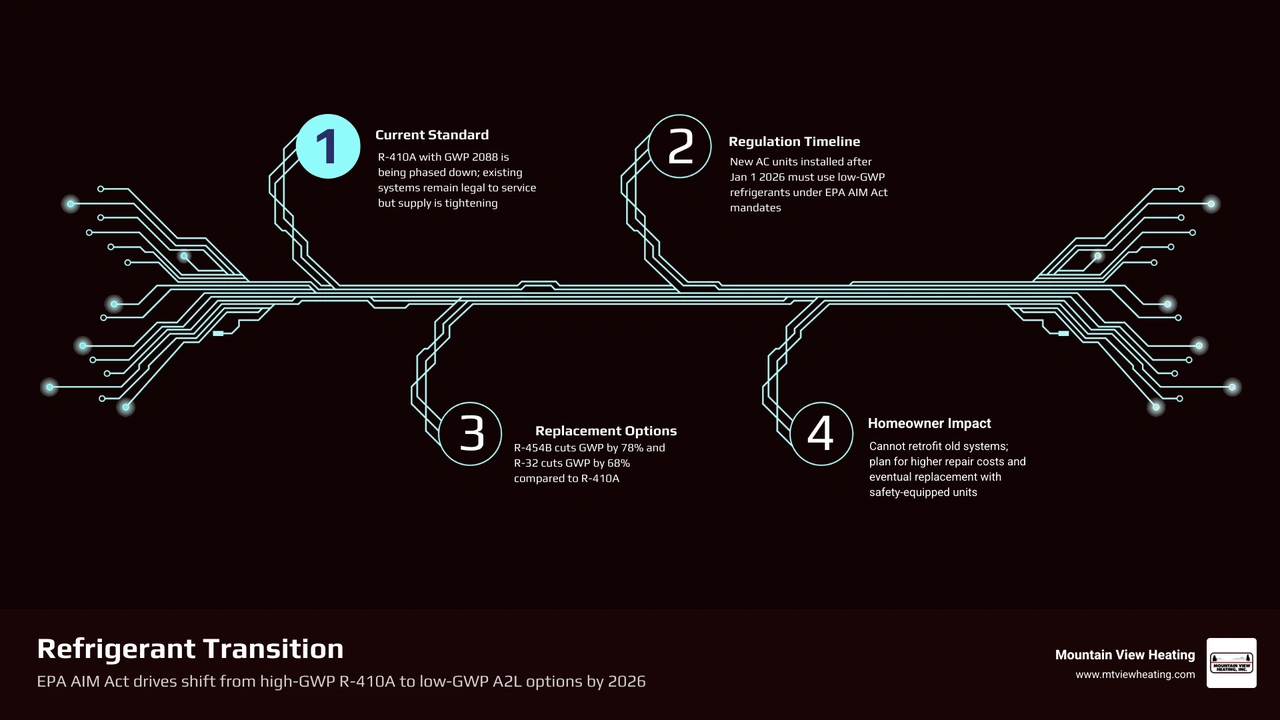
- New AC systems installed after January 1, 2026 must use low-GWP refrigerants like R-454B or R-32
- R-410A refrigerant is becoming harder to source, and servicing is becoming more difficult as supply tightens
- New replacement systems require updated components and safety features
- You cannot retrofit an older system to run on new refrigerants — the chemistries and pressures are incompatible
- New A2L refrigerants are mildly flammable but safe for residential use when installed correctly with proper sensors
- Long-term energy savings of 10–15% are expected with new compliant systems
The short version: you do not need to panic, but you do need a plan. Whether your current system is a few years old or approaching the end of its life, understanding this transition now helps you make smarter decisions — and avoid unexpected surprises down the road.
The shift is driven by the EPA's AIM Act, which targets high-GWP (global warming potential) refrigerants like R-410A and mandates a move to greener alternatives. R-410A carries a GWP of 2,088 — meaning it traps heat more than 2,000 times more effectively than carbon dioxide. The new replacements, R-454B and R-32, cut that impact by 78% and 68% respectively. This is not the first time the industry has gone through a transition like this — the 1990s saw a similar shift away from ozone-depleting refrigerants — but the current change has direct practical consequences for homeowners with systems running on R-410A today.
Understanding the 2025-2026 Refrigerant Transition
The current transition is part of a larger global and national effort to phase down hydrofluorocarbons (HFCs), which are powerful greenhouse gases. Under the American Innovation and Manufacturing (AIM) Act of 2020, the Environmental Protection Agency (EPA) was granted the authority to phase down the production and consumption of these high-GWP substances. By phasing out these compounds, the HVAC industry is moving toward a more sustainable, eco-friendly future.
This regulatory shift mirrors the historic transition of the 1990s under the Montreal Protocol, which successfully phased out ozone-depleting chlorofluorocarbons (CFCs) and hydrochlorofluorocarbons (HCFCs), such as R-22 (commonly known as Freon). That historic effort has had massive, measurable public health benefits. In fact, phasing out ozone-depleting substances is projected to avoid approximately 1.6 million skin cancer deaths and more than 45 million cases of cataracts in the United States among individuals born between 1890 and 2100.
Now, the focus has shifted from protecting the ozone layer to reducing global warming potential. The EPA mandated a GWP limit of 700 or less for all new residential air conditioning and heat pump systems. Because R-410A has a GWP of 2,088, it can no longer be used in newly manufactured equipment. As of January 1, 2025, manufacturers stopped producing R-410A residential split systems, and the final grace period for installing pre-manufactured R-410A systems ended on January 1, 2026.
For local homeowners in Bend, Redmond, and Sisters, this means that any new central air conditioner or heat pump installed today uses the next generation of refrigerants: R-454B or R-32. To make sure your home is prepared for the warm summer months under these new standards, it is highly beneficial to understand How to Prepare Air Conditioner for the Summer so that your cooling equipment runs at peak performance.
How AC Refrigerant Changes Affect Homeowners and Their Existing Systems
If your current air conditioner or heat pump was installed before 2025, it almost certainly runs on R-410A. The most important thing to know is that your existing system is not illegal. You are not required to tear out a perfectly good, working air conditioner just because the regulations have changed.
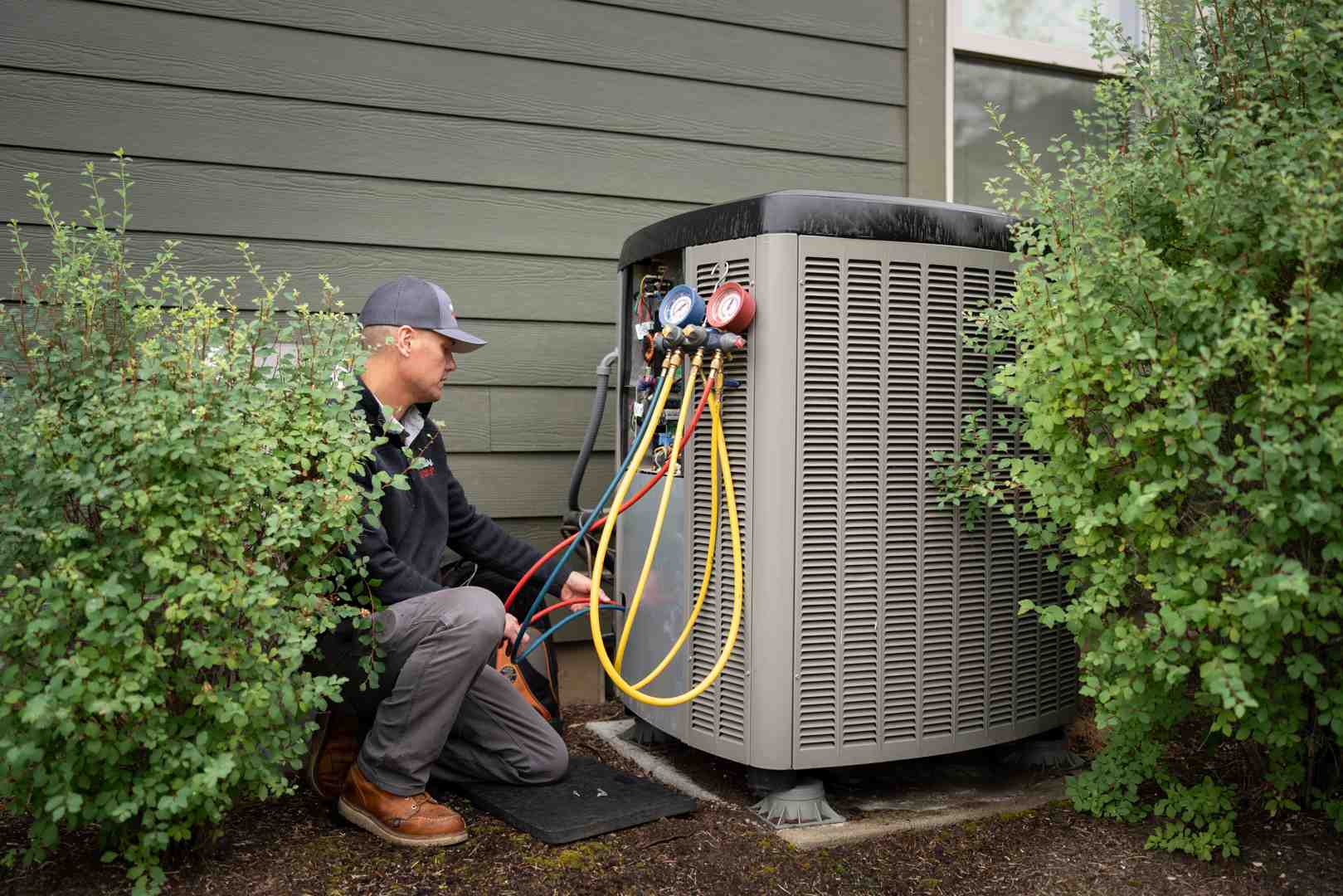
However, the transition directly impacts how we service and repair these older units. Over time, the supply of R-410A will continue to shrink. Under the AIM Act, HFC production is being phased down to an 85% reduction by 2036. As of 2026, production is already limited to just 60% of its historical baseline.
As the supply of R-410A tightens, the market dynamics of servicing older units will change:
- Service Availability: Simple maintenance tasks that require adding refrigerant will become more challenging as the supply of R-410A tightens.
- The "Ticking Clock" on Repairs: If your system develops a major leak or needs a new compressor, investing in extensive repairs for an aging R-410A system might feel like a temporary fix.
- Strategic Planning: Knowing the age and health of your system allows you to plan for an eventual replacement rather than facing a sudden, emergency breakdown during a hot Central Oregon summer.
To help you navigate these repair-versus-replace decisions, our AC Repair Bend OR Complete Guide outlines what to look for when your system begins showing signs of wear and tear.
Practical Ways How AC Refrigerant Changes Affect Homeowners with R-410A Systems
For homeowners keeping their R-410A systems, proactive maintenance is the best defense against dwindling refrigerant supplies. Because refrigerant operates in a closed loop, an air conditioner should never "consume" or run out of refrigerant under normal circumstances. If your system is low on charge, it means there is a leak.
In the past, some homeowners opted to simply "top off" their refrigerant every spring. With R-410A supply shrinking, this is no longer a sustainable strategy. Finding and repairing leaks is now essential to protect both your system's performance and the environment.
Low refrigerant levels do more than just reduce cooling performance; they place immense strain on your system's compressor. When refrigerant levels drop, the pressure inside the system changes, which can cause the indoor evaporator coil to drop below freezing. This leads to ice formation, restricted airflow, and eventually, a complete system breakdown.
If you notice your system is struggling to keep your home cool, or if you suspect a leak, understanding Why Do Air Conditioners Freeze Up can help you diagnose the issue early. Furthermore, if you actually see ice building up on your outdoor copper lines or indoor cabinet, refer to our guide on Ice Forming on Your AC Unit Causes and What to Do to prevent permanent damage to your compressor.
Long-Term Planning: How AC Refrigerant Changes Affect Homeowners Considering a New AC
If your air conditioning system is more than 10 to 12 years old, or if you are facing a major repair, upgrading to a new system utilizing R-454B or R-32 is often the most practical choice.
While new A2L-compliant systems feature advanced safety mechanisms, updated components, and require specialized training for technicians, they offer significant long-term advantages:
- Enhanced Energy Efficiency: The new A2L systems are designed to run 10% to 15% more efficiently than older R-410A systems. In our high-desert climate, where summer afternoons in La Pine, Sunriver, and Terrebonne can bring intense heat, these efficiency gains translate directly into reduced energy consumption.
- Future-Proofed Service: Investing in a new system means you won't have to worry about refrigerant availability or complex repair limitations for the next 15 to 20 years.
- Advanced Safety and Technology: Modern systems include factory-installed leak detection sensors and advanced controls that ensure your home remains comfortable and safe.
To get the most out of a new, highly efficient system, regular professional maintenance is key. Our AC Tune-Up Guide 2026 Central Oregon Homeowners explains how seasonal maintenance keeps these advanced systems running at peak efficiency year after year.
Comparing R-410A, R-454B, and R-32 Refrigerants
To understand why the industry has made this shift, it helps to compare the technical characteristics of the legacy refrigerant with the new alternatives. The two primary low-GWP refrigerants dominating the residential market are R-454B (a blend of R-32 and R-1234yf) and R-32 (a pure HFC).
Both of these new options fall under the A2L safety classification. The ASHRAE safety group classification system rates refrigerants based on toxicity and flammability:
- Class A indicates low toxicity.
- Class 1 indicates no flame propagation (non-flammable under test conditions).
- Class 2L indicates mild flammability with a slow burning velocity.
While R-410A was classified as A1 (non-toxic, non-flammable), R-454B and R-32 are classified as A2L (non-toxic, mildly flammable).
| Refrigerant Feature | R-410A (Legacy) | R-454B (New Standard) | R-32 (New Standard) |
|---|---|---|---|
| Safety Classification | A1 (Non-Flammable) | A2L (Mildly Flammable) | A2L (Mildly Flammable) |
| Global Warming Potential (GWP) | 2,088 | 466 (78% lower than R-410A) | 675 (68% lower than R-410A) |
| Operating Pressure | Baseline | ~3% Lower than R-410A | ~10% Higher than R-410A |
| Relative Flammability | None | Extremely Low (Hard to ignite) | Extremely Low (Hard to ignite) |
| Primary Equipment Use | Legacy ducted systems | Most major ducted brands | Ductless mini-splits & select brands |
| Compatibility | Incompatible with A2L | Incompatible with R-410A | Incompatible with R-410A |
Because these refrigerants have different chemical compositions, operating pressures, and safety profiles, they cannot be mixed. You cannot put R-454B into an R-410A system, nor can you use R-410A in a system designed for R-454B. Doing so is not only illegal but also poses a severe safety hazard and will permanently damage the compressor.
For homeowners in Redmond and surrounding areas, keeping your system properly serviced by certified professionals is more important than ever. Check out our AC Service Redmond OR Complete Guide to learn how professional maintenance ensures your system uses the correct components and remains safe.
Frequently Asked Questions About Refrigerant Changes
Navigating HVAC industry regulations can feel overwhelming. Below are answers to the most common questions we receive from local homeowners about how these changes impact their comfort and safety.
Do I need to replace my working R-410A air conditioner immediately?
No. There is absolutely no regulatory requirement for you to replace a properly functioning R-410A air conditioner. The EPA phase-down rules target the manufacture and installation of new equipment, not the use of existing systems.
As long as your air conditioner is running reliably and efficiently, you can continue to use it. If your system does experience a leak or requires service, recycled and reclaimed R-410A will remain available for repairs for many years to come. However, because the supply of new R-410A is restricted, you should expect servicing for refrigerant leaks to become more challenging over time.
Can my older AC system be retrofitted to use new A2L refrigerants?
No, older systems cannot be retrofitted to use R-454B or R-32. The new A2L refrigerants operate under different pressures and require specific compressor oils that are incompatible with older R-410A systems.
Furthermore, because A2L refrigerants are mildly flammable, new systems are built with specialized safety features, such as integrated leak detection sensors and robust electrical components. Older R-410A systems lack these safety mechanisms. Attempting to "drop in" a new refrigerant would void your manufacturer's warranty, damage your equipment, and create a safety hazard.
If your older system is acting up, it is best to troubleshoot the basics first. Read our guide on AC Not Turning On What to Check First to rule out simple electrical or thermostat issues before assuming you need a major system replacement.
Are the new mildly flammable A2L refrigerants safe for home use?
Yes, A2L refrigerants are exceptionally safe for residential use. While they are classified as "mildly flammable," they are incredibly difficult to ignite. In fact, research shows that A2L refrigerants are far less flammable than common household items like hairspray, aerosol cooking sprays, or natural gas.
To meet strict safety standards, manufacturers of new A2L air conditioners and heat pumps have added several layers of protection:
- Integrated Leak Detection: New indoor coils feature sensors that constantly monitor for refrigerant leaks.
- Automatic Mitigation: If a leak is detected, the system automatically shuts down the compressor and activates the indoor fan to safely disperse the refrigerant, preventing it from reaching flammable concentrations.
- Strict Installation Standards: Our technicians undergo specialized training to handle, install, and service these systems safely, ensuring full compliance with local building codes in Central Oregon.
If you are experiencing minor performance issues and want to perform some basic checks yourself, take a look at our AC Troubleshooting Tips Before Calling a Pro to safely assess your system.
Conclusion
The 2025-2026 refrigerant transition represents a major step forward for environmental sustainability, but it also changes the landscape of residential cooling. While your existing R-410A system remains legal and serviceable, planning for the future will help you avoid unexpected service disruptions and ensure your home stays cool during hot Central Oregon summers.
At Mountain View Heating, we have spent over 40 years helping homeowners in Bend, Redmond, Sisters, Sunriver, La Pine, Terrebonne, and Three Rivers stay comfortable in every season. Our family-owned business is built on a simple promise: prioritizing 100% customer satisfaction for every project, big or small. Whether you need a quick repair on your existing system or want to explore upgrading to a highly efficient, future-proof A2L air conditioner, our team of friendly, experienced professionals is here to guide you every step of the way.
Don't wait for the peak of summer heat to address your cooling needs. Schedule professional residential cooling services with Mountain View Heating today to keep your home comfortable, efficient, and safe.