


The Sudden Shift: When Your Reliable Cooling System Starts Stuttering
Here at Mountain View Heating, one of the most common questions we hear as summer winds down is exactly why your AC starts short-cycling after running flawlessly all July, especially when the weather outside hasn't drastically changed. Your air conditioner handled the brutal mid-summer heat without a single hiccup, keeping your home perfectly comfortable. But now, as the season drags on, the system is turning on and off in rapid, frustrating bursts. The house never quite reaches the temperature set on the thermostat, and the outdoor unit sounds like it is constantly starting up only to shut down moments later.
This frequent on-and-off behavior is known in the HVAC industry as short-cycling. Instead of completing a standard cooling cycle, the system is getting trapped in frequent 5-10 minute cooling cycles. Not only does this fail to properly cool or dehumidify your living space, but it also puts an immense amount of strain on the most expensive components of your equipment. In our experience, when your system acts this way, it is rarely a random breakdown. Rather, it represents the tipping point of cumulative summer stress.
The immediate decision point you face as a homeowner is figuring out if this sudden stuttering is a simple airflow issue you can resolve yourself, or a complex mechanical problem that requires professional air conditioning services. Catching this specific symptom early and getting your system on a routine HVAC maintenance plan can often prevent total compressor failure right before the busy school year begins.
• Normal Cooling Cycle — Average Duration: 15 to 20 minutes — Impact on Home Comfort: Even temperatures, proper humidity removal — Impact on Equipment: Standard, expected wear and tear
• Short-Cycling — Average Duration: 5 to 10 minutes — Impact on Home Comfort: Uneven cooling, clammy or humid indoor air — Impact on Equipment: Severe strain on compressor and electrical parts
Understanding the Tipping Point of Cumulative Summer Wear
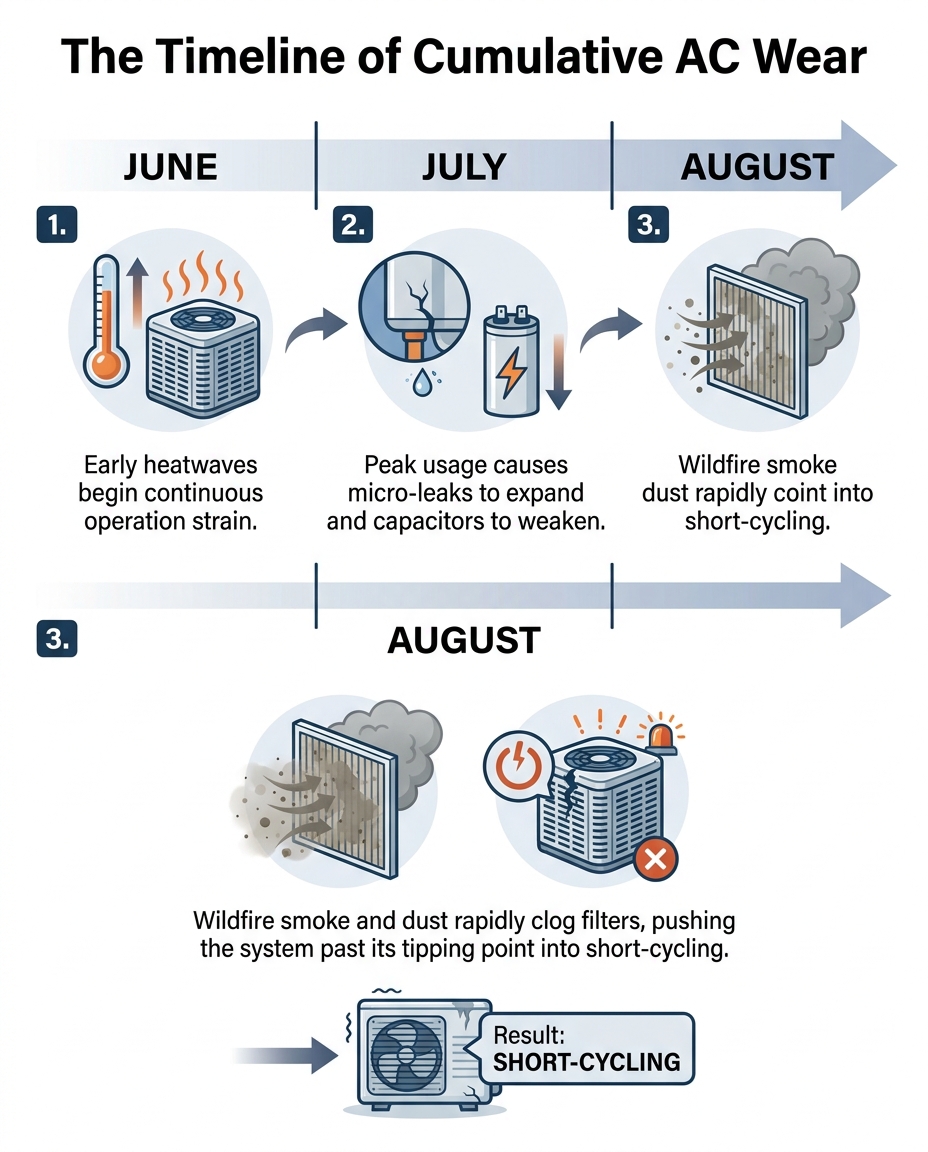
To understand why a perfectly reliable air conditioner suddenly begins to stutter in late summer, our technicians often explain how heating and cooling equipment actually operates. HVAC components have specific operational thresholds. They are built to handle heat, friction, and electrical loads, but these tolerances are slowly worn down by continuous, daily use. When the system runs for hours on end during the peak heatwaves of early and mid-summer, that heavy strain gradually compromises the system's overall efficiency.
Just last year, our service team saw this exact scenario play out. One local homeowner experienced the beginnings of this cumulative wear when early high temperatures in June caused their heat pump system to struggle. Our service technicians worked extended hours to address the sudden demand for service, illustrating just how quickly early-season strain sets the stage for late-season fatigue. By the time August or late summer rolls around, the equipment has logged hundreds of hours of continuous run time. The parts are tired, the filters are loaded with debris, and the electrical components have been subjected to extreme thermal stress.
The protective mechanism: It is crucial to understand that short-cycling is often a built-in protective mechanism. The system is intentionally shutting itself down to prevent catastrophic overheating or a major electrical failure. The air conditioner didn't simply "break" overnight. Instead, it finally crossed a critical threshold where it can no longer compensate for the built-up strain of the previous months. The safety switches are stepping in to save the compressor from destroying itself.

How High Desert Dust and Wildfire Smoke Choke Your System
In our years of troubleshooting late-summer short-cycling in Bend and Central Oregon, our team has found that the primary environmental culprit is almost always severe airflow restriction. The standard manufacturer guidelines for air filter lifespans—which often suggest replacing the filter every 90 days—simply do not apply during peak particulate seasons in our region.
Our high desert climate is naturally dry and dusty, which already puts a heavier load on your filtration system than in other parts of the country. When you add the frequent arrival of August wildfire smoke, a brand-new air filter can become completely clogged with ash and fine particulates in a matter of weeks. This heavy particulate load drastically reduces the volume of air that can pass through the system. Upgrading to specialized indoor air quality solutions can help manage this heavy particulate load, protecting both your lungs and your HVAC equipment.
When airflow is severely restricted, the blower motor is forced to work much harder to pull air through the clogged filter media. This extra effort causes the motor to run hotter than its design limits allow. Eventually, the internal thermal overload switch detects this excessive heat and shuts the motor down prematurely, triggering the short-cycling behavior. The system rests, cools down slightly, and tries to start again, only to repeat the exact same overheating process.
The Domino Effect: Frozen Evaporator Coils
Restricted airflow doesn't just overheat the blower motor; it also causes a chain reaction that directly impacts the refrigeration cycle. Here is how our technicians often see that physical process unfold inside your indoor unit:
• Lack of heat transfer: Your air conditioner cools your home by blowing warm indoor air over the freezing cold evaporator coil. If a dirty filter blocks that airflow, there isn't enough warm air passing over the coil to absorb the cold.
• Condensation freezing: As the system runs, it naturally pulls humidity out of the air, creating condensation on the coil. Without warm air flowing over the metal fins to keep the temperature balanced, that condensation rapidly drops below freezing and turns into a solid block of ice.
• The safety shutdown loop: Once the coil is encased in ice, the system completely loses its ability to cool the air. The thermostat registers that the house is still warm and calls for cooling, but internal safety sensors detect the freezing conditions and shut the outdoor compressor down to protect it. This creates a relentless short-cycle loop.
The Hidden Culprit: Slow Micro-Leaks and Refrigerant Loss
When our technicians arrive at a home and find that the filter is perfectly clean but the system is still stuttering, the secondary major cause of late-season short-cycling is often a drop in refrigerant levels. A common misconception among homeowners is that air conditioners "use up" or consume refrigerant over time, much like a car consumes gasoline. In reality, the refrigerant is housed in a completely closed, pressurized loop. If the levels drop below the critical operational threshold, it always indicates that there is a leak somewhere in the system.
During the peak heat of July, your outdoor condenser unit runs almost constantly. This continuous operation creates significant vibration. Furthermore, the extreme temperature fluctuations between the heat of the afternoon and the cooler night air cause the copper lines and metal fittings to constantly expand and contract. Over the course of the summer, this thermal expansion and continuous vibration can exacerbate tiny, previously undetectable micro-leaks.
The role of the low-pressure switch: As refrigerant slowly escapes through these micro-leaks, the overall pressure inside the closed loop begins to drop. Air conditioners are equipped with a low-pressure safety switch designed to protect the compressor from running dry. When the pressure drops too low, this switch instantly cuts power to the compressor. The pressure briefly equalizes while the system is off, allowing it to turn back on a few minutes later, only to trip the switch again. This is often the underlying mechanical issue if you find yourself troubleshooting an AC that is blowing warm air alongside the rapid on-and-off behavior.
Electrical Fatigue: Failing Run Capacitors and Overheating Motors
Beyond airflow and refrigerant, our repair crews frequently see the mechanical and electrical toll of a long, hot Bend summer. The electrical components that regulate your air conditioner's cycles take a massive beating during continuous operation, and the run capacitor is usually the first part to surrender to the heat.
The run capacitor acts somewhat like a heavy-duty battery. Its job is to store electrical energy and deliver a continuous, steady boost of power to the compressor and the fan motors while they are running. However, these capacitors are highly sensitive to extreme temperatures. The combination of scorching outdoor heat and the internal heat generated by continuous daily operation slowly degrades the capacitor's ability to hold a proper electrical charge.
When a capacitor begins to fail late in the season, it forces the compressor to draw far too much electrical current (amperage) just to keep running. This excessive power draw causes the compressor to rapidly overheat. Once the compressor gets too hot, a safety device called the thermal overload switch trips, cutting the power entirely. The unit shuts down after just a few minutes of running, waits to cool off, and then tries to start again, resulting in severe short-cycling.
A critical warning for homeowners: You should never attempt DIY electrical diagnostics on your HVAC system. The capacitors and contactors inside your outdoor unit handle extremely high voltage that can be incredibly dangerous, even when the power to the house is turned off at the breaker. Always leave electrical testing and part replacement to licensed professionals.
Next Steps: What Homeowners Can Check vs. When to Call an Expert
When your system starts stuttering in late summer, it is important to know exactly what you can safely check yourself and when professional intervention is mandatory to save your equipment. Our team at Mountain View Heating brings deep expertise in diagnosing Central Oregon's specific late-summer environmental stressors, making us the local authority on whether an issue is just a clogged filter or a failing compressor. Follow these actionable steps to protect your system:
1. Turn off the AC completely: If the unit is turning on and off every five minutes, go to your thermostat and turn the cooling function completely off. Allowing the system to continue short-cycling will cause permanent damage to the compressor.
2. Inspect and replace the air filter: Pull your indoor air filter out and inspect it under a bright light. If it is visibly gray, clogged with late-summer wildfire ash, or heavily coated in high desert dust, replace it immediately with a fresh filter.
3. Check the outdoor condenser unit: Walk outside and look at the metal fins on your AC unit. Ensure there is no heavy debris, fallen branches, tall weeds, or thick blankets of dust blocking the airflow around the exterior of the machine.
4. Call a licensed professional: If you have replaced a dirty filter, cleared the outdoor unit, and the system still short-cycles when you turn it back on, turn it off again immediately. At this stage, the issue is likely a refrigerant leak or electrical fatigue, and you need an expert to safely check the internal pressures and high-voltage components.
Frequently Asked Questions About AC Short-Cycling
Why did my AC suddenly start short-cycling?
It is rarely a sudden event; rather, it is usually the result of cumulative strain from continuous summer operation reaching a critical threshold. Months of heat, friction, and dust gradually wear down components until a safety switch is finally triggered. By late summer, parts that were slightly weak in July finally cross the line into failure.
Why is my AC turning on and off every 5 minutes?
This rapid cycling is caused by the system's internal safety switches shutting the unit down to protect it from damage. Overheating motors, severely restricted airflow, or low refrigerant pressure will trigger an emergency shutdown. The system rests for a few minutes, cools slightly, and attempts to restart, creating the endless 5-minute loop.
How does a dirty filter cause short-cycling?
A severely dirty filter chokes off the necessary airflow required for the system to function. Without enough warm air moving through the system, the indoor evaporator coil will freeze solid, and the blower motor will rapidly overheat. Both of these conditions trigger safety sensors that force the system to shut down prematurely.
Can low refrigerant cause short-cycling?
Yes, low refrigerant is a very common cause of short-cycling. When refrigerant leaks out of the system, the internal pressure drops significantly. This triggers the low-pressure safety switch to repeatedly shut the compressor off to prevent it from running dry and burning out.
Can wildfire smoke damage my AC?
Yes, heavy smoke and ash can rapidly clog indoor air filters and coat the delicate fins of the outdoor condenser coil. This severe particulate buildup restricts airflow drastically, forcing the entire system to overwork. During peak fire season, you may need to change your filter every few weeks rather than every few months.
Is short-cycling bad for my AC compressor?
Yes, short-cycling is incredibly damaging to the compressor. The compressor draws the most electrical power and endures the highest amount of physical wear during the initial startup phase. Constant, rapid restarting prevents the system from stabilizing and can quickly lead to permanent, premature compressor failure.
Protect Your Compressor Before the Season Ends
Ignoring a short-cycling air conditioner is one of the fastest ways to turn a minor late-summer issue into a major, costly compressor replacement. While it is frustrating when a system that ran beautifully in July starts acting up, understanding the tipping point of cumulative summer wear helps you make the right call. Don't let a clogged filter or a stressed capacitor ruin your comfort just as the school year is beginning. Reach out to our team at Mountain View Heating to reset your system's baseline, safely diagnose the root cause, and explore options for ongoing care that will keep your home comfortable for seasons to come.