


When the Summer Heat Breaks Your Chill: Diagnosing a Sudden AC Shutdown
Diagnosing a clogged AC condensate drain on a humid July afternoon is a scenario we see often when peak summer heat settles over Bend and your air conditioner has been working overtime to keep your living room comfortable. Then, without warning, the system goes completely silent. The vents stop blowing, the thermostat display might look perfectly normal, but the house is rapidly warming up. A normally dry home quickly becomes uncomfortable when sudden summer humidity strikes, leaving you sweating and wondering if your entire system just suffered a catastrophic failure. Before you panic about replacing the unit, the culprit might be much smaller than you think. Often, the system is simply pulling excessive moisture that overwhelms the condensate drain. Figuring out exactly why the AC stopped running is the critical first step, which requires understanding how your system handles the sudden influx of moisture.
If you need immediate help evaluating a sudden system shutdown, our comprehensive HVAC services and targeted air conditioning services can safely restore your home's comfort.
How Sudden Monsoonal Moisture Shocks Central Oregon Air Conditioners
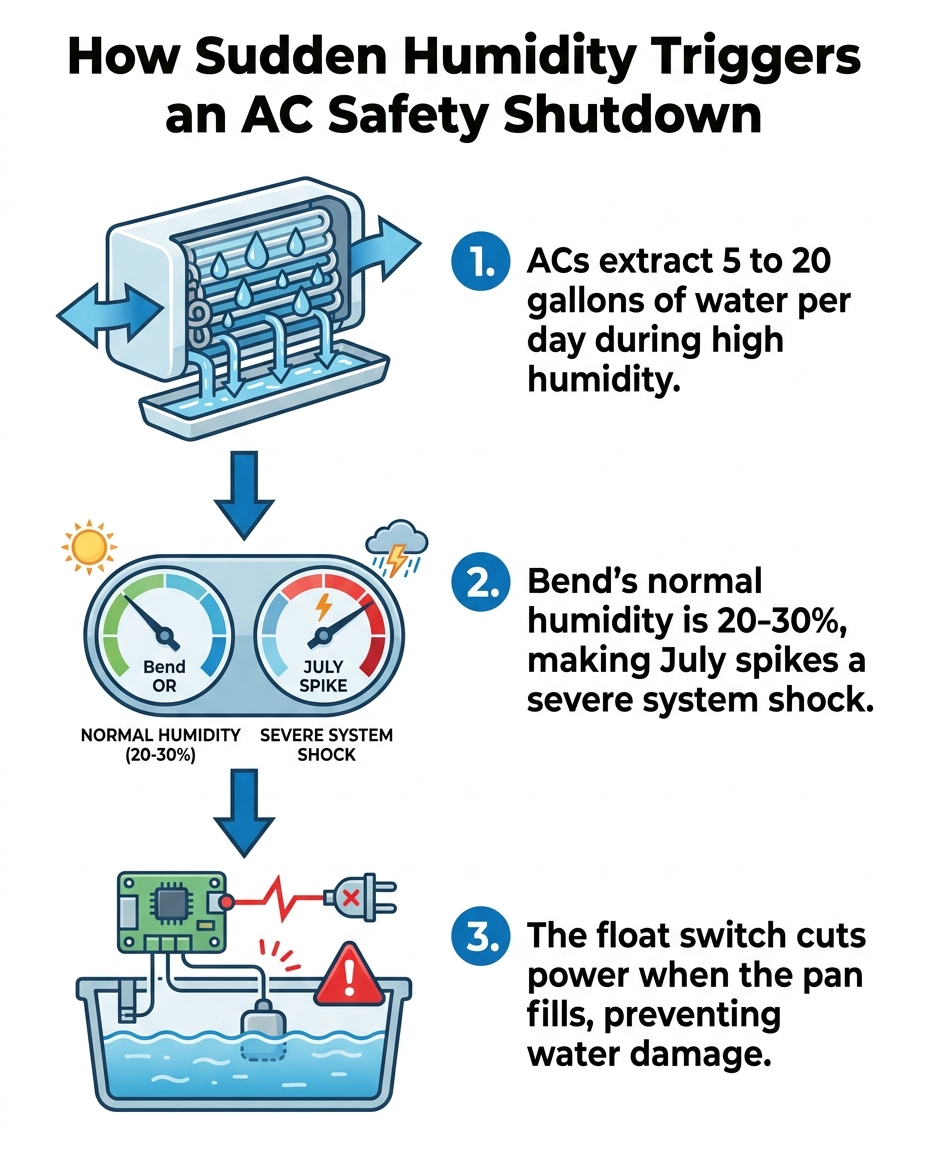
Bend, OR is famous for its dry, high-desert climate. Most of the year, your cooling equipment operates in an environment with very little moisture in the air. But when sudden July monsoonal spikes roll through the region, the operational rules change entirely. Central Oregon air conditioners, accustomed to low relative humidity levels around 20 to 30 percent, are suddenly forced to process massive amounts of condensation.
At Mountain View Heating, our deep understanding of Central Oregon's unique high-desert climate anomalies means we know exactly how these sudden weather shifts impact local equipment. In our years of dispatching technicians across Bend, our team typically sees a massive wave of panicked calls the moment these humidity spikes hit. For example, during a sudden wave of high temperatures and monsoonal moisture last summer, one local customer reached out when their heat pump system completely shut down under the heavy cooling load. Our service teams worked extended hours to address the sudden high demand for service across the region, successfully diagnosing the clogged drain and getting their system functioning reliably again despite the extreme weather.
The Invisible Load of Indoor Humidity
To understand why your system shuts down, you have to look at how an air conditioner actually cools your home. It doesn't just lower the temperature; it also removes moisture. Warm indoor air is blown across a freezing cold evaporator coil. As the air cools, it loses its ability to hold water vapor. That vapor turns into liquid condensation on the coil, much like water droplets forming on the outside of a cold glass of iced tea on a hot day.
During normal, dry weather, this process produces a small, manageable trickle of water. However, during periods of peak July summer heat and humidity, a standard residential air conditioner can extract anywhere from 5 to 20 gallons of water per day from your indoor air. This sudden, massive increase in water volume puts an enormous strain on a drainage system that rarely sees heavy use.
• Typical Bend Summer Day — Average Relative Humidity: 20% - 30% — Daily AC Condensation Volume: 1 to 3 Gallons — Impact on Drain Line: Minimal flow, allows dust to settle in pan
• July Monsoonal Surge — Average Relative Humidity: 50% - 70%+ — Daily AC Condensation Volume: 5 to 20 Gallons — Impact on Drain Line: Heavy flow, rapidly flushes debris into the drain pipe
The Anatomy of a Drain Line Backup: From High Desert Dust to Mud
The transition from a perfectly functioning air conditioner to a flooded system usually starts months before the actual shutdown. The physical cause of the clog is rarely just water. Instead, it is a combination of environmental factors unique to our region.
During the dry season, your indoor air handler pulls in microscopic particles of high-desert dust, pet hair, and household debris. Even with a good air filter, a small amount of this material makes its way to the evaporator coil and eventually settles into the dry condensate drain pan beneath it. Because the air is so dry, this dust simply sits there, accumulating slowly over time.
The sudden transformation: When peak July summer heat and humidity arrive, that sudden influx of 5 to 20 gallons of water mixes with the accumulated dust. Instantly, the fine dust turns into a thick, heavy mud. A partially blocked drain line that was "good enough" for a tiny trickle of water during dry weather becomes completely overwhelmed by the heavy flow of mud and debris. If you are already looking into troubleshooting steps for an AC that's blowing warm air, it is important to note that a struggling system often produces even more erratic condensation patterns.
• Airborne dust: High desert winds push fine particulate matter into the home, which eventually finds its way into the HVAC system.
• Biological growth: When the pan finally gets wet and stays wet during a humidity spike, dark, damp conditions encourage algae to bloom inside the pipe.
• Pet hair and dander: These materials bind with the wet dust, creating structural clogs that easily wedge into the narrow PVC drain fittings.
The Float Switch: Why a Dead AC is Actually Protecting Your Home
When the mud and debris finally block the PVC drain pipe completely, the water has nowhere to go. It begins to fill the drain pan. This is the exact moment when homeowners usually notice their system shutting down. However, this sudden loss of cooling is not a catastrophic breakdown—it is a highly effective safety feature stepping in to protect your property.
Modern air conditioning systems are equipped with a condensate overflow switch, commonly known as a float switch. This small, unassuming device is mounted on the side of the drain pan or directly on the primary drain pipe. Its entire job is to monitor the water level. When peak July summer heat and humidity cause the pan to fill faster than it can drain, the rising water lifts a small buoyant float inside the switch.
The sequence of protection:
1. The drain pipe becomes fully obstructed by mud or debris.
2. Condensation continues to drip rapidly from the evaporator coil into the pan.
3. The water level rises, lifting the mechanical float inside the safety switch.
4. The switch trips, instantly breaking the low-voltage electrical circuit connecting your thermostat to the air conditioner.
5. The system shuts down completely, halting the production of any new condensation.
While losing your air conditioning on a sweltering afternoon is frustrating, this intentional shutdown prevents severe water damage. Without the float switch, those 5 to 20 gallons of water would overflow the pan, soaking into your drywall, ruining your ceiling (if the unit is in the attic), or warping your hardwood floors. The system is doing exactly what it was designed to do, but the underlying clog must be resolved before cooling can resume.

Safe Diagnostic Signs Homeowners Can Check
When your system goes quiet, you want to know what you are dealing with before making a service call. While clearing a deep clog requires professional expertise, there are several safe, completely non-invasive ways to confirm that a clogged drain line is the reason your system shut down. Homeowners in Bend, OR can look for these specific diagnostic signs without ever touching a tool.
• Standing water in the pan: If your indoor air handler is located in an accessible closet or basement, shine a flashlight near the base of the unit. If you can see a secondary drain pan sitting under the equipment, check if it is holding standing water.
• A bone-dry outdoor pipe: Walk outside to where your AC condenser sits. Nearby, you should see a small PVC pipe exiting the side of your house. On a highly humid day, this pipe should be dripping water steadily. If it is completely dry while the house is warm and humid, the water is trapped inside.
• Unusual gurgling sounds: Right before the system shuts down, you might hear a distinct gurgling, bubbling, or dripping sound coming from the indoor air handler as water struggles to push past a partial blockage.
• A blank thermostat screen: Because the float switch cuts the low-voltage power that also runs to the thermostat, a completely blank thermostat screen is a strong indicator that the safety switch has tripped.
A critical safety warning: We strictly advise against opening the air handler panels or attempting to bypass the float switch. The switch is wired directly into the system's electrical board. Bypassing it not only risks severe electrical shock, but it guarantees that the system will overflow and cause massive water damage to your home.
Why Deep Drain Line Clogs Require Professional Tools
When faced with a clogged drain, many homeowners turn to the internet for quick fixes. However, the solutions that work for a slow bathroom sink are often ineffective—or outright dangerous—for an HVAC system. Establishing clear boundaries on why DIY drain clearing can be risky is essential for protecting your equipment.
Pouring vinegar down the access pipe is a common internet tip. While vinegar is excellent for preventing light algae growth during routine maintenance, it does absolutely nothing to dissolve heavy mud, packed pet hair, or deep biological blockages. It simply pools on top of the clog.
Improper use of shop vacuums or compressed air is another major risk. Applying too much pressure with an air compressor can easily blow the glued PVC joints apart inside your walls, creating a hidden leak that you won't discover until the drywall rots. Similarly, aggressively sealing a powerful shop vacuum to aging, brittle plastic drain components can crack the drain pan itself.
• Pouring Vinegar — The Intended Result: Dissolve the clog — The Actual Risk: Fails to break down mud; only treats mild algae.
• Compressed Air — The Intended Result: Blow the clog out — The Actual Risk: Ruptures PVC pipe joints hidden behind drywall.
• Shop Vacuum — The Intended Result: Suck the clog out — The Actual Risk: Can crack brittle drain pans or damage the float switch wiring.
A licensed professional in Bend, OR has the proper, specialized tools to clear the line safely. Technicians use regulated, low-pressure nitrogen clearing tools that safely push the blockage out without stressing the plumbing joints. Furthermore, a professional will verify that the float switch is functioning correctly after the line is cleared, ensuring your home remains protected. Remember that professional handling also protects your equipment warranty, which can be voided by improper DIY tampering.
Fortifying Your System Against Future Humidity Spikes
Once the immediate clog is cleared and your home is cooling again, the focus should shift from emergency repair to proactive prevention. You cannot control the weather, but you can control how well your system handles it.
Routine maintenance is the most effective way to prevent this specific issue. During a professional tune-up, technicians clear out the dry dust from the drain pan and flush the lines before the heavy condensation ever begins. By removing the dust before it becomes mud, the system can handle sudden condensation surges much more efficiently when peak July summer heat and humidity finally arrive. A clean evaporator coil also sheds water much faster, preventing moisture from blowing off the coil and into the ductwork.
Additionally, managing your home's overall moisture load reduces the burden on your air conditioner. Implementing indoor air quality solutions, such as whole-home dehumidification systems or improved ventilation, ensures that your AC isn't doing all the heavy lifting during a monsoonal surge. We highly recommend scheduling proactive check-ups through a routine AC maintenance schedule before the peak summer season hits next year, ensuring your drain lines are clear and your safety switches are tested.
Make an Informed Call for Professional AC Restoration
A sudden loss of cooling is stressful, but understanding the mechanics behind it puts you in control. A tripped float switch is a clear sign that your system successfully protected your home from devastating water damage. Now that you know the diagnostic signs of a clogged drain line, you can confidently address the situation without resorting to risky DIY methods.
If your system has gone quiet and you suspect a backed-up drain line is to blame, don't wait for the heat in Bend, OR to become unbearable. Schedule a professional diagnostic today to safely clear the line, test your safety switches, and restore your home's cooling efficiency.
Frequently Asked Questions
Will a clogged drain line stop my AC from working completely?
Yes, a clogged drain line will often cause the entire system to shut down completely. This happens because modern air conditioners are equipped with a safety float switch designed to prevent water damage. When the drain backs up, water fills the pan, lifting the float and breaking the electrical circuit to the thermostat. Until the clog is cleared and the switch is reset, the system will not turn back on.
Why is my AC producing so much condensation suddenly?
Your AC produces sudden, heavy condensation when the indoor relative humidity spikes rapidly. The cooling process naturally pulls moisture out of the air as it passes over the cold evaporator coil. During periods of high humidity—like a sudden summer thunderstorm—the system has significantly more water vapor to process, turning a normally slow drip into a heavy, continuous flow of water.
Where is the AC float switch located?
The AC float switch is typically located near the indoor air handler or furnace. You will usually find it mounted directly on the side of the primary condensate drain pan, or spliced into the PVC drain pipe just as it exits the unit. It often looks like a small plastic cap or a T-shaped PVC fitting with a wire running out of the top and connecting back into the equipment panel.
How do you know if your AC drain line is clogged?
The most common sign of a clogged drain line is an air conditioner that suddenly stops running while the thermostat remains blank or unresponsive. You may also notice standing water in the drain pan beneath the indoor unit, hear unusual gurgling sounds from the air handler, or see that the outdoor condensate drain pipe has stopped dripping water entirely despite the house being warm and humid.
Why does my AC drain clog more frequently during July thunderstorms?
July thunderstorms introduce a massive, sudden surge of humidity into a normally dry environment. Throughout the drier months, dust and debris accumulate in the drain pan. When the thunderstorm hits, the AC suddenly pulls gallons of water from the humid air, mixing with that dry dust to create a thick mud that rapidly overwhelms and clogs the narrow PVC drain pipe.