


Why Arid Climates Put Extra Strain on Your HVAC System
Finding the best ac filter options for high desert homes is one of the most important — and most overlooked — decisions a Bend, Oregon homeowner can make. Central Oregon's high desert climate is uniquely demanding: low humidity, persistent fine dust, seasonal pollen, and increasingly intense wildfire smoke all push through your HVAC system every single day. Standard filters designed for milder climates simply aren't built for these conditions.
Quick Answer: Best AC Filter Options for High Desert Homes
• Pleated polyester (disposable) — MERV Rating: MERV 8-11 — Best For: Everyday dust and pollen; most systems
• Pleated electrostatic — MERV Rating: MERV 11-13 — Best For: Heavy dust, allergens, wildfire smoke
• Washable electrostatic — MERV Rating: MERV 9 — Best For: Reusable; low-waste option
• Deep media (4-inch pleated) — MERV Rating: MERV 11-13 — Best For: Best airflow + filtration balance
• HEPA (standalone purifier) — MERV Rating: N/A — Best For: Supplemental smoke and fine particle control
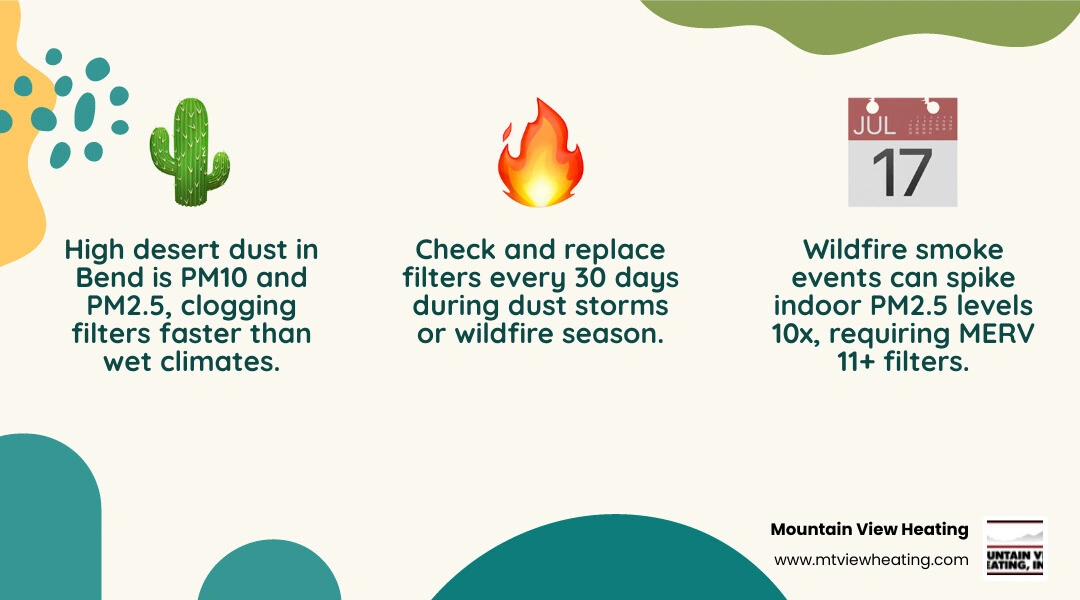
For most Bend-area homes, a MERV 11 to MERV 13 pleated electrostatic filter replaced every 1 to 3 months is the recommended starting point. During wildfire season or after dust storms, check your filter every 30 days — or sooner.
Here's what makes the high desert so hard on HVAC systems and filters: the dust is fine, abrasive, and relentless. Unlike typical household dust in wetter climates, high desert particulate matter — including PM10 and PM2.5 — penetrates deep into filter media and clogs it faster than most homeowners expect. The result is reduced airflow, a strained blower motor, and indoor air that's far from clean. Add wildfire smoke events that have become a regular part of Central Oregon summers, and the case for choosing the right filter gets even stronger.
For a broader look at what your air may be carrying, see Signs of Poor Indoor Air Quality and The Impact of Air Ducts on Indoor Air Quality.
Evaluating the Best AC Filter Options for High Desert Homes
When we evaluate the best ac filter options for high desert homes, we aren't just looking for a filter that catches dust. We are looking for a delicate balance between air filtration and system performance.
In our dry climate, the air is thin, and our HVAC systems already work hard to move air efficiently. When you put a filter in your return air vent, it acts as a gatekeeper. If that gatekeeper is too restrictive, your air conditioner will choke. This is why understanding how different filters utilize electrostatic charges, pleated media, and structural thickness is essential to keeping your home comfortable and your energy usage manageable.
To understand how restriction impacts your cooling, explore How Airflow Affects Your Air Conditioner's Performance.
Why MERV Ratings Dictate the Best AC Filter Options for High Desert Homes
The Minimum Efficiency Reporting Value (MERV) scale runs from 1 to 20, measuring how effectively a filter traps particles of various sizes. However, higher is not always better for residential systems.
• MERV 8: This is a solid, reliable baseline for many homes in Bend and Redmond. It captures larger airborne particles like pollen, dust mites, and standard household lint. If you don't have pets or severe allergies, a MERV 8 filter provides excellent airflow with decent filtration.
• MERV 11: This is the "sweet spot" for many high desert homes. It captures finer particles, including pet dander, mold spores, and car exhaust. It offers a significant upgrade in air quality without creating excessive static pressure in modern HVAC systems.
• MERV 13: Highly recommended during active wildfire seasons, MERV 13 filters capture up to 98% of particles as small as 0.3 microns, including bacteria, virus carriers, and fine smoke particles.
The catch with higher MERV ratings is static pressure. A denser filter weave creates more airflow resistance. If your system's blower motor has to fight too hard to pull air through a dense MERV 13 filter, it will experience severe strain. Over time, this can lead to weak airflow, uneven cooling, higher energy consumption, and even a frozen evaporator coil.
Comparing the Best AC Filter Options for High Desert Homes by Material
Different filter materials perform very differently under dry, dusty desert conditions. Let's break down the most common options:
• Fiberglass Filters: These are the flat, see-through filters you can buy in bulk. While they offer virtually zero airflow resistance, they are terrible for the high desert. Fine silty dust and pollen pass right through them, settling directly on your AC's internal coils and your furniture.
• Pleated Polyester: These disposable filters are the standard recommendation. The pleats vastly increase the surface area of the filter, allowing it to capture more dust without immediately choking your airflow. Many are electrostatically charged, meaning they act like a magnet to attract tiny airborne particles.
• Washable Electrostatic: These permanent filters generate a natural static charge as air passes through a polypropylene weave. They are highly durable, but they require diligent maintenance. You must wash them thoroughly and allow them to dry completely before putting them back. In our dry climate, drying is fast, but failing to dry them can introduce moisture and mold into your ductwork.
• Fiberglass — Typical MERV: MERV 1-4 — Desert Dust Performance: Poor (lets fine dust pass) — Airflow Impact: Extremely Low — Maintenance: Replace every 30 days
• Pleated Polyester — Typical MERV: MERV 8-11 — Desert Dust Performance: Good to Excellent — Airflow Impact: Low to Moderate — Maintenance: Replace every 1-3 months
• Deep Media (4-inch) — Typical MERV: MERV 11-13 — Desert Dust Performance: Excellent (high capacity) — Airflow Impact: Low — Maintenance: Replace every 6-9 months
• Washable Electrostatic — Typical MERV: MERV 9 — Desert Dust Performance: Moderate to Good — Airflow Impact: Moderate — Maintenance: Wash & dry monthly
Managing Wildfire Smoke and Seasonal Dust Storms in Central Oregon
As we prepare for the June 2026 wildfire season, indoor air quality is top of mind for every homeowner in Sisters, Sunriver, and La Pine. Wildfire smoke is composed of microscopic PM2.5 particles (particulate matter smaller than 2.5 microns). These tiny particles bypass our natural respiratory defenses and can easily penetrate standard home filters.
During active smoke events, upgrading to a MERV 13 filter is highly effective because it is dense enough to capture these microscopic smoke carriers. However, true HEPA filters (which capture 99.97% of particles down to 0.3 microns) are generally too thick to be used directly in standard 1-inch residential HVAC filter slots without causing immediate system failure due to extreme airflow restriction.
Instead, we recommend using a high-quality MERV 11 or 13 filter in your central system to protect your equipment and capture larger smoke aggregates, while complementing it with standalone HEPA air purifiers in high-traffic rooms.
To learn more about staying safe indoors during these events, check out Indoor Air Quality During Fires and find out Is It Okay to Operate Your AC During Wildfire Season. If you are wondering about extra filtration devices, read about Are Air Purifiers Actually Effective.
Best Practices for Filter Maintenance and System Efficiency
In the high desert, "set it and forget it" does not work for air filters. Because of the heavy outdoor dust load, filters degrade and clog much faster than they would in wetter, greener climates.
If you have a modern, high-efficiency AC system—especially one with a variable-speed or inverter-driven blower motor—filter maintenance is even more critical. Variable-speed systems are designed to run continuously at lower, energy-saving speeds to maintain precise comfort. While this constant circulation is fantastic for keeping your indoor air cleaner, it also means your filter is constantly filtering air and will fill up with dust much faster.
Here is our recommended maintenance checklist for high desert homeowners:
1. Perform 30-Day Inspections: Pull your filter out every single month. Hold it up to a light source. If you cannot see light passing through the pleats, it is time for a replacement—regardless of how long the package says it should last.
2. Upgrade to Deep Media Filters If Possible: If your system can be retrofitted to hold a 4-inch deep media filter instead of a standard 1-inch filter, do it. Deep pleated media filters provide up to four times the filtering surface area, allowing you to use a high-efficiency MERV 11 or 13 rating with very little airflow resistance.
3. Adjust Your Schedule Seasonally: Our filtration needs change dramatically throughout the year. Keep your system running smoothly by staying ahead of seasonal shifts:
— Prepare your system in spring with our Spring Cleaning Checklist for Better Indoor Air Quality.
— Anticipate autumnal changes by reading about 5 Factors That Will Affect Your Indoor Air Quality During Fall.
— Keep things efficient during our freezing winters with these 3 Ways to Optimize Indoor Air Quality During the Winter.
Frequently Asked Questions About Desert AC Filters
How often should I change my AC filter during a Central Oregon summer?
During a typical Central Oregon summer, you should check your filter every 30 days and replace a standard 1-inch pleated filter every 1 to 2 months. If we experience heavy dust storms, high winds, or active wildfire smoke events, you may need to replace the filter every 3 to 4 weeks. High-dust regions naturally accelerate clogging, and keeping a fresh filter in place is the simplest way to protect your cooling system.
Will a MERV 13 filter damage my air conditioning system?
A MERV 13 filter will not damage your system as long as your HVAC unit and ductwork are designed to handle the higher static pressure. However, in older systems or homes with undersized return ducts, a MERV 13 filter can restrict airflow too much, causing the blower motor to overheat and the evaporator coils to freeze. If you notice weak airflow or longer cooling cycles after installing a MERV 13 filter, step down to a MERV 11 filter.
Can a high-efficiency filter help reduce dust on my furniture?
Yes! High-efficiency pleated and electrostatic filters capture fine, airborne desert dust before it has a chance to settle on your tables, floors, and countertops. By trapping these tiny particles inside the filter media, you will notice a visible reduction in how often you need to dust your home.
To learn more about the physical and health advantages of upgrading your filtration, read about the 3 Benefits of Clean Air in Your Home.
Conclusion
Living in the high desert of Central Oregon means embracing beautiful sunny days, but it also means managing the unique dust and smoke challenges that come with our arid climate. Choosing the best ac filter options for high desert homes is a simple, highly effective way to protect your family's health and ensure your air conditioner operates at peak efficiency all summer long.
At Mountain View Heating, we have spent over 40 years helping homeowners in Bend, Redmond, Sisters, Sunriver, and surrounding communities stay comfortable indoors. We prioritize 100% customer satisfaction on every single job, whether we are performing a routine filter assessment or installing a high-efficiency cooling system.
If you want to ensure your home's cooling system is ready to handle the high desert heat and dust, reach out to our team today to schedule our professional air conditioning services.