


The Hidden August Threat to Your Home's Cooling Power
Before the first autumn breeze arrives, there is a specific seasonal hazard you need to watch out for, which is exactly why late summer pet shedding is the enemy of your evaporator coil. As August temperatures peak, kids get ready to head back to school, and your air conditioner runs around the clock, you might notice your home feeling uncomfortably warm despite the thermostat setting. At Mountain View Heating, Inc., we see many Bend homeowners immediately assume their entire cooling system is failing or dying. However, the true culprit is often a suffocated indoor coil rather than a broken machine. Dog and cat hair bypassing cheap air filters creates a thick, insulating blanket over the system's most critical components, drastically reducing cooling power right when you need it most for that end-of-season cooling relief.
To protect your air conditioning systems from this seasonal threat, you need routine HVAC maintenance and a proactive approach to your indoor air quality.
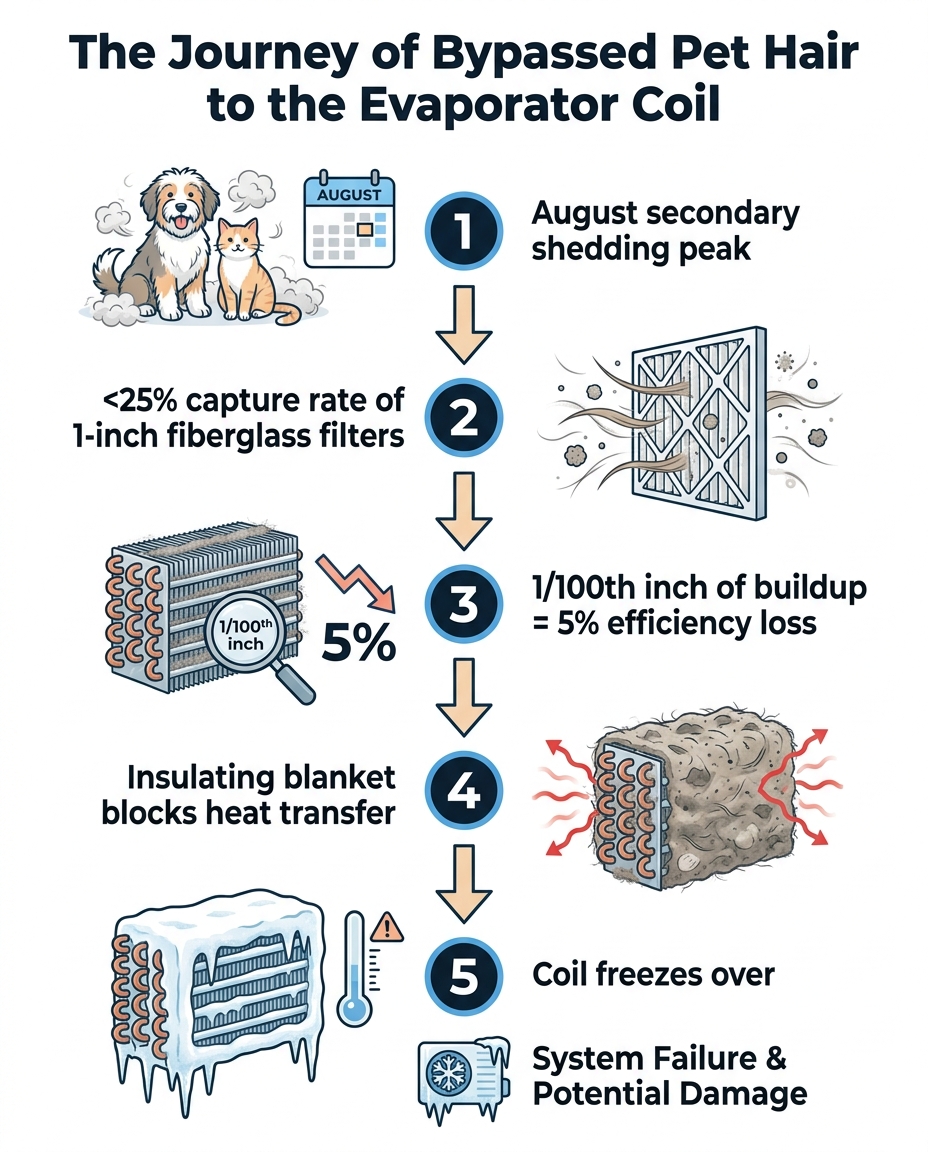
During the intense heat of August late-summer shedding, many dog and cat breeds experience a secondary shedding phase. As they begin preparing to grow their heavier winter coats, they release massive amounts of fine hair and microscopic dander into your home's air. If you rely on basic, low-quality filtration during this peak season, you are leaving your system defenseless. The sheer volume of debris quickly overwhelms standard filters, allowing fine hairs to bypass your defenses entirely and attack the core mechanical components of your cooling equipment. Understanding how this happens is the first step to restoring your home's comfort.
The High Desert Double Threat: Dust Meets Dander
Living in Bend OR presents a unique environmental challenge for your heating and cooling equipment. In our years of servicing High Desert homes, our team regularly sees how our specific late-summer climate—characterized by hot, dry, and highly dusty conditions—wreaks havoc on standard filters. This regional High Desert dust is incredibly fine and pervasive. On its own, this environmental particulate matter rapidly loads the surface of standard air filters, significantly reducing their functional lifespan compared to filters used in more humid, less dusty climates.
When you combine this heavy regional dust load with August late-summer shedding from your pets, you create a compounding effect that spells disaster for your HVAC system. The filter media becomes overwhelmed at an accelerated rate. As the filter clogs with a concrete-like mixture of dirt and dander, the system's blower motor continues to pull air with immense force.
The Path of Least Resistance
Airflow always seeks the easiest route. When a filter is completely blocked by High Desert dust and pet hair, the resulting pressure forces the air to bypass the filter entirely. It slips through the microscopic gaps around the cardboard frame, dragging fine pet hairs right along with it.
• High Desert Dust (Bend OR) — Impact on Standard HVAC Filters: Rapidly coats and seals the filter media surface — Resulting Bypass Risk: High pressure forces air around the filter edges
• Late Summer Pet Shedding — Impact on Standard HVAC Filters: Weaves into the dust, creating a solid physical barrier — Resulting Bypass Risk: Fine undercoat hairs slip through gaps easily
• Combined Dust & Dander — Impact on Standard HVAC Filters: Total filter suffocation in a matter of weeks — Resulting Bypass Risk: Maximum bypass directly into sensitive components
This bypass effect means your filter is no longer doing its job. Instead of trapping the debris, the heavy air pressure forces the shedding pet hair directly into the unshielded, sensitive mechanical zones of your ductwork and air handler.
The Illusion of Protection: Why Cheap Filters Fail Pet Owners
Many homeowners believe that as long as there is a filter in the slot, their system is protected. Unfortunately, standard 1-inch fiberglass filters are designed primarily to protect the large blower motor from massive debris like leaves, large insects, or heavy gravel. They are absolutely not designed to improve your indoor air quality or catch fine pet dander.
According to strict ASHRAE guidelines, these basic, see-through filters typically capture less than 25% of particles in the 3.0 to 10.0 micron range. To put that into perspective, human hair is about 70 microns thick, but the fine undercoat dander from your cat or dog is significantly smaller. Because the fiberglass weave is so wide and porous, these microscopic particles face almost no resistance.
How Fine Hair Slips Through the Cracks
The structural flaw: When you hold a cheap fiberglass filter up to the light, you can easily see right through it. The spun glass fibers are spaced far apart. Fine undercoat hairs from dogs and cats easily slip through this wide weave, especially when pushed by the heavy air pressure of a struggling blower motor.
Once the August late-summer shedding bypasses the filter, it does not just blow out of your vents and back into your living room. Instead, it is pulled directly into the dark, damp, and highly sensitive indoor components of the HVAC system, setting the stage for a major mechanical failure.
Anatomy of a Suffocated Evaporator Coil
To understand why this bypassed hair is so destructive, you have to understand what happens inside the air handler. The indoor evaporator coil is a complex network of copper tubes covered in hundreds of delicate aluminum fins. Its primary job is to pull humidity out of your indoor air via condensation. Because of this natural dehumidification process, the coil is constantly wet while the system is running.
When you rely on cheap 1-inch fiberglass filters, the bypassed pet hair and High Desert dust hit this wet, sticky surface. Rather than blowing past the fins, the debris sticks instantly to the condensation. Over weeks of continuous operation during the intense heat of August, this mixture of wet dust and pet hair weaves into a literal insulating blanket.
The High Cost of a Thin Blanket
• Immediate efficiency loss: A buildup of just 1/100th of an inch of this dirt and hair mixture can reduce overall system efficiency by 5%.
• Longer run times: Because the system cannot cool the air efficiently, it is forced to run longer and harder to reach your thermostat setting.
• Increased mechanical wear: The continuous operation strains the compressor and blower motor, shortening the lifespan of the entire unit.
The wet evaporator coil acts like a magnet for every piece of dander that your basic filter missed. What starts as a few fine hairs quickly becomes a dense, felt-like mat that completely chokes the system's ability to breathe.

From Insulator to Ice: The Chain Reaction of Heat Transfer Failure
The primary job of the evaporator coil is to absorb heat from the warm indoor air passing over it. The cold refrigerant inside the copper tubes acts as a sponge, soaking up the heat so that the air returning to your living room is crisp and cool. However, the blanket of bypassed August late-summer shedding physically blocks this crucial process.
The matted pet hair acts as a powerful insulator. It stands between the warm indoor air and the cold copper tubes. Without the warm air to absorb, the refrigerant inside the coil stays dangerously cold. This triggers a rapid and destructive chain reaction inside your unit.
The Freezing Process Explained
1. Heat transfer stops: The insulating hair blanket prevents the warm air from touching the cold metal of the coil.
2. Temperatures plummet: Because the refrigerant cannot absorb heat, its temperature drops rapidly below the freezing point.
3. Condensation freezes: The natural water droplets sitting on the coil instantly turn into solid ice.
4. Total blockage: The ice spreads across the delicate fins, completely blocking all airflow through the system.
When this happens, you will notice classic symptoms like ice forming on your AC unit, severely restricted airflow from your vents, and a system that blows warm air while running constantly. The machine is suffocating, and the ice will continue to build until the unit is shut down and properly thawed.
Why DIY Coil Cleaning is a Costly Mistake
When we respond to late-summer emergency calls from Bend OR homeowners who discover a frozen, dirty evaporator coil, we often learn their first instinct was to grab a vacuum or a stiff brush to clear the hair away. As HVAC professionals, we always warn that this is one of the most dangerous mistakes you can make with your cooling system. The aluminum fins on an evaporator coil are incredibly thin—often thinner than paper—and they are spaced tightly together to maximize surface area for heat transfer.
If you touch these fins with a household brush or a vacuum attachment, they will instantly crush and fold over. Once the fins are flattened, airflow is permanently ruined, and the entire coil usually needs to be replaced. Furthermore, removing the thick, matted blanket of wet pet hair requires specialized, non-corrosive foaming chemicals that penetrate deep into the coil to dissolve the grime.
The Risks of Amateur Intervention
Chemical damage: Using household cleaners on an aluminum coil can cause rapid corrosion, leading to microscopic holes in the copper tubing and catastrophic refrigerant leaks.
System accessibility: Accessing the coil often requires disassembling the metal plenum and carefully handling components located dangerously close to the highly pressurized refrigerant lines. Attempting to clean the coil yourself without professional training can lead to severe system damage, dangerous leaks, or completely voided manufacturer warranties. In our experience, the only safe way to restore a suffocated coil is through professional intervention.
Upgrading Your Defense: Better Filtration Strategies
Once our technicians at Mountain View Heating, Inc. have professionally cleaned and restored your coil, you must change your defense strategy to prevent the issue from happening again. Relying on cheap 1-inch fiberglass filters is no longer an option if you want to protect your system from heavy seasonal shedding.
Upgrading your filtration requires a careful balance. You need a filter capable of catching fine dander, but you cannot install a filter so thick that it chokes the blower motor. A filter that is too restrictive can cause the exact same freezing issues as a dirty coil by starving the system of return air.
Steps to Protect Your Clean Coil
• Upgrade to pleated filters: Switch from flat fiberglass to a pleated filter with an appropriate MERV rating. Typically, a MERV 8 to 11 filter is ideal for homes with pets, as it captures fine dander without overly restricting airflow.
• Increase replacement frequency: During the peak shedding season, check and replace your filters much more frequently. In dusty environments, this often means installing a fresh filter every 30 days to prevent bypass.
• Monitor system airflow: Keep an eye on the air pressure coming from your vents. If airflow feels weak, check the filter immediately.
For homes with multiple shedding pets, relying on a single 1-inch filter might never be enough. Integrating dedicated indoor air quality solutions like whole-home air purifiers or upgraded 4-inch media cabinets can capture dander long before it ever reaches the sensitive HVAC components.
Frequently Asked Questions
Can dog hair cause an AC unit to freeze up?
Yes, dog hair is a leading cause of frozen AC units in homes with pets. When hair bypasses the air filter, it sticks to the wet indoor coil and forms an insulating blanket. This blanket prevents the system from absorbing heat, causing the internal temperatures to drop below freezing and turning the condensation into solid ice.
What happens when an AC evaporator coil gets dirty?
When an evaporator coil gets dirty, the system loses its ability to transfer heat efficiently. The dirt and hair act as a physical barrier between the warm indoor air and the cold refrigerant inside the copper tubes. This forces the unit to run longer, drives up energy costs, and eventually leads to system overheating or freezing over completely.
Why is my AC running but not cooling the house?
If your AC is running continuously but the house remains warm, you likely have a severe airflow restriction or a dirty evaporator coil. The system is mechanically functioning, but it cannot successfully absorb heat from the air inside your home. Checking your air filter is the first step, but a professionally cleaned coil is often required to restore cooling power.
How often should pet owners change their AC filter in late summer?
Pet owners should check their air filters every 30 days during late summer. Because of the secondary shedding phase and increased dust in the environment, filters clog much faster than they do in the spring or winter. If the filter looks gray and heavily loaded with hair, it needs to be replaced immediately, regardless of the manufacturer's suggested lifespan.
Can pet hair permanently break an air conditioner?
While pet hair itself doesn't break the metal, the strain it puts on the system can cause permanent mechanical failure. A suffocated system forces the blower motor and outdoor compressor to work twice as hard to move air. Over time, this constant strain can cause these expensive components to burn out prematurely.
What is the best MERV rating for a house with multiple shedding pets?
A MERV 8 to MERV 11 filter is generally the best choice for a home with multiple pets. These ratings are tight enough to capture fine pet dander and hair, but porous enough to allow healthy airflow through the system. Going higher than MERV 11 without professional ductwork modifications can restrict airflow too much and damage your equipment.
Late summer shedding doesn't have to mean the end of your home's comfort. By understanding the mechanical risks and taking proactive steps to upgrade your filtration, you can keep your system running smoothly. A clear, logical explanation of how pet hair bypasses cheap filters proves that poor cooling isn't a dying unit—it just means you need a professional coil cleaning followed by a stronger defense strategy.