


Spotting Ice on Your Outdoor Unit During Fall Mornings
You wake up, the house feels unusually chilly, and you step outside to check your HVAC system, only to find the outdoor cabinet covered in a layer of white frost. When dealing with unfamiliar heating issues, relying on local service expertise and area tips is the best way to determine if you are facing a quick fix or a genuine emergency. Your immediate instinct might be to panic, especially when you head back inside and notice the vents blowing cool air instead of the warm heat you expected.
At Mountain View Heating, Inc., our team frequently receives worried calls during the crisp, freezing early mornings of the High Desert. We always reassure our customers that it is entirely normal for your system to work harder than usual. In Central Oregon, drastic day-to-night temperature swings mean your equipment is constantly adapting to changing demands. What looks like a major breakdown is often just the system adjusting to the seasonal shift. However, distinguishing between standard operation and a true mechanical failure is critical for protecting your equipment before winter fully sets in. Keeping up with routine AC maintenance and seasonal heating tune-ups provides a baseline of reliability, ensuring that when those October first-freeze morning startups occur, your system is prepared to handle the load.
The immediate takeaway: Do not turn off your system immediately or attempt to chip the ice away. Understanding how your equipment operates in lower temperatures will help you make an informed decision about whether to wait it out or call a professional technician.
Why Your 'AC Unit' Acts Differently in Autumn
Many homeowners we visit refer to the large metal box sitting outside their house simply as the "AC unit." While it certainly kept your Central Oregon home cool all summer, that cabinet actually houses a heat pump. A heat pump is a versatile piece of engineering designed to provide both cooling and heating by moving heat from one place to another. In the summer, it absorbs heat from inside your house and dumps it outside. In the autumn and winter, it reverses this exact process.
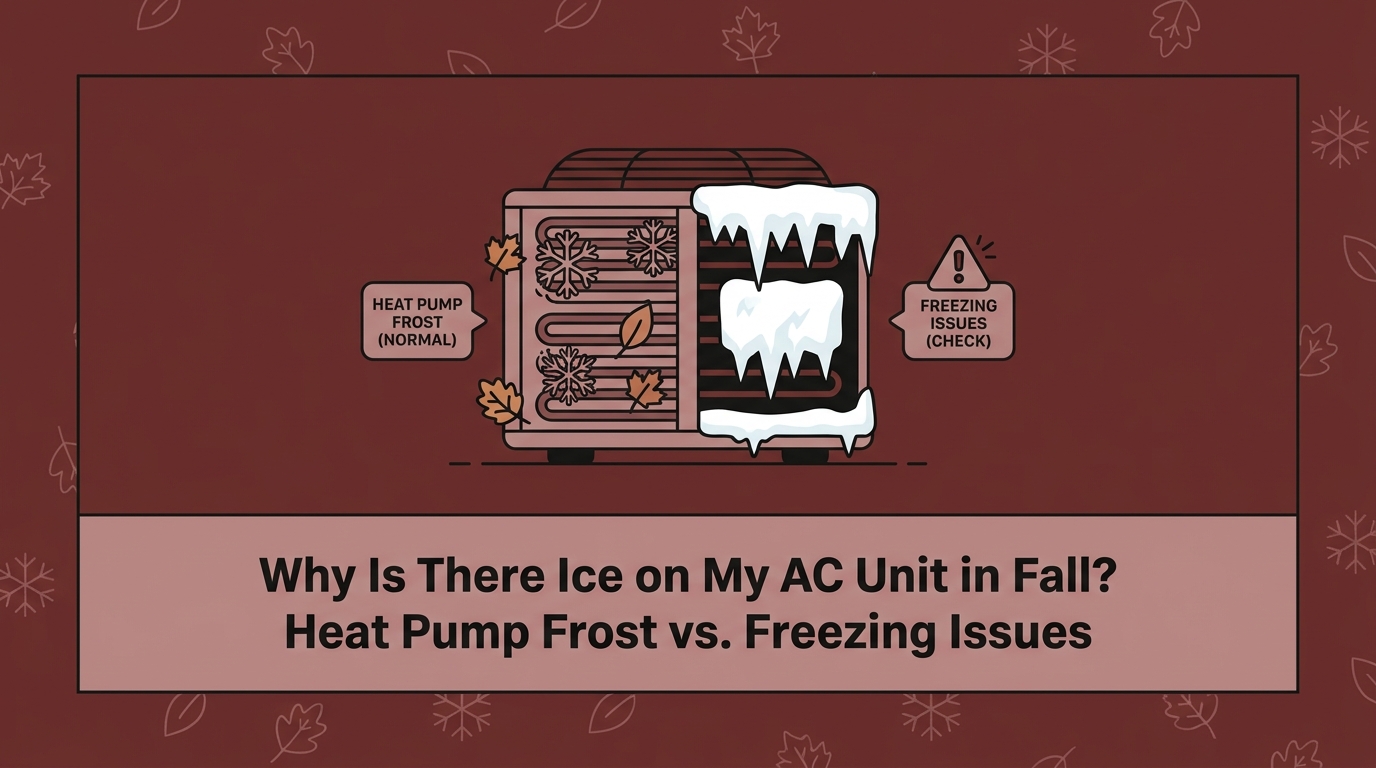
As ambient temperatures drop near freezing, the outdoor coil acts as an evaporator. It absorbs whatever ambient heat is available in the cold outdoor air. Because the refrigerant inside the coil is much colder than the outside air, moisture from the atmosphere naturally condenses on the cold metal fins. When the outside temperature dips low enough, this condensation freezes into a layer of frost. This is a normal, expected part of autumn heating operation, and it requires a completely different troubleshooting approach than what to do when ice forms on your AC unit during a sweltering summer afternoon.
The Shift from Cooling to Heating
The magic behind this seasonal transition is a component called the reversing valve. This heavy-duty brass valve sits near the compressor and directs the flow of pressurized refrigerant. When you switch your thermostat from "Cool" to "Heat," an electrical solenoid shifts the valve. Instantly, the hot, high-pressure gas that was being pumped outside during the summer is redirected inside to your indoor coil.
Key operational changes during the shift:
• Refrigerant flow reverses: The indoor coil becomes the condenser (releasing heat), and the outdoor coil becomes the evaporator (absorbing heat).
• Outdoor fan speeds adjust: The system may modulate the outdoor fan to optimize heat absorption from the cold air.
• Moisture collection changes locations: Instead of your indoor unit dripping condensation into a drain pan, your outdoor unit begins collecting condensation on its exposed metal fins.
Because the fundamental physics of the system remain the same, it is easy to see why homeowners misinterpret outdoor frost as a cooling failure rather than a normal heating function.
Understanding the Mechanics of a Heat Pump Defrost Cycle
Because frost naturally accumulates on the outdoor coil during cold weather, heat pumps are engineered with a built-in mechanism to melt it away: the defrost cycle. If the frost were allowed to build up indefinitely, it would insulate the coil, preventing the system from absorbing any heat from the outside air. To maintain efficiency, the system must periodically clear itself.
A standard defrost cycle is a temporary mode where the heat pump essentially switches back into air conditioning mode for a short period. By shifting the reversing valve, the system sends hot, pressurized refrigerant back to the outdoor coil. This rapid influx of heat melts the accumulated frost quickly and efficiently. During this time, the outdoor fan will intentionally stop spinning. If the fan kept running, it would blow cold outside air over the coil, defeating the purpose of the hot refrigerant and making it harder to melt the ice.
While this is happening outside, you will likely notice a change inside your home. Because the system is temporarily operating as an air conditioner to harvest heat for the outdoor melt, it will produce lukewarm air output during defrost mode. This is the exact symptom that causes homeowners to worry during October first-freeze morning startups. To prevent the house from getting too cold, many systems will automatically engage auxiliary electric heat strips to temper the air, but the airflow will still feel significantly cooler than the normal blast of winter heating.
What to expect during a normal defrost cycle:
• Duration: A typical cycle lasts between 5 and 15 minutes, depending on the severity of the frost and the outdoor temperature.
• Visuals: You may see steam rising from the outdoor unit as the hot refrigerant melts the frost. This is water vapor, not smoke.
• Audio: You will likely hear a distinct "whoosh" sound when the reversing valve shifts, followed by the compressor running while the outdoor fan remains completely silent.
Understanding these mechanics is a fundamental part of owning modern air conditioning systems and heat pumps, as it prevents unnecessary service calls for equipment that is operating exactly as designed.
Visual and Operational Signs: Normal Frost vs. Solid Ice
In our years of serving the Bend community, our technicians have found that equipping yourself with a clear diagnostic framework is the best way to evaluate the ice on your outdoor unit. Because drastic day-to-night temperature swings make light morning frost a daily occurrence, observing the system's behavior is more important than simply reacting to the sight of ice.
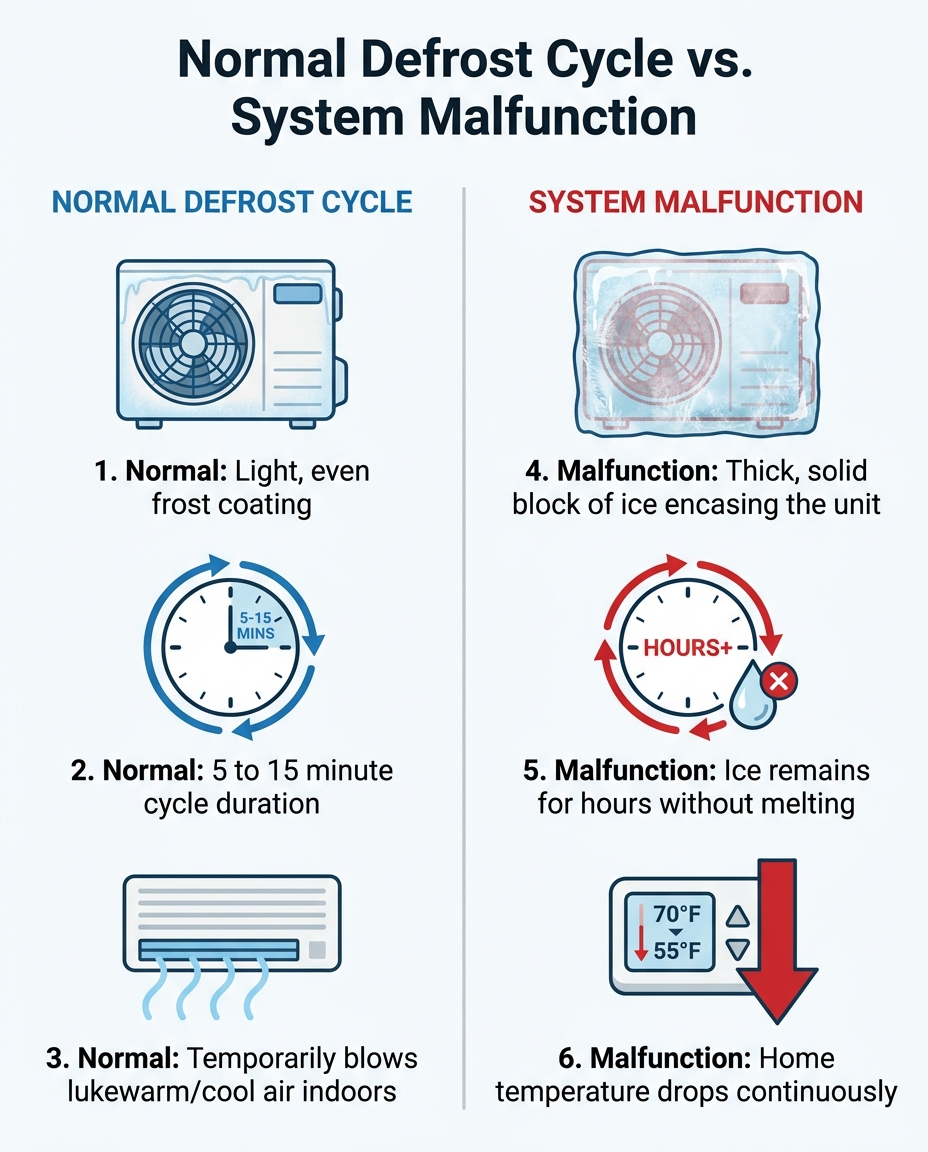
Normal frost appears as a light, even, white coating across the metal fins of the outdoor cabinet. It looks similar to the frost you might see on your car windshield early in the morning. When the defrost cycle engages, this white coating should melt away completely within 15 minutes, leaving the coils wet but entirely clear of ice. Once the cycle finishes, the outdoor fan will kick back on, and the indoor vents will return to blowing warm heat.
Abnormal ice, on the other hand, is thick, dense, and solid. It may look like a glacier forming on the side of your house. This type of ice often encases the copper refrigerant lines, builds up heavily on the fan blades, or traps the compressor in a solid block. If you observe the unit for a full 15-to-20-minute cycle and the thick ice does not melt—or if the system never attempts to run a defrost cycle at all—you are likely facing a mechanical malfunction.
Crucial warning: Never attempt to chip, scrape, or break ice off your outdoor unit with a tool, knife, or shovel. The aluminum fins and copper lines are incredibly fragile. Striking them with a hard object can easily puncture a pressurized refrigerant line, turning a moderate repair into a catastrophic system failure.
• Appearance of Ice — Normal Defrost Cycle: Light, white, even coating of frost on the fins. — Mechanical Malfunction: Thick, solid, clear or cloudy block of dense ice.
• Cycle Duration — Normal Defrost Cycle: Melts completely within 5 to 15 minutes. — Mechanical Malfunction: Ice remains for hours or never fully melts away.
• Indoor Airflow — Normal Defrost Cycle: Temporary lukewarm air output during defrost mode. — Mechanical Malfunction: Continuous cold air blowing; home fails to warm up.
• System Sounds — Normal Defrost Cycle: "Whoosh" sound, compressor humming, fan stopped. — Mechanical Malfunction: Grinding fan blades hitting ice, or system constantly running.

Mechanical Failures That Cause Severe Freezing
If your system fails the visual and operational tests outlined above, the thick ice is likely the symptom of a deeper mechanical issue. Outdoor units do not freeze solid for no reason. When our team is dispatched to a home where a heat pump is encased in dense ice, we typically find it points to one of three technical failures that disrupt the system's delicate balance of pressure, temperature, and timing.
Low Refrigerant Levels
Your heat pump requires a very precise amount of refrigerant to operate correctly. This chemical compound is responsible for absorbing and releasing heat. If there is a leak in the copper lines, the coils, or a fitting, the overall volume of refrigerant drops. In the world of HVAC thermodynamics, a drop in pressure equals a drop in temperature. When refrigerant levels are low, the saturation temperature of the outdoor coil plummets far below its normal operating range. This causes moisture in the air to freeze onto the coil much faster and heavier than the system is designed to handle. A standard defrost cycle cannot keep up with this rapid, heavy freezing, resulting in a solid block of ice and continuous lukewarm air output during defrost mode.
Faulty Defrost Control Board or Sensors
The defrost cycle is governed by a dedicated electronic control board and a series of temperature sensors attached to the outdoor coil. The sensors monitor the exact temperature of the metal fins. When the temperature drops to a specific threshold (indicating frost buildup), the sensor sends a signal to the control board to initiate the defrost cycle. If a sensor fails, it may never send the signal, allowing ice to build up endlessly. Alternatively, if the solid-state control board itself shorts out or fails, the "brain" of the operation stops working. The system will continue trying to heat your home while the outdoor unit slowly turns into an iceberg.
Failing Reversing Valve
The reversing valve is a mechanical component with moving internal parts. Over time, the internal slide can become stuck due to wear, electrical solenoid failure, or debris in the refrigerant lines. If the valve gets stuck in the heating position, the system physically cannot switch into air conditioning mode to send hot gas to the outdoor coil. Without that influx of heat, the system has no way to melt the accumulating frost. Diagnosing a stuck reversing valve requires specialized tools to measure temperature differentials across the valve body, making it a complex issue that demands immediate professional attention.
The Role of Airflow and System Maintenance
While complex mechanical failures often require heavy repairs, a pattern we see frequently during our fall maintenance visits is surprisingly simple: poor airflow. Your heat pump relies on a continuous, balanced volume of air moving across both the indoor and outdoor coils to facilitate heat exchange. If that airflow is restricted, the entire thermodynamic cycle breaks down.
When the system enters a defrost cycle, it needs to absorb heat from the indoor air to send outside. If your indoor air filter is clogged with months of dust, pet dander, and debris, the blower motor cannot pull enough air over the indoor coil. Without that indoor heat, the refrigerant traveling back outside is not hot enough to melt the frost. This leads to incomplete defrost cycles, where a thin layer of ice is left behind each time. Over several October first-freeze morning startups, these thin layers compound into a thick, solid block of ice.
Maintaining proper airflow is not just about preventing ice; it is deeply connected to your home's overall environment. Keeping the system clean, ensuring return vents are unblocked by furniture, and maintaining proper ventilation supports optimal indoor air quality while reducing the strain on your equipment. Checking and replacing your air filters before the heavy winter heating season begins is the single most effective maintenance task a homeowner can perform to prevent unexpected freezing issues.
Airflow checklist for winter preparation:
• Inspect filters monthly: Hold the filter up to a light; if you cannot see light shining through, it is time for a replacement.
• Clear outdoor debris: Ensure there is at least two feet of clearance around the outdoor cabinet, free from fallen autumn leaves, tall grass, or snow drifts.
• Open all indoor vents: Closing vents in unused rooms disrupts the system's static pressure and reduces the overall volume of air the system needs to function properly.
When to Call a Professional for Heat Pump Diagnostics
If you have observed your system through a full cycle and determined that the ice is not melting, it is time to take action. The first step is to turn your thermostat to the "Off" position. Allowing the system to continue running while encased in solid ice forces the compressor to work under extreme stress, which can lead to a complete and costly compressor burnout. If your thermostat has an "Emergency Heat" or "Auxiliary Heat" setting, you can engage this to keep the house warm using only the electric heat strips while the outdoor unit remains safely powered down.
Diagnosing the root cause of severe ice buildup requires a professional. When you call on the Mountain View Heating team, working with our highly trained, NATE-certified technicians ensures that you are getting an accurate diagnostic rather than a temporary band-aid. A certified technician has passed rigorous hands-on exams that test real-world HVAC knowledge. They have the expertise to safely handle pressurized refrigerants, test high-voltage electrical components, and correctly identify whether the ice is caused by a simple airflow restriction or a complex, hidden refrigerant leak.
What a professional diagnostic includes:
• Refrigerant charge testing: Using specialized gauges to measure superheat and subcooling to detect micro-leaks.
• Electrical component testing: Checking the microfarad readings on capacitors and the electrical resistance on temperature sensors.
• Defrost board evaluation: Forcing a manual defrost cycle at the control board to test the reversing valve and timing circuits.
• Airflow calculation: Measuring static pressure in the ductwork to ensure the blower motor is moving the correct volume of air.
Relying on expert diagnostics guarantees that the underlying issue is resolved, protecting your investment and restoring reliable comfort to your home.
Frequently Asked Questions About Frozen Heat Pumps
Is it normal for a heat pump to have ice on it?
Yes, a light layer of white frost is completely normal during cold weather operation. Because the outdoor coil is colder than the ambient air, moisture naturally condenses and freezes on the fins. As long as this frost melts away completely during a 5-to-15-minute defrost cycle, your system is operating exactly as designed.
Why is my heat pump blowing cool air during a defrost cycle?
During a defrost cycle, the system temporarily reverses operation to send hot refrigerant outside to melt the ice. Because it is harvesting heat from inside your home to do this, the air blowing from your vents will feel cooler. This lukewarm air output during defrost mode is temporary and should only last until the outdoor ice is cleared.
Why is there ice on my outside AC unit in the winter?
If you have a heat pump, the outdoor unit operates year-round, acting as a heater in the winter. The ice forms because the system is extracting heat from the cold outdoor air, causing condensation to freeze on the coils. It is a normal part of the thermodynamic process, provided the system regularly clears the ice via a defrost cycle.
How long does a heat pump defrost cycle last?
A standard defrost cycle typically lasts between 5 and 15 minutes. The exact duration depends on how much frost has accumulated, the outdoor ambient temperature, and the specific programming of your system's defrost control board. Once the sensors detect that the outdoor coil is warm and clear of ice, normal heating operation resumes.
Should I turn off my heat pump if it is frozen solid?
Yes, if the unit is encased in a thick, solid block of ice that does not melt after 15 minutes, you should turn the thermostat to "Off" or "Emergency Heat." Continuing to run a severely frozen system can cause catastrophic damage to the compressor and fan motor. Once the system is off, contact a professional for a diagnostic.
Can a dirty air filter cause my outdoor unit to freeze?
Absolutely. A clogged air filter restricts the volume of indoor air moving across the indoor coil. During a defrost cycle, the system needs that indoor heat to melt the outdoor ice; without proper airflow, the defrost cycle will be incomplete. Over time, these incomplete cycles allow thick ice to compound and encase the outdoor unit.
Ensuring Reliable Heating Through the Winter
Transitioning into the colder months requires a shift in how you monitor your home's HVAC system. Seeing a light coating of frost on your outdoor cabinet and feeling temporary lukewarm air output during defrost mode are perfectly normal parts of autumn operation. However, knowing how to spot the difference between this normal cycle and a solid block of ice is crucial for preventing major mechanical damage.
When you encounter severe ice accumulation during those October first-freeze morning startups, turning off the system and calling for a professional diagnostic is the safest route. Schedule a seasonal check-up with our team to ensure your filters are clean, your refrigerant levels are precise, and your defrost sensors are fully functional. If your older system requires replacement, federal tax credits and local utility incentive programs may apply to qualifying heat pump installations (always verify current programs with your utility or a tax professional). Proactive care provides peace of mind, ensuring your system delivers reliable, efficient warmth all winter long.