


The Late-Summer Cooling Crisis: When Your AC Can't Keep Up
Your thermostat is set to a comfortable 70 degrees, but the indoor temperature refuses to drop below 78, leaving you to wonder exactly how sun-baked ductwork in your attic destroys AC efficiency. The vents are blowing air, the compressor is humming loudly outside, yet your living space still feels uncomfortably warm. At Mountain View Heating, Inc., we field countless calls exactly like this during the August late-summer high desert heat, when end-of-season cooling systems are pushed to their absolute limits. Most homeowners immediately assume their air conditioning unit is either undersized, failing, or completely broken. They brace themselves for the expense of a massive equipment replacement.
Here is a pattern we see often: a continuously running AC that fails to cool the house does not automatically mean the mechanical unit is dead. Before you decide to replace your entire cooling system, you must investigate the path the conditioned air takes to reach your living areas. If your ductwork travels through an unconditioned, sweltering attic space, the air you just paid to cool might be absorbing intense radiant heat before it ever reaches your bedroom vents. Understanding this critical decision point can save you from replacing perfectly good equipment when the real culprit is your home's air delivery system.
To learn more about how your system should perform, explore our Air Conditioning services.
Inside the Oven: The Physics of a High Desert Attic
To understand why your cooling system is losing the battle, you first have to understand the extreme environment living right above your ceiling. In our years of serving Bend, our team has seen firsthand how our specific high altitude and intense summer sun drastically increase radiant heat transfer into attic spaces compared to lower-elevation climates. The thinner atmosphere allows solar radiation to beat down on your roof deck with incredible intensity. The roof shingles absorb this energy and radiate it downward into the enclosed, unconditioned attic space.
Because attics are designed to breathe but are not actively cooled, the temperatures inside escalate far beyond the outdoor ambient temperature. Even on a day when the outside air is 90 degrees, our technicians routinely measure trapped heat inside roof spaces reaching 130°F+ radiant attic temperatures. This cumulative heat buildup peaks in late August, maximizing the thermal stress on everything located inside that space as kids get ready to head back to school.
Unfortunately, for many homes, that space includes the vital network of ductwork responsible for delivering chilled air to your rooms. Thin metal ducts or flexible plastic tubing are frequently suspended right in the middle of this extreme environment. When these materials are exposed to such intense ambient heat, they become incredibly vulnerable. The attic essentially turns into a massive oven, and your fragile air distribution network is forced to operate directly in the center of the bake cycle.
For professional solutions to these extreme thermal challenges, learn more about our Air Distribution expertise.
The Reverse Heat-Exchanger Effect on Your Conditioned Air
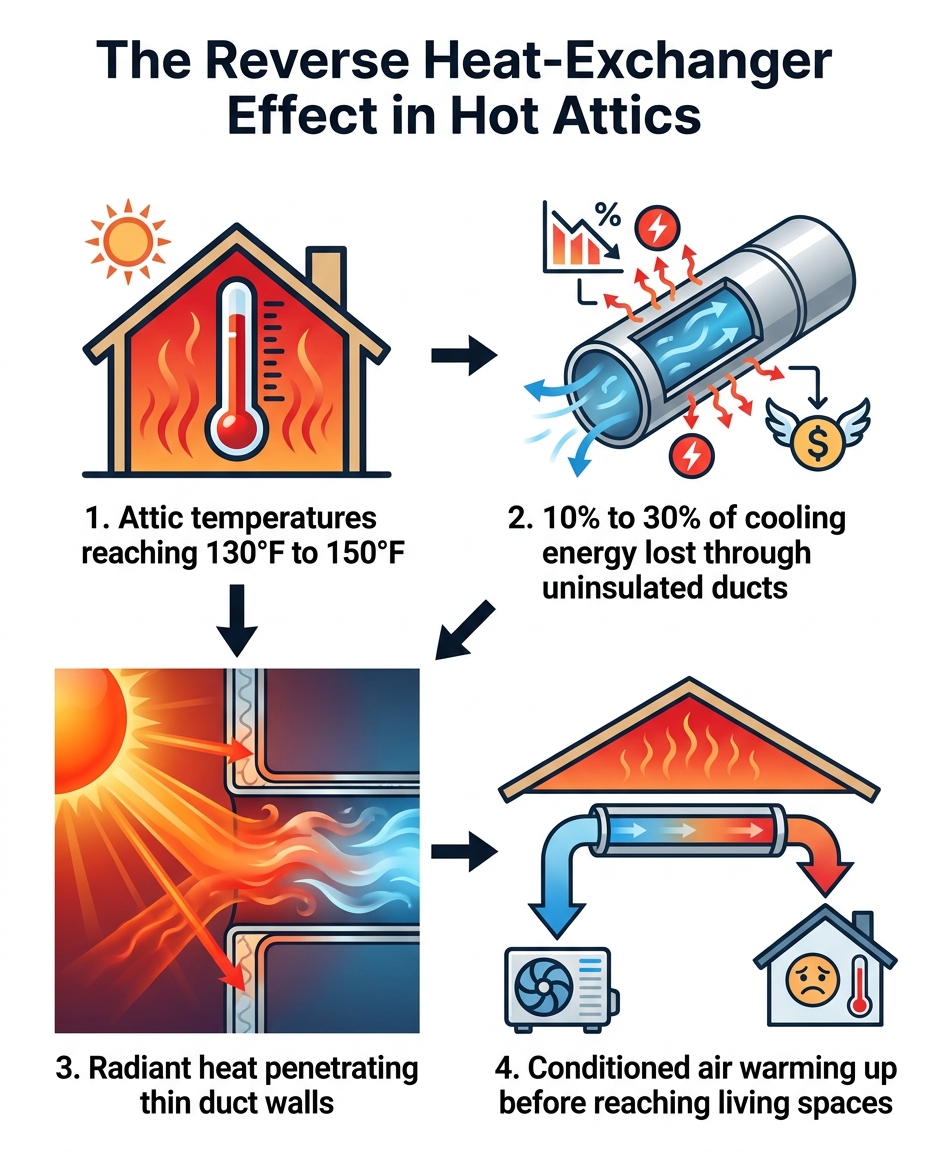
The core problem with routing chilled air through a boiling attic comes down to a phenomenon known as the reverse heat-exchanger effect. Your air conditioning unit works hard to remove heat from the air inside your home, dropping the temperature of the air leaving the air handler to a crisp, refreshing level. However, as that cold air travels through the ductwork, the duct walls absorb the 130°F+ radiant attic temperatures and transfer that intense heat directly into the cold air stream.
Instead of acting as a protective tunnel, uninsulated or poorly insulated duct materials act as a thermal bridge. The laws of thermodynamics dictate that heat will always move toward cold. The massive amount of radiant energy in the attic aggressively forces its way through the thin walls of the ductwork. As a result, the air warming up inside the ducts effectively destroys your cooling efficiency before a single breeze reaches your living space.
The energy loss is staggering. Studies show that 10 to 30 percent of the energy used to cool a space can be lost simply by forcing the air to travel through a hot attic. You are essentially paying your utility provider to air condition your roof space. If the air leaving your indoor unit is 55 degrees, but the air arriving at your bedroom vent is 72 degrees, your system has to run twice as long to achieve the same level of comfort.
• Properly Insulated Ducts — Air Temp at Handler: 55°F — Air Temp at Vent: 57°F - 59°F — Cooling Efficiency Impact: Minimal heat gain; system cycles off normally.
• Uninsulated Sun-Baked Ducts — Air Temp at Handler: 55°F — Air Temp at Vent: 68°F - 75°F — Cooling Efficiency Impact: Severe heat gain; up to 30% energy loss.
• Leaky, Compromised Ducts — Air Temp at Handler: 55°F — Air Temp at Vent: Lukewarm / Weak flow — Cooling Efficiency Impact: Catastrophic loss; system runs constantly.

Warning Signs That Sun-Baked Ducts Are Sabotaging Your Comfort
How do you know if your specific home comfort issues are caused by attic heat affecting the ductwork rather than a mechanical failure of the AC unit itself? Identifying the symptoms of distribution failure can save you time and frustration during the August late-summer high desert heat. Often, the signs are right in front of you, disguised as a struggling air conditioner.
One reliable diagnostic step our team recommends is to check your vent temperatures at different times of the day. If the air coming out of your vents feels icy cold in the early morning but turns noticeably lukewarm during the hottest part of the afternoon, radiant heat transfer in the attic is highly likely. A failing compressor typically struggles to produce cold air regardless of the time of day.
Common symptoms of sun-baked ductwork include:
• Uneven cooling between floors: The downstairs remains freezing while the upstairs bedrooms are sweltering, often because the upstairs duct runs are buried in the hottest part of the attic.
• Weak airflow from specific vents: Hot ductwork can cause old tape to fail, creating leaks that bleed air pressure into the attic before it reaches your room.
• Constantly running cooling cycles: The thermostat never reaches its set point because the air arriving in the room isn't cold enough to satisfy the sensor.
• Spiking utility bills: Forced continuous operation drives electrical consumption through the roof without delivering actual comfort.
At Mountain View Heating, Inc., we see these distribution problems frequently in our area. One local homeowner we recently helped purchased a property that had no upstairs temperature control and extremely poor air distribution throughout the rest of the house. Our technician performed a thorough analysis of the system, arranged the necessary servicing, and corrected the distribution issues. The work was completed in a timely manner with no callbacks, significantly improving both the heating and AC performance across the entire home. If you are experiencing similar issues, reviewing troubleshooting steps for an AC blowing warm air is a great place to start your investigation.
Why Duct Insulation and Air Sealing Matter More Than AC Size
When faced with a house that will not cool down, many homeowners jump to the conclusion that they need a bigger, more powerful air conditioning unit. However, installing a larger cooling unit without fixing the underlying ductwork issues will only result in wasting more energy. A bigger unit will simply pump a larger volume of cold air into an uninsulated, leaky tunnel, resulting in even more conditioned air being lost to the 130°F+ radiant attic temperatures.
The actual solution lies in protecting the air you have already paid to cool. This requires a two-pronged approach: blocking radiant heat transfer through proper insulation, and stopping physical air loss through professional sealing. While these concepts are straightforward, applying them correctly in a high-temperature environment requires professional materials and techniques.
The Role of R-Value in Ductwork
R-value is a standard measurement that defines a material's resistance to heat flow. The higher the R-value, the better the material is at preventing heat from passing through it. When ductwork is routed through extreme heat zones like a high desert attic, higher R-values are absolutely critical.
Standard, builder-grade flex duct often comes with a minimal R-value that is insufficient for blocking intense radiant heat. By upgrading the insulation wrapped around the ductwork, you create a thick thermal barrier. This barrier forces the heat to stay in the attic and allows the cold air inside the duct to maintain its temperature all the way to your bedroom vent. Upgrading R-value is one of the most effective ways we help homeowners reclaim lost cooling efficiency.
Sealing the Leaks: Beyond Standard Tape
Insulation only works if the physical duct system is airtight. Unfortunately, many older homes have ductwork held together by standard cloth duct tape. In an extreme attic environment, the adhesive on standard tape dries out, turns brittle, and eventually fails completely. When the tape peels away, gaps open up at the joints.
These gaps create a massive problem. Not only does your expensive cold air leak out into the attic, but the negative pressure in the return ducts can actually pull the scorching hot, dusty attic air into your system and blow it into your living room. Our professionals do not rely on standard tape to seal ducts. Instead, we use mastic—a thick, paste-like sealant that hardens into a permanent, flexible, and airtight bond. Mastic withstands extreme temperature fluctuations without degrading, ensuring that your air distribution network remains perfectly sealed year after year. Because verifying static pressure and ensuring safe airflow requires specialized diagnostic tools, this level of sealing should always be integrated into Routine AC Maintenance by a qualified technician.
Diagnosing the Root Cause Before Premature AC Replacement
Replacing an air conditioning unit that is attached to a compromised, poorly insulated duct system is a wasted investment. The new, high-efficiency equipment will be severely handicapped by the old, leaky distribution network. To truly solve comfort issues during the August late-summer high desert heat, you need a comprehensive approach that looks at the entire HVAC ecosystem.
When the Mountain View Heating, Inc. team performs an air distribution evaluation, our technicians go far beyond just checking the refrigerant levels in your outdoor unit. Because we understand the unique challenges of high desert climates, we inspect the entire air path. This involves checking the static pressure to ensure the blower motor isn't straining against collapsed flex ducts. It involves visually inspecting the insulation for signs of degradation or pest damage. It also involves measuring the airflow at individual vents to pinpoint exactly where the system is losing pressure.
Addressing the whole system—both the mechanical equipment and the ductwork—drastically improves your overall indoor environment. When ducts are properly sealed and insulated, you gain better humidity control, less dust infiltration, and a significantly more even temperature profile from room to room. We recently performed a first annual inspection for a customer who had a new air conditioner, heater, and ductwork installed the year prior. They reported that the entire experience was wonderful, highlighting how the combination of quality equipment and a properly designed distribution system transformed their home comfort.
Proactive inspection of your ductwork during annual cooling check-ups is the best way to catch insulation degradation before it ruins your summer. By focusing on the root cause of your comfort issues, you can protect your investment and ensure your home remains a sanctuary, no matter how hot the attic gets. Addressing these distribution flaws is a vital component of maintaining excellent Indoor Air Quality and system longevity.
Frequently Asked Questions About Attic Heat and AC Efficiency
How does a hot attic affect air conditioning?
A hot attic severely impacts air conditioning by transferring extreme radiant heat into the ductwork that runs through the space. When 130°F+ radiant attic temperatures surround thin metal or flex ducts, the cold conditioned air inside absorbs that heat before reaching your vents. This forces your AC unit to run longer and work harder to achieve the desired indoor temperature.
Why is my AC running but the house is still hot?
If your AC is running constantly but the house remains warm, your system may be losing its cooling capacity to the attic environment. Leaky duct joints can bleed cold air into the attic, or poor insulation can allow radiant heat to warm the air inside the ducts. This distribution failure means the mechanical unit is working, but the cold air is being destroyed in transit.
Can you insulate existing ductwork in an attic?
Yes, existing ductwork can absolutely be retrofitted with better insulation to improve efficiency. Our professionals can wrap uninsulated metal ducts with high R-value materials or replace degraded flex ducts with heavily insulated alternatives. This process creates a thermal barrier that protects your conditioned air from the extreme attic heat.
How much efficiency is lost through uninsulated ducts?
Homes with uninsulated or poorly sealed ductwork located in unconditioned spaces can lose between 10 and 30 percent of their cooling energy. This massive energy loss directly translates to higher utility bills and decreased indoor comfort. Sealing and insulating the distribution system is one of the most effective ways to reclaim that lost efficiency.
Does radiant heat transfer happen in winter as well as summer?
Yes, the exact same physics apply during the winter heating season, just in reverse. During cold months, the heat from your furnace travels through freezing attic ducts, and radiant heat transfer causes the warm air to lose its thermal energy to the cold attic. Properly insulating your ductwork protects your comfort and efficiency year-round.
Restoring Your Home's Comfort with Professional Air Distribution Solutions
True cooling efficiency requires protecting the conditioned air every single step of the way, from the indoor air handler all the way to your bedroom vent. When you understand how sun-baked ductwork in your attic destroys AC efficiency, it becomes clear that a struggling cooling system doesn't always mean you need to buy a brand-new mechanical unit. Often, the smartest and most effective solution is to address the environment your air travels through.
Do not let the August late-summer high desert heat force you into a premature equipment replacement. If your system is running constantly but failing to keep you comfortable, it is time to look above the ceiling. Reach out to the experts at Mountain View Heating, Inc. for a professional evaluation of your air distribution system today to reclaim your comfort, lower your energy bills, and stop air conditioning your attic.