


Losing Your Cool: Facing a Blank Thermostat During a Heat Wave
As the August late-summer cooling season pushes your system to its limits, knowing exactly what to do when your AC thermostat goes blank on a hot day can mean the difference between a quick reset and a miserable, sweltering weekend. You walk past the hallway wall, expecting to check the indoor temperature, but instead, you are greeted by a completely dark, unresponsive screen. The immediate discomfort of the rising indoor heat is quickly followed by a sense of panic. Is the entire air conditioner dead? Do you need to rush out and buy a whole new thermostat?
Before you assume the worst, it is important to recognize the core decision point you are facing right now. You need to determine if this is a safe, simple visual fix—like a tripped household breaker or a slightly ajar cabinet door—or a complex electrical fault that requires a professional touch. A blank screen does not automatically mean the thermostat itself is broken. In many cases, it is actually a sign that your HVAC system is functioning exactly as designed to protect your home from severe damage.
If you need immediate assistance with your HVAC services, our team is ready to provide professional air conditioning repair to restore your comfort safely.
It's Probably Not Broken: Understanding the Built-In Safety Shutoff
To understand why your screen suddenly died, you have to look at how residential heating and cooling systems actually power their controls. Your thermostat does not plug into a standard wall outlet, and it does not run on the standard 120-volt electricity that powers your lamps and televisions. Instead, residential HVAC systems operate thermostats on a dedicated 24-volt low-voltage circuit. This power is supplied by a small transformer located inside your indoor air handler or furnace.
When the system detects a critical risk—such as a massive electrical surge, an overheating blower motor, or an impending water overflow—the control board intentionally cuts this 24-volt power supply. By severing the connection, the system forces the entire cooling cycle to stop immediately. Because the thermostat relies on that exact same 24-volt circuit to keep its digital screen illuminated, the display instantly goes dark.
Living in Bend, OR, the high desert extreme summer heat puts maximum strain on cooling systems. When an air conditioner is running nearly nonstop to combat intense afternoon temperatures, the internal components work overtime. This intense, continuous operation makes abrupt safety shutoffs much more common. Rather than viewing the blank screen as a broken piece of equipment, you should view it as a highly effective protective safety feature doing its job to prevent a minor issue from turning into a catastrophic failure.
The Usual Suspect: Tripped Float Switches and Condensate Clogs
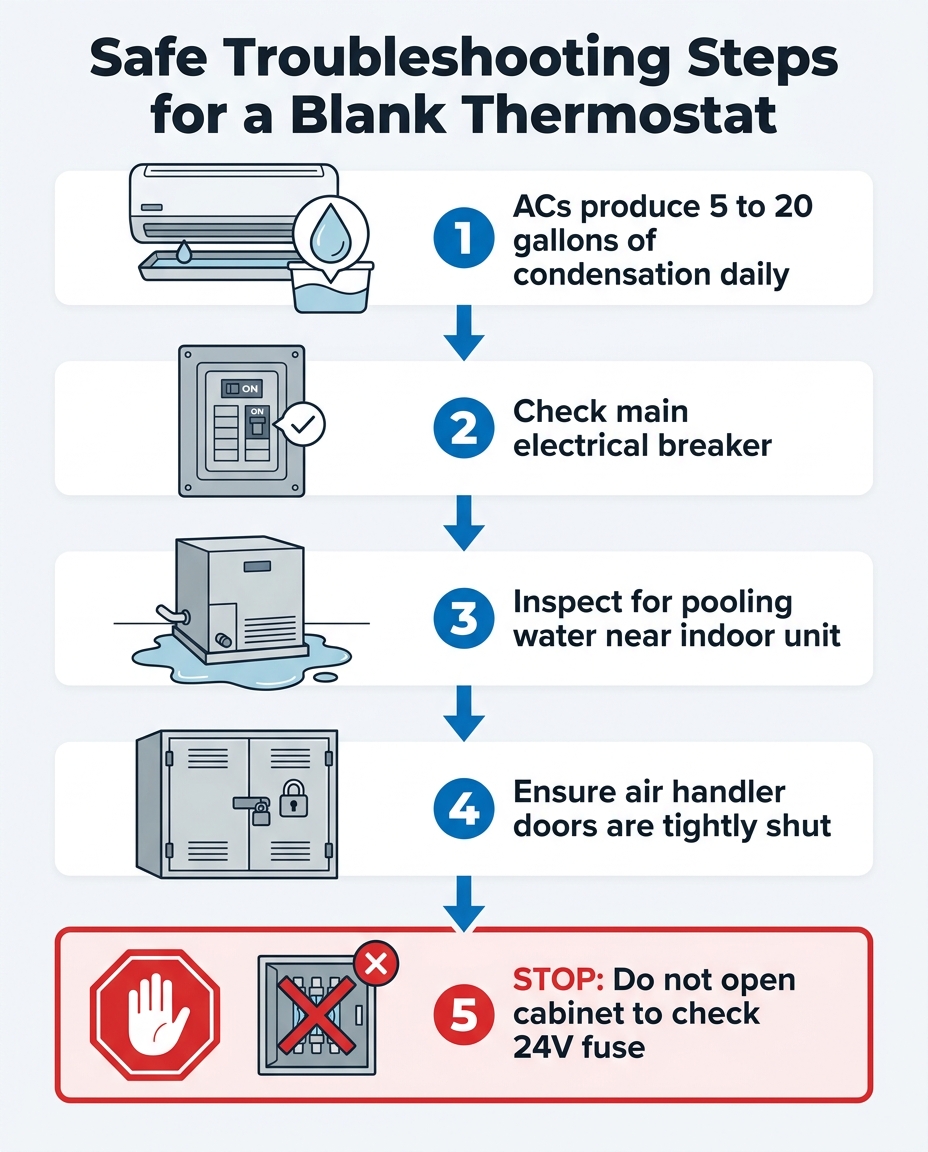
During the peak of the August late-summer cooling period, your air conditioner is doing much more than just lowering the air temperature; it is also extracting massive amounts of humidity from your home. In fact, standard residential air conditioners can produce anywhere from 5 to 20 gallons of condensation per day during heavy operation. All of this water has to go somewhere.
The Problem: Condensate Buildup
Normally, this water drips off the cold evaporator coil into a primary drain pan, where it flows safely out of your house through a white PVC pipe. However, if the system has been running heavily without recent upkeep, dust, dirt, and biological growth can easily form a thick sludge inside this narrow pipe. Once the pipe clogs, the water has nowhere to drain, causing it to back up rapidly into the drain pan.
The Cause: The Float Switch Activation
To prevent this backed-up water from overflowing and destroying your ceilings, walls, or floors, modern HVAC systems are equipped with a small safety device called a condensate float switch. This switch is typically installed on the edge of the drain pan or directly on the drain pipe itself. It contains a small plastic bobber. As the water level rises in the pan, the bobber floats upward.
The Solution: Breaking the Circuit
Once the bobber reaches a specific height, it triggers a mechanical switch that physically breaks the low-voltage electrical circuit. Because this circuit is the lifeline for your thermostat, the power is instantly severed, resulting in a blank screen. The system will not turn back on until the clog is cleared and the water level recedes, allowing the float switch to drop back into its normal resting position. Keeping up with regular AC maintenance is the most effective way to ensure these drain lines remain clear and these unexpected shutdowns are avoided.
• Water pooling around indoor unit — Likely Cause: Clogged condensate drain line — Thermostat Status: Blank screen (Float switch tripped)
• No power to the entire house — Likely Cause: Grid outage or main breaker trip — Thermostat Status: Blank screen (No power to transformer)
• Acrid burning smell near vents — Likely Cause: Overheating blower or electrical short — Thermostat Status: Blank screen (Blown internal fuse)
Safe Visual Checks You Can Perform Right Now
Before you pick up the phone to request an emergency repair in Bend, OR, there are a few safe, entirely visual troubleshooting steps you can take. These checks do not require any tools, and they keep you safely away from the dangerous high-voltage electrical components inside the machinery.
• Check the main electrical panel: Locate your home's primary electrical breaker box. Look for the breakers labeled "AC," "Air Conditioner," "Furnace," or "Air Handler." If the switch is resting in the middle position, push it firmly to the "Off" position, and then snap it back to "On." A power surge may have simply tripped the breaker.
• Visually inspect the indoor unit for water: Walk to wherever your indoor air handler or furnace is located (often a garage, attic, or closet). Shine a flashlight around the base of the unit. If you see pooling water, damp insulation, or water sitting high in the visible drain pan, you have a clogged condensate line that has triggered the safety float switch.
• Ensure the cabinet doors are secure: The metal doors covering your indoor air handler are equipped with a mechanical safety switch (similar to a refrigerator door light). If a door vibrates loose or is not latched completely shut, this switch pops out and cuts all power to the system, including the thermostat. Press firmly on the doors to ensure they are seated tightly.

The Danger Zone: Why You Shouldn't Hunt for Blown Low-Voltage Fuses
If you have completed the safe visual checks and the screen remains dark, the issue likely lies deeper within the electrical system. The 24-volt circuit that powers your thermostat is protected by a small internal fuse, usually located directly on the main control board inside the air handler. This fuse looks exactly like a small, brightly colored 3-amp or 5-amp automotive blade fuse that you would find in your car.
It can be tempting to search online forums that advise you to simply pull off the metal panels, find the little purple or orange fuse, and swap it out. We strongly warn against opening the air handler cabinet to hunt for this fuse. Doing so exposes you directly to the high-voltage components (often 120 or 240 volts) that power the heavy blower motors. Mountain View Heating prioritizes your safety above all else, and we always advise leaving internal electrical diagnostics to licensed technicians who have the proper training and insulated tools.
Furthermore, a blown low-voltage fuse is never the actual problem; it is merely a symptom of a much larger electrical short. Fuses blow because the circuit experienced an unsafe surge of electricity. If you manage to replace the fuse without diagnosing the root cause—such as a bare wire rubbing against a metal bracket, or a failing contactor outside—the new fuse will blow again the exact second you turn the power back on. If you are experiencing other related issues, like troubleshooting an AC blowing warm air, the diagnostic process may differ, but the rule remains the same: never attempt DIY repairs on internal HVAC electrical components.
Making the Call: When to Rely on Professional Emergency Response
If you have verified that the main breaker is on, the cabinet doors are secure, and there are no obvious signs of a massive water leak, but the thermostat screen is still completely blank, a professional diagnosis is required. The system has effectively locked itself out to prevent further damage, and restoring it requires specialized electrical testing equipment.
Rapid emergency response is highly important during extreme heat to prevent health risks and keep your home from becoming dangerously uncomfortable. The high desert temperatures in Bend, OR, can elevate indoor heat quickly when the AC drops offline. Local experts have the multi-meters required to safely trace electrical shorts through miles of wiring, and they carry the commercial-grade equipment needed to clear stubborn, compacted condensate clogs that a standard wet-vacuum cannot budge.
Our dedication to rapid, honest response is something we take seriously year-round. For example, one customer recently reached out after a misunderstanding regarding their heating and cooling services; our Service Manager personally spoke with them and made immediate efforts to resolve the situation completely. That same level of local expertise, accountability, and dedication applies when your AC fails during a heatwave. When you contact our technicians, you are partnering with professionals who prioritize your safety and the long-term health of your HVAC system.
Frequently Asked Questions About Blank AC Thermostats
Why is my thermostat blank but the AC has power?
The outdoor compressor unit and the indoor air handler operate on entirely different electrical circuits. The outdoor unit runs on a dedicated high-voltage circuit, while the low-voltage circuit powering the thermostat originates from the indoor unit. If a float switch trips or an internal 3-amp fuse blows inside the indoor air handler, it will instantly sever the low-voltage connection to the thermostat, leaving the screen blank even if the main electrical panel shows that the heavy-duty AC breaker is still turned on.
Will a clogged AC drain cause the thermostat to go blank?
Yes, a clogged condensate drain is actually the most common cause of a blank thermostat during the August late-summer cooling season. When the drain pipe clogs with dust and algae, the condensation forces water to back up into the secondary drain pan. This rising water trips a safety device called a float switch, which intentionally severs the low-voltage power to the thermostat to shut down the system and prevent catastrophic water damage to your ceilings and floors.
How does a float switch turn off a thermostat?
The float switch is wired directly into the 24-volt circuit that runs from the control board to the thermostat. Specifically, it is usually wired in series along the red power wire. When rising water lifts the float mechanism, it physically opens the circuit, breaking the electrical connection. Without an uninterrupted path for the 24-volt electricity to travel, the digital display on the thermostat instantly loses power and goes dark.
What causes an AC low voltage fuse to blow?
A low-voltage fuse blows when it encounters an electrical short, which causes a dangerous spike in amperage. Common culprits include damaged thermostat wiring where the protective insulation has worn away, allowing bare copper wires to touch the metal HVAC cabinet due to vibration over time. Additionally, failing contactors in the outdoor unit or a shorted internal transformer can draw excess current, causing the small 3-amp or 5-amp fuse to pop to protect the expensive main control board.
How do I fix a blank thermostat screen without batteries?
Start by performing safe visual checks: verify that the main circuit breaker in your electrical panel hasn't tripped, and ensure that the indoor air handler's metal cabinet door is securely shut, as a loose door will trigger a safety switch. Also, look for any pooling water around the indoor unit. If these visual checks do not restore power, the issue is likely a blown internal fuse or a complex short, meaning a licensed technician must diagnose the 24-volt circuit safely.
Is there a reset button for a blank thermostat?
Hardwired residential thermostats do not typically have a dedicated reset button that will magically restore a blank screen. Because the blank screen is usually a symptom of a severed power connection—either from a tripped float switch, a blown control board fuse, or an open cabinet door—power can only be restored by resolving the underlying mechanical or electrical issue. Once the drain line is cleared or the electrical short is repaired, power will flow back to the unit, and the screen will turn on automatically.
Restore Your Cooling Safely and Quickly
A blank thermostat screen in the middle of a Bend, OR heatwave is incredibly frustrating, but it is reassuring to know that your system is actively protecting itself from serious water damage or electrical fires. While checking your breakers and ensuring your cabinet doors are tight are great first steps, you should never push past safe boundaries to hunt for blown fuses inside high-voltage cabinets.
If your safe visual checks did not solve the issue, it is time to reach out for a professional diagnosis. A trained technician can swiftly identify whether a stubborn condensate clog or a hidden wire short is to blame. Schedule a repair today to get your home back to a comfortable temperature safely, efficiently, and without the risks of dangerous DIY troubleshooting.