


The Hidden Threat to Your AC During Bend's Wildfire Season
Your air conditioner is running constantly, but the air coming through the vents feels weak and warm. Knowing exactly what happens when wildfire ash coats your outdoor compressor is critical for homeowners in Bend, OR, especially when the skies turn orange and the air quality plummets. In our high desert environment, heavy ash fall can rapidly coat outdoor equipment overnight, acting as a thick, insulating blanket on your condenser coils. This sudden blockage traps heat inside the system, leading to massive spikes in refrigerant pressures.
Before you march outside to flip a breaker or grab a garden hose to wash it down, you need to recognize that a sudden system shutdown during heavy smoke requires expert intervention. A tripped breaker in these conditions is a strict signal to leave the unit off. For a thorough evaluation and safe restoration of your cooling system, relying on professional HVAC services is the only way to prevent permanent mechanical damage.
The Anatomy of an Ash-Choked Condenser Coil
To understand why your system struggles during a fire event, you have to look at how the outdoor unit operates. The primary function of your outdoor condenser coil is to exhaust the heat your system absorbs from inside your home out into the surrounding air. Under normal conditions, these coils experience a gradual buildup of seasonal dirt, pollen, and yard debris over several months. Wildfire ash, however, creates a rapid, extreme particulate load that can overwhelm the system in a matter of hours.
When heavy smoke rolls into Bend, OR, the condenser fan actively pulls that contaminated air directly through the sides of the unit. The ash physically blocks the microscopic spaces between the delicate aluminum fins that line the outside of the equipment. Because this blockage severely restricts heat transfer, the thermal energy stays trapped inside the system, forcing the compressor to work exponentially harder just to maintain a baseline level of cooling.
Why Ash is More Dangerous Than Standard Dust
Wildfire ash is not like normal household dust or yard dirt. It presents a unique set of hazards to your cooling equipment:
• Microscopic size: Ash particles are uniquely fine and easily drawn deep into the center of the coil by the powerful condenser fan.
• Insulating properties: Ash acts like a heavy winter coat wrapped around your equipment, preventing the necessary thermal exchange required for cooling.
• Rapid accumulation: Unlike dirt that takes months to build up, a heavy ash fall can choke a fully clean system in a single afternoon.
When your system loses its ability to breathe, the mechanical strain compounds rapidly. Scheduling a comprehensive air conditioning service is the safest way to address this acute buildup before it leads to a catastrophic component failure during the July peak heat and wildfire season.
How High-Head Pressure Triggers Sudden AC Lockouts
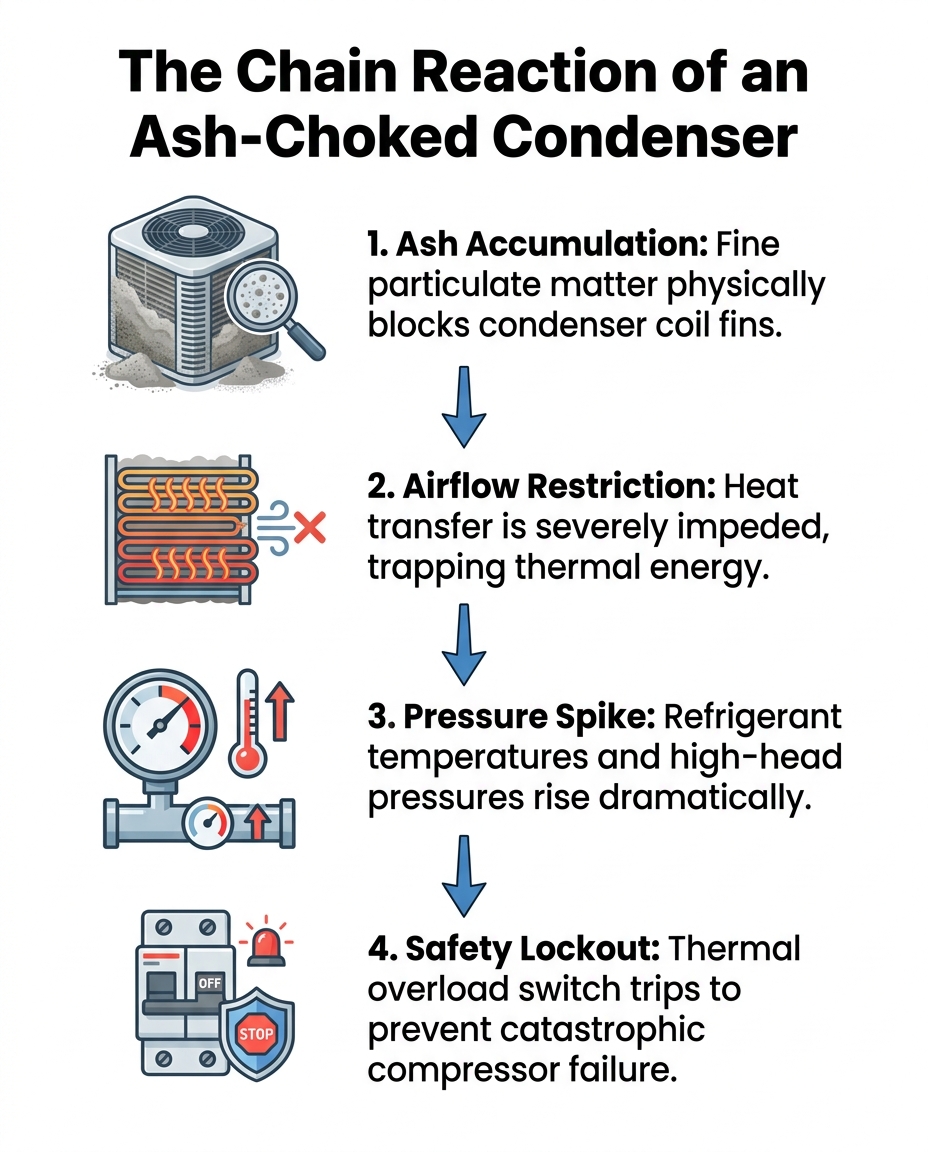
When airflow is restricted by a thick layer of ash, a dangerous mechanical chain reaction begins inside your outdoor unit. Because the blocked coils cannot release heat into the outside air, the temperature of the refrigerant circulating through the system begins to rise uncontrollably. As the temperature of the refrigerant increases, the pressure inside the copper lines spikes dramatically—a condition known in the HVAC industry as high-head pressure.
Your air conditioning system is equipped with built-in safety mechanisms designed to prevent it from destroying itself under these extreme conditions. Here is the exact sequence of events that leads to a sudden system lockout:
1. Heat entrapment: Ash blocks the aluminum fins, preventing the condenser fan from exhausting thermal energy.
2. Refrigerant boiling: The trapped heat causes the refrigerant to absorb more thermal energy than it can shed, raising its core temperature.
3. Pressure spike: The elevated temperatures cause the refrigerant gas to expand, creating dangerously high-head pressure inside the compressor.
4. Safety trip: The thermal overload switch or high-pressure safety limit detects the critical pressure and immediately cuts power to the compressor.
A sudden shutdown during an ash event is not a random glitch; it is the system's built-in defense mechanism against catastrophic failure. At Mountain View Heating, we have deep local expertise in diagnosing rapid-onset, ash-related high-head pressure lockouts in Bend, OR. We know exactly how to identify these safety trips and safely restore the system to normal operating pressures.

The Danger of the 'Quick Fix' Breaker Reset
When the air conditioning suddenly stops working on a sweltering July afternoon, a homeowner's first instinct is often to check the electrical panel. While flipping a tripped breaker might seem like a harmless quick fix, doing so during a wildfire event can be a remarkably expensive mistake. Resetting a tripped breaker bypasses the system's safety lockout without fixing the high-pressure environment that caused the trip in the first place.
The mechanical reality: If the thermal overload switch tripped because the coils are choked with ash, the physical blockage is still there. By forcing the compressor to turn back on and run with choked coils, you are intentionally overriding the safety limit. This forces the motor to fight against massive internal resistance.
Repeatedly resetting the breaker under these conditions leads directly to electrical failure or permanent mechanical damage. The compressor is the heart of your cooling system and the most expensive component to replace. If your breaker trips while heavy smoke is in the air over Bend, OR, treat it as a strict signal to leave the unit off and call for professional diagnostics. Ignoring the safety lockout will only turn a routine cleaning appointment into a full system replacement.
Why DIY Hosing Can Make Ash Buildup Worse
It is tempting to grab a garden hose and spray down the outdoor unit when you see it covered in gray flakes. However, mixing water with wildfire ash on delicate mechanical equipment creates severe physical and chemical risks. Wildfire ash is highly abrasive, and depending on what burned, it can become highly corrosive when mixed with moisture.
Amateur hosing often does far more harm than good for several reasons:
• Creating cement: When fine ash gets wet, it turns into a thick, sludge-like paste. Hosing the unit often pushes this wet ash deeper into the center of the delicate aluminum fins, where it dries into a hard, cement-like blockage that is nearly impossible to remove.
• Chemical corrosion: Wet ash can be highly alkaline. If left sitting against the aluminum fins and copper tubing, it can accelerate corrosion and weaken the coils over time.
• Physical damage: The aluminum fins on a condenser coil are incredibly thin. Using a high-pressure nozzle to blast away ash can easily bend or crush the fins flat, permanently restricting airflow even after the ash is gone.
Professional cleaning involves specialized, non-acidic foaming chemicals and specific low-pressure washing techniques. Technicians know exactly how to safely dissolve and remove the ash from the inside out without damaging the high-pressure refrigerant lines or bending the delicate fins.
Indoor Air Quality vs. Outdoor Mechanical Survival
During a heavy smoke event, most homeowners naturally focus on keeping the air inside their homes breathable. While managing indoor smoke infiltration is critical for your health, it is easy to forget that the outdoor mechanical equipment bears the absolute brunt of the physical ash load. Standard indoor air filters do absolutely nothing to protect the outdoor condenser coil.
In fact, running the air conditioner continuously to circulate and filter indoor air actually increases the runtime of the outdoor unit. Every minute the compressor runs, the outdoor fan is actively drawing more and more ash into the coils. Balancing both indoor air quality and outdoor mechanical health requires a comprehensive approach to system care.
• Indoor Air Quality — Primary Threat During a Wildfire: Smoke infiltration and fine particulate matter (PM2.5) entering the living space. — System Impact: Clogged indoor return filters, reduced indoor airflow, poor breathing conditions. — Required Action: Upgrade indoor filters, seal windows, and utilize indoor air quality solutions.
• Outdoor Equipment — Primary Threat During a Wildfire: Heavy ash fall physically coating the condenser coil. — System Impact: Blocked heat transfer, spiked refrigerant pressures, and thermal safety lockouts. — Required Action: Keep unit off if tripped, schedule professional exterior coil cleaning.
Protecting the Whole System
Protecting your home requires looking at the entire HVAC ecosystem. For a deeper understanding of how your system handles smoke inside the home, read our guide on Does Air Conditioning Actually Filter Out Wildfire Smoke? Ultimately, professional oversight is necessary for both the indoor filtration components and the outdoor mechanical components during and after heavy smoke events.
Summer Heat and Ash: A Double Threat in Central Oregon
The mechanical strain of wildfire ash does not happen in a vacuum. In Bend, OR, these smoke events almost always coincide with the peak July heat and wildfire season. During peak summer heat, air conditioning units are already operating near their maximum thermal capacity just to keep the house cool. The compressor is hot, the refrigerant pressures are elevated, and the fan is running constantly.
When you add an insulating layer of ash during these high-demand periods, you push the system past its thermal limits much faster. A typical pattern we see in Bend involves extreme weather triggering massive spikes in demand. For example, during early high temperatures in June, a sudden heat wave caused a massive surge in demand for HVAC service and new systems. Our service teams frequently work extended hours to meet this demand, ensuring customers receive professional and courteous service even when extreme heat pushes aging systems to their breaking points.
The compounding stress on aging or unmaintained systems facing extreme heat and heavy particulate loads simultaneously is immense. Proactive, routine maintenance is the best way to ensure your system has the baseline resilience to handle sudden environmental stressors. Enrolling in a routine HVAC maintenance plan guarantees that your coils start the summer completely clean, giving the system a larger buffer before ash buildup forces a shutdown.
Protect Your Compressor with Professional Ash Removal
Sudden shutdowns during smoke events are critical safety lockouts, not minor electrical glitches. When the air is thick with ash and your system trips its breaker, the worst thing you can do is force it to keep running. The built-in safety mechanisms are trying to tell you that the internal pressures have reached a critical, dangerous level.
Reiterating the importance of leaving the system off cannot be overstated. Avoid the temptation of DIY hosing, which can push corrosive ash deeper into the delicate fins and cement it in place. Instead, protect your investment by scheduling a professional inspection and specialized coil cleaning. Taking the safe path forward ensures your compressor survives the wildfire season and continues to keep your Bend, OR home comfortable for years to come.
Frequently Asked Questions
Can wildfire ash break my AC compressor?
Yes, heavy wildfire ash can absolutely cause permanent damage to your AC compressor. The ash acts as an insulator on the outdoor coils, trapping heat and causing refrigerant pressures to spike dangerously high. If the system is forced to run in this condition without safety lockouts intervening, the compressor motor can overheat and burn out completely.
Why did my AC shut off suddenly during heavy smoke?
Your air conditioner likely shut off due to a built-in safety mechanism called a thermal overload switch or high-pressure limit. When ash blocks the outdoor unit from releasing heat, the internal pressures rise past safe operating limits. The system shuts itself down intentionally to prevent the compressor from destroying itself under the extreme strain.
Is it safe to reset my AC if it overheats from ash?
No, it is highly dangerous to reset an AC unit that has overheated due to ash buildup. Resetting the breaker forces the system to bypass its safety lockout and run while the coils are still choked. This forces the compressor to fight massive internal resistance, which can quickly lead to electrical failure or severe mechanical damage.
Does wildfire smoke damage the inside of AC units?
While smoke itself primarily affects your indoor air quality and clogs your indoor return filters, the physical ash from the smoke is what threatens the outdoor unit. The indoor evaporator coil is generally protected by your air filter, but a heavily clogged indoor filter can restrict airflow and cause the indoor coil to freeze. Frequent filter changes are necessary during smoke events to protect the indoor components.
How do professionals clean ash off an outside AC unit safely?
Professionals use specialized, non-acidic foaming coil cleaners that safely dissolve the ash without corroding the metal. They also use precise, low-pressure washing techniques to flush the debris from the inside out. This careful process ensures the delicate aluminum fins are not bent or crushed, which frequently happens when homeowners attempt to use high-pressure garden hoses.
Should I turn off my AC if ash is falling heavily in Bend?
If you notice a thick, visible layer of ash accumulating on the outside of your condenser unit, it is wise to turn the system off to prevent high-head pressure lockouts. Running the unit actively draws more ash into the delicate fins. Shutting it down and calling for a professional coil cleaning is the safest way to protect the expensive compressor from heat-related failure.