


Navigating Wildfire Smoke and Your Home's Air System
Are you wondering if it is actually safe to run your air conditioner when the sky outside is thick with wildfire smoke? When facing poor outdoor air quality, relying on local service expertise and area tips is the best way to protect your home and your HVAC equipment. It is a common source of anxiety for homeowners to see a haze of smoke outside and worry that turning on the thermostat will pump that same hazardous air directly into their living room.
The good news is that standard residential cooling systems do not operate the way most people assume. However, dealing with summer smoke is only half the battle. In the Central Oregon high desert, the combination of intense summer heat and regional wildfires creates significant indoor air quality challenges that linger long after the smoke clears. The dust and particulate matter that your system filters out during August will inevitably impact how your furnace performs when the weather turns cold.
Understanding this connection is vital for the long-term health of your air conditioning systems and your heating equipment. The real decision point for most homeowners arrives months later, when a strange burning smell during the first cold snap forces them to figure out if their furnace is just burning off normal dust, or if a smoke-clogged system requires immediate professional attention.
Does Running Your AC Pull Outside Smoke Indoors?
The short answer is yes—it is generally perfectly safe to run your central air conditioner during a smoke event. In fact, keeping your system running is often one of the best ways to maintain a comfortable and breathable environment inside your home.
To understand why, it helps to look at the mechanics of how residential cooling actually works. Central air systems do not pull fresh air from the outside to cool your home. Instead, they operate on a closed-loop recirculation system. The indoor unit (the air handler) pulls warm air from inside your house through the return vents, passes it over a freezing-cold evaporator coil to remove the heat, and then pushes that exact same cooled air back into your rooms.
The large unit sitting outside your house—the condenser—is only responsible for exhausting the heat that was removed from your indoor air. No air is exchanged between the outside unit and the inside unit; only chemical refrigerant travels between them through sealed copper lines.
Important precautions to take:
• Close fresh-air dampers: If your home has a dedicated fresh-air intake system or a mechanical ventilator, you must ensure the damper is completely closed during heavy outdoor smoke.
• Keep windows tightly sealed: Even a small crack can allow fine particulate matter to bypass your system entirely.
• Upgrade your filtration: Running your system on "fan only" mode can actually help filter your indoor air, provided you have upgraded to comprehensive indoor air quality solutions that can trap microscopic smoke particles.
The Hidden Toll of Summer Smoke on Your HVAC Equipment
While running your AC is safe for your lungs, heavy wildfire smoke places an enormous hidden burden on your HVAC equipment. Fine particulate matter, known as PM2.5, is microscopic. It easily bypasses standard fiberglass air filters, circulating through your ductwork and settling on the sensitive internal components of your system.
As these particles accumulate, they load your air filters at a highly accelerated rate. A filter that normally lasts 90 days might become completely choked with soot and dust in just two weeks during a severe regional fire event. When a filter becomes clogged, your blower motor has to work twice as hard to pull the same amount of air through the system.
The Danger of Restrictive Filters
Many homeowners try to solve this problem by rushing to the store and buying the thickest, highest-MERV-rated filter they can find. While you might wonder does air conditioning filter wildfire smoke effectively with these upgrades, taking a DIY approach can be dangerous for your equipment.
Highly restrictive filters create immense static pressure. If your blower motor is not rated to handle that level of resistance, the airflow through your system drops dramatically. Without enough warm indoor air blowing over your indoor evaporator coil, the coil will quickly freeze solid into a block of ice, shutting down your cooling entirely and potentially damaging the compressor.
To protect your system, you must balance filtration with airflow. During smoke events, it is often better to use a mid-range pleated filter and simply replace it every week, rather than installing a hospital-grade filter that suffocates your blower motor.
Bridging the Gap: The Mid-Fall Transition to Heating
The consequences of a smoky summer rarely stay in the summer. Because your air conditioner and your furnace share the exact same air handler, blower motor, and ductwork, the particulate matter that accumulates in August directly impacts your heating system in the fall.
During a typical mid-fall October heating startup, your furnace is igniting for the very first time after sitting dormant for six to eight months. Over the summer, the fine Central Oregon high desert dust and regional wildfire smoke particles that slipped past your filter have slowly settled like a blanket over your furnace's heat exchanger and burners.
The sudden temperature drops in October force a rapid transition from cooling to heating. Many homeowners are caught completely off guard because they forgot to change the air filter that was heavily abused during the summer fire season. When the thermostat calls for heat, the gas burners ignite, and the heat exchanger rapidly warms up to hundreds of degrees.
Any soot, dust, or pet hair resting on those metal components instantly scorches. This creates a delayed reaction from the summer air quality events, manifesting as alarming odors and poor system performance right when you need reliable heat the most.
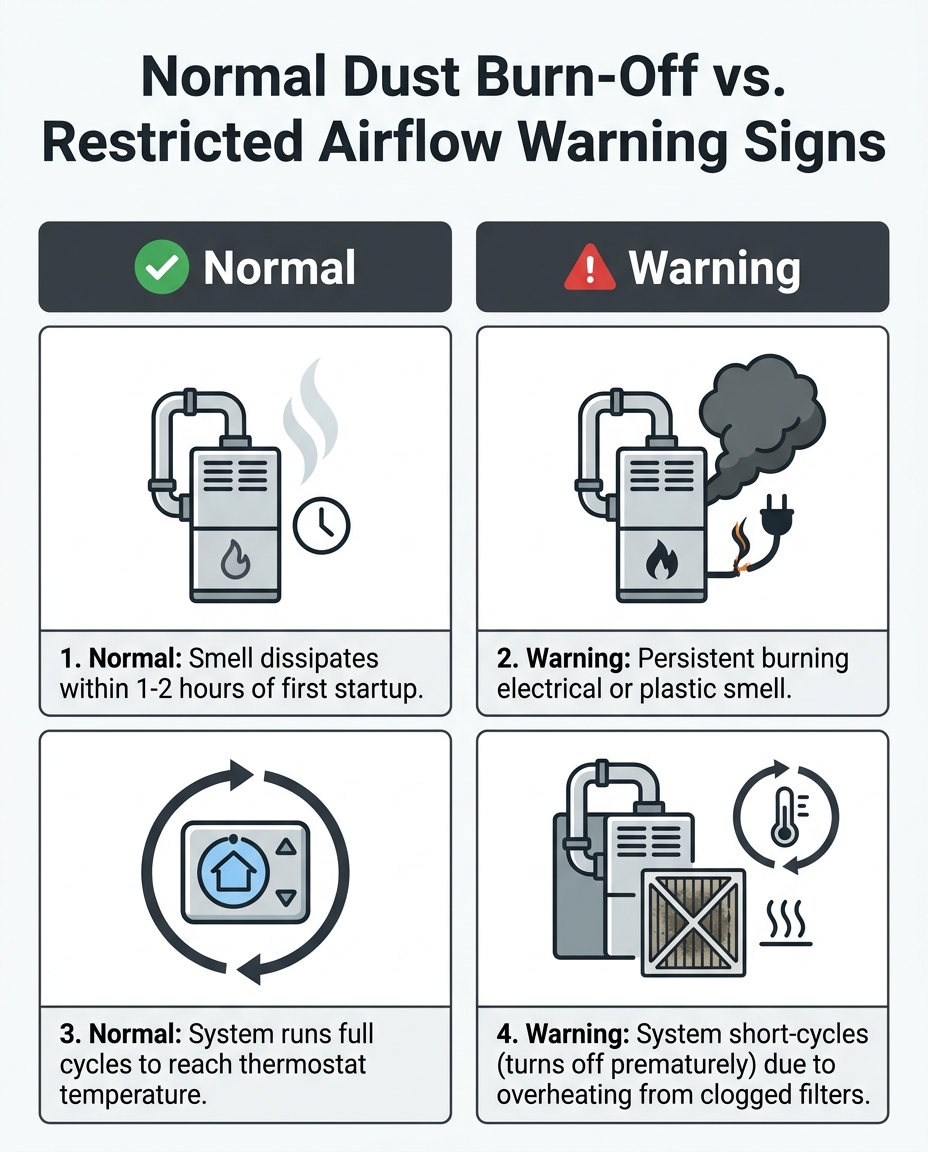
Decoding Furnace Smells: Normal Dust Burn-Off or Restricted Airflow?
When you turn your heat on for the first time, smelling a faint burning odor is common. However, knowing the difference between a harmless seasonal burn-off and a dangerous system malfunction is a critical decision point for any homeowner.
Local HVAC teams have a deep understanding of how to protect equipment specifically during these regional air quality transitions, and they look for very specific warning signs.
Normal vs. Warning Signs
• Normal Dust Burn-Off — What You Will Notice: A faint, dusty, "warm" smell similar to a space heater turning on. — Typical Duration: Dissipates completely within 1 to 2 hours of the first startup. — Required Action: None. Monitor the system and ensure the smell fades.
• Restricted Airflow — What You Will Notice: A sharp, persistent electrical odor, or the smell of melting plastic. — Typical Duration: Lasts for hours or returns every time the heat kicks on. — Required Action: Turn the system off immediately and call a professional.
• Normal Operation — What You Will Notice: The furnace runs in full, steady cycles until the house reaches the set temperature. — Typical Duration: Continuous operation for 15-20 minutes at a time. — Required Action: Enjoy a comfortable home.
• System Short-Cycling — What You Will Notice: The furnace turns on, runs for 2 minutes, and abruptly shuts down before the house is warm. — Typical Duration: Constant on-and-off cycling throughout the day. — Required Action: Check your filter; if clean, request a service call.
If your summer filter is still in place and completely clogged with smoke particulate, your furnace cannot pull enough cold air over the heat exchanger to keep it cool. The internal temperature of the furnace will spike to dangerous levels. To prevent a fire, a built-in safety device called a limit switch will trip, shutting the burners down prematurely. This is known as short-cycling.
If you experience persistent burning smells or a system that refuses to stay on, do not force it to keep running. Turn the thermostat off and wait for a professional evaluation.

Preparing for Winter: The Importance of Professional System Evaluation
Changing a dirty filter is an excellent first step, but it is rarely enough to undo the heavy wear and tear of a smoky summer. Before the harsh winter weather arrives, a comprehensive pre-winter inspection by a licensed technician is the only way to guarantee your system is operating safely.
During a seasonal tune-up, a technician looks far beyond the filter. They will inspect the blower assembly, which often becomes coated in heavy particulate matter that throws the fan wheel off balance. They will also thoroughly evaluate the heat exchanger for stress cracks. A cracked heat exchanger can allow deadly carbon monoxide to leak into your home, a risk that increases if the system has been overheating due to poor airflow.
A professional pre-winter inspection typically includes:
• Testing safety controls: Ensuring the high-limit switch and flame sensor are operating correctly.
• Cleaning the burners: Removing summer dust and soot to ensure a clean, efficient burn.
• Checking electrical connections: Tightening wires that may have vibrated loose during heavy summer usage.
• Evaluating airflow: Measuring static pressure to ensure your ductwork is moving air efficiently.
Clear communication and accountability are vital when preparing your home for freezing temperatures. For example, if a homeowner experiences a misunderstanding regarding heating and cooling services, a dedicated Service Manager will step in, speak with the customer, and quickly make it right to ensure the property is safely prepped for winter. That level of dedication is exactly what you get when you invest in routine HVAC maintenance. It provides total confidence that your equipment will survive the seasonal transition.
Frequently Asked Questions: Protecting Your Air Quality and Equipment
Does AC filter out wildfire smoke?
Standard air conditioning filters are designed to catch large dust particles and pet hair, but they easily miss fine PM2.5 smoke particles. If you are relying on a basic 1-inch fiberglass filter, the smoke will simply pass right through the material and circulate back into your living room. To achieve true smoke filtration, you must utilize upgraded indoor air quality solutions and higher MERV-rated filters that are specifically designed to trap microscopic particulate matter.
Is it safe to run window AC when it's smoky?
Window units can be risky during a fire event if they do not fit perfectly tight inside the window frame, as the gaps will allow outdoor air to seep inside. Furthermore, many window units have a fresh-air vent lever. If you run a window unit during a smoke event, you must ensure it is strictly set to recirculate the indoor air. Bringing in fresh air through a window unit will actively pull hazardous smoke directly into your bedroom.
How do I protect my AC from wildfire smoke?
The most effective way to protect your system is to keep all fresh-air intake dampers firmly closed until the outdoor air quality improves. Additionally, you must monitor your indoor air filters relentlessly. Check your filter every few days during a heavy smoke event, and replace it immediately once it turns dark gray or black. Running a system with a clogged filter causes severe strain on the blower motor and can lead to expensive breakdowns.
Does running AC bring in outside air?
Central residential AC systems generally do not pull in outside air at all. They are designed as closed-loop systems that simply absorb heat from the air already inside your home and move that heat outside via the refrigerant lines. As long as your home's doors, windows, and mechanical fresh-air intakes are sealed, running your central air conditioner will not introduce outdoor smoke into your home.
Why does my heater smell like burning after a smoky summer?
Throughout the summer cooling season, fine dust and smoke particles bypass the air filter and settle directly onto the furnace's heat exchanger and burners. When the furnace ignites for the very first time in the fall, these settled particles are instantly scorched by the gas flames. This rapid burning off of summer debris creates a distinct, dusty odor that usually fills the house for a few hours before dissipating completely.
Ensure Your System is Ready for the Winter Cold
Transitioning from a smoky summer to a freezing winter puts immense stress on your home's air system. Never ignore persistent burning smells, electrical odors, or a furnace that constantly short-cycles during its initial seasonal startup. These are clear indicators that your equipment is struggling to breathe. Contact a local HVAC expert today to schedule a comprehensive pre-winter tune-up, ensuring your home remains warm, safe, and efficient all season long.