


Why Your Thermostat Is Stuck at 78 Degrees During a Heatwave
Your AC is running nonstop, but the house still feels warm, highlighting the reality of AC performance drops during sustained 95-degree heatwaves. That strange noise from your outdoor unit isn't the problem—the real issue is the relentless afternoon sun beating down on your roof. You check the thermostat: it is set to 72°F, but the indoor temperature reading refuses to drop below 78°F. As the hours tick by and the compressor continues to hum without a break, a familiar sense of panic sets in. You start wondering if a vital component has failed, if a refrigerant leak has developed, or if you need to schedule an emergency repair before the house becomes unbearably hot.
Before you assume your air conditioning systems are broken, it is critical to understand the physical limits of residential cooling equipment. Late August 95-degree heatwaves place an immense, compounding load on your home's thermal envelope. When outdoor temperatures spike and stay elevated for days on end, your HVAC system is forced to work against an overwhelming amount of radiant and ambient heat. The central decision point for many homeowners during these extreme weather events is determining whether the system is actually malfunctioning and requires immediate professional intervention, or if it is simply operating at its maximum design capacity.
Most residential cooling systems are not engineered to maintain a frosty 68°F indoors when the outside world feels like an oven. They are built to adhere to specific mathematical and physical boundaries. Understanding these boundaries is the first step in diagnosing your home's comfort levels and avoiding unnecessary emergency service fees during the hottest weeks of the year.
The Physics of Cooling: Understanding the 20-Degree Differential Rule
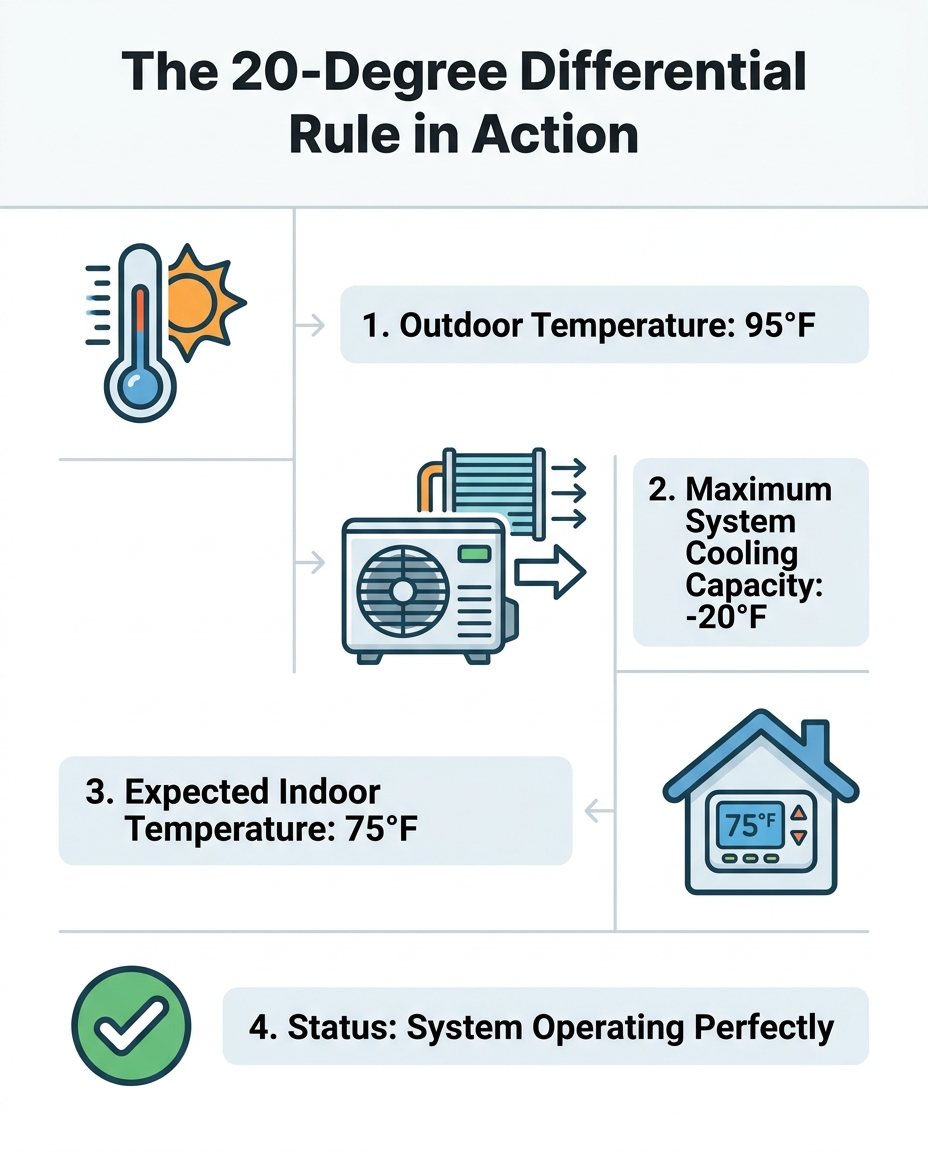
To set realistic performance expectations for your home's climate control, you have to look at the underlying science. The most important metric to understand is the standard 20-degree temperature differential. This is the universal engineering limit that dictates how much heat a standard residential air conditioner can effectively remove from a home at any given time.
Air conditioners do not actually "create" cold air. Instead, they act as heat transfer machines. They absorb thermal energy from inside your living space and pump it outside. The hotter the outdoor air becomes, the harder this heat transfer process gets. Here is how the physics of this process break down in practical terms:
1. The baseline capacity: A perfectly functioning system is designed to cool the indoor air by a maximum of 20 degrees Fahrenheit compared to the outdoor temperature.
2. The extreme heat math: If the outdoor temperature reaches 95°F, an indoor temperature of 75°F indicates that your system is operating at 100% capacity and functioning flawlessly.
3. The thermostat myth: Pushing your thermostat down to 65°F will not force the system to blow colder air or cool the house faster. It simply commands the system to run continuously in a futile attempt to reach an impossible target.
4. The heat transfer bottleneck: As outdoor temperatures climb toward 100°F, the refrigerant in your outdoor condenser coil struggles to release the heat it absorbed from your house, slowing down the entire cooling cycle.
When you understand the 20-degree temperature differential, the behavior of your system during a late-summer heatwave makes much more sense. The equipment is not failing; it is simply hitting the absolute ceiling of its thermodynamic capabilities.

How Bend's High Desert Climate Tests Older Residential Construction
The Problem: Even with a perfectly functioning HVAC system, many local homes struggle to maintain that 20-degree differential. During sustained late-August heatwaves, indoor temperatures can creep up to 78°F or 80°F, leaving homeowners frustrated and uncomfortable. The root of the issue often lies not in the mechanical equipment, but in the building envelope itself.
The Cause: Bend's specific high desert climate variables present a unique challenge. We experience significant diurnal temperature swings—cool, crisp mornings followed by intense, baking afternoon sun. Much of the older Bend residential construction was built before modern extreme temperature swings were common, meaning these homes lack the advanced thermal envelopes required to combat sustained radiant heat. Lower R-value insulation in attics and walls allows solar heat to penetrate the living space far faster than the air conditioner can remove it. Furthermore, aging, uninsulated ductwork running through sweltering crawlspaces or attics often warms the conditioned air before it even reaches the vents. Once the intense afternoon sun hits, these older homes completely lose their ability to retain the natural morning cool air.
The Solution: Bridging the gap requires a holistic approach to home performance. Upgrading attic insulation, sealing leaky ductwork, and installing radiant barriers can drastically reduce the amount of heat entering the home. By improving the building's thermal resistance, you give your air conditioner a fighting chance to maintain the 20-degree differential, even when the high desert sun is relentless.
System Sizing and ASHRAE Design Temperatures
A common question homeowners ask during a heatwave is, "Why didn't the installers just put in a bigger unit?" The short answer is that bigger isn't better when it comes to HVAC sizing. Residential cooling systems are precisely calculated based on strict engineering guidelines, not worst-case scenarios.
The American Society of Heating, Refrigerating and Air-Conditioning Engineers (ASHRAE) sets the industry standards for sizing HVAC equipment. Professionals use a complex calculation known as a Manual J load calculation to determine exactly how much cooling capacity a specific home needs. These calculations rely on historical regional climate averages—known as design temperatures—rather than extreme, anomalous heatwaves. In most regions, systems are sized to handle the 99th percentile of summer temperatures, which means they are intentionally not designed for the absolute hottest day of the decade.
Oversizing an air conditioner to handle a rare 100-degree day introduces severe performance issues for the rest of the summer. An oversized unit will cool the house too quickly and shut off before it has a chance to dehumidify the air, a phenomenon known as short-cycling. This leads to a clammy, uncomfortable indoor environment, significantly higher energy bills, and premature wear and tear on the compressor. The 20-degree temperature differential is a byproduct of this careful, efficiency-focused sizing process.
If your home consistently struggles with heat gain and you are looking for supplemental options that operate under different efficiency curves, exploring heat pump cooling can provide targeted relief for specific zones without compromising the efficiency of your primary central system.
Troubleshooting vs. Normal Limits: When Should You Actually Call for Service?
One of the most frustrating experiences for a homeowner is paying an emergency diagnostic fee only to have a technician arrive, inspect the unit, and declare that the system is working perfectly. Our honest local-authority approach prioritizes your education over collecting unnecessary fees. We want you to know exactly when to pick up the phone and when to simply close the blinds and wait out the afternoon heat.
Differentiating between a perfectly functioning system hitting its physical limit and a genuinely broken system requires observing a few key symptoms during late August 95-degree heatwaves.
Signs Your System is Functioning Normally
• Continuous operation during peak heat: It is entirely normal for your system to run without stopping from 2:00 PM to 7:00 PM.
• Plateauing temperatures: The indoor temperature settling at 75°F to 78°F when it is 95°F+ outside indicates the system is holding the line.
• Cool supply air: The air coming out of your vents still feels distinctly cool to the touch, even if the house isn't getting colder.
Signs You Need a Professional
• Blowing warm air: If the air from the vents feels like room temperature or warmer, the cooling cycle has failed.
• Ice buildup: Frost or solid ice forming on the outdoor refrigerant lines or the indoor evaporator coil is a major red flag indicating restricted airflow or a refrigerant issue.
• Short-cycling: The system rapidly turning on and off every few minutes without ever reaching the 20-degree differential points to an electrical or pressure problem.
The quick fix test: You can verify your system's performance by measuring the temperature drop yourself. Place a thermometer at the return vent (where air gets sucked in) and then at a supply vent (where air blows out). A healthy system should show a temperature drop of roughly 15 to 20 degrees between the two points. If the air is cooling properly but the house remains warm, you are simply fighting heat gain. If the temperature drop is minimal, it is time to look into troubleshooting an AC blowing warm air.
• Thermostat reads 76°F, outside is 96°F — System Status: Normal Operation — Recommended Action: Keep system running, close blinds
• Vents blowing room-temperature air — System Status: Malfunction — Recommended Action: Turn system off, call for service
• AC runs constantly all afternoon — System Status: Normal Operation — Recommended Action: Ensure filter is clean, monitor
• Grinding or squealing noises — System Status: Mechanical Failure — Recommended Action: Turn system off, call for service
Practical Steps to Support Your AC When Temperatures Soar
If your system is functioning normally but the house is still uncomfortably warm, the best strategy is to reduce the home's cooling load. You can significantly ease the burden on your HVAC unit without touching any electrical or refrigerant components. Especially in older Bend residential construction, managing heat gain from the inside out makes a massive difference.
Here are actionable ways to help your system keep up during extreme weather:
• Block radiant solar heat: Keep blinds, shades, and heavy curtains closed on all south and west-facing windows during the peak afternoon hours. Sunlight passing through glass acts like a greenhouse, adding massive amounts of thermal energy to the room.
• Manage heat-generating appliances: Avoid using ovens, clothes dryers, or dishwashers between 2:00 PM and 7:00 PM. These appliances add both sensible heat (temperature) and latent heat (humidity) to the air, forcing the AC to work harder.
• Unblock your airflow: Walk through your home and ensure all return air grilles and supply registers are completely unobstructed. Moving furniture, rugs, or drapes away from vents ensures the blower motor does not have to strain to circulate air.
• Optimize your ventilation: Keep interior doors open to promote even circulation throughout the house. Additionally, managing your indoor air quality through proper filtration ensures the system doesn't choke on dust and debris while trying to move massive volumes of air.
Maximizing Equipment Efficiency with Routine Care
While no amount of fine-tuning can alter the laws of thermodynamics or push a system past the 20-degree temperature differential, neglecting your equipment will certainly cause it to fall short of that limit. A poorly maintained air conditioner might only manage a 10- or 15-degree drop, leaving you sweltering even on moderately warm days.
The impact of dirty coils: The outdoor condenser coil is responsible for releasing heat into the outside air. If this coil is blanketed in dust, pollen, or yard debris, it acts like a thick winter sweater on the unit, trapping the heat inside and crippling the system's cooling capacity.
The role of refrigerant: Air conditioners do not consume refrigerant like a car consumes gas. The system is sealed. However, if micro-leaks develop and the refrigerant charge drops, the system cannot absorb enough heat from the indoor air. Having these levels professionally verified before extreme heat arrives is critical for peak performance.
Consistent care is what keeps systems resilient. A typical pattern we see involves homeowners realizing they need comprehensive service during a brief window of time. For instance, one homeowner visiting their vacation property on a tight schedule reached out for thorough HVAC service and a fireplace repair. A technician arrived promptly, completed the comprehensive HVAC maintenance, and repaired the fireplace within their narrow timeline. Whether it is preparing for winter cold or summer heat, that level of proactive care ensures the system operates at its absolute peak when you need it most.
To ensure your system is prepared to handle the intense stress of prolonged extreme temperatures, investing in routine AC maintenance is the most reliable step you can take. Professional service teams clean the critical components, verify electrical draws, and ensure that your system is fully capable of delivering maximum cooling power.
Frequently Asked Questions
What is the 20-degree rule for air conditioning?
The 20-degree rule states that standard residential air conditioners are designed to cool the indoor air by a maximum of 20 degrees Fahrenheit below the outdoor temperature. If it is 95°F outside, achieving an indoor temperature of 75°F means the system is operating at 100% capacity.
Why does my AC run constantly in 95-degree heat?
Your AC runs constantly because it is continuously fighting the massive amount of radiant heat entering your home. During extreme heatwaves, the system must operate continuously just to maintain the indoor temperature and prevent the house from getting hotter.
Should I call a technician if my house is 78 degrees during a heatwave?
If the outdoor temperature is 98°F or higher, a 78-degree indoor temperature indicates the system is functioning normally. You only need to call a technician if the system is blowing warm air, making strange noises, or failing to maintain the 20-degree differential.
How can I help my AC keep up during extreme summer temperatures?
You can reduce the cooling load by closing blinds on south and west-facing windows, avoiding the use of heat-generating appliances during the afternoon, and ensuring all air vents remain unblocked. Replacing a dirty air filter also improves vital airflow.
Is it bad for my air conditioner to run all day without stopping?
No, it is not inherently bad for the system to run continuously during peak heat. Air conditioners are actually most efficient when running in long, steady cycles rather than rapidly turning on and off, provided they are clean and well-maintained.
Can adding more refrigerant make my AC cool below the 20-degree limit?
No, adding excess refrigerant will not improve cooling capacity and can actually severely damage the compressor. Refrigerant must be precisely charged to factory specifications; overcharging disrupts the delicate pressure balance required for heat transfer.
Dealing with the reality of AC performance drops during sustained 95-degree heatwaves can be stressful, but understanding the physical limits of your equipment provides much-needed peace of mind. By recognizing the 20-degree differential rule, you can confidently distinguish between a perfectly normal system working hard and a genuine mechanical failure. Taking practical steps to reduce your home's heat gain, coupled with proactive maintenance, ensures you stay as comfortable as possible without the panic of an unnecessary emergency service call.