

Did Your Electric Bill Jump Without Changing the Thermostat?
Why did your utility statement suddenly skyrocket when you haven't touched the dial on your wall all month? Here at Mountain View Heating, our phones ring off the hook every late summer with this exact question. If you are searching for the real reason your cooling bill spiked between July and August, you are certainly not alone. In our years of keeping Bend comfortable, we know it is incredibly frustrating to open that late-summer envelope, see a massive jump in energy consumption, and know with absolute certainty that your family's daily habits haven't changed one bit. You haven't started leaving the front door open, you haven't been running the system at a colder temperature, and you haven't added new heat-generating appliances to your living space.
The truth is, your home's energy consumption is driven by total system run time, not simply the number displayed on the thermostat screen. Your thermostat is just a switch that tells the equipment when to turn on and off. It does not control how much electricity the system pulls per minute, nor does it control how hard the system has to work to overcome the environmental heat load pressing against your walls and roof.
As the summer progresses, your home's physical structure begins fighting a losing battle against cumulative heat. This natural progression leads directly to longer AC run times to maintain the same target temperature that felt so effortless to achieve just a few weeks prior. Upgrading or maintaining your air conditioning systems is often the first step we recommend in mitigating these seasonal cost spikes, but understanding the environmental science behind the spike is critical for achieving true peace of mind.
The Physics of Thermal Mass: Why August Feels Harder on Your AC
To understand what is happening to your utility bill, our technicians often explain the concept of thermal mass to homeowners. Building materials—such as brick siding, concrete foundations, asphalt roof shingles, and thick attic insulation—are excellent at absorbing and storing heat energy. Throughout the early parts of summer, these materials are relatively cool. When the sun beats down on your house, the materials absorb that heat, acting like a giant thermal sponge that prevents the heat from immediately transferring into your living space.
However, this absorption process has a limit. As you experience consecutive hot days with minimal overnight cooling, your home's building materials lose their ability to shed that stored heat back into the outside air. The radiant heat trapped in your attic and walls continues to transfer indoors long after the sun goes down. Your air conditioner is no longer just fighting the ambient outdoor air temperature; it is actively fighting the heat radiating inward from the very structure of the house itself.
The Cumulative Effect of Summer Heat
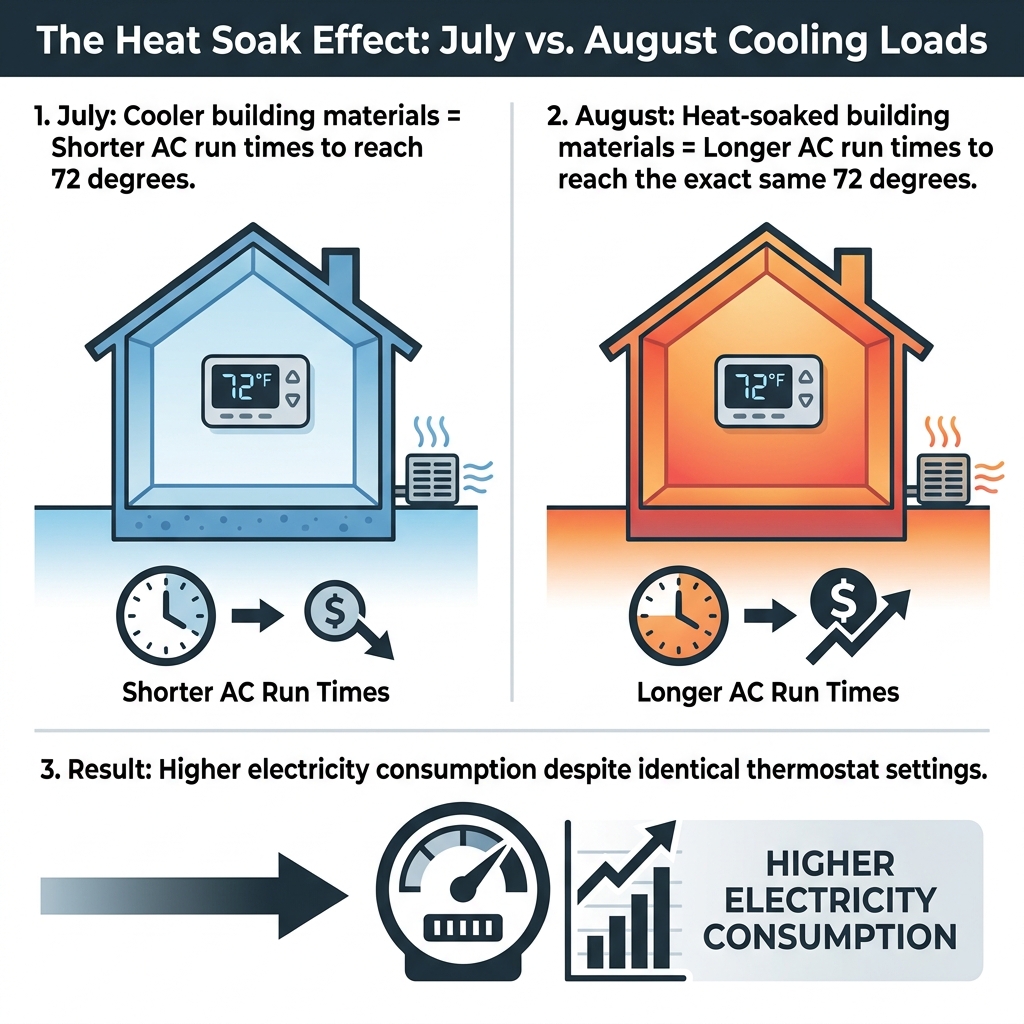
The exact same 90-degree afternoon in June requires significantly less cooling energy than a 90-degree afternoon in late summer. In early summer, the building materials are still shedding the chill of spring. By the time late summer arrives and the kids are getting ready to head back to school, your home is experiencing severe August late-summer heat soak. The materials are fully saturated with thermal energy. Because the walls and roof are constantly radiating heat inward, your cooling equipment must run much longer cycles to remove that continuous influx of thermal energy, driving up your electricity usage without you ever touching the controls.

Thermostat Settings vs. Actual Energy Consumption
A widespread misconception we see among Central Oregon homeowners is that a static thermostat setting guarantees a static energy bill. Most central air conditioners operate at a single, fixed speed. Unless you have a high-end variable-capacity unit, your compressor is either running at 100% capacity or it is completely off. Therefore, the system consumes electricity based entirely on how many hours it runs per day.
Consider this scenario: maintaining a comfortable 72-degree set point in July might require your system to run for a total of 6 hours over the course of the day. In late summer, because of the massive radiant heat load pushing through the ceiling and walls, maintaining that exact same 72-degree set point might require 10 or 12 hours of run time. The thermostat setting hasn't changed, but the energy consumption has nearly doubled because of the longer AC run times to maintain the same target temperature.
This is also why cranking your thermostat to 60 degrees when you get home from work won't cool the house any faster. The system cannot blow colder air; it can only blow the same cold air for a longer duration. Forcing the system to aim for an impossibly low temperature simply forces the compressor to run non-stop, wasting electricity without actually accelerating the cooling process. Remember, the thermostat only measures the indoor air temperature right where it is mounted on the wall; it cannot detect the massive wave of radiant heat pushing down from your baked attic.
How Central Oregon's High Desert Sun Accelerates Heat Soak
The physics of thermal mass apply everywhere, but in our decades of experience, they are uniquely intense in Central Oregon. At an elevation of roughly 3,625 feet, Bend experiences intense direct solar radiation. The thinner atmosphere provides less filtering of the sun's rays, meaning the UV energy striking your roof and siding is significantly stronger than it would be at sea level.
Furthermore, our high desert climate is characterized by a lack of cloud cover and very low humidity. While low humidity makes the heat feel more comfortable on your skin, it allows maximum solar penetration during our long summer days. Your home's exterior absorbs this intense radiation for up to 15 hours a day. We see the effects of this intense sun early and often. For instance, when unseasonably high temperatures hit early in June, our Mountain View Heating service teams worked extended hours installing new ductless systems for local homeowners whose existing setups simply couldn't handle the sudden, intense solar load. By the time the season progresses into late summer, that solar load has been baking the home for months, creating deep August late-summer heat soak.
These extreme temperature swings and high-altitude solar loads cause sudden surges in cooling demand as the home struggles to shed daytime heat. If your system seems to run endlessly as the sun goes down, it is likely battling the heat radiating from your own attic and walls. Our local service teams frequently see this exact phenomenon causing extended run times in homes across the high desert.
Is Your Air Conditioner Failing, or Just Working Overtime?
When the late-summer utility bill arrives, the primary decision point for most homeowners is determining whether they need to call us for repairs or if the system is just battling natural environmental factors. It is completely normal for a system to run longer cycles during periods of extreme heat soak, but there is a fine line between working hard and actively failing.
Modern, energy-efficient heat pumps and variable-speed systems handle these late-summer loads much more gracefully than older, single-stage AC units. However, regardless of what equipment you have, we recommend monitoring its behavior to distinguish between a normal, extended cooling cycle and an actual mechanical malfunction.
• Air Temperature at Vents — Normal Heat Soak Operation: Air feels distinctly cold, even if the house is cooling down slowly. — Warning Sign of Mechanical Failure: Air feels lukewarm, room temperature, or completely unconditioned.
• Cycle Length — Normal Heat Soak Operation: System runs for hours at a time but eventually shuts off at night. — Warning Sign of Mechanical Failure: System "short-cycles" (turns on and off every 5-10 minutes) continuously.
• Target Temperature — Normal Heat Soak Operation: Struggles during peak afternoon sun but reaches the set point after dark. — Warning Sign of Mechanical Failure: Never reaches the target temperature, even in the middle of the night.
• System Noises — Normal Heat Soak Operation: Steady, consistent humming of the compressor and blower fan. — Warning Sign of Mechanical Failure: Grinding, screeching, rattling, or sudden banging noises from the outdoor unit.
• Visual Inspection — Normal Heat Soak Operation: Outdoor unit is free of debris; indoor coil is wet with normal condensation. — Warning Sign of Mechanical Failure: Thick layers of ice forming on the refrigerant lines or indoor evaporator coil.
If your system aligns with the normal operation column, the longer AC run times to maintain the same target temperature are simply the result of environmental load. If you notice symptoms from the warning column, it is time to have our professionals diagnose the equipment.
Strategic Ways to Reduce Your Home's Cooling Load
If your equipment is functioning properly but you want to reduce those extended run times, we always advise our customers to focus on reducing the thermal load on their homes. By implementing a few structural and behavioral changes we regularly recommend, you can help your unit keep up with the August late-summer heat soak without using excess electricity.
• Block solar heat gain early: Close blinds, shades, and thermal curtains on all south-facing and west-facing windows before the peak afternoon sun hits. Preventing the UV rays from entering the home is far more efficient than trying to cool the air after it has been heated.
• Delay heat-generating activities: Ovens, stovetops, dishwashers, and clothes dryers release massive amounts of heat and humidity into your living space. Delay using these appliances until after the sun sets to give your cooling system a fighting chance during the hottest part of the day.
• Utilize the wind-chill effect: Ceiling fans do not lower the temperature of a room, but they do cool the people in it by evaporating moisture from the skin. Running a ceiling fan allows you to comfortably raise your thermostat setting by a few degrees, significantly reducing compressor run time.
• Keep interior doors open: Central air systems rely on balanced airflow. Closing doors to unused bedrooms traps heat and disrupts the return air pathways, forcing the blower motor to work against increased static pressure.
• Consider targeted zoning: If your upstairs bedrooms are chronically hot due to rising heat and attic radiation, utilizing ductless mini split cooling allows you to directly condition those problem areas without overworking the primary central system.
Combating Late-Summer Efficiency Drops with Professional Care
While environmental heat soak is an inevitable part of living in the high desert, a well-maintained cooling system requires significantly less electricity to overcome it. When your equipment is dirty or neglected, it compounds the problem. A clogged air filter restricts airflow, forcing the blower motor to draw more amperage. Dirty outdoor condenser coils act like an insulating blanket, preventing the system from releasing the heat it just removed from your house. These maintenance issues guarantee longer AC run times to maintain the same target temperature.
This is where Mountain View Heating's deep understanding of Central Oregon's unique high desert climate becomes invaluable. Having worked on countless local HVAC units, we know exactly how the intense local sun and dusty conditions impact equipment efficiency, and our specific maintenance plans are designed to combat these exact seasonal drops. Just recently, one of our Bend customers called us out for routine servicing of their HVAC equipment. Our technician Scott provided thorough, efficient, and knowledgeable service, ensuring the coils were clean and the vital components were operating within safe electrical tolerances. Because the equipment received great service, it was fully prepared to handle the extended cooling cycles of late summer without burning excess electricity.
Having an expert perform thorough routine AC maintenance ensures the equipment operates at peak efficiency. It is the absolute best defense against surprise utility bills, unexpected breakdowns, and premature system failure when the weather is at its worst.
Frequently Asked Questions About Late-Summer Cooling Bills
Why did my electric bill go up when my thermostat stayed the same?
Your electric bill went up because your air conditioner had to run for more hours each day to maintain that same temperature. The thermostat only acts as an on/off switch; it does not dictate how hard the system works. As the outdoor heat intensifies and the building materials absorb thermal energy, the system experiences longer AC run times to maintain the same target temperature.
Why is my electric bill so high in August?
Your bill is highest in August due to the cumulative effect of summer heat on your home's structure. By late summer, your roof, attic, and walls are completely saturated with thermal energy, a phenomenon known as August late-summer heat soak. The air conditioner must consume more electricity to fight both the hot outdoor air and the heat radiating inward from your own walls.
Does AC use more electricity when it is hotter outside?
Yes, air conditioning systems use significantly more electricity when it is hotter outside. The compressor must work against a higher pressure differential to release heat into the outdoor air. Additionally, extreme outdoor temperatures cause the system to run longer, more frequent cycles, which directly multiplies your daily electrical consumption.
Why did my AC bill double in one month?
A bill that suddenly doubles is usually the result of severe weather shifts, intense heat soak, or a sudden mechanical failure. If the weather transitioned from mild early summer to intense late-summer heat, the sheer volume of run time required to cool the house increases dramatically. If the weather has been consistent, a doubled bill could indicate a failing component, such as a clogged coil or low refrigerant charge, forcing the system to run non-stop.
How can I tell if my AC is broken or just struggling with the heat?
You can tell your system is functioning normally if the air coming from the vents feels distinctly cold and the home eventually reaches the target temperature after the sun goes down. If the air coming from the vents is lukewarm, if the system is turning on and off every few minutes, or if you hear grinding noises, the equipment is likely broken and requires professional diagnosis.
Will setting my thermostat higher in late summer actually save money?
Yes, setting your thermostat higher will directly reduce your energy consumption and save you money. Every degree you raise the target temperature significantly reduces the amount of time the compressor needs to run. Using ceiling fans to stay comfortable while keeping the thermostat set a few degrees higher is one of the most effective ways to combat August late-summer heat soak.
Restore Your System's Efficiency Before the Season Ends
An unexpected spike in your utility statement is always frustrating, but it is often a natural result of building physics and intense solar radiation rather than a catastrophic equipment failure. The combination of high desert sun and cumulative thermal mass creates an environment where longer AC run times to maintain the same target temperature are simply unavoidable. By understanding how your home absorbs heat, you can make strategic adjustments to ease the burden on your equipment.
However, if your system is struggling to keep up, running non-stop without cooling the home, or making unusual noises, a professional evaluation by our team is the safest and most cost-effective route. Don't let an inefficient system drain your wallet as the season winds down. Take proactive steps to ensure your equipment is clean, calibrated, and ready to perform. If you are still wondering about the real reason your cooling bill spiked between July and August, giving Mountain View Heating a call to schedule a comprehensive tune-up will provide the definitive answers and the peace of mind you deserve.