


The Sweltering After-Work Rush: Why We Reach for the Dial
If you have ever walked into a stiflingly hot house during the July peak summer heat, you are likely looking for the truth about cranking your thermostat to 60 degrees after work. The air inside feels heavy, the vents are silent, and your immediate reflex is to walk straight to the wall and turn the temperature down as far as it will go. You want relief, and you want it right now.
It is a completely natural reaction to an uncomfortable situation. When the house is hot, dropping the dial to a 60°F thermostat setting feels like you are commanding the system to work harder and faster. But does this extreme setting actually cool your home any quicker? The short answer is no. Understanding how your air conditioning services actually function can save you from unnecessary frustration and high energy bills. Replacing this daily habit with routine HVAC maintenance and smarter operation is the true key to lasting, reliable comfort.
The 60-Degree Misconception: Unpacking the Myth of 'Faster' Cooling
Most homeowners treat their thermostat like the gas pedal in a car. In a vehicle, pressing the pedal closer to the floor delivers more fuel to the engine, resulting in faster speeds. It is easy to assume your cooling system works the exact same way—that a lower number on the screen forces the equipment to pump out colder air at a higher velocity.
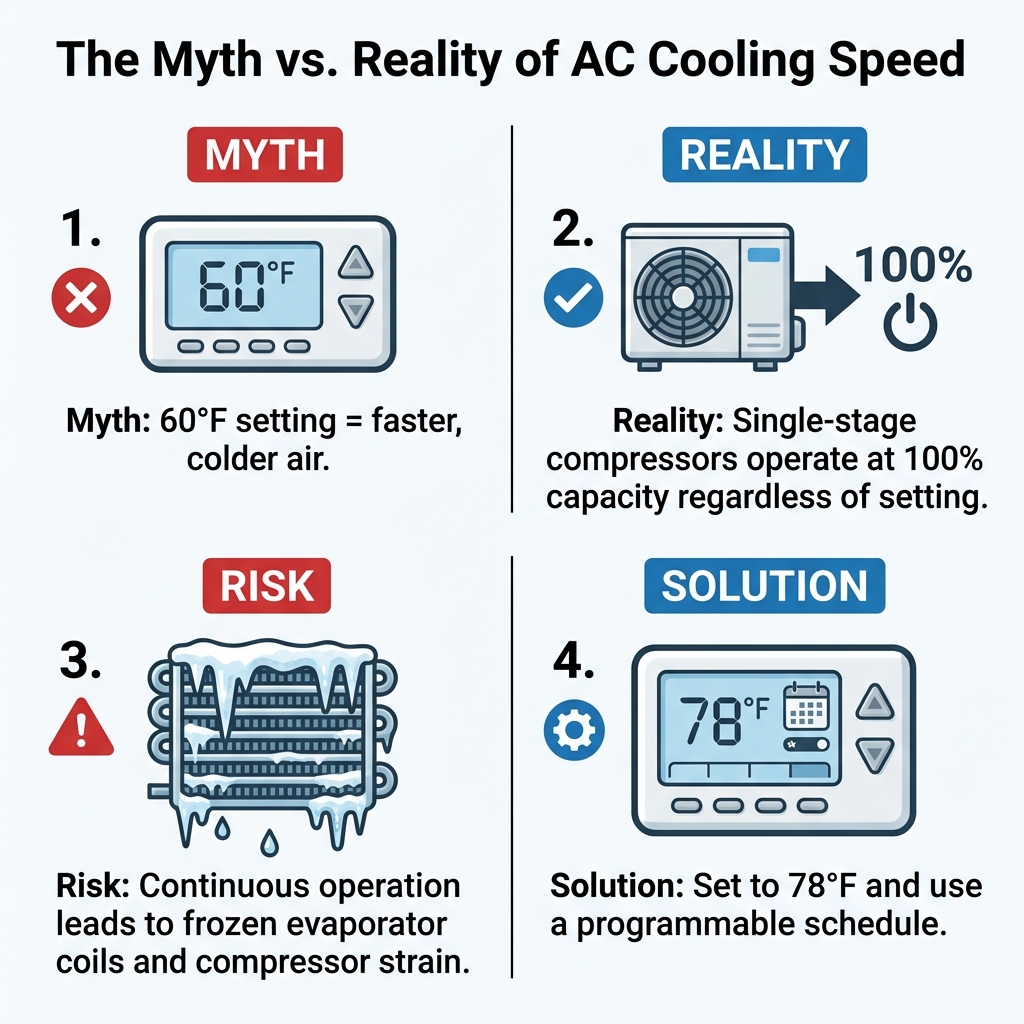
This is a fundamental misunderstanding of what a thermostat actually does. Your thermostat is not a measure of speed or intensity; it is simply a destination. When you input a 60°F thermostat setting, you are giving the system a target temperature to reach before it turns off. You are not telling it to work faster, blow harder, or generate colder air than it normally would.
This misconception leads to massive energy waste and uncomfortable temperature swings inside the home. By demanding an unrealistic indoor temperature during the hottest part of the day, you force your equipment to run constantly without achieving the desired result. Bridging the gap between human impatience and mechanical reality starts with understanding your thermostat settings and how they communicate with your equipment.
• Setting the dial to 60°F makes the air coming out of the vents colder. — The Mechanical Reality: The air from the vents is always the same temperature (usually 15-20 degrees cooler than the room).
• A lower setting forces the fan to blow air faster into the rooms. — The Mechanical Reality: Single-stage systems have a fixed blower speed that does not change based on the setpoint.
• Dropping the temperature cools the house down in half the time. — The Mechanical Reality: The home cools at the exact same rate per hour, regardless of how low the dial is set.
Under the Hood: How Single-Stage Compressors Actually Operate
To truly understand why the 60-degree trick fails, we have to look at the mechanics of standard air conditioning systems. The vast majority of residential homes use what is known as a single-stage compressor. This piece of equipment is the heart of your cooling system, and it operates on very strict, unchangeable rules.
The 100% Capacity Rule
A single-stage compressor is binary. It only has two speeds: 100% on, or 100% off. Think of it like a standard light switch rather than a dimmer switch. When the indoor temperature rises above your setpoint, the thermostat flips the switch to "on." The compressor immediately ramps up to its maximum capacity and stays there.
Because it only operates at full capacity, the unit delivers the exact same volume and temperature of chilled air whether the dial is set to 72 degrees or a 60°F thermostat setting. The system simply responds to the thermostat by running continuously until the target temperature is reached. It cannot give you 110% effort just because you are uncomfortable.
Managing the Afternoon Heat Load
Cooling a home is not about pumping cold air into a room; it is about extracting heat from the indoor air and moving it outside. Equipment is sized to remove a specific amount of heat per hour, measured in BTUs (British Thermal Units). This extraction rate is fixed.
Here in Bend, our Mountain View Heating technicians see firsthand how the high desert's rapid diurnal temperature swings affect local HVAC systems. Cool mornings give way to intense afternoon heat loads. Throughout the day, your roof, walls, and windows absorb thermal energy. By 5:00 p.m., the heat load trapped inside your home is at its absolute peak. Your system must systematically remove this heat at its fixed rate. No matter where you set the dial, the equipment can only extract heat as fast as its mechanical sizing allows.

The High Cost of Impatience: System Strain and Component Wear
Forcing your system to chase an impossible 60°F thermostat setting during the July peak summer heat does more than just waste electricity. It actively damages your equipment. Air conditioners are designed to run in cycles. They turn on, extract heat, reach the target temperature, and turn off to rest. Continuous, unbroken operation bypasses this necessary resting phase.
The risk of frozen coils:
When a system runs endlessly without cycling off, the evaporator coil inside your home gets exceptionally cold. If the system runs for hours on end—especially if your air filter is dirty or airflow is restricted—the condensation on that coil can literally freeze into a solid block of ice. Once the coil freezes, airflow is completely blocked, and the system will blow warm air or stop working entirely.
Accelerated wear and tear:
Running a compressor non-stop on the hottest days of the year forces the motor to endure extreme thermal stress. This habit accelerates wear and tear on capacitors, contactors, and the compressor itself, leading to premature and costly breakdowns.
During a recent peak-summer service call here in Bend, our Mountain View Heating technicians encountered a system that had completely frozen over. After safely thawing the coils and restoring proper airflow, our team explained to the homeowner that regular check-ups and proper thermostat habits—rather than cranking the dial to 60 degrees—prevent exactly this kind of mid-summer system strain.
If you are looking for a system that handles varying heat loads more gracefully, you might explore heat pump cooling. Variable-speed heat pumps can adjust their output to match the exact cooling demand of the home, providing consistent comfort without the harsh on/off cycling of traditional single-stage units.
Smarter Cooling Strategies for High Desert Homes
Instead of relying on extreme temperature drops, you can maintain a highly comfortable environment by managing your home's thermal load proactively. Adopting smarter habits ensures your system works efficiently without burning out the compressor.
1. Follow the 78-degree guideline: The Department of Energy recommends setting your thermostat to 78 degrees during the summer months. This provides an optimal balance of indoor comfort and energy efficiency, preventing the system from overworking during the hottest parts of the day.
2. Utilize programmable schedules: Use a programmable or smart thermostat to begin cooling the home gradually before you arrive from work. If you get home at 5:30 p.m., set the system to start dropping the temperature at 4:00 p.m. This removes the afternoon heat load slowly and steadily.
3. Maintain a reasonable baseline: Never turn your system completely off when you leave for work. If the house reaches 85 degrees inside, the AC will have to work for hours to remove the heat baked into your furniture and walls. Keep the baseline temperature around 78 to 80 degrees while you are away.
4. Keep up with regular check-ups: Even with smart strategies, complex issues arise. In one instance this past July, our team identified a complicated airflow restriction on a local heat pump, developed a fix, and repaired it quickly so the system could handle the intense summer heat load safely. Regular professional care ensures your equipment is always ready for peak demand.
Partnering for Efficiency: Why Understanding Your Equipment Matters
Knowing how your equipment works empowers you to make better decisions for its longevity. In our years of serving Bend, our team at Mountain View Heating has always believed in an educational and transparent approach. We prioritize helping homeowners understand their systems because mechanical reality cannot be bypassed by twisting a dial. It can, however, be optimized through professional care and smart daily habits.
A well-maintained system will always cool more effectively than a neglected one, regardless of the setting. Dust buildup on blower motors, dirty condenser coils, and low refrigerant levels all reduce the fixed cooling capacity of your unit. If your system is struggling to keep up with the July peak summer heat, the solution is not a 60°F thermostat setting; the solution is restoring the equipment to its factory-rated efficiency.
This is where proactive care makes all the difference. Investing in a Comfort Club membership ensures your system is thoroughly cleaned, inspected, and calibrated before the worst of the heat arrives. Keeping the system running at its actual peak capacity means shorter run times, lower utility bills, and a much cooler home when you walk through the door.
Frequently Asked Questions About Thermostat Settings and AC Speed
Does setting the thermostat lower cool the house faster?
No, setting the thermostat lower does not cool the house faster. Standard single-stage AC units run at a fixed speed and capacity, meaning they extract heat at the exact same rate whether the dial is set to 72 degrees or a 60°F thermostat setting. The lower setting simply forces the unit to run longer, not faster.
What happens when you set your AC to 60 degrees in the summer?
When you set your AC to 60 degrees during the heat of summer, the unit runs continuously without cycling off. This unbroken operation puts immense strain on the compressor and significantly increases the risk of frozen evaporator coils. It also leads to a massive spike in your monthly energy consumption.
Why is my house not cooling down when set to 60?
Your house struggles to cool down because the heat load inside the home exceeds the unit's fixed cooling capacity per hour. If the outdoor temperature is 95 degrees, a residential AC system physically cannot achieve a 60-degree indoor temperature. The system will run endlessly while failing to reach the impossible target.
What is the best temperature to set your thermostat in summer?
The Department of Energy recommends setting your thermostat to 78 degrees during the summer for a balance of comfort and efficiency. If you are away from home during the day, you can raise this baseline slightly, but avoid turning the system off entirely to prevent excessive heat buildup.
How does a programmable thermostat help with afternoon heat?
A programmable thermostat allows the system to gradually reduce the temperature before you arrive home. By starting the cooling cycle an hour or two before you walk through the door, the system manages the afternoon heat load systematically, ensuring you arrive to a comfortable environment without overworking the equipment.
Optimize Your Comfort and Protect Your System
True comfort comes from a well-maintained, properly functioning system, not an unrealistically low number on the dial. By understanding how your equipment actually operates, you can abandon the 60-degree myth and adopt better temperature management habits that protect your investment. As the July peak summer heat approaches, do not wait for your system to struggle under the heavy afternoon load. Schedule routine HVAC maintenance today to ensure your cooling equipment is ready to deliver efficient, reliable comfort all season long.