


Navigating the Abrupt Late-Summer Temperature Swings
The late-August back-to-school transition brings more than just busy mornings and shorter days; it signals a sudden, undeniable weather change, making Preparing Your Home for the Shift from Cooling to Heating Season an immediate priority. You might find yourself running the air conditioner to combat an 80-degree afternoon, only to wake up shivering in a 40-degree house by dawn. This abrupt swing places an immense mechanical strain on your HVAC equipment, forcing it to switch roles rapidly after months of operating strictly in cooling mode.
For proactive homeowners, this specific window creates a critical decision point. You need to know which end-of-summer maintenance tasks are safe to tackle yourself and which require the trained eye of a licensed professional. Preparing your home heating systems now ensures you aren't caught off guard when the first real freeze hits. If you want to skip the guesswork and ensure your equipment is fully prepped, the smartest move is to schedule heating maintenance in Bend before the emergency service rush begins.
The High Desert Reality: Why August Brings Unique HVAC Stress
If you read national home improvement blogs, you will often see advice telling you to wait until late October to think about your furnace or heat pump. In the Bend high desert, following that generic timeline is a recipe for an uncomfortable, freezing night. Our regional climate does not offer a slow, linear slide into autumn. Instead, we experience extreme diurnal temperature variations—often shifting 30 to 40 degrees between the daytime high and the nighttime low.
The strain of dual-mode days: Running your cooling and heating systems within the same 24-hour period forces your equipment to work overtime. The system barely has time to equalize pressures and shed the heat from the afternoon before it is commanded to reverse the process and warm the house. This constant cycling accelerates wear and tear on electrical contacts, blower motors, and refrigerant valves. At Mountain View Heating, our deep understanding of Central Oregon's unique high desert climate swings means we know exactly how much stress these late-summer weeks put on local systems.
Bypassing the generic advice: Because our nighttime temperatures plummet so rapidly in late August, your heating system must be perfectly dialed in much earlier than in other parts of the country. A system that has been vibrating, accumulating dust, and enduring the heavy workload of July is not automatically ready to heat your home safely in September. Proactive preparation is the only way to bridge the gap between the seasons.
The Danger of the First Freeze
Unexpected early frosts are a hallmark of the high desert, and they pose a significant threat to unprepared outdoor units. When a heat pump has been running hard all summer, the components are fatigued. If a sudden cold snap hits and the system is covered in late-summer debris or low on refrigerant, the outdoor coil can quickly freeze over. This compounding effect of summer wear-and-tear leading directly into a freezing night is exactly what causes catastrophic system lockouts, leaving you without heat when you need it most.
Clearing Summer Debris: Safe DIY Prep for Your Condenser
While the mechanical complexities of the cooling to heating transition require a professional, there is plenty you can do to help your system breathe easier. By the time the late-August back-to-school transition arrives, your outdoor condenser unit has likely collected months' worth of environmental buildup. Clearing this debris is a safe, highly effective DIY task that directly impacts your system's efficiency.
The threat of restricted airflow: Throughout the summer, your outdoor unit pulls in massive amounts of air to dissipate heat. Along with that air comes pollen, fine dust, cottonwood seeds, and overgrown vegetation. When this debris blankets the condenser coils, it acts like an insulating sweater. In heating mode, your heat pump needs to absorb ambient heat from the outside air. If the coils are blocked, the system experiences severe efficiency drops, struggles to warm your home, and becomes highly susceptible to freezing over.
Here is a safe, step-by-step checklist for an end of summer ac maintenance sweep:
• Disconnect the power: Always locate the outdoor disconnect box near the unit or your main electrical panel and turn off the power at the breaker before cleaning around the equipment.
• Establish a 2-foot clearance: Trim back any bushes, tall grass, or low-hanging branches so there is a minimum of 24 inches of clear space around all sides of the unit.
• Remove large debris: Carefully pick out any leaves, twigs, or trash that have accumulated in the grates or around the base of the pad.
• Gently rinse the fins: Using a standard garden hose on a gentle setting (never a pressure washer), rinse the outside fins to wash away loose dust and pollen. Point the water straight down the fins to avoid bending the delicate metal.
• Check the base pan: Ensure the drain holes at the bottom of the unit are clear of mud and debris so that condensation and defrost runoff can easily escape.
The Heat Pump Reversing Valve: The Heart of the Transition
If you rely on a heat pump, the most critical component during the seasonal shift is the reversing valve. This intricate brass valve is the literal heart of the transition, responsible for changing the direction of the refrigerant flow. When it shifts, it transforms your system from an air conditioner into a heater.
The mechanics of the shift: The reversing valve uses an electrical solenoid to move a small internal slide. Because this component sits idle in cooling mode for months, a lack of maintenance or the sudden shock of rapid seasonal mode-switching can cause the internal slide to stick. When this happens, the symptoms are immediate and frustrating. You might turn your thermostat up to 70 degrees on a freezing morning, only to feel ice-cold air blowing from your vents because the system is stranded in AC mode.
A job for the pros: Inspecting, testing, and diagnosing the reversing valve is strictly a job for licensed professionals. It involves high-voltage electrical testing and specialized refrigerant gauges. Attempting to force or bypass this valve yourself can cause permanent compressor damage. During a comprehensive heat pump tune-up, a technician will cycle the valve, verify the electrical draw of the solenoid, and ensure the pressure differential is correct.
Our team at Mountain View Heating sees this exact scenario play out every August. Just last season, a local Bend homeowner reached out to us during a seasonal transition with a complicated heat pump problem where the system simply refused to switch modes. One of our experienced technicians quickly identified a mechanical issue with the reversing mechanism, developed a safe fix, and repaired it efficiently, getting the heat pump working properly before the evening temperatures dropped.
Why Reversing Valves Fail
Mechanical wear is the most common culprit behind a failed reversing valve. The constant, rapid shifting required during high-fluctuation weeks takes a toll on the internal seals. Additionally, if your system has a slight refrigerant leak, there may not be enough pressure to physically push the slide inside the valve. Diagnosing these flow issues requires specialized tools and a deep understanding of thermodynamics, which is why professional oversight is non-negotiable.
Thermostat Management During Extreme Temperature Fluctuations
When the Bend high desert weather is unpredictable, your thermostat becomes the command center for your home's comfort and energy efficiency. However, improper thermostat management during the late summer can easily spike your utility bills and put unnecessary wear on your equipment.
The pitfalls of manual slamming: One of the most common mistakes homeowners make is manually slamming the thermostat from "cool" to "heat" and back again multiple times a day. This reactionary approach forces the system to run in short, inefficient bursts. It prevents the equipment from completing a full cycle, which is necessary to manage indoor humidity and properly circulate air.
To manage your indoor controls efficiently during the shift, follow these numbered steps:
1. Utilize the 'Auto' function: If your thermostat has an "Auto" mode, this is the perfect time of year to use it. Auto mode allows the system to switch between heating and cooling automatically based on your setpoints, eliminating the need for manual intervention.
2. Set an appropriate deadband: The "deadband" is the temperature buffer between your heating and cooling setpoints. Set a deadband of at least 3 to 5 degrees (e.g., heat to 68 degrees, cool to 73 degrees). This prevents the system from fighting itself and rapidly bouncing between modes as the sun comes in and out of the clouds.
3. Leverage natural cooling: Before turning the AC back on during a warm afternoon, check the outside temperature. Utilize cooler evening air by opening windows to reduce your reliance on mechanical cooling, which gives your heat pump a much-needed break before it has to switch to heating later that night.
4. Review your schedule: Adjust your programmable schedule to account for the new back-to-school routine, ensuring you aren't paying to heat or cool an empty house.
In our years of experience serving Central Oregon, we've found that understanding exactly how to program these settings can save you significant frustration. For a deeper dive into optimizing your controls, you can review our thermostat modes and settings guide.
Drawing the Line: When to Call a Professional
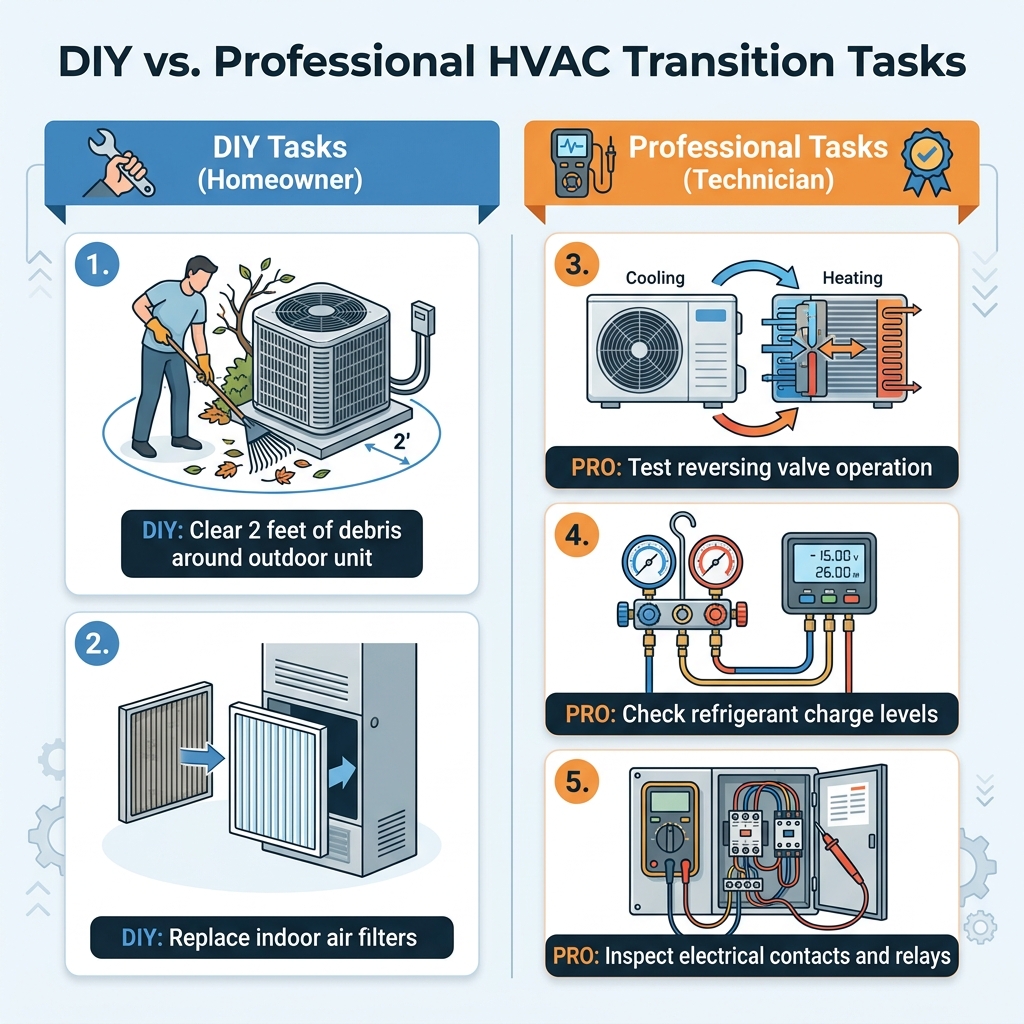
There is a definitive boundary between the tasks you can safely manage and the critical maintenance that requires a licensed technician. By late August, you should have already completed your DIY prep: replacing your indoor air filters, clearing the perimeter of the outdoor unit, and ensuring all your indoor vents are open and unblocked.
Once those basics are handled, it is time to pass the baton. Professional maintenance goes far beyond a simple visual check. A dedicated technician will test the reversing valve, verify the refrigerant charge levels, inspect electrical contacts for pitting, and measure the amperage draw of the blower motor. Having a professional explain your system's readiness offers immense value. For instance, during a routine fall maintenance visit, our Mountain View Heating technicians always take the time to clearly explain your furnace or heat pump's condition, turning a standard service call into a masterclass on home comfort.
Proactive vs. Reactive: Scheduling this service proactively avoids the emergency rush. When the first real freeze hits, local HVAC schedules fill up instantly with reactive calls from homeowners whose systems failed to start. Getting on the schedule in August guarantees your spot and your peace of mind.
• Replacing indoor air filters — Who Should Perform It: Homeowner (DIY) — Why It Matters: Ensures proper airflow and prevents the blower motor from overheating.
• Clearing 2 feet of condenser debris — Who Should Perform It: Homeowner (DIY) — Why It Matters: Allows the outdoor unit to efficiently absorb or release heat.
• Testing the reversing valve — Who Should Perform It: Licensed Professional — Why It Matters: Guarantees the system can successfully physically shift into heating mode.
• Checking refrigerant charge levels — Who Should Perform It: Licensed Professional — Why It Matters: Prevents coil freeze-ups and ensures the system operates at peak efficiency.
• Inspecting electrical contacts — Who Should Perform It: Licensed Professional — Why It Matters: Identifies pitted or failing relays before they cause a complete system breakdown.

Frequently Asked Questions About the Cooling to Heating Shift
When should I switch my thermostat from AC to heat?
The ideal time to switch your thermostat is when indoor temperatures consistently drop below your comfort threshold (usually around 68 degrees) and the outdoor temperature no longer warrants cooling. In the Bend high desert, this often means utilizing your thermostat's "Auto" function in late August so the system can handle the drastic day-to-night swings automatically. If you are switching manually, wait until the evening air cools down significantly before engaging the heat to prevent short-cycling.
How do I prepare my heat pump for the winter transition?
Preparing your heat pump involves a mix of simple homeout tasks and professional diagnostics. Start by replacing your indoor air filters and clearing all summer debris, dust, and vegetation at least two feet away from the outdoor condenser. Once the unit can breathe freely, you must bring in a licensed technician to perform a fall hvac maintenance checklist, which includes testing the reversing valve, calibrating the thermostat, and verifying refrigerant pressures.
Why is my heat pump stuck in cooling mode?
If your heat pump is blowing cold air when the thermostat is set to heat, the most likely culprit is a stuck reversing valve. This internal brass valve directs the flow of refrigerant, and if the internal slide mechanism fails due to mechanical wear, electrical solenoid failure, or low refrigerant pressure, the system cannot physically transition out of AC mode. Because this involves high-voltage and pressurized refrigerant, it requires immediate professional repair.
What temperature should I set my thermostat in autumn?
For optimal comfort and efficiency during autumn, the Department of Energy recommends setting your thermostat to 68 degrees while you are awake and lowering it slightly while you sleep or are away from home. If you are using an "Auto" mode to manage high desert temperature swings, ensure you set a deadband of at least 3 to 5 degrees between your heating and cooling setpoints so the system doesn't constantly fight itself.
Can I test my heat pump's reversing valve myself?
No, testing a heat pump's reversing valve is not a safe or viable DIY project. Properly diagnosing this component requires cycling the system while monitoring high-voltage electrical draws and reading live refrigerant pressures with specialized manifold gauges. Attempting to tamper with the valve without the proper training can result in severe electrical shock, refrigerant leaks, or permanent damage to your compressor.
How does summer debris affect my heating efficiency in the fall?
Summer debris like pollen, dust, and grass clippings acts as a thick insulating blanket over your outdoor condenser coils. During the fall and winter, a heat pump must absorb ambient heat from the outside air to warm your home. If the coils are blocked by debris, the system cannot absorb that heat efficiently, leading to longer run times, higher energy bills, and a significantly increased risk of the outdoor unit freezing over completely.
Secure Your Comfort Before the Cold Settles In
The late-August back-to-school transition is your final window of opportunity to prep your home before the true high desert cold arrives. Taking action while the weather is still manageable gives you the ultimate peace of mind, knowing that your system has been professionally inspected, cleaned, and tested. You won't have to cross your fingers and hope the heat turns on during that first freezing night.
By handling the DIY debris cleanup and leaving the mechanical testing to the experts, you secure your family's comfort for the long season ahead. Don't wait for the emergency rush when everyone else's system fails to start. Be proactive and schedule heating maintenance in Bend today to ensure your heat pump is ready for whatever the high desert weather brings.