


The Fall Dilemma: To Block or Not to Block?
September pre-heating-season fall prep is officially underway, which means it is time to uncover the truth about closing your foundation vents for winter in Oregon. Every year, as the evening temperatures begin to drop, our team at Mountain View Heating watches homeowners head to their local hardware stores to purchase foam vent blocks. You might find yourself standing outside your house, holding one of these blocks, debating whether conventional wisdom still applies to modern homes. Neighbors often share conflicting advice, with one side warning about burst pipes and the other side cautioning against trapped moisture and mold.
The traditional habit: For decades, the standard practice was to seal up the crawlspace tightly from October through April. The logic seemed sound—block the freezing air to keep the plumbing safe. However, building science has evolved significantly since those guidelines were established. We now understand that your home operates as a complete, interconnected system. How you treat the air beneath your floorboards directly impacts how your winter heating systems perform inside your living space.
The modern reality: Simply stuffing a piece of foam into a vent does not solve the complex environmental challenges happening under your house. In fact, depending on how your foundation is constructed, blocking those vents might be creating a much larger, hidden problem. Modern building science provides a definitive verdict on this debate, shifting the focus away from outdated habits and toward comprehensive moisture management and thermal boundary control.
Why High Desert Homes Face a Unique Winter Threat
When you read general building advice for the state, it usually assumes you live in the wet Willamette Valley or along the coast. However, in our years of serving the Central Oregon / Bend High Desert area, we've learned firsthand that this environment presents an entirely different set of challenges. We do not deal with constant coastal rain, but we do face extreme diurnal temperature swings. It is common to experience comfortable afternoons followed by plummeting overnight temperatures, creating a severe threat of freezing pipes.
The false sense of security: Because the High Desert climate feels so dry, many homeowners assume moisture is not a concern. This is a dangerous misconception. The earth beneath your home contains a massive amount of hidden water. Even in an arid climate, that bare soil continuously releases moisture vapor into the air. When you seal your foundation vents tightly, you trap that evaporating ground moisture inside the crawlspace.
The greenhouse effect: As the overnight temperature drops, the exterior foundation walls become freezing cold. Meanwhile, the trapped air inside the crawlspace retains some ambient warmth and a high concentration of moisture vapor from the soil. When that warm, damp air meets the freezing concrete foundation walls, condensation forms instantly. You essentially create a dark, damp greenhouse directly beneath your floorboards, right in the middle of a dry winter.
The Hidden Danger of Ground Moisture
Understanding the mechanics of ground moisture is crucial for protecting your home. Here is what happens when a crawlspace is improperly managed during the cold months:
• Continuous respiration: Bare earth respires moisture 24 hours a day, regardless of the ambient humidity levels outside your home.
• Condensation cycles: Trapped warm, moist air meeting freezing exterior walls results in constant condensation, dripping water onto wooden floor joists and insulation.
• Insulation degradation: Fiberglass batt insulation acts like a sponge. Once it absorbs this condensation, it loses its thermal resistance and often falls out of the subfloor entirely.
• Biological growth: Wood rot, mold, and mildew thrive in these exact conditions, slowly degrading the structural integrity of your home's foundation.
The Stack Effect: How Crawlspace Air Becomes Your Breathing Air
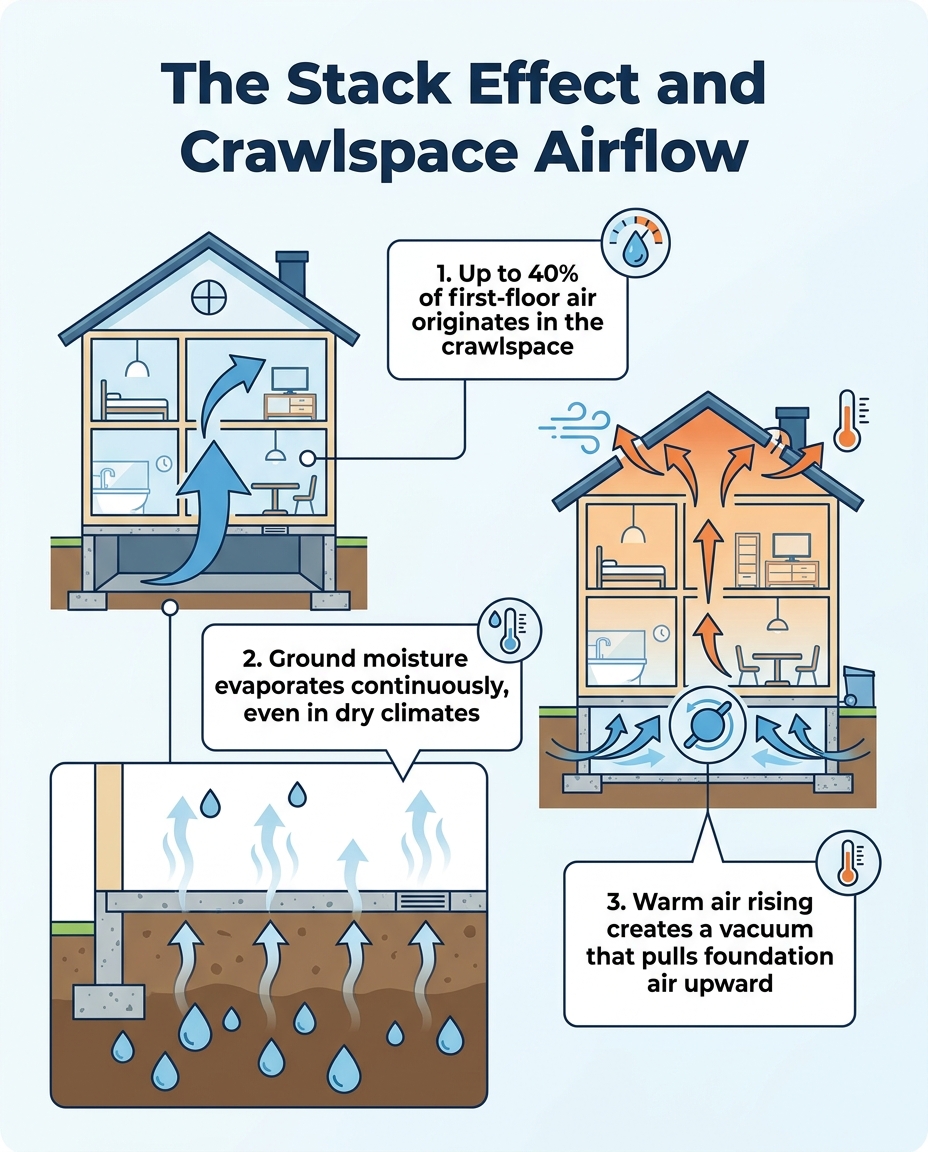
The debate over foundation vents is not just about protecting pipes; it is fundamentally about your home's indoor air quality. To understand why, you have to understand a building science principle known as the "stack effect." As warm air from your heating system rises toward your ceilings and upper floors, it creates a slight negative pressure—or vacuum—at the lowest levels of your house.
The upward pull: This vacuum effect actively pulls air up from your crawlspace, through the gaps around your plumbing penetrations, electrical wiring holes, and floorboards, right into your living room. According to the Building Science Corporation, up to 40 percent of the air you breathe on the first floor of your home originates beneath the house.
The HVAC connection: If you have closed your vents and allowed moisture to build up, the resulting mold spores, mildew odors, and stagnant air are pulled directly into your home. As local HVAC experts at Mountain View Heating, our technicians see this constantly. Homeowners complain about musty smells, increased allergy symptoms, and dusty air during the winter. They often blame their furnace, but we frequently trace the real culprit back to a poorly managed crawlspace. Addressing the root cause requires looking at comprehensive indoor air quality solutions that manage the air exchange between the foundation and the living space.

Building Science: Conditioned Crawlspaces vs. Traditional Venting
So, what is the definitive, science-backed answer to the vent closure question? It depends entirely on how your foundation is constructed. Modern building science, supported by EPA guidelines, increasingly favors unvented, conditioned crawlspaces over the traditional passive venting methods of the past.
If your home has a traditionally vented crawlspace with exposed dirt or a flimsy, torn plastic sheet, closing the vents is highly risky. You will almost certainly cause a moisture problem. However, leaving them open exposes your plumbing to freezing temperatures. The ultimate solution is to eliminate the dilemma entirely through encapsulation.
• Airflow Strategy — Traditional Vented Crawlspace: Relies on passive outside air blowing through vents. — Modern Conditioned Crawlspace: Fully sealed from the outside, treated as part of the home's interior.
• Moisture Control — Traditional Vented Crawlspace: Highly vulnerable to ground evaporation and condensation. — Modern Conditioned Crawlspace: 100% heavy-duty vapor barrier completely stops ground moisture.
• Winter Pipe Risk — Traditional Vented Crawlspace: High risk if vents are open; moisture risk if vents are closed. — Modern Conditioned Crawlspace: Pipes are protected inside the home's thermal envelope.
• HVAC Efficiency — Traditional Vented Crawlspace: Ductwork runs through freezing, unconditioned space, losing heat. — Modern Conditioned Crawlspace: Ductwork operates in a tempered environment, saving energy.
The efficiency advantage: Fully encapsulated, conditioned crawlspaces solve both the freezing pipe and moisture problems simultaneously. When the foundation is sealed correctly, the temperature beneath the floor remains stable. This is especially critical for modern, high-efficiency heat pump systems, which perform optimally when the home's thermal envelope—including the foundation—is properly managed. When ductwork does not have to fight against freezing crawlspace temperatures, your equipment runs less often, lasts longer, and costs less to operate.
Protecting Your Pipes Without Compromising Ventilation
If you have a traditional crawlspace and cannot currently upgrade to a fully conditioned system, you still need to survive the Central Oregon / Bend High Desert winter. You must find a balance between protecting your plumbing and allowing enough ventilation to prevent rot during your September pre-heating-season fall prep.
Instead of blindly sealing the perimeter, focus your efforts on the pipes themselves and the barrier on the ground. By isolating the vulnerable components, you can safely leave your vents open to breathe.
Safe Winterization Checks
1. Verify pipe insulation: Do not rely on thin, degraded foam tubes. Check that all plumbing lines, especially those running near exterior foundation walls, are wrapped in high-quality, thick pipe insulation so no bare metal or PEX is exposed to the cold air.
2. Inspect the vapor barrier: The plastic sheeting on the dirt floor is your primary defense against ground moisture. Look to ensure you have a thick (at least 6-mil) barrier covering 100% of the soil with sealed seams. If you can see bare dirt, you have a moisture problem waiting to happen and should call a professional.
3. Check subfloor insulation: Keep the heat inside your living space by verifying the fiberglass batts between your floor joists are snug and properly supported. The paper vapor retarder (if present) should face upward toward the heated living space.
4. Clear perimeter vents of debris: Instead of stuffing foam blocks into the vents, inspect the heavy wire mesh screens. Remove any accumulated fall leaves, spider webs, or debris that might block natural airflow. Ensure the screens are intact to keep rodents and pests out of the space during the cold months.
Making Crawlspace Checks Part of Your Pre-Winter Routine
The best time to evaluate your crawlspace ventilation and moisture risks is during early fall, well before the first major freeze hits the region. Waiting until a late-night cold snap to crawl under your house with a flashlight is stressful and often leads to rushed, poor decisions.
The professional evaluation: Integrating a foundation check into your annual HVAC maintenance is a smart strategy. When a Mountain View Heating professional evaluates your heating system, we do not just look at the metal box in your garage or closet. We evaluate the airflow, check the integrity of the ductwork running through the crawlspace, and assess the overall health of the system's environment. For example, one of our Bend customers scheduled routine furnace maintenance this past fall. Our technician arrived, performed above-and-beyond service, and took the time to clearly explain how their entire system—including the ductwork running through the foundation—was operating. This level of comprehensive care prevents small issues from becoming mid-winter emergencies.
The value of proactive care: A comprehensive preventative maintenance plan catches disconnected ducts, torn vapor barriers, and failing pipe insulation long before the holiday season. It gives you peace of mind knowing your home is structurally protected and your equipment is running efficiently. As the leaves begin to turn, this holistic approach is the best method for preparing your home for the shift to heating season.
Securing Your Home's Comfort Before the First Freeze
The definitive verdict on foundation vents requires looking past the old myths. Do not blindly block your vents without understanding your home's vapor barrier status and moisture risks. In the Central Oregon / Bend High Desert climate, the threat of freezing pipes is very real, but the hidden danger of trapped ground moisture destroying your indoor air quality is equally severe.
Balancing these two factors is the key to a healthy, efficient home. Focus on insulating your pipes and securing your vapor barrier rather than suffocating your foundation. We encourage homeowners to consult with our local experts to evaluate their specific foundation and heating system needs. By taking a proactive approach to your indoor air quality and seasonal tune-ups, you can ensure your home remains warm, safe, and breathing easily all winter long.
Frequently Asked Questions
Should crawl space vents be open or closed in winter?
It depends on your crawlspace design and vapor barrier. If you have an unsealed dirt floor and traditional venting, leaving them open prevents severe moisture buildup and mold, provided your pipes are heavily insulated. If you have a fully encapsulated and conditioned crawlspace, there are no vents to close, as the space is permanently sealed and climate-controlled.
At what temperature should you close foundation vents?
There is no specific temperature that universally dictates closing vents, because doing so always risks trapping moisture. Instead of closing vents when temperatures drop below freezing, building scientists recommend leaving them open for ventilation while ensuring all exposed plumbing is thoroughly wrapped in high-quality insulation to prevent freezing.
Do closed vents cause mold in a crawl space?
Yes, closed vents are a primary cause of mold in traditional crawlspaces. Bare earth continuously releases moisture vapor, and when vents are blocked, that moisture has nowhere to escape. It condenses on cold foundation walls and wooden floor joists, creating the perfect damp environment for mold and wood rot to thrive.
Is it code to have crawl space vents in Oregon?
Building codes in Oregon generally require ventilation for traditional crawlspaces to manage moisture. However, modern building codes also allow for unvented, conditioned crawlspaces provided they meet specific criteria, such as complete encapsulation with a heavy vapor barrier and mechanical air conditioning or exhaust systems.
Should I close my foundation vents in winter in Central Oregon?
Generally, no, unless your crawlspace is professionally encapsulated. The extreme overnight temperature drops in Central Oregon make frozen pipes a major concern, but the dry climate masks the reality of continuous ground moisture evaporation. Focus on insulating your pipes and securing a 100% coverage vapor barrier rather than blocking airflow.
How does crawlspace moisture affect indoor air quality?
Due to the stack effect, warm air rising in your home pulls air up from the crawlspace into your living areas. If your crawlspace is damp and filled with mold or mildew due to poor ventilation, up to 40 percent of the air you breathe on the first floor will carry those spores and odors, significantly degrading your indoor air quality.