


Waking Up to a Chilly Home: Is Your Heat Pump Malfunctioning?
Early fall September mornings in the High Desert are notorious for drastic temperature swings, and if you are wondering how to tell if your heat pump reversing valve is stuck in cooling mode, you are likely dealing with a sudden, frustrating loss of heat. The season has shifted, the overnight lows have plummeted, and you finally switch your thermostat to heat for the very first time since spring. You wait a few minutes, expecting a wave of comforting warmth to fill the living room. Instead, you feel a steady stream of actively chilled air blasting from the vents. It is an incredibly jarring experience to wake up to a cold house, only to have your HVAC equipment make it even colder.
When this happens, most homeowners immediately question if they made a mistake at the thermostat. Once you confirm the settings are correct, the next logical fear is a catastrophic system failure. However, this specific symptom—blowing actively cold air when the thermostat calls for heat—often points to a very specific mechanical component. Understanding the core components of heat pump systems is the first step in diagnosing this sudden drop in indoor comfort. You need to determine whether this cold air is a simple user error, a temporary operational cycle, or a true mechanical failure that requires professional intervention.
The First Sign of Trouble: Experiencing Cold Air When You Expect Heat
The most immediate and undeniable sign of a malfunctioning heat pump is the sensory experience of cold air blowing from your indoor vents while the thermostat is clearly set to the heating mode. It is important to distinguish between neutral, room-temperature air circulating through the ductwork and air that is actively being cooled by the system. If the system is merely circulating air, it might feel slightly cool to the touch, but if the air is distinctly frigid—the exact same temperature it was during the peak of summer—your system is actively operating in cooling mode.
This sudden failure almost always occurs on the very first heating attempt of the season, catching homeowners completely off guard. You rely on your system to seamlessly transition from summer cooling to autumn heating, but when the internal mechanisms fail to make that shift, the result is a home that rapidly loses its warmth. One local homeowner experienced this exact frustration over Labor Day weekend when the seasonal shift began. Their 23-year-old heating unit suddenly failed, actively blowing cold air when the thermostat called for heat. A technician had to come out on a Saturday, diagnose the catastrophic failure, provide temporary space heaters for comfort, and ultimately replace the aging unit. While not every failure requires a full replacement, the frustration of a system actively fighting your thermostat is a clear signal that a core component is not responding.
What Is a Reversing Valve and Why Does It Get Stuck?
To understand why your heat pump is behaving this way, you have to look at the component responsible for its dual functionality: the reversing valve. Unlike a traditional air conditioner that only cools, a heat pump can both heat and cool your home. The reversing valve is a specialized, four-way brass valve located inside the outdoor unit. Its sole job is to physically slide an internal mechanism that changes the direction of the pressurized refrigerant flow. When the refrigerant flows one way, the system absorbs heat from inside and dumps it outside (cooling). When the internal slide shifts, the flow reverses, absorbing ambient heat from the outdoor air and releasing it inside your home (heating).
So, why does this heavy-duty component suddenly fail? The answer usually lies in the seasonal demands of the Bend, OR and Central Oregon climate. During our long, hot summers, your heat pump runs exclusively in cooling mode. This means the internal sliding mechanism inside the reversing valve stays locked in one exact position for months on end without moving. Over time, friction, slight oxidation, or microscopic debris can cause that sliding mechanism to mechanically seize. When the crisp fall weather arrives and your thermostat sends the electrical signal to shift into heating mode, the valve simply refuses to budge.
When investigating common heat pump problems, technicians always distinguish between the two parts of the reversing valve:
• The Electrical Solenoid: This is the magnetic coil attached to the valve. When the thermostat calls for heat, it sends voltage to this coil, which creates a magnetic field to pilot the pressure change. If the solenoid burns out, the valve never gets the signal to move.
• The Mechanical Valve Body: This is the brass housing containing the slider. Even if the electrical solenoid is working perfectly and "clicking" upon receiving power, a physically jammed slider will leave the system permanently stuck in cooling mode.
Is It a Stuck Valve or Just a Normal Defrost Cycle?
Before you panic and assume your reversing valve is permanently broken, you must rule out a completely normal, built-in function of your heat pump known as the defrost cycle. On early fall September mornings, the outdoor temperature drops, and there is often moisture in the air. As your heat pump pulls ambient heat from the chilly outside air, condensation forms on the outdoor coils and quickly freezes into a layer of frost or solid ice. If this ice builds up too thickly, the system cannot breathe or absorb heat effectively.
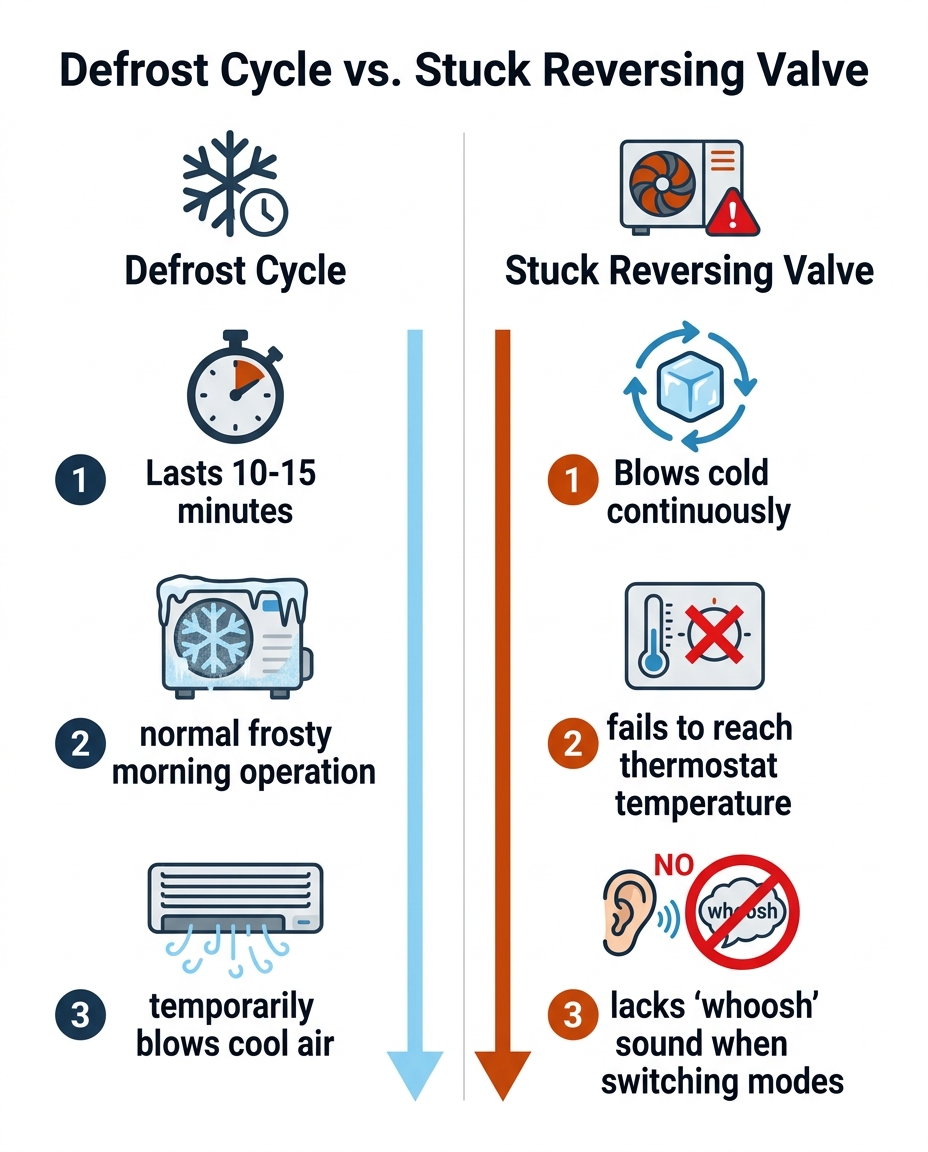
To protect itself and melt the ice, the heat pump's internal control board intentionally triggers a defrost cycle. To do this, it temporarily shifts the reversing valve back into cooling mode. This sends hot, pressurized refrigerant back out to the exterior coil, rapidly melting the accumulated ice. Because the system is technically in cooling mode during this brief window, it will blow cool air from your indoor vents. To prevent you from feeling this chill, most systems activate auxiliary heat strips, but you might still notice a drop in air temperature. The key difference between a normal defrost cycle and a catastrophic mechanical failure comes down to time and repetition.
• Duration of Cold Air — Normal Defrost Cycle: Temporary (usually 10 to 15 minutes max) — Stuck Reversing Valve: Continuous (never stops blowing cold air)
• Outdoor Unit Appearance — Normal Defrost Cycle: May be steaming as heavy frost melts away — Stuck Reversing Valve: No visible frost melting; normal fan operation
• Indoor Temperature — Normal Defrost Cycle: Maintains temperature or drops very slightly — Stuck Reversing Valve: Drops steadily as the home is actively air-conditioned
• System Recovery — Normal Defrost Cycle: Automatically returns to blowing hot air — Stuck Reversing Valve: Requires the system to be manually shut off

Top Signs Your Reversing Valve is Mechanically Seized
If you have waited past the 15-minute mark and your home is only getting colder, it is time to look for the definitive symptoms of a seized valve. Diagnosing a mechanical failure requires observing how the system behaves under pressure. Here are the top signs that your reversing valve is mechanically stuck and requires professional attention:
• Continuous active cooling: The most obvious sign is blowing cold air when the thermostat calls for heat, and this cold air does not stop after a brief defrost window. The air feels distinctly refrigerated, not just lukewarm.
• Absence of the pressure "whoosh" sound: When a heat pump successfully shifts from cooling to heating, the reversing valve slides, causing a sudden, audible equalization of pressurized refrigerant. This sounds like a distinct "whoosh" or "pssst" coming from the outdoor unit. If you stand near the unit while a helper turns on the heat at the thermostat, and you hear a click but no "whoosh," the internal slider has not moved.
• Sudden failure after seasonal transition: The system functioned perfectly in cooling mode all summer long without a single hiccup, but failed on the very first heating attempt of the fall. This pattern strongly points to a valve that has seized after months of remaining stationary.
• Continuous operation without satisfying the thermostat: Because the system is blowing cold air into a room that is already chilly, the indoor temperature will never reach your desired heating setpoint. As a result, the heat pump will run continuously, wasting massive amounts of electricity while making your home increasingly uncomfortable.
The Danger of DIY: Why You Shouldn't Try to Unstick the Valve
When homeowners realize their reversing valve is stuck, they often turn to the internet for quick fixes. One of the most common—and most dangerous—pieces of DIY advice you will find online is to take a hammer or the handle of a heavy wrench and physically tap on the brass body of the reversing valve to jar the slider loose. You must never attempt this. The reversing valve is a highly pressurized vessel containing chemical refrigerant. Striking the brass body can easily dent the metal. Even a microscopic dent will permanently trap the internal slider, guaranteeing that the entire valve must be cut out and replaced. Furthermore, striking pressurized refrigerant lines can cause a catastrophic rupture, leading to severe chemical burns and environmental hazards.
Accurately diagnosing whether the issue is a failed electrical solenoid or a mechanically seized valve body requires specialized electrical multimeters to test voltage and resistance safely. Because these systems operate under extreme pressure and require handling regulated refrigerants, the law requires a licensed professional to service them. Attempting DIY repairs on sealed mechanical components will also instantly void your manufacturer's warranty.
Another local Comfort Club member faced a highly complicated heat pump issue this past spring. Instead of attempting a risky DIY fix that could have caused further damage, they called for professional help. A technician quickly identified the complex mechanical fault, developed a safe repair plan, and had the system back online in a short amount of time. Scheduling a comprehensive heat pump tune-up before the extreme cold sets in is the safest way to ensure all internal components, including the reversing valve, are operating freely and safely in the Bend, OR and Central Oregon climate.
Frequently Asked Questions About Heat Pump Reversing Valves
Why is my heat pump blowing cold air on heat mode?
This usually indicates the system is either in a temporary defrost cycle, has a stuck reversing valve, or is experiencing a refrigerant leak. If the air stays cold for more than 15 minutes, it is likely a mechanical failure requiring professional attention. A system low on refrigerant will struggle to produce heat, but a system that actively feels like an air conditioner in the middle of fall is almost certainly suffering from a reversing valve that refuses to shift out of its summer position.
How do I know if my reversing valve is stuck?
The primary indicator is the system operating in the opposite mode of the thermostat setting. You may also notice the absence of the typical pressure-shifting "whoosh" noise from the outdoor unit when changing modes. If you set the thermostat to heat, the outdoor unit turns on, but the indoor vents blast chilled air continuously without ever warming up, the internal slide mechanism inside the valve is mechanically seized.
Is my heat pump in defrost mode or broken?
Defrost mode is a normal, temporary function that lasts 10 to 15 minutes to melt ice on the outdoor coil. If the system blows cold air continuously and your home's temperature continues to drop, the system is malfunctioning. You can usually confirm defrost mode by looking at the outdoor unit; if it is covered in frost that is actively melting and steaming, the cycle is normal. If the outdoor coil is completely clear and dry, yet the system blows cold air indoors indefinitely, it is broken.
Can a reversing valve be repaired, or must it be replaced?
If the electrical solenoid is the issue, that specific part can often be replaced on its own without opening the sealed refrigerant lines. However, if the internal mechanical valve body is seized, the entire reversing valve must be cut out and replaced by a licensed professional. This is a major repair that involves recovering the existing refrigerant, unbrazing the old valve, brazing in a new one under a nitrogen purge, pulling a deep vacuum, and recharging the system to exact factory specifications.
What happens when a reversing valve gets stuck?
The heat pump becomes locked into one operational mode (either heating or cooling), regardless of what the thermostat requests. This drastically impacts home comfort and forces the system to run continuously without ever satisfying the thermostat. If left running in this condition, it places immense strain on the compressor and can lead to heavily inflated utility bills as the system fights a losing battle against the outdoor temperatures.
Restore Your Home's Warmth with Expert Diagnostics
A stuck reversing valve is a definitive mechanical issue that simply cannot be resolved with a thermostat reset or a DIY internet hack. When your system is blowing cold air when the thermostat calls for heat, it requires professional tools to diagnose correctly. Whether the electrical solenoid has burned out after a long summer, or the internal brass slider has permanently seized, having clear diagnostic signs confirmed by a licensed technician provides immediate peace of mind.
When early fall September mornings bring sudden temperature drops to the High Desert, you need fast, reliable local diagnostic expertise from a team that understands the specific operational stress this climate puts on heat pumps. Do not let a malfunctioning valve leave your family shivering. Secure professional heat pump repair to safely evaluate the equipment, replace the faulty components, and efficiently restore your home's heating capacity before the deep winter freeze arrives. Knowing exactly how to tell if your heat pump reversing valve is stuck in cooling mode empowers you to act quickly, protect your equipment, and reclaim your comfort.