


The Late-Night Ramping Sound: Is Your System Failing?
Your heat pump is running nonstop, and the outdoor unit sounds like it is working harder than ever as the sun goes down. If you are wondering how dropping nighttime temperatures affect mini split efficiency, you are not alone—especially when you wake up in the middle of a chilly fall night to hear your system running continuously. That persistent humming and ramping up can easily trigger anxiety. You might worry that the constant operation means the equipment is broken, struggling to keep up, or quietly driving up your monthly utility bill.
Our team at Mountain View Heating fields countless calls about this exact concern during the September transition, when the weather shifts from warm afternoons to suddenly crisp evenings. The good news is that modern ductless systems are actually designed to behave exactly this way to maximize your indoor comfort and energy efficiency. By understanding how your equipment responds to the changing weather, you can stop worrying about every noise it makes. If you are looking to optimize your home's comfort, exploring professional heating services can ensure your system is perfectly calibrated for the season ahead.
The High Desert Thermal Load: Surviving 40-Degree Diurnal Swings
The unique challenge: To understand why your heat pump acts the way it does, we have to look at the environment it operates in. Central Oregon is known for its distinct climate, which places a very specific type of stress on residential heating and cooling equipment. The core issue is something meteorologists call "diurnal temperature variation"—the difference between a day's highest and lowest temperatures.
The rapid thermal shift: In many coastal or highly humid climates, temperatures drop gradually and stay relatively stable overnight. In our decades of keeping homes comfortable here in the Bend, OR high desert, we know firsthand that our atmosphere holds very little moisture to trap heat. As a result, we frequently experience a massive 40-degree day-to-night temperature swing during the early fall. You might enjoy a comfortable 75°F afternoon on the patio, only to see the thermometer plummet to a near-freezing 35°F by the early morning hours.
Understanding thermal load: As the outdoor temperature drops rapidly, your home begins losing heat to the outside air. The amount of heating required to replace that lost warmth and maintain your desired indoor temperature is called the "thermal load." Because our local temperature drops so fast, the thermal load on your house increases dramatically in a very short window of time.
This rapid shift is exactly what confuses new owners of ductless mini split systems. During deep winter, the cold is steady and predictable, so the system hums along at a consistent rate. But during the fall transition, we typically see the system having to actively chase a rapidly moving target, adjusting its output minute by minute to counter the sudden influx of cold air.
• High Desert Fall — Temperature Behavior: Rapid 40-degree drops at sunset — HVAC System Response: Dynamic ramping up to match sudden heat loss
• Steady Winter Cold — Temperature Behavior: Consistently freezing day and night — HVAC System Response: Steady, moderate-to-high sustained operation
• Coastal / Humid Fall — Temperature Behavior: Gradual, mild 15-degree overnight shifts — HVAC System Response: Minimal adjustments, occasional low-speed cycles
Inverter Compressors Explained: Why Continuous Running is Normal
To make sense of the late-night noises outside your bedroom window, our HVAC experts often tell customers they need to bypass the basic definitions and look at the mechanical heart of your system: the inverter-driven compressor. This technology is the primary reason why your equipment sounds and behaves differently than older heating systems.
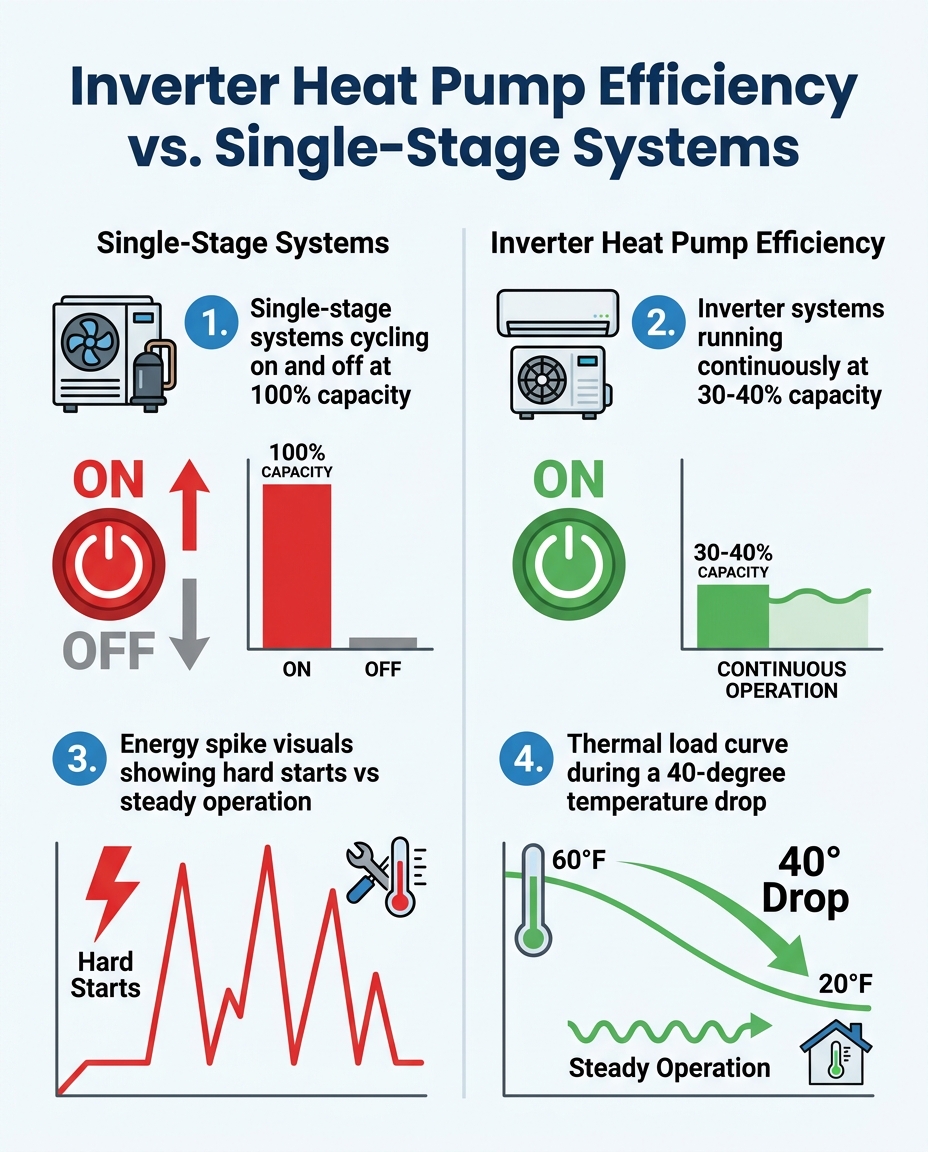
The old way vs. the new way: Traditional, single-stage heating systems operate like a light switch. They are either 100% on, blasting maximum heat into the room, or they are 100% off. When the house gets cold, they roar to life, overheat the space slightly, and shut down. This constant starting and stopping requires a massive surge of electricity each time.
Modern ductless units use an inverter compressor, which operates more like the accelerator pedal in your car. Instead of simply turning on and off, an inverter dynamically modulates its speed to match the exact thermal load of the house. When you hear that "ramping up" sound as the evening cools off in the Bend, OR high desert, you are hearing the compressor smoothly increasing its output to counter the dropping outdoor temperatures. If you are comparing central air and mini splits in the high desert, we always highlight this variable-speed capability as the defining difference in how they handle local weather.
• Dynamic modulation: The system continuously reads indoor and outdoor temperatures, adjusting its motor speed in tiny increments.
• Cruise control efficiency: Just like a car gets better gas mileage cruising at 60 MPH than it does in stop-and-go traffic, an inverter uses less power running steadily at a low speed.
• Temperature precision: By running constantly, the system eliminates the uncomfortable hot and cold swings associated with traditional furnaces.
The Coefficient of Performance (COP)
The efficiency of a heat pump is often measured by its Coefficient of Performance (COP). In simple terms, COP is the ratio of heat provided to the home versus the electrical energy consumed to produce that heat. Maintaining a steady, low-speed operation yields a significantly higher COP than forcing the system to perform frequent, energy-heavy "hard starts." When your system runs continuously at a low speed, it is extracting ambient heat from the outside air with incredible efficiency, stretching every unit of electricity as far as possible.

Do Mini Splits Use a Lot of Electricity When Running Constantly?
The fear of the constant hum: It is entirely logical to assume that a machine running for eight hours straight will cost more to operate than a machine that only runs for three hours. Because of this, we frequently encounter homeowners who mistakenly believe their constantly running heat pump is driving up their utility bills.
The reality of capacity modulation: The short answer is yes—mini splits use significantly less electricity, even when they run continuously. The secret lies in the energy penalty of hard starts. Turning a heavy mechanical system on requires a massive surge of amperage. Once an inverter system is running, it scales back its power draw dramatically. A system running at 30% capacity for eight hours uses far less total power than a single-stage system running at 100% capacity for just three hours.
When our region experiences a rapid 40-degree day-to-night temperature swing, we always warn our customers that aggressively turning your system off before bed and turning it back on in the morning is actually counterproductive. By morning, the walls, floors, and furniture will have lost their ambient heat. The system will then have to run at maximum capacity for hours to recover that lost thermal mass.
1. The "set it and forget it" rule: Leaving the thermostat at a steady temperature overnight allows the inverter to gently manage the declining outdoor temperatures.
2. Avoiding the recovery penalty: A system maintaining a temperature works far less hard than a system trying to raise a freezing room by ten degrees.
3. Optimized heat transfer: Running continuously at a low fan speed gives the refrigerant more time to extract heat from the outdoor air, maximizing the efficiency of the heat transfer process.
Normal Ramping Sounds vs. Real System Failures
While continuous operation is part of the design, it is still crucial to know the difference between the normal operational noises of an adjusting inverter and the warning signs of a genuine mechanical failure. As the September transition brings colder nights, your outdoor unit will naturally become more vocal, but there are distinct lines between healthy adjustments and cries for help.
What normal operation sounds like: When the outdoor temperature drops, you will likely hear a soft whoosh as the reversing valve shifts, followed by a gradual increase in fan speed. You may also notice a low, steady humming noise as the compressor ramps up to handle the increasing thermal load. These sounds are simply the system doing its job. Additionally, occasionally hearing a louder swoosh followed by a temporary pause in indoor heating means the unit has entered its normal defrost cycle to melt frost off the outdoor coils.
When to call a professional: Abnormal sounds are usually jarring and impossible to ignore. If you hear loud grinding, metal-on-metal screeching, or violent rattling, shut the system down. These are not normal ramping sounds; they indicate failing bearings, loose internal components, or a struggling motor. Sudden loss of heating power combined with severe noises requires immediate professional attention.
A pattern we see often is homeowners mistaking normal seasonal adjustments for mechanical issues. During a routine maintenance visit this early fall, one local homeowner had questions about these exact noises while having their equipment checked. Our maintenance tech, Kasey, walked them through the system, providing clear, easy-to-understand explanations about how their equipment operates as the weather changes. That kind of clarity is exactly what we aim for, ensuring homeowners feel confident in their equipment. Highlighting the importance of proactive seasonal care is why we highly recommend scheduling a heat pump tune-up as the best way to ensure your system is ready for the transition into the colder months.
• Low, steady hum increasing in pitch — Likely Cause: Inverter compressor ramping up — Required Action: None. Normal operation.
• Soft whoosh followed by temporary pause — Likely Cause: System entering defrost cycle — Required Action: None. Wait 10-15 minutes for heat to resume.
• Harsh grinding or screeching — Likely Cause: Failing motor bearings or fan issue — Required Action: Turn off system immediately and call for service.
• Violent rattling or clanking — Likely Cause: Loose internal components or debris — Required Action: Turn off system and schedule an inspection.
Frequently Asked Questions About Fall Mini Split Operation
Why does my mini split run all the time at night?
Your mini split runs continuously at night because it uses an inverter-driven compressor that adjusts its speed to match the exact cooling or heating needs of your home. Instead of turning on and off at full blast, it modulates down to a low, steady speed to maintain the temperature efficiently. This continuous circulation provides better comfort and actually uses less energy than older stop-and-go systems.
Should I turn off my mini split at night?
No, we recommend leaving your mini split on at night rather than turning it off completely. Turning the system off allows the home's walls and floors to lose their retained heat, forcing the system to work at maximum capacity the next morning to recover. Leaving it on allows the inverter technology to efficiently maintain a steady climate using minimal electricity.
What is the best temperature setting for a mini split at night?
The best approach is to find a comfortable temperature and leave it there, or use a very minor setback of no more than two to four degrees. Deep temperature setbacks (dropping the thermostat by ten degrees or more at night) force the heat pump to work incredibly hard the next morning. A steady setting allows the system to "cruise" efficiently through the night.
Do mini splits use less electricity than traditional heating?
Yes, mini splits use significantly less electricity than traditional electric resistance heating systems like baseboards or electric furnaces. Instead of burning fuel or using raw electricity to generate heat, a heat pump simply transfers existing ambient heat from the outside air into your home. This heat transfer process can provide up to three times more heat energy than the electrical energy it consumes.
Why does my heat pump make noise when it gets cold?
When outdoor temperatures drop near freezing, your heat pump will naturally ramp up its compressor speed to extract harder-to-find ambient heat, creating a louder hum. Additionally, the system will periodically enter a defrost cycle to melt frost accumulation off the outdoor coils. The swooshing sounds and fan changes associated with this cycle are completely normal protective functions.
Keep Your System Optimized for the High Desert Fall
At the end of the day, those late-night ramping sounds are proof that your equipment is working exactly as intended. Inverter compressors are brilliantly designed to handle the widening gap between indoor and outdoor temperatures, smoothly adjusting their speed to keep your home comfortable without wasting power. When you live in the Bend, OR high desert, continuous nighttime operation is the hallmark of an efficient, well-functioning system adapting to our unique environment.
Our team at Mountain View Heating has a deep understanding of local high desert climate challenges, and after years of working in Central Oregon homes, we know exactly how to optimize these advanced systems for extreme temperature swings. We want you to feel completely confident in your home's comfort as the seasons change. If you still have concerns about your system's performance, or if you simply want the peace of mind that comes from a professional inspection, scheduling a seasonal tune-up ensures your equipment is fully prepared for whatever the fall weather brings.