


Stop Losing Winter Warmth to Your Crawlspace
Your furnace is running non-stop, but the living room still feels drafty and cold. If this sounds familiar, assessing your home's duct insulation before the first freeze is one of the most critical steps our team recommends to protect your comfort and your equipment. Many homeowners assume that a chilly house means the furnace is failing, but the reality is often hidden right beneath their feet. The delivery network carrying that heated air is just as crucial as the heating unit itself. When your ductwork runs through unconditioned spaces like a crawlspace or an attic, those freezing environments actively steal the heat your furnace just worked so hard to generate.
Addressing this issue in the September pre-freeze window is essential. Once extreme weather sets in, the temperature differential between your heated air and the unconditioned space becomes severe, forcing your system to work overtime just to maintain a baseline temperature. Upgrading and maintaining air distribution systems ensures that the warmth you are paying for actually reaches your living spaces, rather than bleeding out into the dark corners of your home's foundation.
The Hidden Cost of Neglected Delivery Systems
Your heating system operates as a closed loop, and any vulnerability in that loop compromises the entire operation. Uninsulated or poorly insulated ductwork acts like a giant radiator in reverse, broadcasting your winter warmth to the dirt floor of your crawlspace. This not only leaves your family shivering but also drastically accelerates the wear and tear on your HVAC equipment as it struggles to satisfy the thermostat.
The Physics of Heat Loss in High Desert Climates
Understanding why unconditioned spaces are so detrimental requires a look at the extreme temperature differentials we experience. In our years of serving Central Oregon's high desert climate, we've seen firsthand how the rapid drop in temperature as the sun goes down creates a massive thermal challenge for your home's envelope. Bend's 3,623-foot elevation contributes directly to freezing winter nights, making unconditioned spaces particularly vulnerable to extreme heat loss. When the outside air drops below freezing, your crawlspace and attic temperatures plummet right along with it.
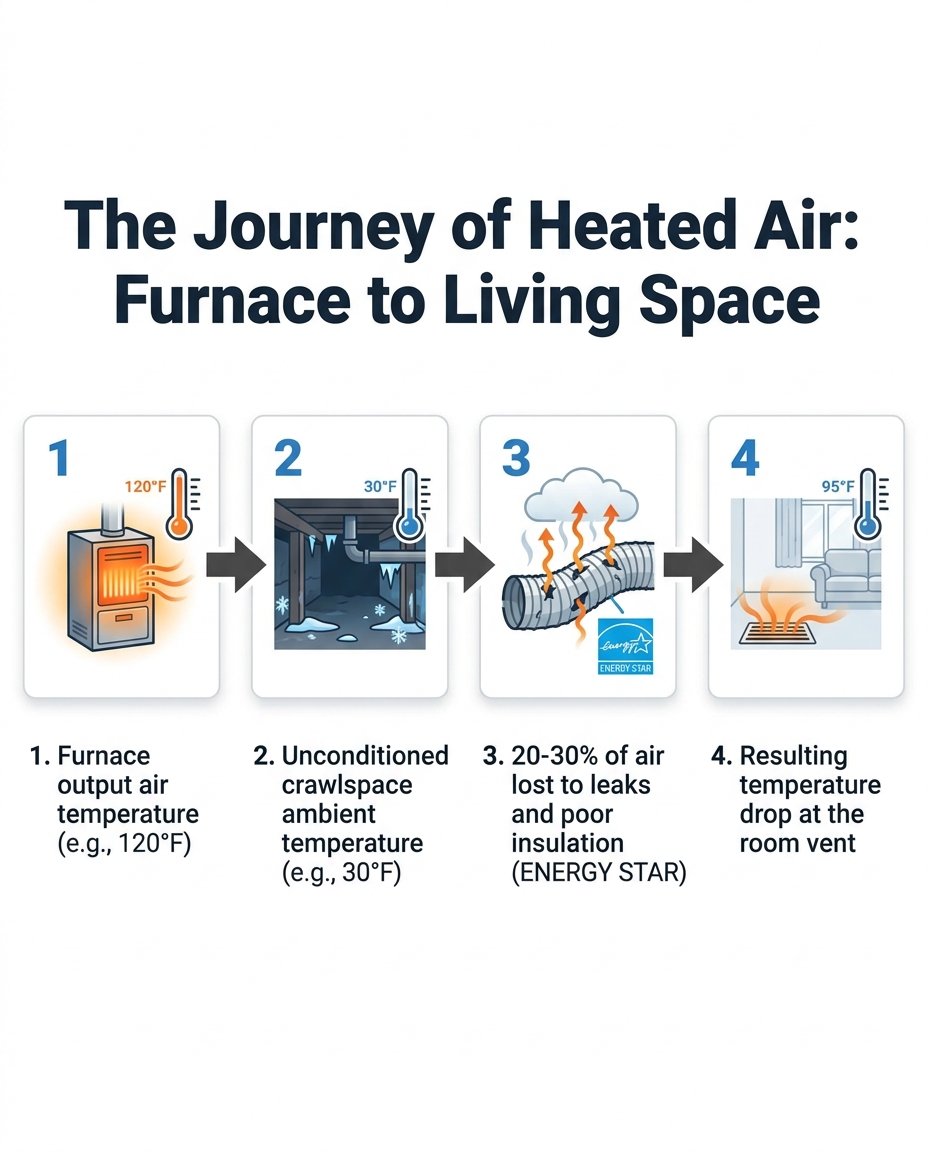
The thermal clash: Inside your heating ducts, the air leaving the furnace is typically around 120 degrees Fahrenheit. If those ducts are traveling through a crawlspace that is sitting at 30 degrees, you have a 90-degree temperature differential. Physics dictates that heat will aggressively move toward cold. Without proper insulation creating a thermal barrier, the thin sheet metal of your ductwork offers almost no resistance to this transfer.
According to ENERGY STAR data, 20 to 30 percent of the air moving through a typical residential duct system is lost to leaks, holes, and poor insulation. In older Bend homes with crawlspaces, our technicians frequently see this percentage climb even higher due to the extreme ambient cold. This massive thermal loss forces the HVAC system to run much longer cycles, burning more energy and putting unnecessary strain on the blower motor and heat exchanger.
• Conditioned Living Space — Typical Winter Temperature: 68°F - 72°F — Impact on Uninsulated Ductwork: Minimal heat loss; ducts are protected by the home's thermal envelope.
• Unconditioned Attic — Typical Winter Temperature: 10°F - 30°F — Impact on Uninsulated Ductwork: Severe heat loss; warm air rises and escapes rapidly through thin duct walls.
• Ventilated Crawlspace — Typical Winter Temperature: 20°F - 35°F — Impact on Uninsulated Ductwork: Extreme heat loss; acts as a massive heat sink pulling warmth from the floor and ducts.
Why High-Efficiency Furnaces Underperform in Older Properties
Investing in a top-tier, high-efficiency furnace is a smart move for winter comfort, but that investment is essentially wasted if the delivery system runs through freezing, uninsulated zones. Many homeowners upgrade their heating equipment expecting an immediate transformation in comfort, only to find that the back bedrooms are still freezing. The culprit is rarely the new furnace; it is the architectural reality of homes built before modern duct insulation standards were enforced.
Older properties often feature sprawling duct runs through drafty crawlspaces. Because these homes were constructed when energy was cheaper and building codes were less focused on thermal retention, the original ductwork is often bare metal or wrapped in woefully inadequate, deteriorating insulation. This is where our team's deep local expertise in servicing and retrofitting older Central Oregon homes becomes invaluable. Bringing these legacy systems up to modern standards requires a thorough understanding of how these specific structures breathe and lose heat.
During a recent annual fall furnace maintenance visit, a local homeowner scheduled a visit with our team at Mountain View Heating to look over their aging system. Our technician performed a thorough service, explaining the heating system clearly and maintaining it effectively. Part of that comprehensive approach involved looking beyond the furnace cabinet to see how the air was actually being delivered, highlighting how routine check-ups are the perfect time to evaluate the entire home envelope.
The Retrofit Advantage
Retrofitting insulation on existing ductwork unlocks the true potential of your existing heating equipment. When you eliminate the heat sink effect of the crawlspace, you gain several immediate benefits:
• Modern efficiency standards: Upgrading duct insulation brings older homes much closer to contemporary energy codes, maximizing the output of professional heating services and equipment upgrades.
• Reduced mechanical workload: By delivering hotter air to the rooms, the thermostat is satisfied faster, drastically reducing the run time and workload on aging or newly installed furnaces.
• Consistent ambient temperatures: Properly insulated delivery lines mean the air reaching the furthest bedroom is nearly as warm as the air reaching the living room directly above the unit.
The Warning Signs: Measuring the Temperature Drop
At Mountain View Heating, our HVAC technicians do not rely on guesswork to determine if your crawlspace is stealing your heat; we use concrete diagnostic indicators. The most definitive test for duct insulation failure is measuring the temperature drop between the furnace output and the room vent. By placing a digital thermometer at the supply plenum (where the air leaves the furnace) and taking another reading at the furthest supply register in the house, our team calculates exactly how much thermal energy is bleeding into the unconditioned space.
If the air leaving the furnace is 120 degrees, but the air arriving at your bedroom vent is only 95 degrees, that significant temperature drop indicates a total failure of the ductwork's insulation. The heat is being absorbed by the freezing crawlspace before it ever reaches you. Recognizing the warning signs early allows you to schedule heating maintenance in Bend before the system is pushed to its breaking point during a blizzard.
Key symptoms of duct heat loss:
• Lukewarm airflow: Feeling lukewarm or even cool air blowing from a vent while the furnace is actively running is a classic symptom of severe heat loss in the duct run.
• Uneven heating: Certain rooms taking significantly longer to heat up than others, especially those located furthest from the mechanical room.
• Constant cycling: The furnace runs almost continuously because the thermostat never quite reaches its set point.
• Cold floors: A freezing crawlspace pulling heat from uninsulated ducts often results in aggressively cold floors directly above those duct runs.

The Hidden Impact of Unconditioned Spaces on Air Quality
While the immediate concern with uninsulated ducts is thermal loss, there is a secondary, equally severe consequence: degraded indoor air quality. The integrity of your ductwork in a crawlspace directly impacts the air your family breathes. Poorly insulated ducts are almost always poorly sealed ducts. When the blower motor kicks on, it creates pressure dynamics that can pull unconditioned, contaminated air directly into the air stream.
The Problem: Infiltration and Condensation
In older Bend homes with crawlspaces, the environment beneath the floorboards is often dusty, damp, and filled with particulates. If the ductwork lacks proper insulation and sealing, the system acts like a vacuum, drawing in crawlspace air and distributing it throughout the living space. Furthermore, the extreme temperature differentials between the hot air inside the uninsulated ducts and the freezing air outside can lead to condensation forming on the metal surfaces.
The Cause: Moisture in the System
When warm, conditioned air hits freezing sheet metal, moisture drops out of the air. Over time, this condensation creates a damp environment inside and around the ductwork. Moisture in the duct system is the enemy of clean air, providing a breeding ground for biological growth, musty odors, and airborne contaminants that are then circulated directly into your bedrooms and living areas.
The Solution: Comprehensive Envelope Protection
Proper insulation serves as both an energy efficiency measure and a vital air quality safeguard. By creating a thermal break, insulation prevents condensation from forming. When paired with professional duct sealing, it ensures that the air passing through the system remains pure and uncontaminated by the crawlspace environment. Investing in comprehensive indoor air quality solutions starts with securing the very pathways that deliver air to your family.
Why DIY Duct Wrapping Falls Short
When homeowners realize their crawlspace is stealing their heat, the first instinct is often to head to the hardware store for a roll of foil-backed fiberglass. However, attempting to wrap ducts yourself is a process fraught with hidden pitfalls that can actually make the situation worse. Professional assessment and installation are necessary to protect the integrity of the HVAC system.
The danger of trapped moisture: Wrapping ducts requires specific materials and exact techniques to prevent moisture trapping. If a vapor barrier is installed incorrectly, or if gaps are left exposed, condensation can become trapped between the insulation and the metal duct. This hidden moisture rusts the ductwork from the outside in and destroys the insulative properties of the material.
The problem of compression: Insulation relies on trapped air pockets to provide an R-value (resistance to heat flow). Improperly installed insulation that is pulled too tight or compressed against floor joists loses its ability to prevent heat loss. Our professionals know exactly how to suspend and secure the material to maintain its full thermal resistance.
Furthermore, we can identify hidden leaks that must be sealed before any insulation is applied. Covering a leaky duct with fiberglass does not stop the air leak; it simply forces the conditioned air into the insulation itself. Accurately assessing the system requires specialized tools to measure the temperature drop between furnace output and room vent, test static pressure, and verify airflow—diagnostics that cannot be performed with a standard toolbox.
Securing Your System Before the Fall Freeze
Timing is everything when it comes to home performance. Early fall represents the final, most critical window for proactive home envelope and ductwork assessments. Once the heavy freezes arrive, diagnostic work becomes more difficult, and HVAC technicians are often booked solid with emergency no-heat calls.
One local homeowner learned the importance of proactive timing when their heating unit failed completely over a recent Labor Day weekend. The system, which was 23 years old, finally gave out just as the fall chill was setting in. We dispatched a technician on Saturday to diagnose the problem, provided space heaters to keep the family safe, and successfully replaced the entire unit by Wednesday. While the home was kept warm, the stressful situation highlights why getting ahead of the weather is so important.
Scheduling your assessments in the September pre-freeze window ensures that your system is running at peak efficiency precisely when it is needed most. Taking action now provides the ultimate peace of mind that comes from knowing your home is fully prepared for the shift to heating season.
1. Schedule a baseline assessment: Have a professional measure the temperature differentials across your duct system.
2. Seal before insulating: Ensure all joints, seams, and connections are professionally sealed with mastic to prevent air infiltration.
3. Apply proper R-value insulation: Have the correct thickness of insulation applied with a continuous vapor barrier to protect against the crawlspace climate.
4. Verify performance: Retest the airflow and temperature delivery to confirm the heat sink effect has been eliminated.
For more strategies on getting your property ready for the changing weather, preparing your home for the shift to heating season involves looking at the entire thermal envelope, from the attic down to the foundation.
Frequently Asked Questions About Duct Insulation
Should ductwork in a crawl space be insulated?
Yes, any ductwork running through an unconditioned space like a crawlspace or attic must be insulated. Without insulation, the extreme cold of the crawlspace will rapidly pull heat out of the metal ducts, forcing your furnace to work harder and delivering cooler air to your living spaces. Proper insulation creates a thermal barrier that keeps the heat inside the delivery system.
How much heat is lost through uninsulated ducts?
According to the Department of Energy and ENERGY STAR, homes can lose 20 to 30 percent of the air moving through the duct system due to leaks, holes, and poor insulation. In older Bend homes with crawlspaces, the extreme winter temperatures can push that thermal loss even higher, resulting in significantly longer furnace run times and compromised comfort.
How do you know if your ducts are poorly insulated?
The most noticeable sign is a significant temperature drop between the air leaving your furnace and the air coming out of your room vents. You might also notice that rooms furthest from the furnace are constantly cold, or that the air blowing from the registers feels lukewarm rather than hot. Cold floors directly above the duct runs are another strong indicator.
Does insulating ductwork make a difference in winter?
Absolutely. Insulating ductwork in unconditioned spaces makes a massive difference in winter comfort and system efficiency. By preventing the heat from escaping into the crawlspace, the furnace can satisfy the thermostat much faster, reducing mechanical wear and tear and ensuring that every room in the house reaches a comfortable temperature.
Can poorly insulated ducts affect my indoor air quality?
Yes, they can have a significant negative impact. Poorly insulated ducts are prone to condensation when hot air travels through freezing environments, which can lead to moisture buildup and biological growth inside the system. Additionally, ducts lacking proper insulation are often poorly sealed, allowing dusty, contaminated crawlspace air to be sucked into the system and blown into your home.
Schedule Your Early Fall Ductwork Evaluation
There is a profound sense of satisfaction in knowing that the heat your furnace generates is actually making it into your living room, rather than being wasted in a dark crawlspace. If your home struggled to stay warm last winter, or if you suspect your ductwork is exposed to the elements, now is the time to act. Talk to our experts at Mountain View Heating about the specific architectural needs of your property, and schedule a professional evaluation in this crucial September pre-freeze window to ensure your home is sealed, secure, and ready for winter.