

The September Freeze: When Idle Furnaces Face Their First Test
September in the high desert is only weeks away, and your heating system has likely been sitting completely idle since spring. Before the first freeze hits, you need to understand the hidden dangers of delaying fall heating maintenance on older furnaces. Turning on an aging system that has sat dormant all summer without a proper inspection introduces invisible, potentially severe safety risks into your home. The transition to early fall brings sudden, freezing morning temperatures that demand immediate, heavy heat from equipment that hasn't moved in months.
As a homeowner, you face a critical decision right now: schedule a proactive safety verification while the weather is still mild, or wait until the system is forced to run continuously during a deep freeze. At Mountain View Heating, our technicians have spent years preparing Central Oregon homes for this exact seasonal shift. We know that true peace of mind comes from knowing your equipment is structurally sound before you actually need it. If you want to ensure your home is ready for the temperature drop, exploring professional heating services is the smartest first step you can take.
Understanding Metal Fatigue in Aging Heat Exchangers
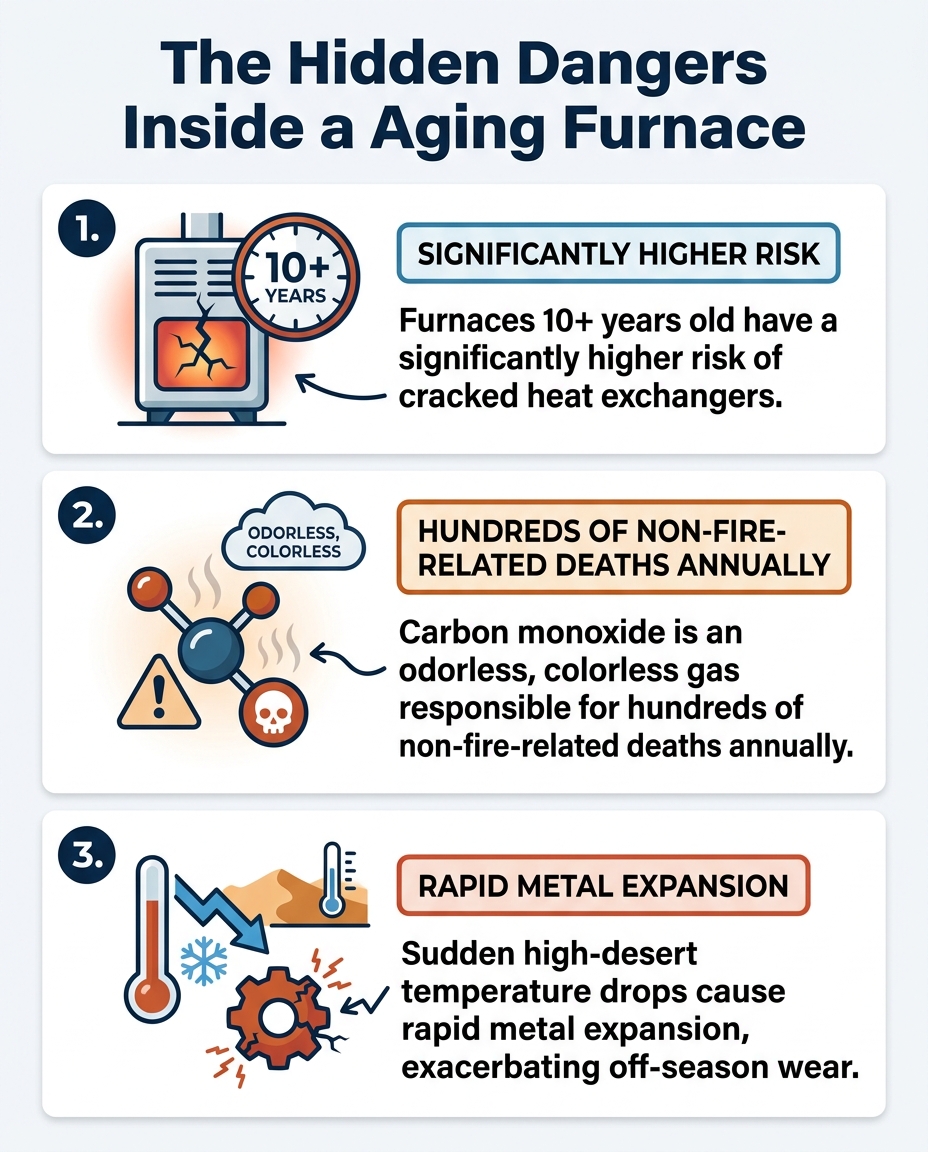
The Problem: The most critical component inside your gas furnace is the heat exchanger. This metal chamber acts as the absolute barrier separating the breathable air circulating through your home from the toxic combustion gases created by burning fuel. When this barrier is compromised, your home is no longer safe. The primary issue is that over a decade of use, the constant, daily cycle of heating up and cooling down causes severe metal fatigue in older gas furnaces (10+ years old).
The Cause: Metal naturally expands when it gets hot and contracts when it cools. Over thousands of cycles, the metal walls of the heat exchanger lose their elasticity. When an idle, cold furnace is suddenly pushed hard during the first cold snap of the season, the rapid thermal expansion creates immense stress. This sudden shock can cause weakened, fatigued metal to finally crack or split. What makes this so dangerous is that these hairline fractures are often entirely invisible to the naked eye and can develop or worsen while the unit is completely powered down over the summer months.
The Solution: You cannot prevent metal from aging, but you can monitor its structural integrity. Understanding the difference between summer dormancy and sudden fall demand highlights why these cracks happen exactly when you turn the system on for the first time.
• Summer Dormancy — Component Condition: Metal is cold, contracted, and brittle. Micro-fissures may have formed during the previous winter's final cycles. — Risk Level: Low (System is off)
• First Fall Startup — Component Condition: Burners ignite, sending sudden extreme heat against cold metal, forcing rapid and violent expansion. — Risk Level: High (Cracks open up)
• Continuous Winter Use — Component Condition: Metal remains expanded. If cracks exist, they widen as the blower fan pushes air across the compromised chamber. — Risk Level: Severe (Gas mixing)
Because these cracks open up as the metal heats and expands, a visual glance at a cold furnace will almost never reveal the danger. It requires professional evaluation to ensure the metal can still safely handle the stress of combustion.
The Silent Threat of Carbon Monoxide Leaks
When a heat exchanger cracks, the immediate threat to your household is carbon monoxide (CO) exposure. This is the primary safety danger associated with older gas furnaces (10+ years old), and it is entirely invisible. Carbon monoxide is completely odorless, colorless, and tasteless, making it impossible to detect without specialized equipment or dedicated, functioning home alarms.
A compromised heat exchanger allows toxic combustion gases to escape the exhaust flue and mix directly into the clean airflow that is being distributed through your vents into your bedrooms and living spaces. According to the Centers for Disease Control and Prevention (CDC), carbon monoxide poisoning is a leading cause of non-fire-related incidents during the heating season. Because the symptoms of mild CO exposure—headaches, dizziness, and nausea—often mimic the early fall flu, families frequently fail to realize their heating system is the culprit.
It is important to note that when you turn on your furnace for the first time in autumn, you will likely smell a distinct burning odor. This is usually just settled dust burning off the heat exchanger walls. However, distinguishing between normal dust burning off and actual hazardous gas issues requires professional diagnostic tools. If you are ever in doubt about the odors coming from your vents, diagnosing furnace gas smells quickly is vital for your safety.
Key facts about carbon monoxide risks in aging furnaces:
• It builds up gradually: A hairline crack might only leak a small amount of CO initially, but as the furnace runs longer on colder nights, the concentration in your home increases.
• It bypasses standard filters: No standard air filter can catch or neutralize carbon monoxide gas.
• It requires active drafting: If a crack alters the pressure inside the combustion chamber, the system may fail to draft exhaust gases up the flue, spilling them into your basement or utility closet instead.

How High-Desert Climates Accelerate System Wear
Regional weather patterns dictate exactly how hard a heating system has to work and how quickly its internal components degrade. In our decades of serving Bend, Oregon, the Mountain View Heating team has seen firsthand how our high-desert climate places a highly specific, intense strain on HVAC equipment. We do not experience a slow, gentle glide into winter. Instead, we face rapid daily temperature swings where the afternoons might still feel comfortably warm, but average September early-fall temperature drops in the high desert frequently push overnight lows down into the 30s.
This extreme cyclical demand accelerates thermal stress on internal components. Your furnace might sit completely idle from noon until sunset, allowing the metal to cool and contract completely. Then, at 2:00 AM, the thermostat calls for heat, and the system is forced to fire up and run at maximum capacity to fight off the freezing outdoor air. This rapid transition from cold-dormant to high-fire creates a shock to the system that steady, persistently cold climates do not experience to the same degree.
Preparing a system for this specific type of high-desert climate requires much more than a standard filter change. The constant expanding and contracting of the heat exchanger, the strain on the blower motor pushing dense cold air, and the electrical load on the ignition system all compound over time. When an older unit is subjected to these violent temperature swings year after year, the margin for error shrinks dramatically. Ensuring your equipment can handle these specific regional demands is a core part of pre-season preparation.
Why 'It Ran Fine Last Year' is a Dangerous Assumption
One common pattern our technicians at Mountain View Heating see every fall is homeowners assuming that because a furnace kept the house warm in March, it is perfectly safe to turn on in September. A furnace's condition at the end of spring does not guarantee its safety at the beginning of fall. Months of total inactivity create an entirely new set of challenges for older gas furnaces (10+ years old).
When you skip proactive heating maintenance, you are gambling that nothing has degraded during the off-season. Here is exactly what happens to an idle furnace over the summer months:
1. Debris Accumulation: Dust, pet dander, and airborne particulates settle heavily on the burners, flame sensor, and ignition assembly. When the system fires up, this debris can cause delayed ignition—a dangerous mini-explosion of gas inside the chamber.
2. Electrical Degradation: During the months of inactivity, the subtle vibrations from your air conditioning system (if they share an air handler) or simply the passage of time can cause electrical connections to loosen, increasing the risk of shorts or electrical fires.
3. Component Seizing: Dormant metal parts, bearings, and blower motor components can lose their lubrication and seize up. Forcing a seized motor to run can cause it to burn out entirely within minutes of startup.
4. Pest Intrusion: Spiders and small insects frequently build webs inside the narrow burner tubes over the summer. This restricts gas flow, causing the flames to burn unevenly or roll out of the cabinet, creating a severe fire hazard.
Turning on an uninspected system risks triggering any of these hidden issues. Consistent, professional upkeep is the absolute only way to establish a baseline of safety for aging equipment. Assuming it is safe simply because it hasn't been used is a critical mistake.
What a Meticulous Safety Inspection Actually Entails
A true safety verification involves specialized diagnostic equipment, not just a visual once-over with a flashlight. Our meticulous, professional safety inspections are designed specifically to catch invisible carbon monoxide risks in aging equipment and provide true peace of mind. For example, one of our Bend customers who has relied on Mountain View Heating for ongoing maintenance since 2007 recently experienced a service hiccup after a long-term technician retired. Our team's quick, meticulous response resolved the issue immediately, ensuring their older equipment continued to operate safely without missing a beat. That level of dedicated, ongoing attention is what a proper safety verification is all about.
Professionals do not guess when it comes to your family's safety. They rely on hard data and advanced tools. Clear, easy-to-understand explanations of your older gas furnace's (10+ years old) health empower you to make informed decisions without feeling pressured into unnecessary replacements. Here is a look at what happens during a comprehensive evaluation.
Combustion and Airflow Analysis
This phase focuses strictly on how safely the fuel is burning. Technicians use digital combustion analyzers to measure the exact makeup of the exhaust gases. By measuring gas pressure and flame characteristics, they can ensure the fuel is burning cleanly and efficiently, without producing excess carbon monoxide. They also test the draft pressure, ensuring proper drafting so exhaust gases vent safely outdoors through the flue rather than spilling backward into your home's air supply.
Electrical and Mechanical Verification
The mechanical integrity of the system is just as crucial. Technicians use specialized infrared cameras to inspect the entirety of the heat exchanger for microscopic stress fractures that the naked eye cannot see. They also focus heavily on testing safety limit switches that prevent overheating. These switches are your last line of defense; if the furnace gets too hot, the limit switch shuts off the gas. Finally, they secure all electrical connections to prevent off-season corrosion issues from causing a sudden short circuit during a freezing night.
The Domino Effect of Sudden Fall Breakdowns
The Problem: Delaying a safety check often results in a complete system failure during the absolute most inconvenient times. When you wait for a breakdown to prompt a service call, you lose all control over the timeline. September early-fall temperature drops in the high desert wait for no one, and sudden freezes often align with busy holiday weekends when emergency service is hardest to secure.
The Cause: When an aging unit fails suddenly, it is usually because a compromised component—like a weakened blower motor or a failing ignition module—was pushed past its breaking point during a cold snap. Without a pre-season tune-up to catch the weakened part, the system operates under extreme stress until it snaps. One of our local Mountain View Heating customers found this out the hard way when their heating unit failed completely over the Labor Day weekend right as temperatures began to drop. We dispatched a technician on Saturday to diagnose the problem and provide space heaters, keeping the home warm until the aging unit could be fully replaced by Wednesday.
The Solution: Proactive scheduling ensures issues are diagnosed and resolved on your timeline, not during a freezing emergency. A failing older unit may require complete replacement if critical safety components like the heat exchanger are compromised. Finding this out in September gives you weeks to weigh your options, secure financing if needed, and schedule an installation. Finding out in late October leaves you scrambling. By scheduling a furnace repair or tune-up early, you break the domino effect before it starts, ensuring your home remains safe and warm when the weather turns.
Prioritizing Peace of Mind Before Winter Arrives
Ultimately, aging heating systems carry hidden risks that only professional diagnostics can uncover. While we all appreciate lower energy bills and efficient operation, verifying the structural integrity of the heat exchanger is a non-negotiable safety step before the cold weather sets in. The transition from summer to fall is the perfect window to ensure your older gas furnaces (10+ years old) are structurally sound and free of invisible carbon monoxide risks.
If you are unsure about the health of your older system, a professional can help evaluate its safety and give you a clear understanding of where it stands. Do not wait for the first freezing morning to test your equipment. Secure your household's safety and schedule a comprehensive furnace tune-up today to catch invisible hazards before they become winter emergencies.
Frequently Asked Questions
Can an old furnace leak carbon monoxide?
Yes, an older furnace can absolutely leak carbon monoxide into your home. Over years of use, the constant heating and cooling cycles can cause the metal heat exchanger to develop hairline cracks. When these cracks open up during operation, toxic combustion gases can escape the exhaust chamber and mix with the breathable air circulating through your vents.
What are the signs of a cracked heat exchanger?
The most definitive signs of a cracked heat exchanger require professional tools to detect, but there are a few visual clues you might notice. You may see soot buildup inside the furnace cabinet, notice a strong, persistent formaldehyde-like odor, or observe the burner flames burning yellow or dancing erratically instead of burning a steady blue. However, because many cracks are invisible and carbon monoxide is odorless, relying solely on visual signs is highly dangerous.
Why do old furnaces need annual maintenance?
Old furnaces need annual maintenance primarily to verify their safety, not just to improve efficiency. As components age, the risk of electrical shorts, seized motors, and cracked heat exchangers rises significantly. An annual inspection ensures that all safety limit switches are functioning and that no dangerous wear and tear has developed while the system sat idle over the summer.
What happens if you don't service your furnace before fall?
If you don't service your furnace before fall, you risk turning on a system that has accumulated dust, loose connections, or structural damage over the off-season. This can lead to delayed ignition, sudden breakdowns during the first cold snap, or worse, the silent circulation of carbon monoxide gas. Skipping service leaves you entirely blind to the actual condition of your heating equipment.
How often should a 10-year-old furnace be inspected for safety?
A furnace that is 10 years old or older must be inspected for safety at least once every single year, ideally in the early fall before the heating season begins. At this age, the metal components have endured thousands of thermal cycles, making them highly susceptible to fatigue and cracking. Annual professional diagnostics are the only way to ensure the system remains safe to operate through the winter.