


Why Does My Furnace Smell Like Gas on the First Chilly Morning?
Are you suddenly diagnosing a furnace that smells like gas vs normal startup odors on the first chilly night of the season? If you just turned on your thermostat for the very first time this fall and immediately noticed a harsh, alarming scent filling your hallways, your first reaction is probably panic. At Mountain View Heating, Inc., our team fields a sudden spike in calls for "furnace smells like gas" every single year during the September first cold snap, as homeowners across Bend and Central Oregon fire up their dormant systems and wonder if their family is in danger.
This is a critical decision point. You need to determine immediately whether you are dealing with a highly dangerous natural gas leak that requires emergency evacuation, or if you are simply experiencing the completely harmless seasonal burn-off of accumulated summer dust. While a true gas leak is a severe hazard, a large percentage of early-fall furnace odors are completely normal and pose no threat to your home.
The key to keeping your family safe is knowing exactly what to smell for, how to react, and when to call for backup. For any professional heating services, safety must always be the primary concern. By understanding the distinct differences between a harmless dusty odor and a true chemical warning sign, you can confidently navigate that first chilly morning without unnecessary panic.
The Immediate Triage: What to Do Right Now
When you are staring at your heating system and wondering if your home is safe, you do not have time to read a textbook. You need an immediate, clear decision tree to protect your household. In our decades of providing heating services across Central Oregon, our safety-first approach dictates that you should never attempt to troubleshoot a suspected fuel leak on your own. If you suspect raw fuel is escaping, your only job is to leave.
Use this immediate triage checklist to determine your next steps:
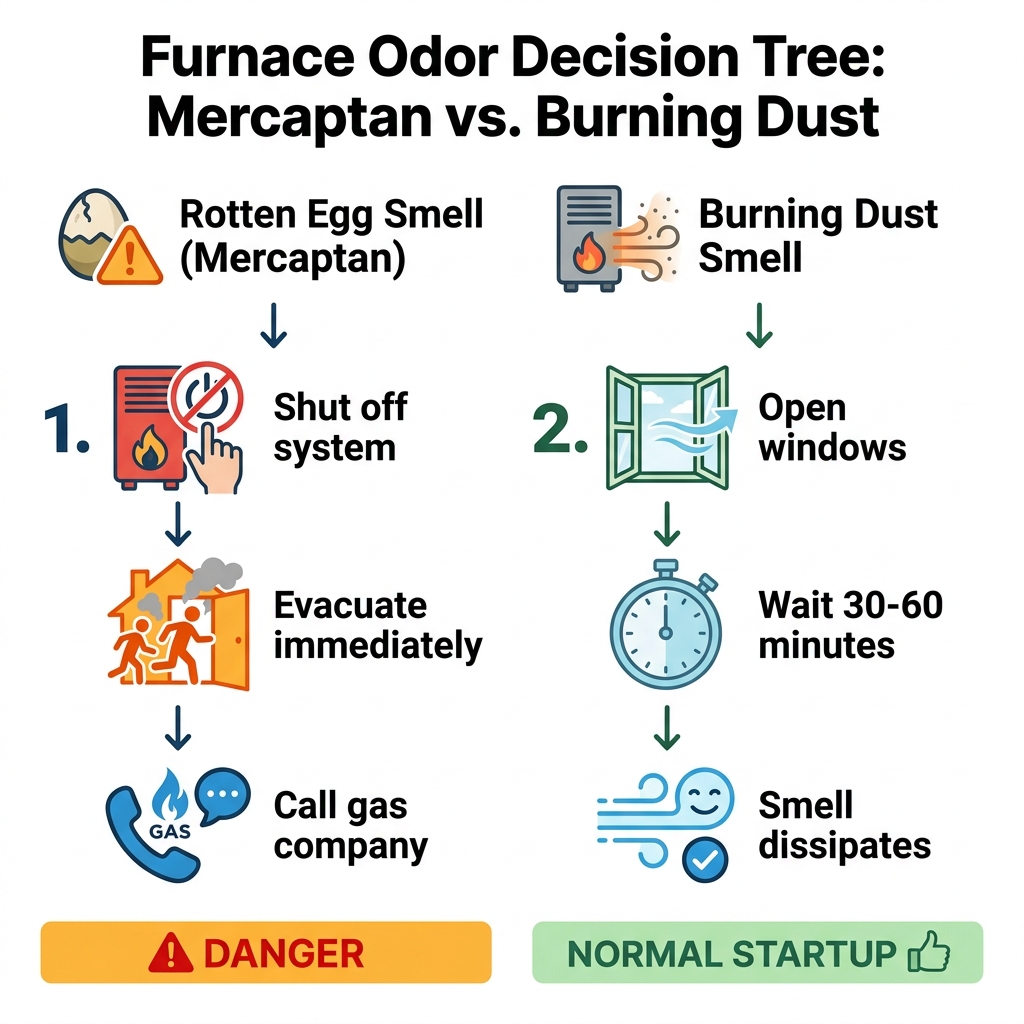
• If you smell "rotten eggs" or sulfur: This is the signature scent of Mercaptan, the additive put into natural gas. Shut off your heating system at the thermostat immediately. Do not flip any other electrical switches, do not unplug anything, and do not use a lighter. Evacuate your home immediately, leaving the doors open behind you. Once you are a safe distance away, call your local gas utility company's emergency line.
• If you smell burning hair or dusty smoke: This is the classic signature of summer dust burning off the heat exchanger. Open a few windows to ventilate the house and let the system run. Monitor the scent—it should begin to fade within 30 to 60 minutes.
• If you smell melting plastic or electrical burning: Shut the system down at the thermostat immediately. This indicates an overheating blower motor or melting wire insulation. You will need a professional evaluation before turning it back on.
Homeowners should never attempt to diagnose, tighten valves, or repair a suspected natural gas line leak themselves. Combustible fuels require specialized tools, pressure testing equipment, and strict licensing to handle safely. If your triage points to a mechanical failure rather than a gas leak, scheduling professional furnace repair in Bend ensures the underlying issue is resolved without putting your property at risk.

Understanding the 'Rotten Egg' Smell: Mercaptan and Gas Leaks
To truly understand why a gas leak smells the way it does, it helps to know a bit about the fuel itself. In its natural state, natural gas is completely odorless, colorless, and tasteless. If a pipe were to leak raw natural gas into your basement, you would never know it was there until it reached dangerous, highly combustible concentrations.
The Role of Mercaptan
Because undetected gas is so dangerous, utility companies inject a harmless but highly pungent chemical compound called mercaptan (specifically methanethiol) into the gas supply before it reaches your neighborhood. Mercaptan contains sulfur, which is why it so closely mimics the smell of rotten eggs, skunk spray, or decaying organic matter. The human nose is incredibly sensitive to sulfur compounds, allowing us to detect mercaptan even when it is present in microscopic amounts.
If you notice this rotten egg smell, and it seems strongest near your floor vents or directly next to the furnace cabinet in your utility room, you must treat it as an active fuel leak. The protocol is strict and unforgiving: no open flames, no adjusting the thermostat (other than turning it off if you are already standing right there), and absolutely no flipping light switches, as a tiny electrical arc behind the switch plate can ignite the gas.
Professional Diagnostics and Safety
In our experience serving Bend, gas issues sometimes present themselves subtly during other types of service. During a routine early-fall preparation visit, one of our local homeowners asked a Mountain View Heating technician to check their system and mentioned a faint, lingering gas issue near their furnace. Our technician identified the source of the gas issue immediately, repaired the furnace, and prepped the system for the heating season—providing clear explanations every step of the way without compromising safety. This highlights why having a trained professional look at your system is so critical; our team carries the electronic sniffers and pressure gauges required to find micro-leaks that the human nose might barely register.
The 'Burning Dust' Smell: A Normal Early Fall Occurrence
If you do not smell rotten eggs, but rather a dry, smoky, or dusty odor, you are likely experiencing the most common and harmless heating event of the year: the early fall burn-off.
The Mechanics of the Burn-Off
Your heating system sits completely dormant for months at a time. Throughout the spring and summer, your blower motor circulates air through the ductwork to keep your house cool. Even with a high-quality air filter in place, microscopic particles of dust, pet dander, lint, and airborne debris inevitably slip through and settle on the internal components of your HVAC system.
The primary resting place for this debris is the heat exchanger—the large metal chamber inside your furnace that gets incredibly hot to warm the air passing over it. As local HVAC experts, we know firsthand that Bend's dry, dusty high-desert summer conditions mean more particulate matter naturally circulates in the ambient air, which leads to heavier dust accumulation on dormant furnace components compared to other, more humid climates.
What to Expect During the First Cycle
When the September cold snap hits and your thermostat finally calls for heat, the burners ignite and the heat exchanger rapidly climbs to hundreds of degrees. All of that settled high-desert dust is instantly incinerated. This flash-burning creates a distinct, sometimes smoky smell that gets pushed through your ductwork and into every room of your house.
How to handle the burning dust smell:
1. Do not panic: Recognize the smell for what it is—a sign that your heat exchanger is doing its job and getting hot.
2. Ventilate the space: Open a few windows on opposite sides of the house to create a cross-breeze.
3. Monitor the time: The smell should peak within the first 10 minutes and completely dissipate within 30 to 60 minutes.
4. Check your filter: Ensure your air filter is clean so the system gets proper airflow.
If you want to understand more about this specific seasonal phenomenon, reading about why your furnace smells like burning dust on the first fall morning can provide extra peace of mind.
Carbon Monoxide: The Odorless Threat You Can't Smell
One of the most dangerous misconceptions in home heating is the confusion between smelling a gas leak and experiencing carbon monoxide (CO) exposure. Because both involve the furnace and both are dangerous, homeowners frequently combine them in their minds. However, they are entirely different threats requiring different safety measures.
The Invisible Danger
Unlike natural gas, which is laced with foul-smelling mercaptan, carbon monoxide is completely odorless, tasteless, and invisible. It is a natural byproduct of combustion. When your furnace burns fuel properly, the carbon monoxide is safely vented out of your home through the exhaust flue. However, if the heat exchanger cracks, or if the exhaust flue becomes blocked by a bird's nest or heavy snow, that carbon monoxide can spill backward into your living space.
You cannot smell carbon monoxide. If you smell gas, you are smelling raw fuel. If you are breathing carbon monoxide, you will not smell anything at all until physical symptoms begin to manifest.
Symptoms and Prevention
Because you cannot rely on your nose to detect CO, you must rely on technology. Functional carbon monoxide detectors are an absolute necessity in any home with gas appliances. They should be installed outside every sleeping area and on every level of the home, including the basement near the utility room.
Physical symptoms of CO exposure include:
• Dull, persistent headaches
• Dizziness or lightheadedness
• Nausea or vomiting
• Shortness of breath
• Confusion or blurred vision
If your CO alarm sounds, or if multiple family members suddenly experience these symptoms while the heat is running, evacuate immediately and call emergency services. Our team strongly advocates that the best way to prevent CO leaks from happening in the first place is through routine heating maintenance, where a technician specifically tests the heat exchanger for structural integrity.
Other Concerning Furnace Odors to Watch Out For
While mercaptan and burning dust are the two most common smells you will encounter, they are not the only odors a struggling HVAC system can produce. Providing a safe home means knowing how to identify other warning signs that something is mechanically wrong with your equipment.
Musty or Damp Smells (The "Dirty Sock" Syndrome)
If your vents smell like a damp basement, a wet dog, or a locker room, you are likely dealing with microbial growth. This usually points to mold or mildew thriving in your ductwork, on the evaporator coil, or inside a clogged condensate drain pan. While not an immediate emergency like a gas leak, circulating mold spores can severely impact your indoor air quality and trigger asthma or allergies. This usually requires a professional cleaning of the internal components and ductwork.
Electrical or Burning Plastic Smells
An odor that resembles melting plastic, burning rubber, or an overheated electrical outlet is a serious mechanical warning. This typically indicates that the blower motor is overheating, a capacitor is failing, or wire insulation is melting due to a short circuit. Continuing to run a system that smells like burning plastic risks a severe electrical fire.
Exhaust or Metallic Smells
If your home smells like the exhaust pipe of a running car, or has a harsh, metallic tang, your furnace is not venting properly. This could indicate a cracked heat exchanger or a disconnected flue pipe, meaning combustion gases (including carbon monoxide) are entering your breathable air.
• Rotten Eggs (Sulfur) — Likely Cause: Natural gas leak (Mercaptan) — Urgency Level: Critical — Action Required: Evacuate immediately, call gas company
• Burning Dust / Hair — Likely Cause: Settled summer dust burning off — Urgency Level: Low — Action Required: Wait 30-60 min, ventilate the home
• Electrical / Melting Plastic — Likely Cause: Overheating motor, wiring issue — Urgency Level: High — Action Required: Shut down at thermostat, call a professional
• Musty / Damp / Wet Dog — Likely Cause: Mold in ducts, clogged drain — Urgency Level: Moderate — Action Required: Schedule system and duct cleaning
When to Shut Down the System
Any smell resembling melting plastic, electrical burning, or car exhaust warrants an immediate shutdown at the thermostat. Do not wait to see if the smell goes away. Contact a licensed technician for rapid professional diagnostics before attempting to restart the equipment.
How Professional Maintenance Prevents Startup Odors
The best way to handle the anxiety of a first-startup odor is to prevent it from happening entirely. Transitioning from reactive troubleshooting to proactive care ensures your equipment runs safely and smoothly all winter long. Scheduling a comprehensive inspection before the first major cold snap allows a licensed professional to address potential hazards before they become late-night emergencies.
A professional tune-up prevents odors by:
1. Cleaning the Heat Exchanger: A technician will carefully clean the accumulated summer dust off the internal components, vastly reducing or completely eliminating that initial burning smell when you first turn the system on.
2. Testing Gas Valves: Professionals use specialized equipment to check all gas connections, valves, and the burner assembly for micro-leaks, ensuring no raw fuel is escaping into your utility room.
3. Checking Electrical Connections: Tightening loose wires and testing the amp draw on the blower motor prevents the melting plastic and electrical burning smells associated with failing components.
4. Verifying Proper Venting: Inspecting the flue pipe and testing for carbon monoxide guarantees that all combustion exhaust is safely routed outside your home.
At Mountain View Heating, we believe reliable service builds lasting peace of mind. One of our long-term customers, who has relied on our ongoing maintenance since 2007, recently experienced a minor service hiccup after their usual, long-term technician retired. Our team acted quickly to resolve the issue to the customer's complete satisfaction, proving that consistent, high-quality furnace tune up service remains our standard, no matter what. Knowing your system has been professionally inspected by our certified technicians and cleared for safe winter operation removes the anxiety from that first chilly morning.
Frequently Asked Questions About Furnace Smells
Why does my furnace smell like gas when it turns on?
A very brief, faint whiff of gas can sometimes happen for just a second during the initial ignition sequence before the burner fully lights. However, a persistent "rotten egg" smell that lingers or grows stronger indicates a dangerous leak and requires immediate evacuation and a call to your gas utility provider.
Is it normal for a furnace to smell like gas?
No, it is never normal for your home to smell like raw natural gas. While a burning dust smell is a completely normal part of the seasonal startup, a distinct mercaptan (sulfur) smell is an intentional warning sign designed by utility companies to alert you to a hazardous fuel leak.
What to do if furnace smells like gas?
If you detect a distinct rotten egg odor, evacuate the home immediately, leaving the doors open behind you. Do not use any electronics, do not flip light switches, and do not attempt to find the leak yourself. Call your gas utility provider's emergency line from a safe location outside.
How long does the burning smell last when turning on the heater?
The normal burning dust smell should peak within the first few minutes of operation and completely dissipate within 30 to 60 minutes of the first heating cycle. If the smell lasts longer than an hour, or if it smells like electrical plastic rather than dust, shut the system down and call a professional.
Can a dirty air filter cause a burning smell?
Yes, a severely clogged air filter restricts airflow, which forces the blower motor to work significantly harder than intended. This strain can cause the motor to overheat, producing a harsh electrical burning smell that requires an immediate system shutdown and a filter replacement.
Ensure Your Family's Safety This Heating Season
Navigating the first cold snap of the year shouldn't fill your household with anxiety. While early fall dust odors are a completely normal part of owning a heating system, you should never ignore a true gas smell. Trusting your nose and following strict safety protocols can protect your property and your loved ones from serious harm.
If you suspect any mechanical or safety issues beyond the normal 60-minute dust burn-off, rapid professional diagnostics are your best defense. At Mountain View Heating, Inc., we are committed to providing safety-first peace of mind for Central Oregon homeowners. Ensure your family's comfort and safety this fall by scheduling a thorough inspection and tune-up with our team, so you can enjoy the warmth with absolute confidence.