



The Myth of the Quick Cooling Fix
Buying a heavy, noisy appliance to fix one hot bedroom seems like a smart hack, but it actually forces your main system to work harder. In our years of servicing Central Oregon, our team at Mountain View Heating often sees homeowners ignore the hidden costs of buying a window unit to supplement a struggling central AC, thinking it will save time and hassle. Instead of solving the root cause of the heat, this approach creates a cycle of massive energy waste and delayed maintenance.
Before you rely on a temporary fix, our technicians strongly recommend having your central air conditioning evaluated, or exploring a permanent ductless mini-split installation to truly resolve the issue.
As we transition into the back-to-school season during August late-summer heatwaves, the temptation to grab a quick spot-cooling device from the local hardware store is incredibly high. When the upstairs office or the master bedroom feels like an oven, a fast blast of cold air feels like the perfect solution. However, we always remind our customers that this is nothing more than a temporary band-aid. Your home was designed to operate as a unified ecosystem. When one room is sweltering while the rest of the house is cool, it is a clear indicator to our HVAC professionals that the central system is failing to distribute air properly.
Running a window unit alongside a failing central system compounds your energy waste. The main thermostat still registers that the house has not reached the desired temperature, forcing the central compressor to run continuously. You end up paying to run two separate air conditioning systems simultaneously, while the underlying mechanical problem in your primary unit continues to worsen.
Why Central Systems Struggle in Specific Rooms
The Problem: Uneven cooling is rarely a mystery; it is usually a matter of basic physics combined with mechanical wear. Heat naturally rises, which makes second-story rooms inherently more difficult to cool. When the sun beats down on the roof during peak afternoon hours, the thermal load on the upper floors increases dramatically. If your cooling system is not perfectly calibrated to handle this load, the upstairs will always feel warmer than the ground floor.
The Cause: When our technicians inspect Bend OR homes with struggling upstairs airflow, we find that the root issue is rarely a lack of cooling power, but rather a systemic distribution failure. Poor ductwork design, leaky ducts, or a failing blower motor can severely restrict the amount of conditioned air that actually reaches the furthest points of the house. If the blower motor is wearing out, it simply lacks the force to push heavy, cold air up to the second floor. Similarly, if your ductwork has loose connections or tears, the cold air spills into your attic or crawlspace long before it reaches your bedroom vents.
The Solution: Adding a window unit does absolutely nothing to solve these underlying mechanical or ductwork failures. It treats the symptom while ignoring the disease. Our team's professional diagnostic expertise at Mountain View Heating is designed to uncover the actual root cause of these central AC struggles. For example, we recently worked with a local homeowner who purchased a house that had absolutely no upstairs heating or cooling, alongside poor air distribution on the main floor. Instead of resorting to window units, they arranged for full servicing and coordinated improvements with our team that finally delivered even, comfortable air distribution throughout the entire house. True comfort requires addressing the airflow at its source.
The Compounding Energy Waste: SEER vs. CEER
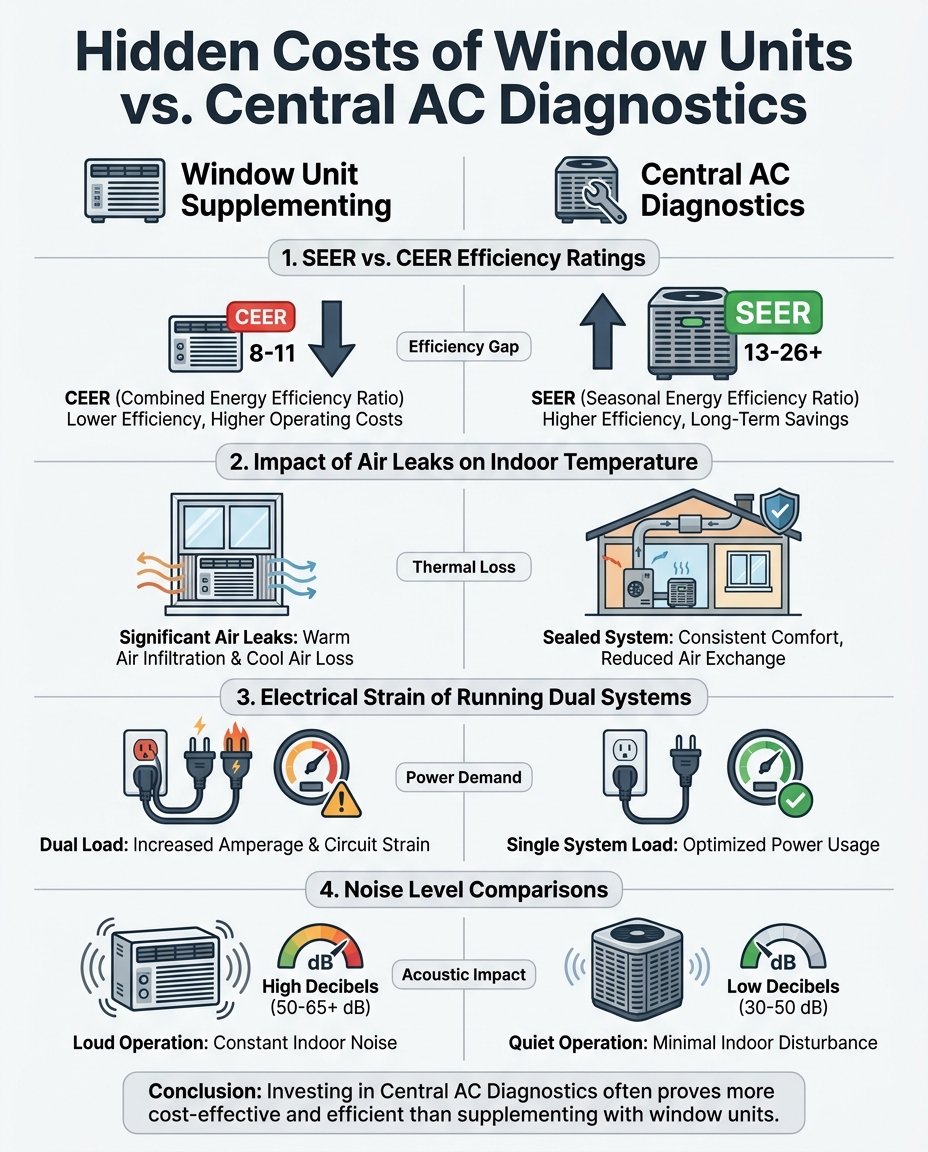
When we explain the financial drain of running dual systems to our customers, we always point out how cooling efficiency is measured. Central air conditioners are rated by their Seasonal Energy Efficiency Ratio (SEER), which measures their cooling output over a typical cooling season divided by the energy consumed. Window units are rated by a Combined Energy Efficiency Ratio (CEER), which accounts for both standby power and operational power. Modern central systems are highly efficient, while window units are notoriously power-hungry.
When you plug a window unit into a standard wall outlet, you are putting a massive electrical strain on your home's breaker panel. Running two compressors—the large one outside for your central system and the small one inside your window—draws a shocking amount of amperage.
• Efficiency Focus — Central AC (SEER): Whole-home, seasonal average efficiency — Window Unit (CEER): Single-room, combined operational/standby efficiency
• Power Draw — Central AC (SEER): Optimized for large-scale, distributed cooling — Window Unit (CEER): High continuous draw on a single electrical circuit
• Air Distribution — Central AC (SEER): Uses ductwork to condition the entire house — Window Unit (CEER): Pushes air only a few feet into a single room
• Cost Impact — Central AC (SEER): Lower cost per square foot of cooling — Window Unit (CEER): High cost per square foot, leading to utility spikes
During August late-summer heatwaves, an inefficient window unit draws significant power while the struggling central AC continues to run non-stop trying to reach the thermostat's set point. Because the central system is starved for airflow or leaking air into the attic, it never satisfies the thermostat. This dual-running scenario leads to massive utility consumption without ever actually achieving whole-home comfort. You pay double the energy costs for a fraction of the comfort.

Masking the Root Cause of HVAC Failure
Using a supplemental cooling device is like turning up the car radio to ignore a grinding engine noise. When a central AC is blowing warm air or suffering from low airflow, it is almost always a symptom of an impending breakdown. If you want to know why your AC is blowing warm air, you have to look at the mechanical components, not just the temperature in the room.
Relying on a window unit allows the central system's compressor or blower motor to continue overworking. This accelerates wear and tear on the most critical components of your HVAC system. Delaying professional diagnostics turns minor, easily fixable repairs into catastrophic system failures.
Based on our extensive experience servicing Bend OR homes with struggling upstairs airflow, our technicians recommend looking for these warning signs before the system fails completely:
1. Weak airflow at the registers: Place your hand over the vent. If you barely feel a breeze, the blower motor is failing or the ducts are severely compromised.
2. Extended cooling cycles: If the central unit runs for hours without shutting off, it is desperately trying to compensate for a mechanical deficit.
3. Unexplained humidity increases: A properly functioning AC removes humidity. If the house feels clammy, the evaporator coil is likely struggling.
4. Strange noises from the air handler: Squealing or grinding sounds indicate belts or bearings that are about to snap.
By ignoring these warning signs and relying on a window box, you allow a small airflow restriction to escalate into a burnt-out compressor, which requires a much more extensive and invasive repair from our technicians.
Air Quality, Noise, and Security Drawbacks
Beyond the mechanical and financial strain, supplemental window appliances introduce a host of secondary negative impacts to your daily life. These drawbacks affect everything from your health to your home's safety.
Indoor Air Quality: Window units are notoriously difficult to seal perfectly. The flimsy plastic accordion panels on the sides leave gaps that allow outdoor pollutants, wildfire smoke, dust, and pollen to infiltrate your home. Our indoor air quality experts regularly remind customers that in Bend OR homes with struggling upstairs airflow, adding a poorly sealed appliance means you are actively inviting allergens into the very room where you sleep, completely bypassing your central system's air filtration.
Operational Noise: A central air conditioner keeps the loud, vibrating compressor outside in the yard. A window unit places that exact same noisy component directly inside your window frame. The loud, rattling hum of the compressor kicking on and off throughout the night disrupts sleep and makes it difficult to hold conversations or watch television in that room.
Home Security Risks: To install one of these units, you have to leave a window partially open and unlocked. This creates an obvious vulnerability, especially on first-floor windows or accessible balconies. An intruder can easily push the unit inward to gain access to the house.
Aesthetic and HOA Concerns: Finally, these appliances are unsightly. They block natural light, ruin the exterior curb appeal of the house, and are frequently prohibited by local Homeowner Association (HOA) guidelines due to their cluttered appearance.
The High Desert Climate Challenge
Our team knows firsthand that contextualizing this problem requires looking at the specific weather patterns of our region. Bend's high desert climate features large diurnal temperature swings. It is not uncommon to experience cool, crisp mornings followed by intense, rapid afternoon heat spikes. This specific environmental challenge requires a highly responsive and robust cooling system.
Window units simply lack the capacity of whole-home systems. Because they are designed for gradual, steady cooling in small, enclosed spaces, they frequently fail to keep up during these rapid temperature increases. When the afternoon sun hits the side of the house, the internal temperature of the room rises faster than the small compressor can remove the heat.
Furthermore, the infiltration of hot outdoor air through the unsealed gaps around the unit actively counteracts the cooling effect. During August late-summer heatwaves, a window unit will run non-stop, drawing maximum amperage, while the room remains uncomfortably warm. The regional climate demands robust, properly sealed, and highly efficient cooling solutions that can adapt to sudden temperature shifts without faltering.
Permanent Solutions for Uneven Cooling
Bridging the gap from a frustrating, hot room to permanent comfort means ditching the temporary fixes and investing in professional solutions. There are highly efficient, permanent ways to address uneven temperatures that do not involve blocking your windows or draining your electrical panel.
For homes that need a comprehensive overhaul, our technicians frequently recommend heat pump upgrades, which provide both efficient cooling and heating without the need for supplemental appliances. Modern heat pumps are incredibly adept at handling extreme temperatures and provide a seamless, whole-home comfort experience. Furthermore, generic federal tax credits and local utility incentives may apply to qualifying high-efficiency permanent upgrades, making these advanced systems more accessible than ever. Always consult a tax professional or your local utility provider to see what general programs you might qualify for.
For Bend OR homes with struggling upstairs airflow, a professional assessment by Mountain View Heating is the only way to determine which of the following solutions is right for your unique floor plan:
Ductwork Diagnostics and Repair
Sometimes, the fix is much simpler than replacing the entire HVAC system. Professional diagnostics can reveal that your ductwork is pinched, disconnected, or improperly sized. By sealing leaks, repairing damaged sections, or rebalancing the dampers within the duct system, our technicians can restore proper airflow to the original central system. This forces the cold air up to the second floor where it belongs, utilizing the equipment you already own.
Ductless Mini-Split Installations
If extending or repairing ductwork is not feasible—such as in a new addition, a converted garage, or a stubborn master suite—we find that ductless mini-splits are the ultimate solution. These systems provide targeted, whisper-quiet zoning. They require absolutely no ductwork, utilizing a small indoor air handler connected to an outdoor compressor via a narrow conduit. Most importantly, they seal perfectly against the outdoors, preserving your indoor air quality and home security while delivering highly efficient, permanent cooling.
Frequently Asked Questions About Supplemental Cooling
Why is my central AC not cooling upstairs?
Heat naturally rises, making upper floors harder to cool, but the most common culprit is poor airflow. Leaky ductwork, an undersized system, or a failing blower motor can prevent cold air from reaching the second story. A professional diagnostic can pinpoint exactly where the airflow is being lost.
Can I use a window AC in a room with central air?
While you physically can, it is highly inefficient and masks underlying problems. Running both systems forces your home's electrical panel to work overtime and causes your central unit to run continuously without ever cooling the whole house properly.
Is it cheaper to run a window AC or central air?
Central air is almost always more cost-effective per square foot of cooling due to higher seasonal efficiency (SEER) ratings. Running a window unit (which has a lower CEER rating) alongside a struggling central system will cause your utility bills to spike significantly.
Does running a window AC ruin your central air system?
It doesn't ruin the central system directly, but it enables neglect. By cooling one room with a window unit, you might ignore the fact that your central AC is struggling with low airflow or a failing motor, which leads to accelerated wear and catastrophic breakdowns over time.
Will a window unit fix my home's airflow imbalance?
No, a window unit only treats the temperature in one specific room. It does nothing to fix the actual ductwork leaks, blower motor issues, or systemic imbalances that are causing the rest of your home to heat up unevenly.
Ditch the Window Unit and Restore Your Home's Comfort
True comfort comes from addressing the root cause of your heat issues, not applying a noisy, inefficient band-aid. If you are dealing with Bend OR homes with struggling upstairs airflow, relying on supplemental appliances will only waste energy and delay necessary repairs. Get your central system evaluated before the late-summer heat takes its final toll on your equipment. Schedule a professional diagnostic visit with our Mountain View Heating team today to explore permanent, quiet, and highly efficient airflow solutions that will keep your entire home comfortable for years to come.