


The Myth of Choosing Between Efficiency and Winter Reliability
When evaluating a dual-fuel system for extreme Central Oregon winters, our team at Mountain View Heating often encounters a persistent myth: the belief that you must choose between the high energy efficiency of a heat pump and the heavy-duty heating power of a traditional gas furnace. For decades, homeowners in colder climates believed that heat pumps were only suitable for mild coastal regions. The assumption was that once the snow started falling, an electric heat pump would simply freeze up and fail, leaving a home vulnerable to the bitter cold. We see this outdated belief force many people to rely entirely on oversized gas furnaces that consume excessive fuel during the milder weeks of early fall and late spring.
In our experience, the reality of modern hybrid heating technology tells a completely different story. Today's equipment is designed to bridge the gap between high-efficiency performance and raw heating power. By combining two distinct heat sources into a single, coordinated system, you no longer have to compromise. You can enjoy low-cost, energy-efficient warmth during the pre-heating season, while still having a robust safety net for the deepest freezes. If you are exploring heat pump systems or planning a new heat pump installation in Bend, understanding how hybrid technology bridges this gap is the first step toward lasting comfort.
Navigating Central Oregon's Drastic Temperature Swings
To understand why hybrid systems are so effective, you have to look closely at the local climate. As HVAC professionals serving Bend, OR and surrounding Central Oregon communities, we know firsthand that the high desert is a land of extremes. We do not experience a slow, predictable slide into winter. Instead, we face rapid, daily shifts in the weather that put immense stress on residential HVAC equipment.
The Challenge of a 40-Degree Daily Swing
During the early transition period, our crews frequently see mild September fall days transitioning to sub-zero January nights. But even within a single 24-hour window in October, you might experience afternoon highs in the comfortable upper 60s or low 70s, only to watch the thermometer plummet to near freezing by midnight. These drastic 40-degree daily temperature swings create a unique challenge for standard, single-source heating systems.
If your home relies solely on a massive gas furnace, we typically see that unit "short-cycle" during a mild 60-degree afternoon. It blasts the house with high-temperature heat for a few minutes, shuts off abruptly, and then turns back on an hour later. This constant starting and stopping wastes fuel and creates uncomfortable hot and cold spots. Conversely, if you rely entirely on a standard air-source heat pump, the unit will run beautifully during the day but may run continuously through the freezing night, struggling to extract enough ambient heat from the frigid air to keep your family warm. We recommend a dual-fuel setup because it eliminates both of these inefficiencies, providing reliable heating solutions that adapt to the exact weather conditions outside your window.
How a Hybrid Heating System Masters the Balance Point
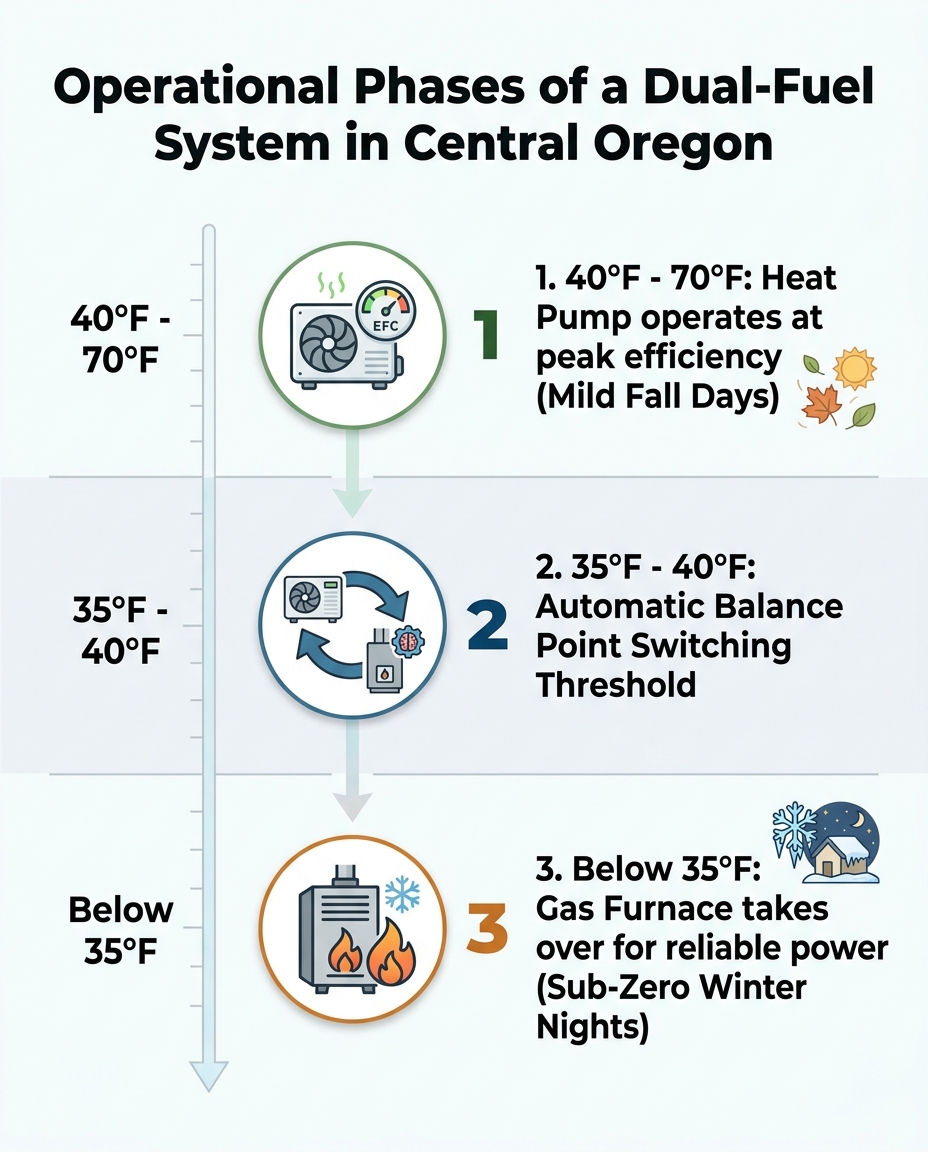
The secret to a dual-fuel system's adaptability lies in a concept known as the thermal "balance point." The balance point is the specific outdoor temperature threshold where it is no longer mathematically efficient for the heat pump to operate on its own, and the gas furnace needs to take over. For most homes we service in the high desert, our technicians carefully calibrate this balance point between 35 and 40 degrees Fahrenheit.
The Seamless Handoff
What makes this technology truly remarkable is that it requires absolutely zero manual intervention from the homeowner. You do not have to wake up at 2:00 AM, check the outdoor thermometer, and flip a switch in your hallway to turn on the gas furnace. The system's smart thermostat constantly monitors real-time outdoor temperatures using exterior sensors. As the sun sets and the temperature drops past that 35-degree mark, the thermostat automatically shuts down the heat pump compressor and ignites the gas furnace. When the sun comes up the next morning and the air warms back into the 40s, the system smoothly transitions back to the highly efficient heat pump.
• Heat Pump Mode — Ideal Temperature Range: Above 35°F - 40°F — Primary Energy Source: Electricity (Ambient Heat Transfer) — Main Benefit to Homeowner: Maximum energy efficiency and lower operational costs during mild weather.
• Gas Furnace Mode — Ideal Temperature Range: Below 35°F — Primary Energy Source: Natural Gas or Propane (Combustion) — Main Benefit to Homeowner: Raw, reliable heating power and rapid recovery during deep freezes.
This automatic switching stands in stark contrast to the inefficiency of forcing a standard system to overwork. Instead of pushing a single piece of equipment past its limits, the hybrid system simply delegates the workload to the component best suited for the current weather.

Phase One: Heat Pump Efficiency for Mild Fall Days
To fully appreciate the hybrid approach, we have to break down the two phases of operation. Phase one belongs entirely to the air-source heat pump. During the pre-heating season—those mild September fall days transitioning into crisp October afternoons—the heat pump acts as your primary defender against the chill.
Unlike a furnace that burns fuel to create heat, a heat pump uses electricity to capture existing heat energy from the outside air, compress it, and move it inside. Because moving heat is significantly easier than generating it from scratch, air-source heat pumps can deliver up to three times more heat energy to your living space than the electrical energy they consume to run the compressor. This phase effortlessly handles the 40 to 70-degree range.
• Maximum Heat Transfer: By capturing ambient thermal energy, the system provides a gentle, consistent flow of warm air that prevents the harsh temperature swings associated with oversized furnaces.
• Lower Operational Strain: Using electricity to move heat during mild weather drastically reduces your reliance on fossil fuels early in the season.
• Year-Round Versatility: Heat pumps also have a reversing valve, meaning they provide highly efficient cooling options for the high desert during the hot summer months.
Because these systems run nearly year-round, professional diagnostics are essential. Just last season, our technicians helped a local homeowner who experienced a complicated problem with their heat pump. We identified the underlying issue, developed a targeted fix, and repaired the unit quickly, getting the system back online before the fall weather shifted. When backed by experienced technicians, heat pump technology is incredibly resilient and reliable.
Phase Two: Gas Furnace Power for Sub-Zero January Nights
Phase two addresses the primary fear that local homeowners share with us when moving away from traditional heating: what happens when the real winter arrives? It is a valid concern. Standalone air-source heat pumps naturally lose their efficiency in extreme negative temperatures because there is simply less ambient thermal energy available in the air to capture and compress.
Why Raw Combustion Power Wins in the Deep Freeze
This is where our team sees the second half of the dual-fuel equation truly shine. Bend's high desert climate experiences sub-zero temperatures during peak January winter nights. When the ambient temperature drops into the single digits or below zero, combustion heat becomes far more effective than extracted heat. Once the smart thermostat registers that the outdoor temperature has fallen below the balance point, the system automatically shuts off the heat pump and activates the gas furnace.
The Combustion Advantage: A gas furnace generates heat by burning fuel in a heat exchanger. This process creates high-temperature air that is immediately forced through your ductwork. It provides the raw, heavy-duty heating power necessary to combat sub-zero drafts and rapidly recover the indoor temperature if doors or windows are opened.
Achieving this seamless handoff requires flawless communication between the electrical and gas components. This is why professional gas furnace installation is so critical. The ductwork, the blower motor, and the control boards must be perfectly integrated by a qualified technician so that the transition between the two distinct fuel sources is entirely invisible to the people sitting in the living room.
Evaluating a Dual-Fuel System for Extreme Central Oregon Winters: Long-Term ROI
When we sit down with customers to discuss upgrading their home's infrastructure, we emphasize that the initial installation is only one part of the equation. A true evaluation requires a conceptual cost-benefit analysis that looks at the long-term return on investment (ROI) over the next ten to fifteen years.
Rather than focusing solely on upfront numbers, we ask homeowners to consider how a dual-fuel system changes the way their home consumes energy on a daily basis. The ROI of a hybrid system is built on flexibility, longevity, and consistent comfort.
• Optimized Fuel Utilization: By utilizing the cheapest and most efficient fuel source for the exact weather conditions outside, you capture monthly energy efficiency gains. You avoid burning expensive gas on a mild 55-degree day, and you avoid overworking an electric compressor on a 5-degree night.
• Extended Equipment Lifespan: In a traditional setup, a single unit bears the burden of heating your home every single day of the winter. In a dual-fuel system, the components share the seasonal workload. The furnace rests during the fall and spring, and the heat pump rests during the deep winter freezes, reducing wear and tear on both units.
• Potential Tax Credits and Incentives: Upgrading to a high-efficiency hybrid system often makes financial sense due to external rebates. General federal tax credits and local utility incentives frequently apply to qualifying high-efficiency heat pump installations. We always advise homeowners to verify current programs with their utility provider or tax professional to maximize their return.
• Intangible ROI and Comfort: The ultimate return on investment is peace of mind. Knowing that your home is equipped to handle mild September fall days transitioning to sub-zero January nights—without you ever having to touch the thermostat—provides a level of guaranteed comfort that single-source systems simply cannot match.
Why Custom Engineering Matters in the High Desert
If you are convinced that a hybrid system is the right path forward, the next step is implementation. This is where we frequently see generic, out-of-the-box HVAC advice fall completely flat. National HVAC guidelines are often written for predictable climates in the Midwest or the South. They completely miss the nuances of high desert diurnal temperature shifts.
The Danger of "Rule of Thumb" Sizing
You cannot simply pull a hybrid system off a warehouse shelf and expect it to work perfectly in Bend, OR and surrounding Central Oregon communities. The system must be custom-engineered for your specific property. A local professional must calculate the exact heat load of your house, factoring in your square footage, ceiling height, insulation quality, and the direction your windows face.
More importantly, a local expert must program the exact balance point into your smart thermostat. If the balance point is set too high, your furnace will turn on prematurely, wasting gas. If it is set too low, your heat pump will struggle, wasting electricity. Our team at Mountain View Heating brings deep local expertise in designing custom hybrid HVAC solutions specifically engineered for Central Oregon's extreme temperature swings.
This customized approach extends well beyond installation. Long-term maintenance relationships are vital for complex systems that encompass both refrigerant lines and gas combustion components. During a routine maintenance visit last fall, one of our technicians performed a thorough system tune-up while providing an easy-to-understand explanation of how the heating system adapts to changing weather, leaving the customer fully educated on their equipment. That level of local dedication ensures your hybrid system performs flawlessly year after year.
Frequently Asked Questions
At what temperature does a hybrid heating system switch to gas?
Most hybrid systems are programmed to switch to gas when outdoor temperatures fall between 35 and 40 degrees Fahrenheit. This specific temperature is known as the thermal balance point. One of our local technicians calculates the exact switching point based on your home's insulation and the specific efficiency ratings of your equipment.
Is a dual fuel system worth the investment in Central Oregon?
Yes, because the high desert experiences drastic daily temperature swings that single-source systems struggle to handle efficiently. A dual-fuel system optimizes your energy usage by relying on the highly efficient heat pump during mild afternoons and the powerful gas furnace during freezing nights. Over the lifespan of the equipment, this shared workload reduces wear and tear while improving overall home comfort.
Can a heat pump work in Oregon winters without a furnace backup?
Yes, but with caveats. While modern cold-climate heat pumps are highly advanced, standard air-source units begin to lose efficiency when temperatures drop into the negative digits. In areas that experience sub-zero January nights, having a gas furnace backup ensures that your home maintains a comfortable temperature without forcing the electric compressor to run constantly.
What is the downside of a dual fuel system?
The primary downside is the upfront complexity of the installation. Because you are installing two distinct heat sources—an electric heat pump and a gas furnace—the initial setup requires careful custom engineering, proper ductwork integration, and access to both electrical and gas utility lines. However, the long-term energy savings and extended equipment lifespan often offset this initial complexity.
Do dual-fuel systems qualify for federal tax credits or utility incentives?
Often, yes. Many high-efficiency heat pumps included in dual-fuel setups meet the stringent energy standards required for general federal tax credits and local utility rebates. Because these incentive programs update frequently based on legislation and utility budgets, we recommend homeowners always verify current qualifying models with their installation contractor and a tax professional.
Evaluating a dual-fuel system for extreme Central Oregon winters ultimately comes down to matching your home with equipment that automatically adapts to the high desert's unpredictable environment. By combining the efficiency of a heat pump with the raw power of a gas furnace, you gain a clear, objective path to long-term comfort. Ensure your family stays warm through every temperature swing by reaching out to our team to schedule a thorough heating evaluation before the heavy winter weather arrives.