


Why We Instinctively Close Doors During the First Fall Chill
You shut the guest room door to keep the rest of the house warm, but you quickly realize that the impact of closed bedroom doors on forced air heating systems actually creates unexpected cold drafts. That strange chill in a closed-off room isn't just your imagination. It is a direct result of how your home breathes.
As the early fall pre-heating season begins in Bend, many homeowners try to manually "zone" their houses. The instinct makes sense: if you are not using a room, why pay to heat it? You shut the door, expecting the warm air to stay trapped in the main living areas. Instead, that closed room becomes freezing, and the hallway feels stuffy. You are now facing a common decision point: do you keep the doors closed to trap the heat, or do you leave them open to let the system breathe?
Before you make that choice, it is helpful to understand how your system actually distributes air. Here at Mountain View Heating, Inc., our team has spent decades helping Central Oregon residents balance their home's airflow. If you need professional help this season, exploring our professional heating services is the best place to start. Otherwise, read on to discover why we always tell our customers that shutting doors does more harm than good.
Understanding Your HVAC as a Closed-Loop System
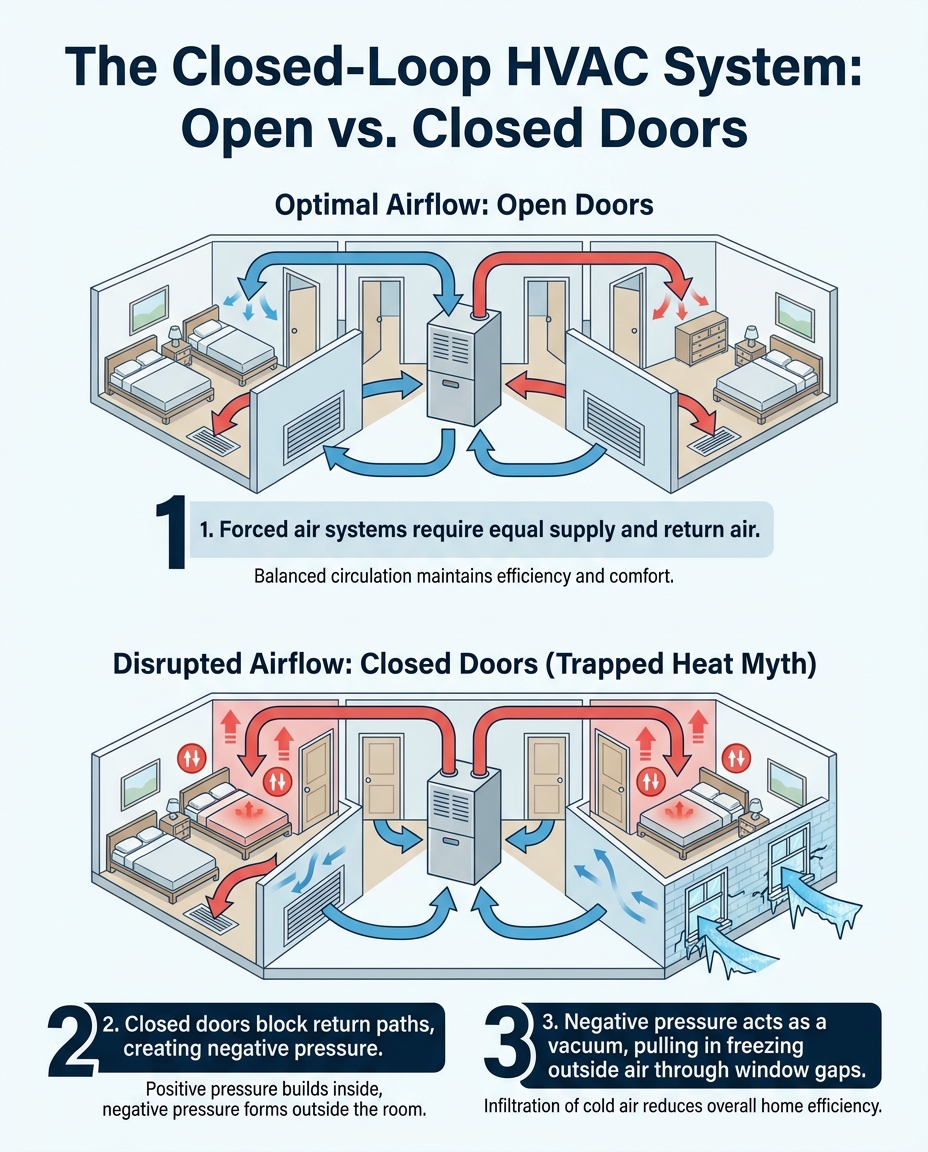
Most people think a furnace works like a space heater: it just blows hot air into a room until the space gets warm. But modern residential heating does not work that way. Your forced-air furnace operates on a continuous cycle known as a "closed-loop" system.
The two sides of the loop:
• Supply vents: These are the registers (usually on the floor or ceiling) that push warm, conditioned air into your rooms.
• Return vents: These are the larger grilles (often located in central hallways or stairwells) that pull neutral room air back into the furnace to be heated again.
For a closed-loop system to function efficiently, it requires perfect balance. For every single cubic foot of warm air that the supply vents push into your bedroom, the exact same amount of air must be pulled back through the return vents. If the furnace pushes out 1,000 cubic feet of air, it must inhale 1,000 cubic feet of air.
At Mountain View Heating, Inc., our technicians believe in empowering homeowners with clear, accessible education about how their equipment actually works. When we show our customers the closed-loop concept during a pre-heating season tune-up, the "trapped heat" myth falls apart. A pattern we see often in Central Oregon homes is that bedrooms only have supply vents. They rely entirely on the large return vent out in the central hallway to pull the air back to the furnace. When you shut the bedroom door, you sever that vital connection.
The Physics of Airflow: What Happens When You Shut the Door
When you close a bedroom door, you physically block the return air path. The supply vent inside the bedroom continues to pump warm air into the space, but that air has nowhere to go. This disruption forces your air distribution systems to fight against basic physics.
Because the air cannot easily escape back to the hallway return vent, the air pressure inside the closed bedroom begins to rise. The room fills up like a balloon. Eventually, that pressurized air forces its way out through the path of least resistance. It squeezes under the small gap beneath the door, but that gap is rarely large enough to handle the volume of air the furnace is producing.
Creating a Pressure Imbalance
This bottleneck creates a severe pressure imbalance across your entire house. The physics break down into two distinct zones:
• Main Living Space (Hallways/Living Room) — Pressure Status: Positive Pressure — What It Means for Your Comfort: The furnace is pulling air from this area, but not getting enough back from the closed rooms. The area can feel stuffy or overheated.
• Closed Bedroom — Pressure Status: Negative Pressure — What It Means for Your Comfort: Air is forced out of the room through gaps, creating a severe depressurization effect that pulls in outside drafts.
This phenomenon is known as depressurization. The furnace is desperately starving for return air, while the closed bedroom is simultaneously choking on too much supply air. The result is negative pressure in the closed bedroom, which sets off a chain reaction of comfort problems.

Turning Your Bedroom Into a Vacuum for Cold Drafts
The most counterintuitive part of the "trapped heat" myth is that closing a door actually makes the room colder. When the closed bedroom experiences depressurization, it acts exactly like a vacuum. Nature hates a vacuum, and the room will pull air from anywhere it can to equalize the pressure.
Because the door is closed, the room cannot pull air from the warm hallway. Instead, it pulls unconditioned, freezing air from outside. The vacuum effect sucks cold air through microscopic gaps in window frames, unsealed exterior walls, recessed lighting fixtures, and even electrical outlets.
The climate factor makes this worse:
Living in the Bend, OR high-desert climate means we experience rapid temperature drops. As our team at Mountain View Heating often warns customers during early fall tune-ups, daytime highs can plummet into the 30s overnight. When your closed bedroom depressurizes, it isn't just pulling in mild outdoor air—it is actively sucking freezing, high-desert night air directly into your sleeping space.
This is exactly why the closed room feels drafty despite the heat running. You are literally pulling the cold weather indoors. Worse, that freezing air eventually seeps under the door and makes its way to the return vent in the hallway. Your furnace then has to work overtime, burning more fuel to heat up the freezing outside air that you accidentally invited inside.
Hidden Strain: How Restricted Airflow Damages Your Blower Motor
Beyond making your rooms cold and drafty, closed doors cause hidden mechanical damage to your heating system. The resistance to airflow within your ductwork is called "static pressure." You can think of static pressure like blood pressure for your HVAC system.
When you block the return path by closing a door, the system's static pressure spikes. The furnace's blower motor—the powerful fan responsible for circulating air throughout the house—suddenly has to push against a wall of trapped air.
The consequences of high static pressure include:
• Blower motor burnout: The motor has to work twice as hard to move the same amount of air, leading to overheating and premature failure.
• Increased energy bills: A struggling motor draws significantly more electricity.
• Cracked heat exchangers: If airflow is too restricted, the furnace cannot dissipate heat fast enough, which can eventually crack the heat exchanger.
• Reduced system lifespan: Constant daily strain shaves years off the life of your equipment.
Addressing these airflow imbalances early is critical. Our team recently helped a local Bend homeowner who purchased a house with existing airflow issues, noting poor heating distribution and completely unconditioned upstairs rooms. By performing a comprehensive analysis and arranging targeted servicing—while coordinating directly with a plumber—we restored the system to improve overall home comfort with no callbacks needed. In our experience, fixing the root cause of airflow restriction always yields better results than forcing the system to work harder.
The Overlooked Connection Between Stagnant Air and Indoor Air Quality
Proper airflow is not just about temperature; it is the foundation of a healthy indoor environment. Your forced-air system relies on continuous circulation to filter the air you breathe.
When air moves freely from the supply vents to the return vents, it passes through the main HVAC filter. This filter is responsible for capturing dust, seasonal allergens, and pet dander. By closing a bedroom door, you trap that air inside the room. The stagnant air never makes it back to the filter.
Signs of stagnant bedroom air include:
• A persistent "stuffy" or stale smell in the morning.
• Increased dust accumulation on nightstands and dressers.
• Waking up with allergy symptoms or a congested nose.
• Condensation forming on the inside of bedroom windows.
When our technicians inspect residential systems, we frequently find that a closed door is the main culprit behind a stuffy bedroom. Trapping stale air leads to poor sleep quality and lingering odors. If you are struggling with airborne allergens, ensuring proper circulation is always the first step. Before you invest in expensive standalone purifiers or humidifiers, you must verify that your home's indoor air quality isn't being sabotaged by closed doors.
Smarter Ways to Manage Your Home's Temperature This Winter
You do not have to sacrifice comfort to protect your furnace. There are smarter, safer ways to manage your home's temperature without causing negative pressure or straining your blower motor.
1. Keep doors cracked open: You do not need to leave your bedroom doors wide open. Leaving them cracked just two to three inches provides enough space for return air to escape back to the hallway, preventing the vacuum effect.
2. Leave supply vents fully open: A common mistake is shutting the actual metal vent levers in unused guest rooms. This causes the exact same static pressure spikes as closing a door. Leave all vents fully open to maintain system balance. Discover more about why closing vents in empty rooms hurts your HVAC performance.
3. Check the undercut on your doors: If you absolutely must close a door for privacy or noise reduction, check the gap at the bottom. A proper undercut should be at least three-quarters of an inch to an inch high over hard floors, and half an inch over thick carpet.
4. Schedule an airflow inspection: If certain rooms remain chronically cold even with the doors wide open, you may have ductwork issues, inadequate insulation, or an undersized system.
During our routine fall maintenance visits, our technicians always take the time to provide an easy-to-understand explanation of your heating system's mechanics, ensuring you know exactly how to manage your airflow moving forward. A professional technician can help you understand your specific home's dynamics and recommend safe zoning solutions if you truly need different temperatures in different rooms.
Frequently Asked Questions About Home Airflow and Heating
Should you close bedroom doors when heating the house?
No, you should generally keep bedroom doors open or at least slightly cracked when running your heating system. Closing doors blocks the return air path back to the furnace. This creates an airflow bottleneck that forces your system to work much harder to distribute heat evenly.
Why is my room colder when the door is closed?
When you close the door, the room becomes depressurized because air is being pumped in but cannot easily escape. This negative pressure acts like a vacuum, pulling freezing outside air into the room through tiny gaps in windows and exterior walls. The cold drafts easily overpower the warm air coming from your vent.
Does closing doors save heating costs?
In our experience, closing doors actually increases your heating costs rather than saving money. The restricted airflow raises the static pressure in your ductwork, forcing the furnace's blower motor to consume more electricity. Additionally, pulling cold outside drafts into the house forces the furnace to burn more fuel to maintain the thermostat's set temperature.
Does closing vents in unused rooms help?
Closing supply vents in unused rooms is highly discouraged. Forced-air systems are sized and balanced for the total square footage of the house. Shutting vents traps air in the ductwork, spikes system pressure, and can lead to frozen coils or cracked heat exchangers.
How can I tell if my home has poor return airflow?
Signs of poor return airflow include doors that slam shut on their own, a whistling sound coming from the small gap under a closed door, or extreme temperature differences between rooms. You might also notice that your furnace filter gets sucked inward or bows dramatically when the system kicks on.
Optimize Your Heating System for a Warmer, More Efficient Winter
Understanding the closed-loop nature of your HVAC system empowers you to make smarter, more effective comfort choices. The "trapped heat" myth might feel instinctive during a cold snap, but the physics prove otherwise. By leaving your bedroom doors open—or at least cracked—you prevent negative pressure, stop freezing outdoor drafts from invading your sleeping space, and protect your blower motor from unnecessary wear and tear.
Taking care of your airflow is just one part of preparing your home for the high-desert winter. The best way we've found to ensure your system runs at peak efficiency is through a comprehensive professional inspection. To keep your furnace running safely and efficiently all season long, schedule your comprehensive heating maintenance with our team today. A well-maintained system guarantees a clear, accessible path to consistent warmth, giving you the peace of mind you deserve.