


Waking Up to a Freezing Bonus Room: The Early Fall Wake-Up Call
The summer heat is fading fast, and understanding exactly why uneven heating becomes obvious during September cold snaps can save you from a long, uncomfortable winter. The transition from August to early fall brings a sudden, sharp drop in nighttime temperatures, transforming peripheral rooms into absolute iceboxes. You go to sleep feeling perfectly comfortable, only to wake up shivering in the bedroom located right over the garage. This abrupt shift is a jarring reminder that your home's thermal envelope might not be as secure as you thought.
If you are tired of dealing with unpredictable indoor temperatures, exploring professional heating services and scheduling comprehensive heating maintenance with our team at Mountain View Heating is the most effective way to restore reliable comfort to every room.
That freezing bonus room presents a very specific decision point for homeowners. It is tempting to dismiss the chill as a temporary seasonal quirk—perhaps just a drafty window or a fluke of the September early fall cold snaps. However, in our experience, ignoring the issue usually means enduring months of discomfort. A noticeably freezing room is rarely an isolated incident; it is almost always a glaring symptom of a much larger airflow or insulation issue. Addressing these root duct design flaws now, before harsh winter weather sets in, is the only way to ensure consistent warmth throughout the house.
The High Desert Climate Stress Test
Living in the Bend high desert climate means dealing with dramatic diurnal temperature shifts that expose a home's hidden thermal weaknesses. In our years of keeping Central Oregon comfortable, we've found that the high desert environment functions as a natural diagnostic stress test for your HVAC system. Daytime highs might comfortably sit in the 70s, lulling you into a false sense of security, but those temperatures can plummet rapidly into the mid-30s overnight.
This rapid thermal shift forces your heating system to work much harder, much faster. As the outside air cools rapidly, the physical materials of your home—wood framing, drywall, and siding—undergo thermal contraction. This contraction can subtly widen microscopic gaps around windows, doors, and poorly insulated wall cavities, allowing cold air to infiltrate the living space at an accelerated rate.
The sudden load on your system: When the thermostat detects this rapid indoor temperature drop, it commands the furnace to kick on and recover the lost heat. However, if a room is poorly insulated, it loses heat faster than the furnace can replace it, making the thermal deficiency immediately noticeable.
• Daytime Highs (70s) — Impact on Home Comfort: Minimal thermal loss; house retains ambient solar heat. — HVAC System Response: System remains largely dormant or cycles infrequently.
• Rapid Evening Drop — Impact on Home Comfort: Exterior materials contract; drafts become noticeable. — HVAC System Response: Thermostat triggers sudden, sustained heating cycles.
• Overnight Lows (30s) — Impact on Home Comfort: Peripheral rooms lose heat rapidly to the outside air. — HVAC System Response: System struggles to push warm air to distant, uninsulated zones.
These drastic day-to-night swings connect environmental factors directly to the physical symptoms you feel inside. The rooms that fail this natural stress test are the ones that our technicians find require immediate attention before the deep freezes of January arrive.
The Physics of Heat Loss in Rooms Above Garages
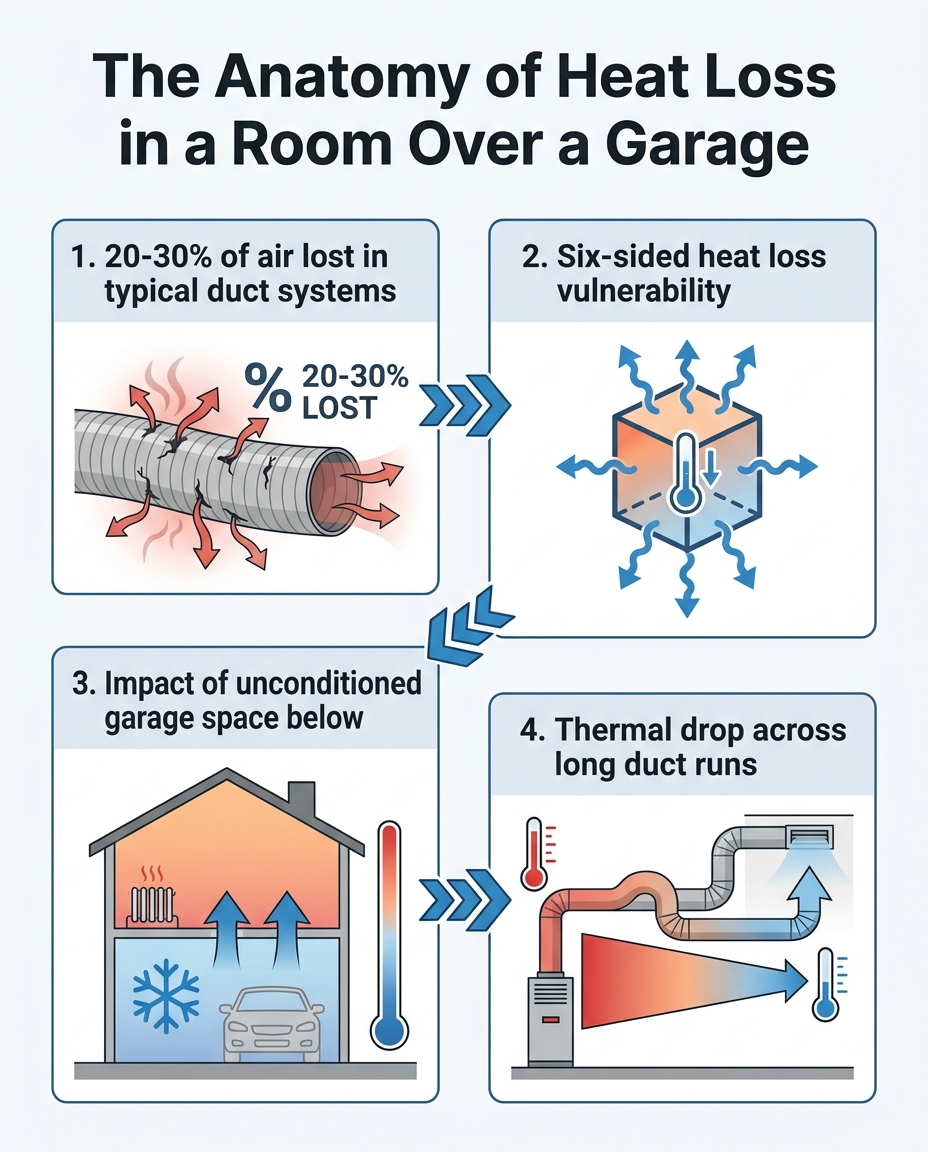
Bonus rooms and bedrooms located over garages are notoriously difficult to heat, and the problem comes down to structural physics. A standard garage is considered an unconditioned space. It lacks the climate control, insulation, and air sealing found in the main living areas of the house. Because heat naturally moves toward cold, the massive, unheated volume of the garage actively siphons warmth away from the floor of the room situated directly above it.
Inadequate insulation in the floor cavity is a primary culprit. If the space between the garage ceiling and the bedroom floor is not heavily insulated and meticulously air-sealed, the cold air from the garage easily penetrates the living space. You feel this directly as freezing floors in the morning. Furthermore, these peripheral rooms often feature exterior walls exposed to the wind and cold on multiple sides, compounding the rate of thermal transfer during the Bend high desert climate shifts.
Understanding Six-Sided Heat Loss
Most rooms in a house share interior walls with other heated spaces, which helps buffer them from the cold. Rooms over garages, however, often suffer from what building scientists call six-sided heat loss. Without proper thermal barriers, the temperature drops rapidly.
• The Floor: Loses heat directly to the freezing, unconditioned garage below.
• The Ceiling: Loses heat to the attic or roof deck if insulation is compressed or lacking.
• Exterior Wall 1: Exposed to prevailing winds and outdoor temperature drops.
• Exterior Wall 2: Often features large windows that act as thermal bridges.
• Exterior Wall 3: Projects outward from the main house profile, increasing weather exposure.
• The Interior Wall: Often the only side sharing a boundary with the heated main house, providing minimal thermal support.
This structural vulnerability means that even if your furnace is running perfectly, the room itself is structurally designed to bleed heat. Transitioning from these structural insulation issues to the HVAC delivery system's role is the next step our team takes in diagnosing the chill.

How Long Duct Runs Lose Heat Before Delivery
Even if a room is perfectly insulated, it will still feel freezing if the heating system fails to deliver warm air effectively. The journey of heated air from your central furnace to the furthest registers in the house is fraught with obstacles. According to energy efficiency data, between 20 and 30 percent of the air moving through typical residential duct systems is lost entirely due to leaks, holes, and poorly connected joints. By assessing your home's duct insulation, our Bend-based HVAC experts can often uncover the exact points where this valuable heat is escaping into crawlspaces or attics.
Beyond actual air leaks, long duct runs suffer from a phenomenon known as thermal drop. When warm air travels a long distance through uninsulated or poorly routed metal ducts, the heat transfers out of the sheet metal and into the surrounding cold spaces. By the time the air finally reaches the register in the garage bedroom, it has cooled significantly. The furnace might be pushing 120-degree air at the source, but it could be arriving at a lukewarm 80 degrees.
These duct design flaws are the primary reason the garage bedroom stays cold even when the thermostat in the central hallway is perfectly satisfied. The main living area reaches the target temperature and shuts the system off long before the peripheral rooms receive enough heat to combat the September early fall cold snaps. Navigating these hidden heat sinks requires local high desert expertise in diagnosing complex ductwork, ensuring that the warm air your furnace produces actually reaches its final destination.
Identifying Airflow Bottlenecks
Ductwork is essentially the respiratory system of your home. When it is compromised, the entire house suffers from poor circulation. Recognizing the signs of restricted airflow can help pinpoint why certain rooms refuse to warm up.
1. Crushed or Pinched Flex Duct: Flexible ductwork routed through tight attic spaces is easily crushed by stored boxes or careless foot traffic, severely choking off the air supply to the rooms at the end of the line.
2. Improperly Sized Trunks: If the main duct trunk is too small to handle the volume of air produced by the blower, the air pressure drops, and distant rooms receive mere trickles of heat.
3. Inadequate Static Pressure: A lack of force at the register indicates that the system is losing pressure somewhere along the run, usually due to a massive leak or a disconnected joint.
4. Sharp 90-Degree Turns: Every sharp bend in a duct run creates turbulence and slows the air down, increasing the time it takes to reach the room and exacerbating thermal drop.
When Aging Equipment Struggles with Sudden Demand
A heating system that performed adequately during mild spring weather can suddenly fail or severely underperform when faced with the sudden demand of September early fall cold snaps. Aging equipment loses efficiency over time, and the mechanical components grow less resilient to long, continuous heating cycles. When the temperature plummets 40 degrees overnight, an older furnace is forced to run non-stop to keep up, pushing worn blower motors and failing heat exchangers to their breaking point.
This exact scenario plays out frequently during the transition into fall. At Mountain View Heating, we saw one local homeowner experience this firsthand when their heating unit failed entirely over Labor Day weekend. Because of the urgent need for heat during the sudden cold snap on a holiday weekend, our dispatch team sent a technician out on a Saturday to properly diagnose the problem. We provided space heaters to keep the family safe and comfortable in the interim, and successfully installed a fully functioning replacement unit by Wednesday. This highlights how rapidly a struggling system can succumb to sudden thermal demand.
The role of neglected maintenance: Often, the strain on aging equipment is compounded by simple neglect. A dirty air filter acts like a wall, forcing the blower motor to work twice as hard just to pull air into the system. This reduces overall system capacity and dramatically weakens the airflow reaching distant rooms. Neglected blowers covered in dust cannot spin at their designed RPMs, further limiting heat distribution. Addressing these warning signs early through professional furnace repair prevents a minor airflow issue from escalating into a complete system breakdown in the dead of winter. Equipment strain only exacerbates existing ductwork and insulation flaws, making a bad situation worse.
Why Professional Diagnostics Reveal Hidden Flaws
Treating uneven heating requires more than just guessing at the problem. While changing a dirty air filter is always a good first step, it rarely solves the complex physics of a freezing bonus room. A comprehensive, whole-home approach to diagnosing uneven heating is necessary to uncover the root causes of thermal loss. Professionals look beyond the furnace box; they evaluate the entire thermal envelope of the home.
Another local customer recently demonstrated the value of this approach when they scheduled their routine annual service with us during the fall transition. By working with a Mountain View Heating technician who clearly explained the furnace system and its interconnected parts, the homeowner gained a complete understanding of how their home's airflow actually functioned. Our technician ensured everything was maintained properly, transforming a routine visit into a valuable educational experience that demystified their home's comfort challenges.
This level of diagnostic precision prevents you from wasting money on the wrong solutions. Throwing a larger furnace at a ductwork problem will not make the garage bedroom warmer; it will just make the central hallway uncomfortably hot while driving up your utility bills. By relying on our Bend high desert climate expertise, our professionals can map the exact path of heat loss.
What a professional diagnostic visit entails:
1. Measuring Airflow Volume: Technicians use specialized tools like anemometers to measure the exact cubic feet per minute (CFM) of air coming out of the registers in the cold room.
2. Testing Static Pressure: By drilling small test holes in the ductwork, professionals measure the static pressure of the system, identifying hidden blockages or massive leaks in the crawlspace.
3. Evaluating Temperature Differentials: Technicians measure the air temperature at the furnace supply plenum and compare it to the air temperature arriving at the distant register to calculate the exact thermal drop.
4. Inspecting the Thermal Envelope: A visual inspection of the floor cavities, attic insulation, and exterior wall sealing helps identify where the six-sided heat loss is most severe.
Targeted Solutions for Stubborn Cold Spots
Once our technicians identify the root cause of the uneven heating, we can apply actionable, professional-grade solutions to the rooms that refuse to stay warm. The fix depends entirely on whether the primary failure is structural insulation, ductwork delivery, or overall system capacity.
For minor airflow imbalances, balancing the existing system is often the first step. This involves adjusting the dampers within the ductwork to slightly restrict airflow to the rooms closest to the furnace, thereby forcing more warm air down the line to the peripheral rooms. If the diagnostic tests reveal a massive pressure drop, duct sealing becomes the priority. Mastic sealant and specialized tapes are used to seal the joints and seams of the ductwork, ensuring that 100 percent of the air produced by the furnace actually stays inside the delivery system.
However, we know that traditional forced air simply cannot overcome the structural heat loss of some bonus rooms, no matter how well the ducts are sealed. When the distance is too great and the insulation is too thin, independent climate control is the ultimate fix. This is where modern zone control solutions excel, providing targeted warmth exactly where it is needed without overworking the primary furnace during the Bend high desert climate shifts.
The Advantage of Ductless Zone Control
For rooms located over unconditioned garages, bypassing the home's main ductwork entirely is often the most efficient and comfortable solution. We frequently recommend installing ductless mini splits to solve the long-run airflow problem instantly. Additionally, federal tax credits and local utility incentives may apply to qualifying heat pump installations, making this an even smarter upgrade. Be sure to verify current programs with your utility provider or a tax professional.
These independent systems feature an outdoor compressor connected directly to an indoor air handler mounted on the wall of the cold room. Because there is no ductwork involved, there is zero thermal drop and zero air leakage. The heat is generated and delivered in the exact same space. This allows you to heat only the occupied bonus room to a comfortable 72 degrees without overheating the rest of the house or wasting energy conditioning empty rooms.
• Traditional Central Furnace — Airflow Delivery: Relies on long, vulnerable duct runs. — Efficiency in Bonus Rooms: Low. Suffers from thermal drop and leaks.
• System Balancing (Dampers) — Airflow Delivery: Redirects existing air pressure. — Efficiency in Bonus Rooms: Moderate. Helps minor imbalances but cannot fix bad insulation.
• Ductless Mini Split — Airflow Delivery: Direct delivery, zero ductwork. — Efficiency in Bonus Rooms: High. Independent control eliminates thermal drop entirely.
Addressing Your Home's Airflow Flaws Before Winter Arrives
Waking up to a freezing garage bedroom is a frustrating experience, but it is fundamentally a solvable structural and airflow challenge. The sharp temperature drops of the September early fall cold snaps serve as a timely warning. They highlight the hidden duct leaks, thermal drops, and insulation gaps that will only become more punishing as the season progresses.
Reiterating the importance of acting now cannot be overstated. Waiting for deep winter means enduring months of discomfort and putting unnecessary strain on an HVAC system that is already struggling to distribute air evenly. By taking action during the early fall, you give yourself the time to properly evaluate the thermal envelope and implement lasting solutions. Schedule a comprehensive airflow and heating evaluation with Mountain View Heating today to ensure that every corner of your home remains perfectly comfortable, no matter how cold the high desert nights become.
Frequently Asked Questions
Why is the room above my garage always freezing?
In our experience, the room above your garage is always freezing primarily because it sits over an unconditioned space. Garages lack heating and insulation, meaning the massive volume of cold air below actively pulls heat out of the bedroom floor. Additionally, these rooms often suffer from long duct runs that lose heat before the air ever reaches the register.
How do you fix uneven heating in a two-story house?
Fixing uneven heating in a two-story house usually requires balancing the airflow and addressing thermal rise. Because heat naturally rises, the second floor often gets too warm while the first floor stays cold, but distant rooms can still freeze if duct pressure is low. Solutions range from adjusting duct dampers to redirect air, to installing independent zone control systems for specific trouble spots.
Does a dirty filter cause uneven heating?
Yes, a dirty filter is a very common cause of uneven heating. A clogged filter severely restricts the amount of air the blower motor can pull into the system, which directly reduces the volume of warm air pushed out. Rooms furthest from the furnace are always the first to suffer when overall system pressure drops due to a dirty filter.
Why is one room colder than the rest of the house?
One room is usually colder than the rest of the house due to a combination of poor insulation, exterior wall exposure, and inadequate airflow. If the room is at the end of a long duct run, the warm air often cools down or leaks out before arriving. Upgrading insulation and sealing ductwork are the most effective ways to correct this imbalance.
Can ductwork design cause cold spots in the fall?
Absolutely, poor ductwork design is a leading cause of cold spots as temperatures drop in the fall. Flex ducts that are crushed, pinched, or improperly sized restrict the necessary airflow to peripheral rooms. When the sudden cold snaps hit, these design bottlenecks prevent the furnace from delivering enough heat to overcome the dropping outdoor temperatures.
How do drastic day-to-night temperature swings affect my HVAC system?
Drastic day-to-night temperature swings force your HVAC system to rapidly shift from a dormant state to high-capacity heating. This sudden thermal demand stresses aging components and highlights any existing airflow restrictions. The rapid contraction of building materials at night also increases drafts, forcing the furnace to run longer cycles to maintain the set temperature.