


Waking Up Cold: Why Did the Heat Fail Overnight?
Is there anything more frustrating than waking up to a freezing house when your thermostat clearly says it should be heating? When you are facing the reality of pilot light failures on the first cold night, that frustration quickly turns into a scramble for answers. You walk over to the unit, peer inside the access panel, and discover that the small blue flame keeping your system ready for action has vanished. At Mountain View Heating, Inc., we field dozens of frantic calls during the suddenness of a September first-freeze in Bend. It means a furnace that has sat completely dormant all summer is suddenly forced into immediate, heavy duty. There is no gradual warm-up period; it is either off, or it is an absolute necessity.
This sudden demand often exposes hidden weaknesses in older heating equipment. The immediate question you face is whether this is a minor nuisance that can be fixed with a simple relight, or a mechanical failure that requires professional intervention. Knowing how to tell the difference is critical for both the safety of your home and the reliability of your comfort system. If you are unsure about the state of your equipment, reaching out for professional heating services is always the safest path forward. But if you want to understand exactly why that little flame refuses to cooperate when you need it most, you have to look closely at the safety mechanisms built into your system.
Understanding Older Standing-Pilot Gas Furnaces
To understand why your system is behaving this way, it helps to know exactly what kind of equipment you are dealing with. If your furnace has a small, continuous flame burning even when the heat is off, you own a standing-pilot gas furnace. These older standing-pilot gas furnaces were largely phased out of new manufacturing in the United States around 2010 due to updated energy efficiency standards, but in our experience servicing Central Oregon's older homes, we still see many of these workhorses in action. Because modern systems use electronic ignition to spark a flame only when heat is actively called for, any system still utilizing a continuous pilot flame is aging and operates on older mechanical principles.
The core of this older technology relies on a brilliantly simple but highly sensitive safety device called a thermocouple. The thermocouple is a small metal rod positioned directly in the path of the pilot flame. When the pilot flame burns, it heats the tip of this metal rod. Through a principle known as thermoelectricity, the heat generates a tiny electrical voltage—usually around 30 millivolts. This microscopic electrical current travels down a copper wire to the main gas valve.
As long as the gas valve receives that 30-millivolt signal, it knows a flame is present and it is safe to keep the pilot gas flowing. If the flame goes out, the rod cools down, the voltage drops to zero, and a spring inside the gas valve snaps shut, cutting off the raw gas supply. This prevents your home from filling with dangerous, unburned natural gas or propane. When this safety communication breaks down, you might find yourself dealing with an older gas furnace clicking but not igniting, or a pilot flame that simply refuses to stay lit no matter what you do.
The Telltale Sign of a Bad Thermocouple
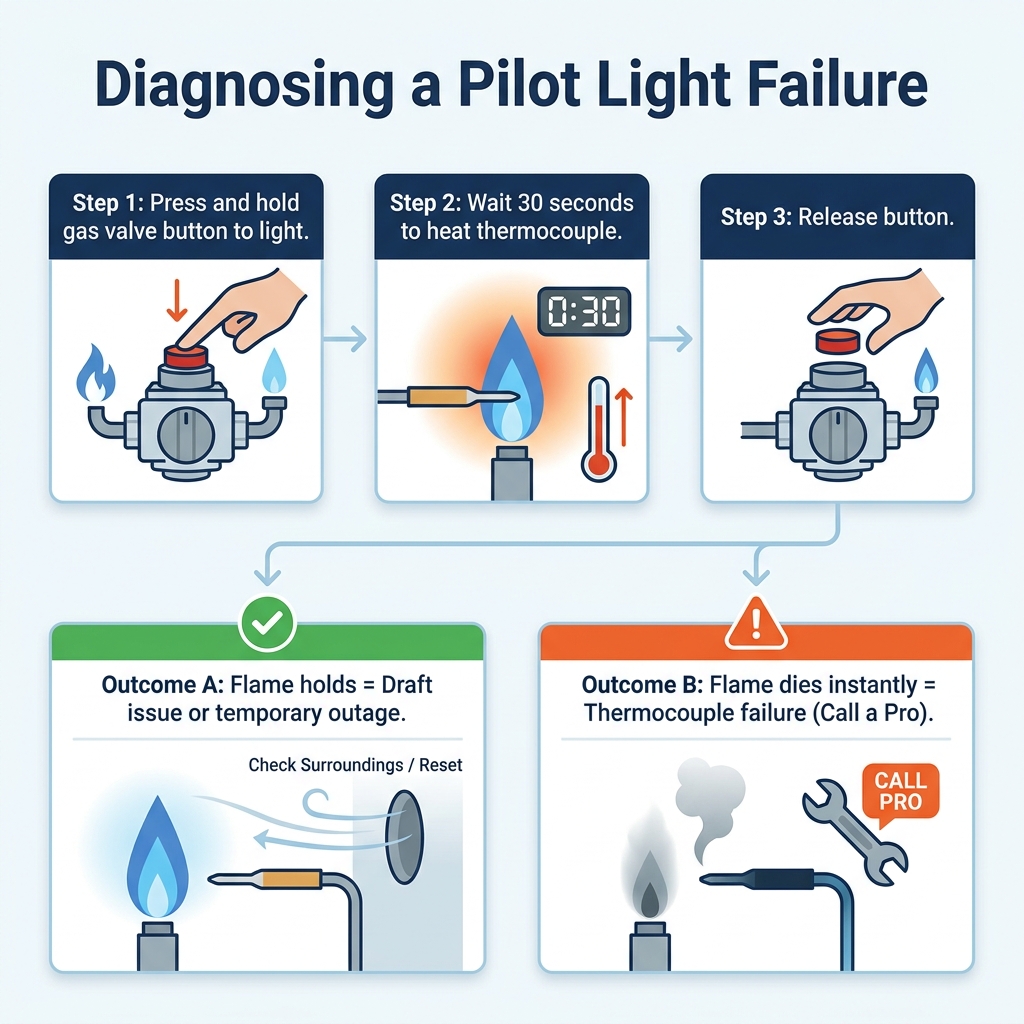
When you discover a dead pilot light, the standard procedure is to follow the manufacturer's instructions printed on the side of the unit. Typically, this involves turning the gas valve dial to "Pilot," pressing the button down to manually override the safety shutoff, and applying a flame to the pilot assembly. You are supposed to hold that button down for 30 to 60 seconds. This manual pressure forces gas to flow while the flame heats up the thermocouple enough to generate that crucial millivolt signal.
Our technicians often tell homeowners that this moment is exactly where you can diagnose the nature of your problem. The definitive symptom of a failed thermocouple in older standing-pilot gas furnaces happens the exact second you let go of that button. While you are pressing down, the flame looks strong, blue, and perfectly healthy. But the very millisecond you release the manual pressure, the flame dies completely.
The mechanics behind the failure:
• Loss of signal: The thermocouple has degraded to the point where it can no longer generate 30 millivolts of electricity, even when bathed in a hot flame.
• Safety valve engagement: Because the gas valve is not receiving the electrical signal, it assumes there is no flame.
• Immediate shutoff: The internal spring snaps the valve shut the moment your finger stops physically holding it open.
If your system exhibits this specific behavior, you are not dealing with a drafty basement or a temporary gas hiccup. You are dealing with a hard mechanical failure. The safety sensor is broken, and the system is doing exactly what it was designed to do: shut down to protect you. When you encounter this symptom, we strongly advise you to stop trying to force the system to work and schedule professional furnace repair in Bend.

Draft Blowout vs. Mechanical Failure
Understanding the hard boundary between a minor environmental issue and a failing component can save you hours of freezing frustration. A pattern we see frequently across Bend is homeowners assuming that any pilot light outage means a broken part, but that isn't always the case. Sometimes, the environment surrounding older standing-pilot gas furnaces is the actual culprit.
• Behavior upon releasing button — Draft Blowout (Environmental): Flame stays lit and holds strong indefinitely. — Thermocouple Failure (Mechanical): Flame dies instantly the moment pressure is removed.
• Timing of outage — Draft Blowout (Environmental): Goes out randomly hours or days later. — Thermocouple Failure (Mechanical): Will not sustain itself for even one second.
• Underlying Cause — Draft Blowout (Environmental): High winds, poor venting, or sudden air pressure changes. — Thermocouple Failure (Mechanical): Sensor cannot generate the electrical voltage to hold the valve open.
• Appropriate Action — Draft Blowout (Environmental): Check for open basement windows or vent obstructions. — Thermocouple Failure (Mechanical): Requires a licensed professional to replace the component.
Why the Distinction Matters
Distinguishing between these two scenarios prevents wasted time and unsafe troubleshooting. If your flame holds after you release the button but goes out three days later during a windstorm, your thermocouple is likely functioning perfectly. Replacing it won't solve the fact that a draft is blowing out the flame. Conversely, if the flame drops instantly upon release, taping the access door shut to "block drafts" will do absolutely nothing. A mechanical failure requires a mechanical replacement, and recognizing this fact early keeps you from making dangerous DIY mistakes.
Safety First: The Dangers of Repeated Relighting
When we arrive at a freezing house for an emergency call, we often hear that the homeowner's natural instinct was to try relighting the pilot over and over again. You might think that if you just hold the button a little longer, or position the lighter a little differently, older standing-pilot gas furnaces will eventually catch and stay lit. This repetitive cycle is incredibly dangerous.
The invisible hazard of gas pooling: Every time you press that manual override button, raw gas flows into the combustion chamber. If the pilot does not light immediately, or if you hold the button down for a minute without a successful ignition, that unburned gas doesn't just disappear. Natural gas and propane can pool inside the heat exchanger and the surrounding cabinet. If you immediately strike another match or click a lighter while that gas is lingering, you risk a severe flash fire or a localized explosion.
The five-minute rule: If you attempt to light the pilot and it fails, you must release the button, turn the valve to "Off," and wait a minimum of five full minutes before trying again. This allows the unburned gas to safely dissipate up the flue or out of the cabinet.
Furthermore, under no circumstances should you ever attempt to bypass a thermocouple. Some DIY forums suggest using wire or tape to force the gas valve to stay open. Doing this removes the only safety mechanism standing between your family and a catastrophic gas leak. If the component has failed, leave the valve off and wait for a professional. Replacing gas line components is strictly licensed work for a reason.
Why High Desert Climates Stress Older Heating Equipment
The environment you live in plays a massive role in how your heating equipment ages and fails. In the high desert, we experience rapid diurnal temperature variation. This means we can enjoy a beautiful, warm fall afternoon, only to watch the thermometer plummet well below freezing the moment the sun drops behind the mountains. A sudden September first-freeze in Bend forces a furnace that has been completely ignored for months to suddenly fire up and run continuously to combat the freezing temperatures.
This rapid shift puts immense thermal stress on aging metal components. The thermocouple, which expands and contracts as it heats and cools, can become brittle over years of use. When it is suddenly subjected to the intense heat of a pilot flame after months of cold dormancy, a weakened sensor will often fail outright. This is why the first cold snap of the year always results in a flood of emergency no-heat calls to our office.
Our team at Mountain View Heating recently helped a local homeowner who experienced this exact sudden failure over Labor Day weekend when an unexpected cold snap hit, bringing the transition season in early. Their heating unit failed entirely just as the temperatures dropped. We dispatched a technician on Saturday, properly diagnosed the underlying mechanical issue, and provided space heaters to keep the family safe and comfortable. The specific part was ordered, and the unit was fully replaced and operational by Wednesday morning.
Working with our team, which has deep expertise in keeping older residential heating systems running safely under these specific high desert conditions, ensures that your home is protected. The best way to avoid this mid-night panic is through proactive heating maintenance. A thorough pre-season inspection allows our technicians to test the millivolt output of your thermocouple before the freezing weather arrives, catching a degrading part before it leaves you in the cold.
Frequently Asked Questions About Pilot Light Failures
Why does my furnace pilot light go out when I release the gas valve button?
This is the classic, definitive symptom of a failed thermocouple on older standing-pilot gas furnaces. The safety mechanism inside the gas valve shuts off the fuel supply because it cannot detect the heat of the flame. When the thermocouple fails to send its electrical signal, the valve's internal spring snaps shut the moment you remove manual pressure from the button, protecting your home from a gas leak.
What are the signs of a bad furnace thermocouple?
The most obvious sign is a pilot flame that dies immediately upon releasing the manual gas button. Other visual signs include heavy soot buildup on the thermocouple rod itself, which insulates it from the flame and prevents it from heating up. You might also notice a visually damaged, corroded, or bent sensor probe that is no longer sitting directly in the path of the pilot flame.
Is it dangerous if a pilot light keeps going out?
If the thermocouple is working properly, the gas shuts off safely, meaning the outage itself is not immediately dangerous. The real danger arises from homeowners who get frustrated and repeatedly hold the manual override button down while trying to force an ignition. This causes unburned gas to pool in the combustion chamber, creating a severe flash fire hazard if a spark is introduced.
Can I bypass a furnace thermocouple?
Absolutely not. Bypassing a thermocouple removes the primary safety shutoff for raw gas entering your home. Doing so risks explosion, severe fire, and carbon monoxide poisoning. If the sensor is failing to keep the valve open, the system must remain off until a licensed professional can replace the broken component.
How often should a thermocouple be replaced?
They typically last several years, but they do degrade over time due to the constant thermal stress of being bathed in a flame and then cooling down. Regular maintenance can identify a weak millivolt signal before the part fails completely. If our technicians measure a drop in electrical output during a fall tune-up, we will recommend replacing it proactively.
Restoring Your Heat Safely and Quickly
Understanding exactly why your system is failing protects your home from dangerous DIY mistakes. When you know that a flame dying the second you release the button is a hard mechanical failure, you can stop fighting with the gas valve and take the right steps to restore your comfort. While a September first-freeze in Bend can be a brutal reminder that winter is coming, a thermocouple replacement by a licensed professional is a straightforward, routine fix.
Because the Mountain View Heating team offers rapid response times for no-heat emergencies, you do not have to suffer through the freezing temperatures for long. If you are dealing with the reality of pilot light failures on the first cold night, stop risking your safety with repeated relighting attempts. Reach out to schedule an emergency diagnostic or repair service, and let our experts safely restore the warmth and reliability your home needs.